Zatanna: being cited in an ad title does not mean being the subject
Typing the name of a character into a classified ads engine does not bring together the booklets devoted to them: it brings together the labels where someone has typed their name. On the query "Zatanna Zatanna 1 2010", noted on August 30, 2026 on a general auction site in the American market, 161 unverified advertisements were in progress, from $1.50 to $375.00, with $16.92 in the middle, and none of the five least expensive was for a publication in which the magician is the subject. There was another title captured by the year alone, a mention slipped into the body of the wording, a cover, and two participations in group series. These amounts are claimed by sellers, not collected. The eleven verified ads, counted separately, ranged from $56.99 to $500.00 around a central value of $119.99: too small a number to draw anything from them.
There are two ways to go wrong when looking for a comic book, and they don't have the same mechanics. The first is the number: two homonymous series, two successive editions, an identical number carried by different objects. The second, the one that concerns us here, has to do with the name. A character is not a bibliographic reference; it's a word. And a word, in an announcement label, can designate the subject of the issue, a guest in a single chapter, a silhouette drawn on the cover, or nothing at all: just a string of characters added to be found. The engine makes no difference between these four situations.
The reading of August 30, 2026 makes this mechanism visible without needing to take its word for it. Of the 161 unverified listings running that day for "Zatanna Zatanna 1 2010," the five lowest-priced listings were not for any publication about the magician. However, they were not fraudulent: each one contained, somewhere, the searched word or one of the other terms of the query. The fault lies neither with the seller nor with the buyer. It is in the operation itself, which promises a set of fascicles and delivers a set of wordings.
What a name search really measures
A classifieds engine indexes text entered by sellers. He has no knowledge of the contents of the fascicles, no list of appearances, no notion of main or secondary role. When a query contains a character name, it returns the cards where this name appears: in the title of the ad, sometimes in the description, often in the middle of an accumulation of keywords intended to capture as many searches as possible. The result is a whole that is perfectly coherent with its own logic, and perfectly offset from the question asked.
The practical consequence is that such a set mixes objects of incomparable nature. The booklet of which the character is the subject, the one where he appears for a few panels, the one where he appears on the cover without being at the center of the story, and the one which only has the year in common with the request: all find themselves lined up in the same list, sorted by price, as if they formed a homogeneous population. They are not one. They share a word, nothing else.
This is where the difference with dialing errors becomes clear. A confusion between two series bearing the same number is corrected by precisely identifying the edition: there is a right answer, we find it. A search by name does not contain any errors to correct, because it does not claim anything other than what it does. The only remedy is to change the expectation: don't ask a list of keywords to do the work of a catalog.
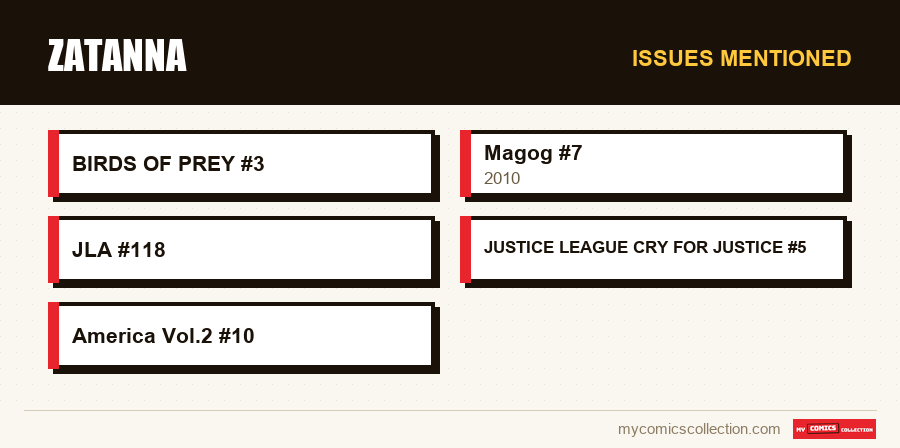
Five ads at the bottom of the rankings, five different reasons to be there
One year alone is enough
A $1.50 ad was for “BIRDS OF PREY #3 [...] DC 2010.” The title has nothing to do with the query; this is the year that brought it back up. An engine that adds keywords instead of crossing them accepts a result validated by only one term out of four.
The mention in the wording
“Magog #7 (2010), DC Comics, Zatanna: party on! » at $2.25: the name is there, added by the seller in the middle of his description. The announcement is sincere, it signals a presence in the booklet. She says nothing about its importance.
Coverage, only specified case
“JLA #118 Zatanna Cover [...] (2005)” at $2.71 was the only one of the five to qualify the nature of the presence. This precision has real value: appearing on the cover is not the same thing as appearing in a lost box in the middle of the story.
Group series
Two listings at $2.71 and $2.75 were collective titles: "JUSTICE LEAGUE CRY FOR JUSTICE #5 [...] (2009 SERIES)" and "Justice League of America Vol.2 #10 [...] 2007." A team welcomes by construction characters of which it is not the subject.
These five lines are not an anomaly: they occupy the bottom of the ranking precisely because they are not what we were looking for. Sorting by increasing price, the usual reflex of those hoping for a good deal, therefore mechanically brings up the items furthest from demand. The more open the list, the more misleading its entry.
Only one of these five ads explicitly stated that the character appears on the cover. The other four just named him. It would be wrong to conclude that they are concealing something: a seller who writes a name without specifying its status is not lying, he simply does not have the space, the habit or the obligation to qualify what he is announcing.
The burden of verification therefore falls on the buyer, and it cannot be carried out from the results list. You have to open the ad, look at the image, and compare the reference to a source that describes the content, a catalog, before deciding what to look at.
Why degrees of presence still matter
To say that a search by name mixes incomparable objects is not to say that all appearances are equal. On the contrary, the market recognizes very concrete degrees, and it is right to do so. A cover is a visible fact, immediately verifiable in a photo, which involves the entire object: it is the first thing we see and the only thing we see again once the booklet is stored in front. An interior apparition plays out on a few pages among the twenty that make up an issue.
Between the two there are all the nuances: the scene that advances the plot, the silhouette in the background of a meeting, the unique line, the simple flashback. None of these situations carry the same weight to a reader, and neither should carry the same weight in a collection. The problem is not that these degrees are unknown; This is because they are invisible in a list of results where only the fact that a word has been typed matters.
Hence a counter-intuitive consequence: the seller who writes “Cover” in his title provides more useful information than the one who is satisfied with the name, and this information deserves to be kept at the time of purchase. She won't be found later. Once the booklet has been put away, the announcement has disappeared and the memory has faded, all that will remain is a line in a list and the impossibility of knowing why it was added.
This mechanism is not specific to any particular character. It works in the same way for any figure which goes through many titles without carrying many, and we can observe it as well on the side of the large long-term series than tighter universes. The more a name circulates, the more it is typed, and the more the whole it brings back moves away from what it designates.
Six Ways a Query Goes Wrong
The name as a magnet
A recognized name is added to the labels because it attracts visits. This is an ordinary practice, not a deception, but it mechanically inflates the whole returned by the search.
The year that overflows
Adding a year to narrow the query has the opposite effect: it becomes an additional criterion that the engine can satisfy alone, and brings in titles that are completely unrelated.
The never said status
There is no requirement for a seller to specify whether the character is the subject, a guest, or a cover figure. The absence of this precision cannot be distinguished, in the list, from a central presence.
Group titles
A team-up series inherently accommodates dozens of characters. Everyone is cited there, none is the subject, and all come up in searches for their name.
The ambiguous number
A number typed in isolation can correspond to several series and several editions. Combined with a name, it does nothing: it adds an additional chance of being caught by mistake.
The sorting that aggravates
Ranking by increasing price brings the least sought-after items to the top, since they are the least expensive for good reasons. The good deal reflex creates a bad first impression.
Collecting this series?
Track what you own, what you are missing and what your collection is worth. 7 day trial.
Start my trial →What a $16.92 median says, and doesn’t say
The middle of the distribution, this August 30, 2026, was at $16.92 on the 161 unverified listings. This figure faithfully describes something: a set massively composed of secondary appearances, participations in collective titles and booklets caught by a word. It describes the whole as the engine made it up. It does not describe the publication we were looking for.
Taking this median for the value of the issue in question would lead to a considerable underestimate, and the comparison with the verified copies clearly shows this: their central value came out at $119.99, with a minimum at $56.99 - that is to say above the maximum of the lower half of the ordinary advertisements. But these verified copies were only eleven. Eleven ads are not a deal, they are a handful of objects; we cannot get any price level from it, and we must say it rather than pretend.
The maximum of $375.00 observed on the unverified side, like that of $500.00 on the verified side, says nothing more. A price displayed at the top of a listing reflects what a seller hopes to get, never what someone has agreed to pay. None of these amounts is a transaction: they are requests in progress, noted at a given moment, for which we do not know whether they will find a buyer.
A larger reserve must be added. This survey was done on a single day. A single measurement draws no trajectory: neither rise, nor decline, nor stability. Any sentence suggesting movement from these figures would be pure invention. What we have is a photograph of what was demanded on August 30, 2026, and this is already sufficient to establish the point that interests us: the composition of the whole, not its evolution.
Contamination works both ways
One aspect of this mechanism often goes unnoticed. We readily imagine that the presence of secondary appearances only “dilutes” the whole thing downwards. In reality, contamination also works in the other direction: a secondary issue can inherit attention that it owes only to the name it bears in its wording. A seller who sees a popular search result in their listing has a reason to maintain a price that a regular group title would not justify on its own.
The result is a set where neither the top nor the bottom provides any information about the intended object. The bottom is occupied by what is not the subject; the top, by the hopes of sellers and by the rare verified copies which, in such small numbers, do not constitute a reference. The usable part is the one that you must reconstruct yourself, ad by ad, discarding anything that does not correspond.
This is a job that the engine will never do for you, because it does not have the necessary information. Only a catalog describing the content of the publications allows us to decide, and we must consult it separately. This detour is not a perfectionist's precaution: it is the only operation which transforms a list of keywords into a list of booklets.
The same reasoning applies to universes where a name serves as an editorial label as much as a character. This is easily verified on series whose posterity goes far beyond their original title: the word circulates, sees itself taken up, and ends up designating as much an atmosphere as a specific object.
What to note when purchasing
Note the nature of the apparition, not just the character's name.“Cover”, “inner appearance”, “mention”: three words are enough, and these are exactly the three distinctions that the announcement list had erased. Without this note, a copy purchased for an appearance in a few panels will become indistinguishable, in six months, from a publication devoted to the character.
Keep the exact title of the series, not the name that made you click. A collective series booklet must be registered under the name of this series, with its number and volume. The character sought then becomes an additional indication, what he really is, and not the identity of the object: which prevents a number of a group title from being placed as if it belonged to an eponymous series.
Record the year of publication separately from the rest. This is the term which brought foreign titles into the search, and it is also the only reliable discriminator between two homonymous series once the booklet is in hand. Noting it as a distinct field, never as a snippet attached to the title, avoids reproducing the ambiguity of the engine at home.
Indicate whether the item is verified or not, and leave the field empty if in doubt. The gap between the two populations was considerable on August 30, 2026, and mixing the two categories in the same collection makes any subsequent summary unreadable. An empty field is corrected; a wrongly checked box spreads without being noticed.
Date the claimed price you observed, and do not call it a value. An amount noted on a specific day in a current ad remains useful, it reminds you of what you saw and what you paid, provided it is accompanied by its date and status. Without these two details, it will silently transform, over time, into an estimate that no one has ever made.
Because a classifieds engine adds keywords together instead of cross-referencing them. An ad validated by a single term in the query (the year, for example) goes back in the same way as an ad validated by everyone. This is what caused a title foreign to the query to appear among the five cheapest results in the August 30, 2026 statement.
No. No rule obliges him to qualify the presence he signals, and the name appears in the booklet he proposes. Anyone who specifies “coverage” is doing a service; he who does not does so remains sincere. The distinction must therefore be established by the buyer, by opening the advertisement and comparing the reference to a catalog.
No, and relying on it would lead to a very large underestimate. This median describes a set composed mainly of secondary appearances and group titles, which is something other than the intended publication. It characterizes the result of the query, not the object of the query.
They ranged from $56.99 to $500.00, with $119.99 in the middle, but eleven listings are too small to establish a price point. They are enough to show that the verified population is significantly above the ordinary population; they do not allow any reference figure.
Not at all. This is a measure taken on a single day, August 30, 2026, relating to amounts claimed in current advertisements and not to concluded sales. A single observation cannot by construction show either an increase, a decrease, or stability: it describes a composition, not a movement.
Keep the nature of each appearance with the copy
My Comics Collection allows you to save a booklet under the exact title of your series, with its year, its condition and a free note where you can record what the announcement list had deleted: cover, interior appearance or simple mention. Six months later, the distinction will still be there.