An anthology booklet brings together several unrelated short stories, each with its own characters. It therefore goes back into the research of all these characters at once, and really does not belong to any. The August 30, 2026 statement on a general American auction site shows this bluntly: on the query “Zatanna Adventure Comics 413”, twelve unverified ads only, between $9.95 and $75.00 claimed, median at $20.99, and the five least expensive ads all designate the same 1971 issue, listing two, three, zero, four and two characters respectively. These amounts are those that sellers request, not those that buyers have paid.
There is a category of objects that collection inventories misclassify, and Zatanna provides a textbook case. The character appears, in the seventies, in series which do not bear his name and which do not tell a single story. These series functioned like collections: several short stories coexisted in the same issue, without continuity or thematic connection, often with different creative teams from one segment to another. The reader of the time bought a summary, not a chapter.
This editorial structure, which has now become rare, has a direct consequence on the way in which these booklets circulate on the second-hand market. The same physical copy is simultaneously a Zatanna object, a Supergirl object, a Robotman object, a Hawkman object. Each of these audiences seeks it, each finds it, and each describes it from their own angle. The survey carried out on August 30, 2026 allows us to precisely measure the extent of this descriptive disorder: provided we accept from the outset that twelve advertisements do not constitute a market, and that nothing in what follows says what a copy is worth.
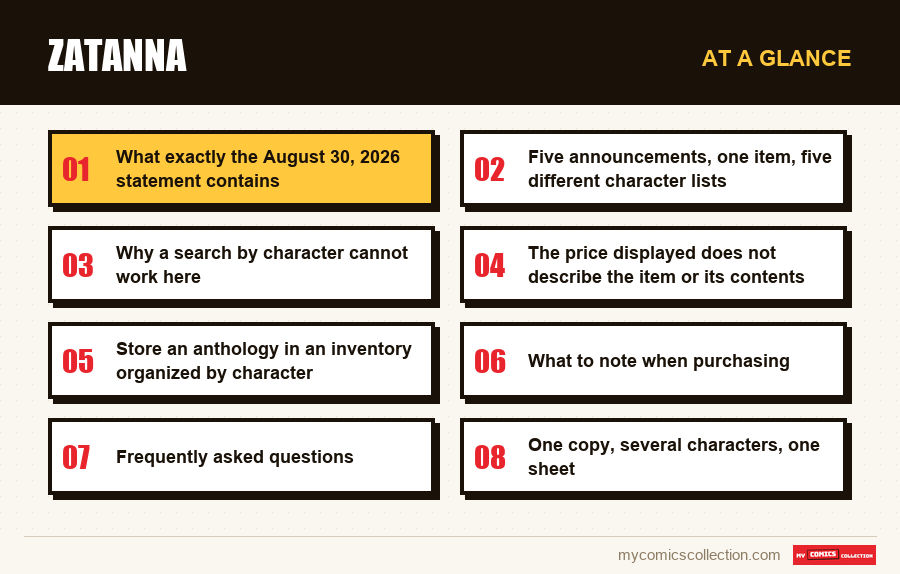
What exactly the August 30, 2026 statement contains
The query query combined the character name, series title, and number: “Zatanna Adventure Comics 413.” It returned twelve unverified advertisements, that is to say twelve copies offered for sale by individuals or resellers, without intervention by an external verification body. The lowest amount requested was $9.95, the highest was $75.00, and the median request value was $20.99. Alongside these twelve ads was a single verified copy, listed at $280.00.
This last figure must be immediately excluded from any reasoning. A single copy does not constitute a stock: there is no way of knowing whether $280.00 is a usual level, an isolated request, or a reflection of an exceptional state of conservation. I therefore conclude nothing on the verified segment of this number, and I explicitly write that no usable data exists concerning it at this date. Comparing one verified specimen to twelve unverified specimens would amount to comparing two populations, one of which has a single individual.
The same caution is required, to a barely lesser degree, for the twelve announcements themselves. Twelve is a very small number. A median calculated over twelve values moves several dollars if two sellers remove their listing or if a third adds one. The $75.00 maximum says nothing more than a seller's hope: no one has paid that amount, and there is no indication that anyone will pay it. I therefore state the median of $20.99 as a descriptive benchmark for the content of the page that day, not as a price level for the booklet.
Finally, this reading was taken on a single date. It shows no evolution, no trend, no movement. Writing that a price “rises” or “falls” would require at least two measurements separated in time, carried out using an identical protocol. A photograph does not tell the story of a movement. All that this statement documents is a state of the offer at a given moment, and above all, this is its real interest, the way in which this offer is described.
Five announcements, one item, five different character lists
The most instructive fact in the statement is not a price. It’s in the titles. The five least expensive ads on the list all point to the same booklet, published in 1971, and yet each lists a separate list of characters.
Two characters, $9.95
“ADVENTURE COMICS #413 Vol. 1 1971 FEATURING SUPERGIRL & ZATANNA.” The seller selects two names and highlights them with the word “featuring”, as if they were the star of the summary. A buyer looking for a third character present in this booklet will never see this ad.
Three characters, $9.99
“Adventure Comics #413 December 1971 VG+ Supergirl, Zatanna, Robotman”. Same object, one more name, and as a bonus a publication date and a status statement. This seller describes more, without claiming to be exhaustive.
No Character, $9.99
"Adventure Comics 413 - Bronze Age DC Comics 1971". The title doesn't name anyone. The ad is strictly invisible to any search by character name: it is only found by searching for the title of the series and the number.
Four characters, $16.24
“Adventure Comics #413 DC 1971 Supergirl Bronze Age Zatanna Hawkman Hawkgirl VG”. The longest list of the lot adds two names absent anywhere else. It alone demonstrates that the other four announcements are incomplete.
The fifth ad, “Adventure Comics 413 Supergirl Zatanna DC Comics Early Bronze Age 1971” at $16.99, returns two names. The final count is therefore: two, three, zero, four, two. Five descriptions of the same object, five different inventories of its contents. None of these announcements are false: the named characters are there. None is complete either, since each omits what another mentions. The description depends on the commercial judgment of the seller, who highlights what he believes sells and leaves the rest aside.
Two advertisements separated by four centimes, one displays two characters, the other three. Six dollars higher, a third shows four. The price difference between these advertisements does not correspond to any difference in object: it is the same issue from 1971, described with more or less generosity.
This means that a search by character name does not sort copies by quality or content. It sorts sellers by verbosity. This is a bias that no automatic classification corrects, and which must be compensated for manually.
Why a search by character cannot work here
On a single-character series, the request and the object coincide: searching for the character amounts to searching for the series. On an anthology, this coincidence disappears. The booklet belongs to several research sets at the same time, and it does not occupy the center in any of them.
This results in a double asymmetry. On the one hand, looking for a character brings up booklets whose main content concerns other characters: the collector sees objects that only partially interest him, and must sort. On the other hand, and this is more serious, certain copies of the booklet sought do not appear at all, because their seller has not named anyone. Of the five least expensive ads in the survey, one was in this case, or one in five.
One in five invisible ads is not a statistical detail. This means that a buyer who sticks to the query by character would miss part of the available offer, and that this part is not random: these are the most laconic announcements, often those of sellers who liquidate a lot without detailing. The only query that captures the whole thing is one that combines the series title and number, without any character names.
Search by title and number, not by name
Querying by character misses ads that don't name anyone. Querying the title of the series followed by the number captures everything, including terse announcements, even if it means sorting manually.
Check the year, never the number alone
The five announcements in the survey mention 1971, one specifying December. It is this year which allows us to confirm that it is indeed the same issue, a single number being able to refer to homonymous series.
Crossing multiple adverts from the same number
No isolated description gives the complete summary. Reading five announcements from the same booklet was enough, here, to increase the known list from two to four characters.
Do not confuse verified and unverified
A verified copy at $280.00 versus twelve unverified ads does not form a price range. The two populations are counted separately and cannot be compared.
Twelve ads don't make a deal
On such a thin workforce, median and ranking are unstable. We need to open the announcements one by one rather than relying on an aggregate figure, and say it clearly rather than leaving it guessing.
Save the summary, not the character
An anthology issue classified under a single name cannot be found in its own collection. The entry must contain the stories present, or failing that the list of characters noted.
Collecting this series?
Track what you own, what you are missing and what your collection is worth. 7 day trial.
Start my trial →The price displayed does not describe the item or its contents
The temptation, when faced with a list sorted by amount, is to read the ranking as a scale of quality. The statement of August 30, 2026 prohibits this reading. Between the first ad at $9.95 and the fourth at $16.24, the object is identical: same series, same number, same year. What changes is the number of characters listed, the presence or absence of a condition statement, and the seller's choice.
Two advertisements in the lot bear an abbreviated status statement, a third specifies the month of publication. These indications are useful, but they come from the seller himself and have not been subject to any external control. They provide information on the care taken in writing the advert more reliably than on the actual condition of the paper. An item described in three words may be in better condition than one described in twenty.
The gap between the low of $9.95 and the high of $75.00 could suggest a fine hierarchy. This is not the case: these two amounts are requests, made by two people who have no obligation to justify their figures. The maximum reflects an expectation, possibly based on a higher state, possibly not. No sales concluded appear in this statement, and therefore no price noted.
The practical consequence is simple. Out of twelve ads, there is no shortcut: you have to open each ad, look at the photographs, read the entire description, and form a judgment on each copy separately. Sorting by ascending price doesn't do this job. Neither is a median. It's tedious, and it's the only honest method when the workforce is so thin.
Store an anthology in an inventory organized by character
The descriptive problem of the market replays itself identically in the personal collection. An inventory structured by character requires, for each copy, to designate an owner. An anthology doesn't have one.
Three bad solutions present themselves spontaneously. Classify the booklet under the best-known character in the summary: the copy becomes impossible to find for anyone looking for it under another name. Classify it under the character who motivated the purchase: the classification depends on a memory that fades. Duplicate it under each name: the collection then has four copies where there is only one, and any count becomes false.
The correct solution is to treat the booklet as what it is, a container. The inventory entry carries the series and number, which uniquely identify the physical object. The summary (the list of stories, and for each story the characters present) is recorded as an attribute of this entry, and not as its identity. The search by character then queries this attribute and finds the only copy, regardless of the name entered.
This is exactly the information that the market refuses to provide. None of the five advertisements examined gives the complete summary; we had to cross them to go from two characters to four. A collector who does not note this summary at the time of purchase, as long as he has the booklet in hand, will later have to reconstruct it from contradictory sources. The catalog allows you to check the composition of an issue, but the copy is in front of you: that's the best time.
What to note when purchasing
The complete list of stories and characters present. The August 30, 2026 survey produced four names where the most economical announcement yielded none, and it took five announcements to get there. With the booklet in hand, this work takes two minutes: go through the summary, note each story and the characters who appear in it. This is the only data that neither the price nor the title of the ad will keep for you.
The precise reason for which you are keeping this copy. An anthology booklet is purchased for a segment, rarely for the whole. Writing which one (such a story, such an appearance, such a designer on such a sequence) avoids rediscovering in five years an object of which we no longer know whether it completes a continued series or whether it was taken from a lot. On an object that belongs to four different searches, the pattern is what connects it to yours.
The exact series and its year of publication. The five advertisements in the survey all mention 1971, with one specifying December. A number alone is never enough to identify an issue, as several series can share the same numbering at different times. The pair of series title and year of publication is the minimum identifier, and it is the one that must be recorded word for word.
The condition that you observe yourself, upon receipt. Two listings in the lot had a condition abbreviation provided by the seller, without outside control. This mention belongs to the ad, not the subject. Once you receive the booklet, examining it and noting what you see (spine, staples, corners, edge) replaces a commercial statement with a first-hand observation, which is the only one for which you are responsible.
The price paid, shipping included, with the date. The amounts in the statement are requests made on August 30, 2026, never completed transactions. Your own purchase is a real transaction: it is the only certain point of reference that your inventory will ever contain on this number. Noted with its date and shipping costs included, it is better than any median calculated on twelve advertisements.
Frequently asked questions
Because it contains several independent short stories, each with their own characters. Sellers name in their ad title those they consider most attractive, and these names become entry points. The report of August 30, 2026 lists, for the same issue from 1971, advertisements citing Supergirl, Zatanna, Robotman, Hawkman and Hawkgirl depending on the case. Searching for one of these names therefore brings up an object whose essential concerns the others.
No. The five cheapest ads in the survey are for the same issue from 1971, with listings of two, three, zero, four and two characters. The difference lies in the wording, not the subject. None of these lists is false and none is complete: they reflect what each seller has chosen to highlight.
As a descriptive marker of the page consulted, yes; as an estimate of value, no. It relates to only twelve advertisements, and to amounts claimed by sellers, not to sales concluded. Such a small workforce becomes distorted as soon as one or two announcements change. On this volume, examining the announcements one by one is the only defensible approach.
Nothing, and that's deliberate. He was alone in his category in the survey. With a single copy, it is impossible to tell if this amount is current, isolated, or linked to a particular condition. No conclusions are therefore drawn about the verified segment of this issue, and it does not compare to the twelve unverified ads, which form a separate population.
By making the identity of the entry bear the series and number, and not a character. The characters present then become an attribute of this entry, supplemented by the list of stories if it is known. The copy remains unique in the counts, while being found under each of the names it contains: which classification under a single character makes impossible.
One copy, several characters, one sheet
My Comics Collection identifies each issue by its series and number, and lets you attach all the characters it contains. Your anthologies remain counted once and can be found under each name, with the condition noted and the price paid kept in the same place.