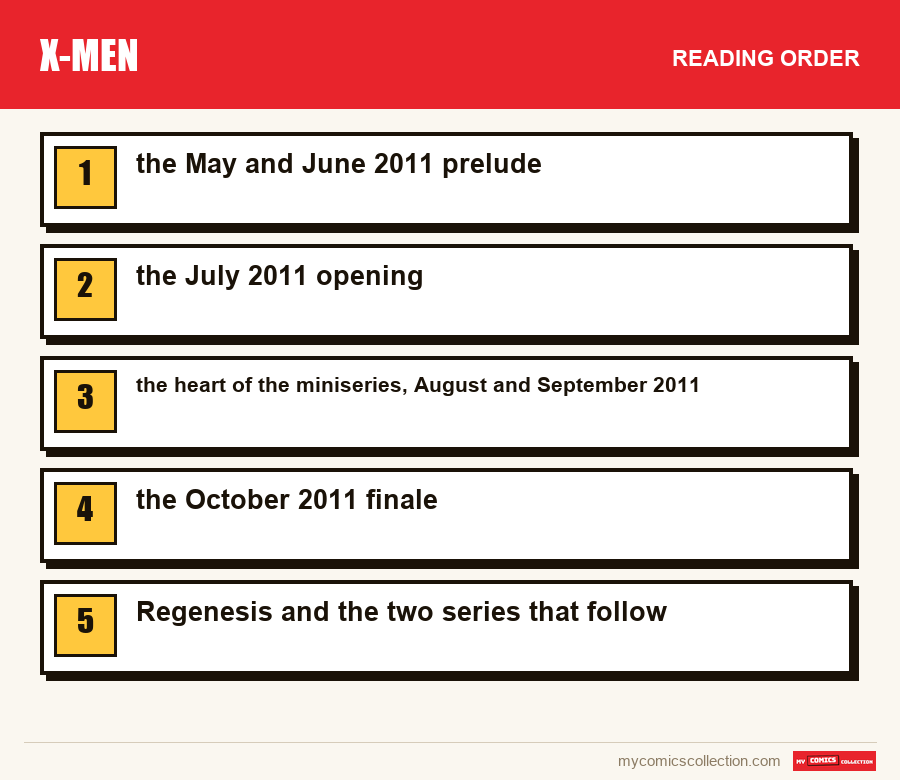
The X-Men: Schism reading order is simple: the event runs five issues, written by Jason Aaron and published from July to October 2011, with a different artist on each one: Carlos Pacheco, Frank Cho, Daniel Acuña, Alan Davis and Adam Kubert. Start with the four issues of X-Men: Prelude to Schism, then read Schism #1 through #5 in order, then the one-shot X-Men: Regenesis. Only then pick your side in the Cyclops vs. Wolverine split: Wolverine and the X-Men or Uncanny X-Men.
Five issues, five artists: Schism is a short story you can read in one evening, yet it commits everything that follows in the X-Men books of the 2010s. The hard part isn't reading it. It's knowing what to read right before, what runs in parallel, and which series to open once you turn the last page. This guide answers those three questions in the order they come up.
As always in this guide, we only state verified information (creators, issue numbers, dates); the analysis is our own, with no reproduction of protected pages or dialogue.
What to read first
Good news: Schism doesn't require ten years of reading. The prelude was designed to set up the situation, and it runs just four issues. That said, a little context makes the miniseries easier to follow, because it rests on a long-standing relationship between two characters who are polar opposites when it comes to method.
- X-Men: Prelude to Schism #1 to #4 (May to June 2011), written by Paul Jenkins. Each issue has its own artist: Roberto De La Torre on #1, Andrea Mutti on #2, Will Conrad on #3 and Clay Mann on #4. The prelude was collected separately in September 2011.
- The background of the Utopia base, set up in San Francisco Bay after the events of 2009: the Utopia crossover lays the groundwork, and the miniseries picks up the day-to-day life there. Reading it in full isn't required to follow Schism.
- To place the event in the larger timeline, open our X-Men reading guide, which sorts the series by era.
If you only remember one title, make it Prelude to Schism. It's the on-ramp Marvel planned for the reader coming in from outside, and it's short.
Phase 1: the May and June 2011 prelude
Read X-Men: Prelude to Schism in full before opening Schism #1. Issues #1 and #2 are dated May 2011; issues #3 and #4, June 2011. Writer Paul Jenkins stays on all four, while the artists change with every issue: that's the rule of this prelude, one artist per issue.
What this phase gives you: a snapshot of the team, its strengths, its weak points, and the pressure bearing on its leaders. It sets the stage without entering the conflict itself. Take the time to read all four issues without skipping pages: they're short, and they establish the cast the miniseries then sets in motion.
If you have the miniseries in collected form, the X-Men: Prelude to Schism trade paperback, gathering issues #1 to #4, came out in September 2011. It's the simplest way to read this phase in one sitting.
Phase 2: the July 2011 opening
Two issues of X-Men: Schism are dated July 2011, and they read together:
- X-Men: Schism #1, written by Jason Aaron, drawn by Carlos Pacheco;
- X-Men: Schism #2, written by Jason Aaron, drawn by Frank Cho.
Pacheco and Cho have different styles, and the shift shows from #1 to #2. Don't let it throw you. Jason Aaron holds the miniseries together from start to finish, and he's the one keeping the tone consistent.
A pacing tip: read these two issues back to back, without a break. The first sets up the threat, the second pushes it into a more personal register. If you stop between the two, you lose the momentum.
Phase 3: the heart of the miniseries, August and September 2011
The next stretch comes with two issues a month apart:
- X-Men: Schism #3 (August 2011), drawn by Daniel Acuña;
- X-Men: Schism #4 (September 2011), drawn by Alan Davis.
This is where the most useful tie-in fits: the series Generation Hope, written by Kieron Gillen and drawn by Tim Seeley, devoted its issues #10 (August 2011), #11 (September 2011) and #12 (October 2011) to this period. If you want to follow the story from the young generation of mutants' side, read #10 after Schism #3, #11 after Schism #4, then #12 after the last issue of the miniseries. That's a reading suggestion, not an obligation: Schism makes sense without them.
Spoiler warning: from this phase on, the break between the team's two leaders becomes the central subject. If you'd rather discover it unprepared, skip straight to the next phase after reading the two issues above.
Phase 4: the October 2011 finale
The fifth issue, X-Men: Schism #5, is dated October 2011. Adam Kubert draws it and Jason Aaron writes it. This is the issue that wraps up the conflict between the two camps and sets the landscape for the series that follow.
Read it right after Generation Hope #12 if you're following the tie-in, or directly after #4 of the miniseries if you're sticking to the essentials. Either way, don't move on to Regenesis before you've closed this issue: the one-shot is its direct consequence.
A volume titled X-Men: Schism, released in July 2012, collects the five issues and adds the one-shot X-Men: Regenesis #1.
Do you collect this series?
Track what you own, what you are missing and what your collection is worth. 7-day trial.
Start my trial →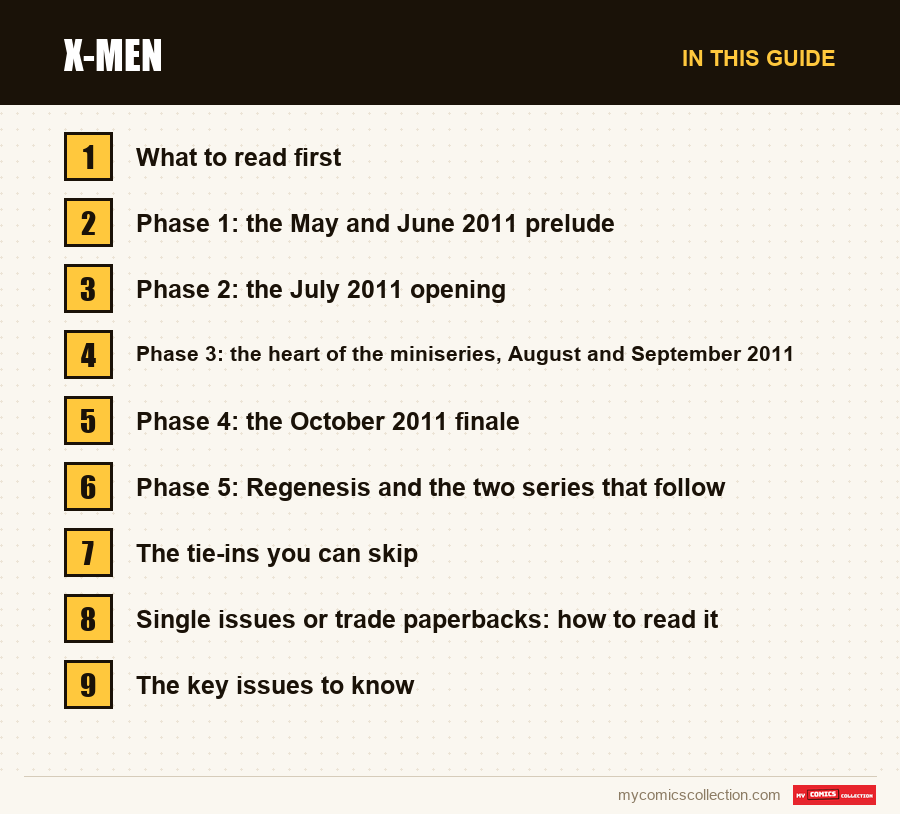
Phase 5: Regenesis and the two series that follow
Once Schism is done, read X-Men: Regenesis #1, a one-shot written by Kieron Gillen and drawn by Billy Tan. It establishes the split into two camps and serves as a bridge to the two series that will fill the coming schedule:
- Wolverine and the X-Men, a series entrusted to Jason Aaron: the Wolverine camp's book, a direct continuation of the miniseries;
- Uncanny X-Men (vol. 2, 20 issues dated 2012), written by Kieron Gillen: the Cyclops camp's book. Carlos Pacheco draws the first issues, alongside other artists. The earlier series of the same name had ended at #544, and this new run restarts at #1.
The choice between the two isn't final: plenty of readers follow both in parallel. For a first read, follow the camp of the character you care about most. Our page on Cyclops and the one on Wolverine gather the useful guides for each path.
The tie-ins you can skip
The list of Schism tie-ins is deliberately short, and that's a strength: the event stands on its own. Issues #10 to #12 of Generation Hope are useful if you already follow that series or if Kieron Gillen interests you, but they aren't essential to understanding the miniseries. The Generation Hope: Schism volume, released in January 2012, collects issues #6 to #12 for anyone who wants to read that series in one go.
What's optional isn't optional for lack of quality, but by design: a tie-in enriches one point of view, it doesn't carry the plot. If you're short on time, the best shortcut is to read Prelude to Schism, Schism and Regenesis, and save Generation Hope for a second read.
This approach gives you the main line in roughly eleven issues (four of prelude, five of miniseries, one one-shot), with no risk of getting lost in the parallel series of summer 2011.
Single issues or trade paperbacks: how to read it
The miniseries is short enough that the choice of format stays simple. In single issues, you read in publication order and catch the rotating artists issue by issue. In collected form, the July 2012 X-Men: Schism volume gathers the five issues and the Regenesis one-shot, which saves you from hunting down the conclusion separately.
A trade paperback has an advantage that matters here: it puts the miniseries and its epilogue in the same volume, which removes the risk of forgetting the one-shot. A single issue has another advantage: the period object, with its cover and issue number, which collectors value for what it represents in the history of the X-Men books.
If you're buying single issues for a collection, check the following before you pay:
- the exact issue number and title, because Schism exists alongside Prelude to Schism, whose numbering restarts at #1;
- the cover: if a variant is involved, the listing should state which cover it is;
- the overall condition, by reading the whole description and not just the first line.
To place this story among the team's other showdowns, browse the X-Men crossovers.
The key issues to know
The key issues of a recent event are recognized by what they set up for the future, not by their rarity. Here are the ones readers and collectors single out, along with the method for judging them:
- X-Men: Schism #1: the opening issue, drawn by Carlos Pacheco. It's the one you look for first in an event collection, because it carries the title on the cover and marks the start of the conflict.
- X-Men: Schism #5: the concluding issue, drawn by Adam Kubert. It closes the miniseries and opens the two series that follow.
- X-Men: Regenesis #1: the epilogue one-shot, written by Kieron Gillen. Easy to forget, and therefore harder to complete than the miniseries itself.
- Wolverine and the X-Men and Uncanny X-Men (vol. 2), first issues: the starting points of the two series. Our Wolverine reading guide places that series in the character's timeline.
Method: for each issue, compare several sold listings rather than a single ad, and make sure you're comparing the same cover. On an event from this period, the gap between two copies comes down first to condition and cover.
Recap: the complete order
- X-Men: Prelude to Schism #1 (May 2011), Paul Jenkins and Roberto De La Torre.
- X-Men: Prelude to Schism #2 (May 2011), with Andrea Mutti.
- X-Men: Prelude to Schism #3 (June 2011), with Will Conrad.
- X-Men: Prelude to Schism #4 (June 2011), with Clay Mann.
- X-Men: Schism #1 (July 2011), Jason Aaron and Carlos Pacheco.
- X-Men: Schism #2 (July 2011), Jason Aaron and Frank Cho.
- X-Men: Schism #3 (August 2011), Jason Aaron and Daniel Acuña; optionally, Generation Hope #10.
- X-Men: Schism #4 (September 2011), Jason Aaron and Alan Davis; optionally, Generation Hope #11.
- X-Men: Schism #5 (October 2011), Jason Aaron and Adam Kubert; optionally, Generation Hope #12.
- X-Men: Regenesis #1, Kieron Gillen and Billy Tan.
- Your pick: Wolverine and the X-Men (Jason Aaron) or Uncanny X-Men (vol. 2), by Kieron Gillen.
To keep going in the mutant universe, the 2010 Second Coming crossover remains a companion read for understanding the state of the team right before the prelude, and Avengers vs X-Men extends the rift between the two camps.
Frequently asked questions
Five issues, from July to October 2011, all written by Jason Aaron. Each has its own artist: Carlos Pacheco, Frank Cho, Daniel Acuña, Alan Davis, then Adam Kubert. The Prelude to Schism prelude adds four issues, and the Regenesis one-shot closes out the run.
It's recommended. The four issues of Prelude to Schism, written by Paul Jenkins and dated May to June 2011, set up the team's situation. The miniseries can be followed without them, but the prelude gives the tension between the two leaders more depth and takes only an hour to read.
Start with the one-shot X-Men: Regenesis #1, written by Kieron Gillen. Then choose between Wolverine and the X-Men, Jason Aaron's series, and Uncanny X-Men (vol. 2), Kieron Gillen's 20-issue series. Many readers follow both, since they respond to each other.
No. Issues #10 to #12 of Generation Hope, written by Kieron Gillen, coincide with the miniseries between August and October 2011 and offer another point of view. They enrich the reading without conditioning it: the main line fits in the prelude, the miniseries and Regenesis.
Yes. The X-Men: Schism volume, released in July 2012, collects the five issues and the Regenesis #1 one-shot. The prelude has its own volume, X-Men: Prelude to Schism, released in September 2011 and gathering issues #1 to #4. The two complement each other for a continuous read.
Your Schism and Prelude to Schism single issues deserve to be pinned down precisely before they're sold or insured.
Estimate my comic