In short
Wonder Man, Simon Williams, debuts in The Avengers #9, cover-dated October 1964. Stan Lee wrote "The Coming of the... Wonder Man!", Don Heck penciled it, and the character is credited to Lee with Heck and Jack Kirby. Simon arrives as a recruit of Baron Zemo's Masters of Evil, sent to destroy the team from inside, and he turns on his masters at the cost of his life.
Few debut issues pack a character's whole arc into a single story the way this one does. Simon Williams is introduced, empowered, sent against the Avengers, converted and apparently killed within the same twenty-odd pages. The issue then waits years for an answer to what happened to him, and that delay is what made the character a durable part of the Avengers mythos.
The credits, dates and the chain of later issues below were checked issue by issue, down to the cover date of each return. The plot summary is a description, not a reproduction of the pages, and the advice on condition and confusable numbers is our own analysis, with no price attached.

What Avengers #9 is: October 1964, credits and story title
The Avengers #9 is cover-dated October 1964. The story title is "The Coming of the... Wonder Man!", with the ellipsis built into the name. Stan Lee wrote it and Don Heck penciled it. Heck succeeded Jack Kirby as the series penciler with this very number, so the book marks a handover in the look of the title as well as a debut.
The creation credit for the character is usually given to Lee, with the artists Kirby and Heck, a combination that reflects the way the series was moving from one penciler to the next at that moment. A buyer should read it as a shared credit rather than hunting for a single artist.
The team on the page is the lineup of the period: Thor, Captain America, Iron Man, Giant-Man and the Wasp. Hulk had left the team at the end of the second issue, and Captain America had returned in issue 4, so this is the version of the group that readers of the early Silver Age would describe as the classic roster.
How Wonder Man is introduced
The story starts not with a hero but with a defendant. Simon Williams is an industrialist's son who has inherited the family company, Williams Innovations, and watched its profits fall under the competition of Tony Stark's firm. He attempts to embezzle company funds, is caught and is jailed, and in his bitterness he blames Stark for his ruin.
That grievance makes him useful to Heinrich Zemo, the villain who leads the Masters of Evil. With the Enchantress paying his bail, Zemo offers him a deal: powers in exchange for a mission. Zemo's ion-based treatments turn Simon into a superhuman. The treatment comes with a hook, because his body now needs periodic doses of a serum to survive, a dependence that keeps him on a leash.
Zemo sends him to join the Avengers under the identity of a hero. The Avengers are lured into a trap and captured. Then the plan turns: Simon decides to save the Avengers, accepts that doing so will cost him his life, and apparently dies. Hank Pym then saves the brain patterns of the fallen hero, in the hope that he might be revived. The Avengers believe him dead, but Simon has actually fallen into a catatonic state, a fact that the series reveals years later.
What makes the issue worth reading beyond its place in a checklist is how compactly it states the character. The embezzler who becomes a hero, the man who takes a deal for revenge and then reverses it, is a pattern that the series returns to for decades, and the cleanest version of it is here.
Who created him and why
Lee wrote the debut in the middle of the first great burst of Marvel Silver Age creation, and Wonder Man belongs to the series' habit of using the Avengers as a place where villains' plans collide with the team's own members. Zemo, the Enchantress and the Executioner were already tied to the Avengers by this point, so a story in which they recruit an outsider to infiltrate the team follows the logic of the series.
The name had a history of its own. In a 1978 interview Stan Lee said that DC Comics took legal action over the name because DC published Wonder Woman, and that Marvel set the character aside as a result. That remark is useful context for collectors who wonder why a debut from 1964 did not lead directly to a stream of appearances.
Nothing in the debut issue itself requires the later revisions. It reads as a complete, contained story: a man is empowered, tests his loyalty, chooses well and dies. The way later writers use the open ends, the saved brain patterns and the apparent death, is a separate matter and part of why the issue became more important over time.
Why it is a key issue
There are three reasons a collector pays attention to The Avengers #9. First, Simon Williams went on to a West Coast team book, a solo series and a 2026 live-action television series starring Yahya Abdul-Mateen II. Second, Hank Pym's saved brain patterns become the template that Ultron later takes for the Vision, whose origin in The Avengers #57 and #58 leads straight back here. Third, it falls inside a small group of early Avengers issues that each introduce something durable, and collectors who assemble that group tend to treat it as a set.
The issue just before it is also worth noting: The Avengers #8 is the debut of Kang, which makes the pairing of issue 8 and issue 9 a natural purchase for anyone building the early run. Our guide to issue 8 covers Kang, and the guide to Silver Age Avengers key issues places both in the wider sequence.
It is worth stressing what the issue is not. It is not an issue about the Vision, who does not exist yet, and it is not an issue that shows Wonder Man alive after the final page. A buyer who expects to find a long-running hero in the book will find a short, tragic story, and that is how the character was designed to begin.
Do you collect this series?
Track what you own, what you are missing and what your collection is worth. 7-day trial.
Start my trial →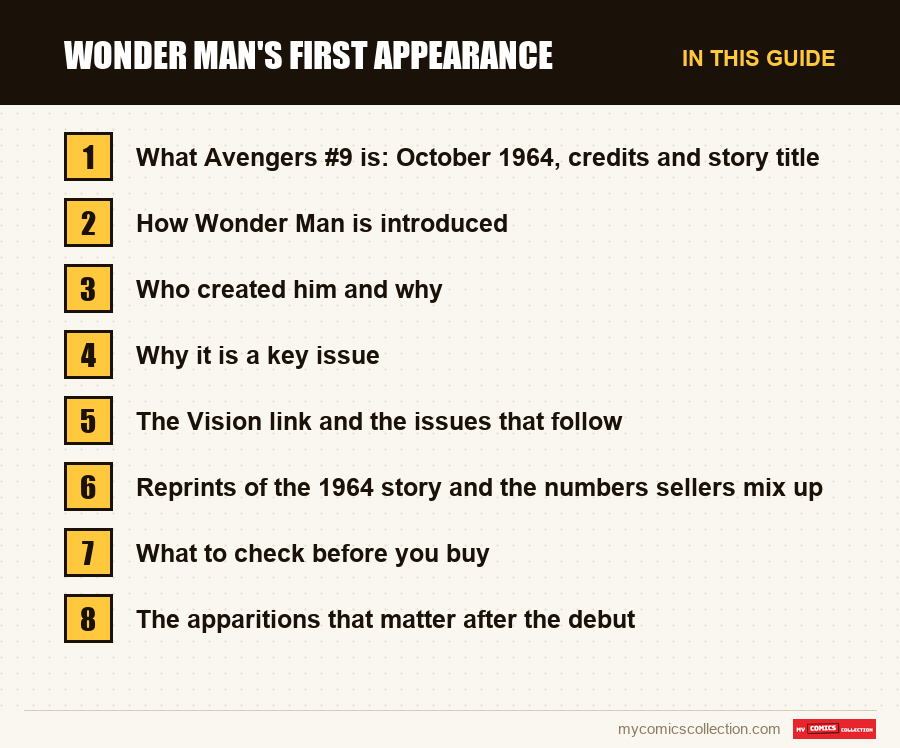
The Vision link and the issues that follow
The thread that runs from The Avengers #9 to the rest of the character's life starts with a single decision at the end of the story: Hank Pym saving the brain patterns. When Ultron builds the Vision, the synthezoid is given the mind template of Simon Williams, and the revelation of that fact belongs to The Avengers #57 and #58. Issue 58 is cover-dated November 1968 and revisits the events of issue 9, explaining that the Avengers had saved Simon's mind in a computer. For the Vision's own debut, see our guide to The Avengers #57.
After that, the body of the character waits. A comatose cameo appears in The Avengers #102, cover-dated August 1972, which shows that the character has not been forgotten. Kang revives him in The Avengers #131 and #132, dated January and February 1975. A zombie version, raised by the villain Black Talon, appears in the storyline around The Avengers #152, cover-dated October 1976, and the Living Laser finally restores him in The Avengers Annual #6, from 1976. He joins the team full-time in The Avengers #160, dated June 1977.
Those six steps, the cameo, the revival, the zombie, the restoration, the return and the Vision connection, are what a collector should know. They are also the stages at which a buyer might be tempted to confuse a later key with the debut, which is why the next section lists the numbers that are most often mistaken for it.
Reprints of the 1964 story and the numbers sellers mix up
The debut story is reprinted in the early volumes of the Marvel Masterworks: The Avengers series, which begin at issue 1, and in other collected editions of the period, in different formats and with different paper and printing from the 1964 original. A reprint tells Lee and Heck's story in full, so a reader who just wants the story can use one without hesitation.
Several issues are regularly mistaken for the debut or confused with it.
- The Avengers #8 (1964). The debut of Kang, which comes right before this issue.
- The Avengers #4 (1964). The return of Captain America. A different key issue, sometimes shelved nearby.
- The Avengers #57 and #58 (1968). The Vision's debut and the explanation that links him to Simon Williams.
- The Avengers #131 and #132 (1975). Kang revives Wonder Man. Often sold as a "return," not the debut.
- West Coast Avengers (1984). Wonder Man is a founding member of the team: a four-issue miniseries ran from September to December 1984, then a 102-issue series.
- A 1986 graphic novel. A self-titled graphic novel, distinct from both the 1991 series and the 1964 debut.
The practical rule is the same as for any Silver Age comic: match the series title and the number on the cover, then check the cover date. For this issue the date is October 1964, and the number is 9, in the first volume of The Avengers, so a #9 from a later volume is not the same book.
What to check before you buy
A 1964 Marvel comic is sixty years old and has passed through many hands, and the best defense against a bad purchase is a fixed order of checks.
Begin with identity. Read the cover: the series title, the number, the month and year. Compare the cover date with the issue number, and confirm that the book is the first volume. Then look at completeness, which means checking that the cover is attached at both staples, that no page is torn out and that no coupon or advertisement has been clipped.
Next, condition. Look at the spine for stress lines and for splits that run from the top or bottom edge toward the staples, and check the corners and edges for wear. The page color should be even from the edge toward the center: Silver Age paper tones with time, and a uniform tone is normal, but a patch of different color or an oily sheen on the cover can indicate cleaning, color touch or other restoration. Look at each staple for rust that has bled into the paper around it.
On a slabbed copy of issue 9, read the label as carefully as the grade number. It should name The Avengers, issue 9 and October 1964, and flag any restoration. A restored Silver Age copy and an unrestored one can share a grade yet be different purchases, and the notes are the line many buyers skip. Our Avengers grading guide explains how labels and notes are read, and the guide to fakes and reprints shows how to separate an original from a later printing or a facsimile of a period piece.
Finally, buy the story you want. A collector who is mainly interested in the Vision link may be better served by a good copy of issue 58 than by a worn copy of issue 9, and a reader who just wants the debut story will find it in a collected edition. A key issue is a collecting decision before it is a reading decision, and the right choice depends on what the finished collection is supposed to show.
The apparitions that matter after the debut
If the debut is the foundation, a short list of later issues shows how the character develops.
The Avengers #58 explains the saved mind and ties Wonder Man to the Vision, which makes it the most important follow-up for anyone interested in the character's place in the larger saga. The Avengers #131 and #132 show Kang reviving the character in the mid-1970s. The storyline around The Avengers #152 is the zombie period, with the Black Talon behind the revival. The Avengers #160 is the point at which Simon Williams joins the team as a full-time member, and West Coast Avengers from 1984 makes him a founding member of a second Avengers team.
Collectors who like a full run will want those five stops, and collectors who want a minimal set can take the debut and issue 58 alone. Our guide to the best Wonder Man comics puts those issues alongside the 2007 miniseries and the later team-book appearances, and the Avengers hub places them in the wider run of the title.
Frequently asked questions
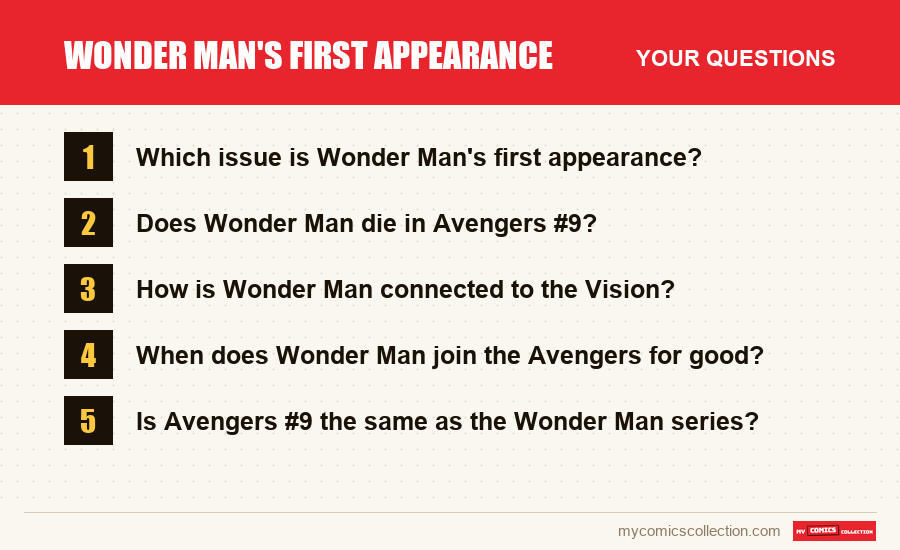
The Avengers #9, cover-dated October 1964, in the story "The Coming of the... Wonder Man!" Stan Lee wrote it and Don Heck penciled it. The character is credited to Lee with the artists Jack Kirby and Don Heck. It is the first volume of the series, not a later restart.
He appears to. Simon Williams turns on Baron Zemo and apparently dies, and Hank Pym saves his brain patterns. Years later the series reveals that Simon had entered a catatonic state, and Avengers #58, dated November 1968, explains that his mind had been saved in a computer.
Ultron steals the brain patterns that Hank Pym saved from Simon Williams and uses them as the template for the Vision. The link is revealed in The Avengers #57 and #58 from 1968, which revisit the events of issue 9. The Vision's debut and Wonder Man's debut are therefore separate issues, almost four years apart.
He joins the team full-time in The Avengers #160, cover-dated June 1977, after a series of returns: Kang revives him in issues 131 and 132, the villain Black Talon raises him as a zombie around issue 152, and the Living Laser restores him in Annual #6. He later becomes a founding member of West Coast Avengers in 1984.
No. The Avengers #9 is the 1964 debut inside the team series. Wonder Man later received a 1986 graphic novel, a 29-issue series that ran from 1991 to 1994, and a five-issue miniseries in 2007 titled My Fair Super Hero. Those are separate publications and not the debut.
If you own The Avengers #9 or the early issues around it, you can get a quick estimate and compare your copy with the checks above.
Estimate my comic