In short
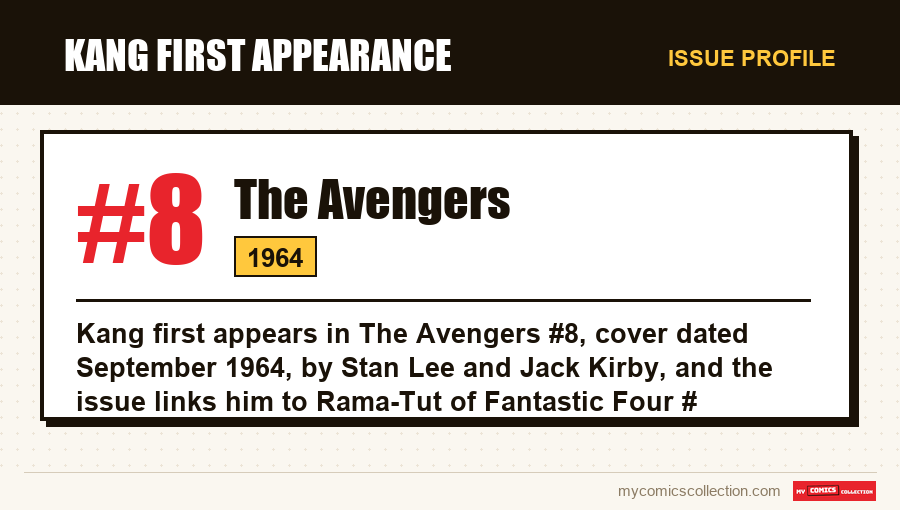
The debut of Kang the Conqueror is The Avengers #8, September 1964 on the cover, with Stan Lee as writer and Jack Kirby as penciler. Its pages bring back the time traveler of Fantastic Four #19 (October 1963), who then went by Rama-Tut, and declare him a younger Kang. Kang captures most of the team and threatens the world with a 24 hour ultimatum, and Thor drives him off.
The Avengers #8 is a debut with a twist: the character had already appeared once, under another name, a year earlier. That makes the issue unusual in a collector's checklist. It is the first appearance of the name Kang and also the issue that rewrites an older one, so it is worth reading as a hinge between two comics.
We checked the cover dates, the Lee and Kirby credits, the outline of the story and the issues that introduce Immortus and the Scarlet Centurion. Why #8 matters and how to buy it are our own analysis.
The identity of the issue: date, creators and place in the series
The Avengers #8 carries a cover date of September 1964. Stan Lee wrote the series from its first issue through #34, and Jack Kirby penciled issues #1 to #8, which makes #8 the last issue of the title that Kirby drew in that opening run. From #9, Don Heck takes over as penciler for issues #9 to #15. For a collector, that detail explains why the debut of Kang is also a Kirby farewell to the series, a second reason to want the number.
The creators are Lee and Kirby, who had also created Rama-Tut. This page names no inker for #8. If you annotate your copy, check the printed credits rather than a catalog entry that gives a full block of names without citing where it comes from.
The issue sits early in the run of the series, which launched in 1963; our analysis of the first series describes that opening stretch. In that context a new villain who threatens the whole world, not a single city, sets the scale for what the book could attempt.
What happens when Kang arrives
In the story, Kang captures the Avengers, with the exception of the Wasp and Rick Jones, and gives the world 24 hours to surrender. The ultimatum is the point of the issue: the threat is not a duel with a villain but a deadline imposed on the planet by a stranger who claims to have come from the future.
The turn comes from the two characters left free. Rick Jones and his friends pose as allies of Kang and then double-cross him, which lets the captured team be freed. Thor then absorbs the radiation rays Kang uses and sends them back at him, forcing the conqueror to escape. The issue ends with the villain driven off, not destroyed, which is the pattern that makes him a recurring character from the start.
We describe the story in outline only. The value of the page is in the structure of the plot, not in a recap panel by panel, and none of the dialogue is reproduced here. What matters for a collector is that the issue presents a self-contained threat, a rescue by the supporting cast and a retreat, so a reader who picks up only #8 gets a complete story with an open door.
The link to Rama-Tut in Fantastic Four #19
The issue's second job is to link Kang to Rama-Tut, who debuted in Fantastic Four #19, cover dated October 1963. That issue, also by Lee and Kirby, introduces a criminal from the year 3000 who had conquered ancient Egypt. The Avengers #8 is where that equivalence is stated.
The practical result for a collection is that there are two debuts to own. Fantastic Four #19 is the first appearance of Rama-Tut. The Avengers #8 is the first appearance of Kang. Both are legitimate answers to "first appearance", and which one a seller means depends on the name used. A listing that says "first Kang" and names Fantastic Four #19 should be read with care, as the character in that book is called Rama-Tut, not Kang. The reverse also holds: a listing that gives The Avengers #8 as the first Rama-Tut is wrong.
If you want one page on how the two issues relate across the character's whole history, our history of Kang in comics covers it. Here the point is narrower: #8 is where the name and the overall identity of Kang begin.
Immortus, the Scarlet Centurion and other linked identities
Several names are tied to Kang, and each has its own issue. Distinguishing them avoids the most common mislabeling.
Immortus first appears in The Avengers #10, cover dated November 1964, created by Lee and Kirby. He is not presented as Kang's future self at that time. Giant-Size Avengers #3, dated February 1975, is the issue cited for the reveal that Immortus is the future persona of Rama-Tut and Kang. An Immortus debut in #10 is therefore a separate purchase from the Kang debut in #8, and the identity reveal belongs to a book published more than a decade later.
The Scarlet Centurion is a third identity. Kang used it once, fighting the Avengers in an alternate timeline in Avengers Annual #2, dated September 1968. It is a distinct collectible, but it does not substitute for the 1964 issue.
The name Nathaniel Richards arrives much later. Fantastic Four #273, dated December 1984, strongly implied that Kang descended from Nathaniel Richards, the father of Reed Richards. What If...? volume 2 #39, July 1992, revealed that Kang's birth name was also Nathaniel Richards, and that was later incorporated into mainstream continuity. Later stories such as Avengers Forever #9 (August 1999) and Doctor Doom #6 (March 2020) leave his ancestry open. None of those later details appears in The Avengers #8, and a seller who attributes them to the debut is describing a later reading.
Do you collect this series?
Track what you own, what you are missing and what your collection is worth. 7-day trial.
Start my trial →
Why the issue is a key number
Three separate reasons make #8 a key issue. It introduces a character who becomes one of the main antagonists of the Avengers. It retroactively connects a Fantastic Four villain to an Avengers villain, a link between a Fantastic Four villain and the Avengers that a reader could follow from one comic to the other. And it is a Kirby issue at the end of his run on the title, which gives it a place in his bibliography.
The character's later importance reinforces the debut. Kang has a long record of returns, and a 2021 miniseries gave him a solo book. Our page on Doctor Doom versus Kang explains why the two are often compared, and why that comparison keeps Rama-Tut and Kang in discussion every time a new adaptation appears.
The issue's strength as a collectible is not tied to any single return. Each time the character is used, attention goes back to a short list of numbers, and #8 is at the top of it because it carries both the name and the structure of the character: a conqueror, a deadline and a link to an earlier self.
Numbers often confused with this one
Four confusions are common. The first is Fantastic Four #19, covered above. The second is The Avengers #10, the Immortus debut, which falls two issues later and is sometimes described as a Kang issue because of the later reveal. The third is Giant-Size Avengers #3, which matters for the Immortus link and is often mentioned together with the debut in lists of "key Kang books".
The fourth is the group of later issues in which Kang is a major presence, including the 1975 sequence around The Avengers #131 and #132. In #131 (January 1975) Kang schemes against the Avengers and Rama-Tut, with Immortus as an ally, and #132 (February 1975) as the issue in which Kang creates the first Legion of the Unliving. These are important for the character's Bronze Age development but are not debuts, and they should be priced and described as follow-ups.
For a view of the Avengers back issues as a whole, the Avengers key issues guide places #8 among the other numbers a collector of the title will meet.
Inspecting a copy of #8 before purchase
Examine the cover first. A Kirby cover from 1964 is typically bold in color and prone to rub along the edges and the spine. Look for color breaks, creases and writing. Check the spine for stress lines, which often show as white lines running across the colored area.
Next, check the interior. Staples may be rusted, the paper may be brittle at the edges, and the pages may be loose. Confirm that the cover is attached at both staples and that the centerfold has not detached. A copy with a replaced cover, a rebuilt spine or color touch can look strong in a photograph and still be a different object from an untouched book, so ask whether any restoration is present.
When the issue is slabbed, the label and the book must agree on number, cover date and grade, and the serial belongs on the grading company's own lookup. With a book that has no grade, ask the seller for sharp photographs of both covers, the spine and the interior, and hold them up against a sound copy. Our guides on grading Avengers back issues and on fakes and reprints describe the checks in more detail.
Think of value as a comparison. A pressed-and-patched copy and an untouched one of the same apparent grade are different objects, as are a slabbed copy and an unexamined one. No amounts appear on this page because each sale moves them; our free comic valuation can help with a specific book.
A short method for building the Kang set
Start with the two debuts, Fantastic Four #19 and The Avengers #8, and keep them together, since the second explains the first. Add The Avengers #10 for Immortus. If you want the identity link, add Giant-Size Avengers #3 and check its condition separately, because a giant-size annual is a different format from a monthly and wears differently.
Then add the context issues if you want a fuller shelf: Avengers Annual #2 for the Scarlet Centurion, The Avengers #131 and #132 for the 1975 sequence, and What If...? volume 2 #39 for the name Nathaniel Richards. For the later era, Avengers Forever #11 and #12 (1999) cover the death and resurrection of Immortus, and the 2021 miniseries is the character's solo return.
The same structure works for a budget. If you can only afford one number, make it the debut of the name, The Avengers #8, and treat the others as stages in a longer project. For the opening issue of the series in which he debuted, see our page on Avengers #1 (1963).
Frequently asked questions
The answer is The Avengers #8, with a September 1964 cover date, by writer Stan Lee and penciler Jack Kirby. That issue also says Rama-Tut, who appeared in Fantastic Four #19 in 1963, is a younger Kang.
It is the first appearance of Rama-Tut, cover dated October 1963, a criminal from the year 3000 who had conquered ancient Egypt. The name Kang arrives a year later in The Avengers #8, which connects the two, so many collectors treat both issues as origin books.
Immortus first appears in The Avengers #10, cover dated November 1964, created by Lee and Kirby. The reveal that he is the future persona of Rama-Tut and Kang comes later, in Giant-Size Avengers #3, dated February 1975.
It is a later addition. Fantastic Four #273 (December 1984) implied a family link, and What If...? volume 2 #39 (July 1992) revealed the birth name, later folded into mainstream continuity. None of this appears in The Avengers #8 itself.
Check the cover for color rub, creases and spine stress, then the staples and interior for age damage. Confirm whether any restoration is present. If the copy is slabbed, the label must describe this book, and its serial number should be confirmed with the grader.
A copy of The Avengers #8 or Fantastic Four #19 deserves an appraisal based on its actual condition and any restoration.
Estimate my comic