
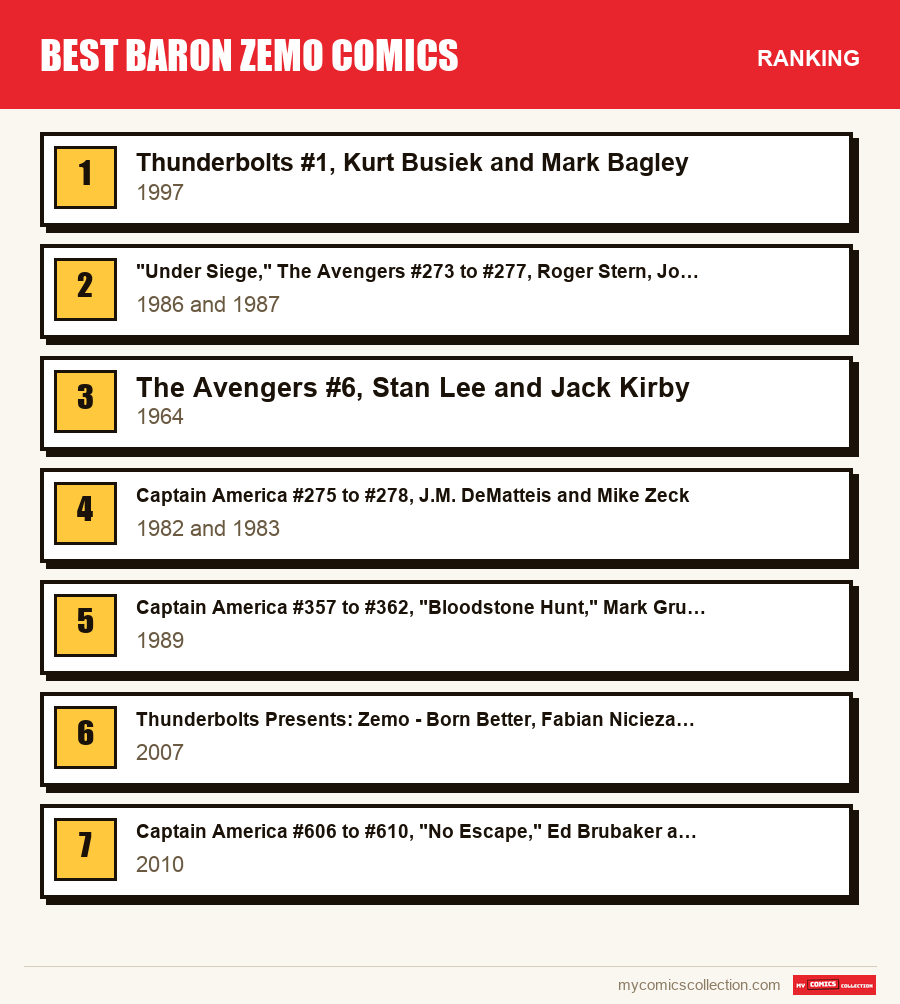
The best Baron Zemo comics come in two stages: Heinrich in The Avengers #6 (July 1964), by Stan Lee and Jack Kirby, then his son Helmut, a baron from Captain America #275 (November 1982). The best place to start is Thunderbolts #1 (1997), by Kurt Busiek and Mark Bagley, followed by "Under Siege," the arc by Roger Stern, John Buscema and Tom Palmer that fills The Avengers #273 to #277.
There are two Baron Zemos, and half the reading confusion comes from that. Heinrich is the Nazi scientist of the sixties, purple mask over his face; Helmut is the son who takes over the title and turns it into that of a patient strategist. This guide ranks seven reads and says, for each, which Zemo it is about.
As always in this guide, only verified facts (creators, issue numbers, dates) are stated as fact; the analysis is our own, with no reproduction of protected art or dialogue.
His first appearance
Heinrich, the father, becomes an active threat in July 1964: Stan Lee devises the plot of The Avengers #6 and Jack Kirby lays out the pages. He was not entirely unknown to readers, though: a flashback in The Avengers #4 (March 1964), the issue that brings Captain America back to the present, already shows him. It is in #6 that he acts for real, and that he assembles the original version of the Masters of Evil, a team of criminals set against the Avengers. He returns in #7, #9 and #10, then dies in #15 (April 1965). He also appears in Tales of Suspense #60 (December 1964) and in Sgt. Fury and His Howling Commandos #8 (July 1964).
His son Helmut has two entries, which need to be kept apart. He first appears under the name Phoenix in Captain America #168 (December 1973). He doesn't put on his father's costume and name until much later: an appearance in Captain America #275 (November 1982), when J.M. DeMatteis and Mike Zeck make him an adversary in his own right. For the 1964 and 1965 issues, look at the spine, the corners and the paper, ask for sharp photos of the interior, and rule out restored copies; our rundown on issue #1 of the 1963 series gives the context for that period.
1: Thunderbolts #1, Kurt Busiek and Mark Bagley (1997)
Issue #1 is dated April 1997, written by Kurt Busiek and drawn by Mark Bagley. The Marvel universe has just lost its great heroes in the events of 1996, and a group of newcomers presents itself to the world as saviors. The last page flips the meaning of everything before it: these heroes are the former Masters of Evil under borrowed identities, and their leader, Helmut Zemo, calls himself Citizen V. The team had been shown as early as The Incredible Hulk #449 (January 1997), but it is the series that gives Zemo his plan.
What this read brings to the character: a baron who no longer attacks head-on, but wins the public's trust before using it. It suits any reader who hasn't yet read any Captain America, since the story stands on its own. The collapse of the plan is told in #10 to #14 (January to May 1998), where the Thunderbolts turn on Zemo; if you want the full fall, keep going that far. Issue #39 (June 2000) leads to his death. The trade paperbacks of the first issues spare you from buying each single issue: the ranking of Thunderbolts runs, cited above, helps you pick the volume.
2: "Under Siege," The Avengers #273 to #277, Roger Stern, John Buscema and Tom Palmer (1986 and 1987)
This is the peak of Baron Zemo as a warlord, and the reason people talk about the Masters of Evil as a real threat. Helmut, who forms a new version of the team starting in #270, seizes Avengers Mansion. The story is scripted by Roger Stern, with John Buscema on pencils and Tom Palmer on inks. What makes it remarkable is that the heroes take a beating: Hercules is put into a coma, the mansion is wrecked, and the comeback takes time.
The arc suits the reader who wants a structured showdown, with clear rising tension. It also says what Helmut is next to his father: less a fanatic than an organizer, who wants to defeat Captain America and make him suffer. It reads easily in the trade paperback, and you can open #270 if you want to see the team's launch. To place the series in its era, reread the historical overview of the Avengers before you begin.
3: The Avengers #6, Stan Lee and Jack Kirby (1964)
Here is Heinrich's entry in action. Script by Stan Lee, art by Jack Kirby, dated July 1964: the formation of the original version of the Masters of Evil, a team of criminals brought together specifically to beat the Avengers. The heart of the story is simple: the issue sets up the pattern that Heinrich will never stop applying.
What this story brings: the template for everything that follows, that is, a villain who readies a team against a team. This read attracts Silver Age fans and those looking for the origin of the baron's title. For buying, it is better to start with a reprint in a collected edition of the period, then decide whether you want the original issue. Heinrich dies in #15 (April 1965); the rundown on Captain America's return puts those issues back in order.
4: Captain America #275 to #278, J.M. DeMatteis and Mike Zeck (1982 and 1983)
This is where the modern Baron Zemo is born. Helmut appears under the title of baron in #275 (November 1982), and the arc, which runs through #278, pits him against Captain America in a shaky alliance with other enemies. The script is by J.M. DeMatteis, the pencils by Mike Zeck. If you want to understand why a son takes up his father's mask, this is the issue to open.
It suits the reader who wants to read the Captain America series in the continuity of the eighties, before turning to Mark Gruenwald's run. The read is more modest than "Under Siege," but it fixes the character's identity: an heir more patient than his father. To place those years in the series, lean on the reading guide mentioned at the top of the article.
Do you collect this series?
Track what you own, what you are missing and what your collection is worth. 7-day trial.
Start my trial →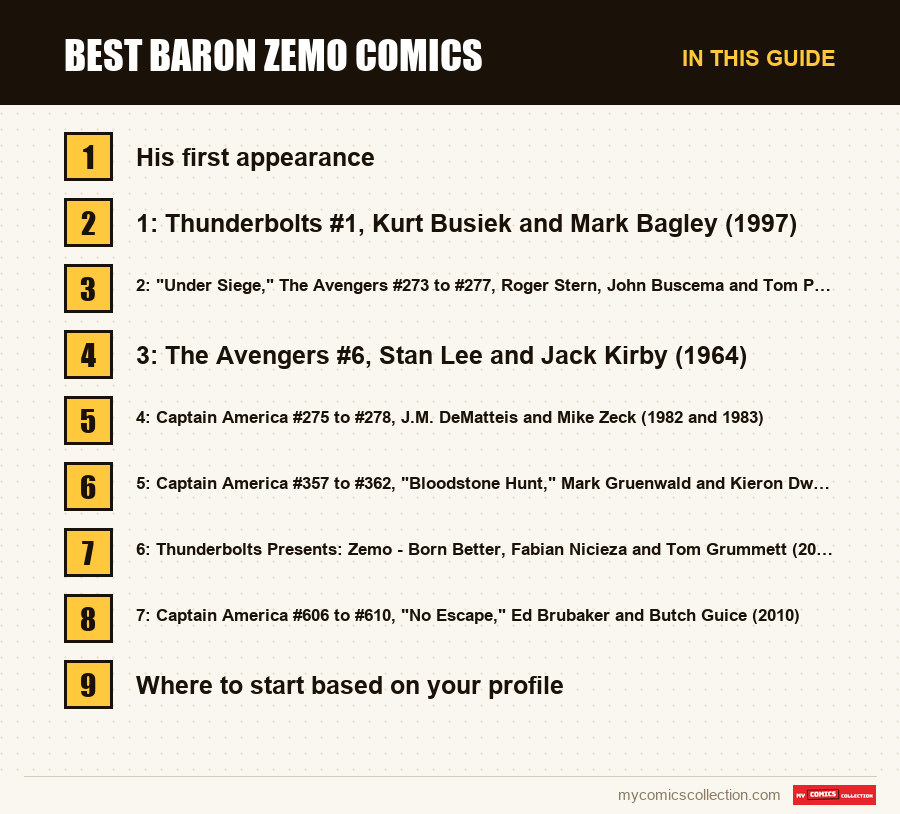
5: Captain America #357 to #362, "Bloodstone Hunt," Mark Gruenwald and Kieron Dwyer (1989)
In this six-part story, dated September to November 1989, Captain America and Diamondback race to gather five fragments of the mystic gem called the Bloodstone, against Helmut Zemo, Batroc, Zaran and Machete. Mark Gruenwald writes, Kieron Dwyer draws. The chase crosses several countries, and the strangest thread is Heinrich's: his corpse, which Helmut keeps, ends up possessed by the living consciousness of the stone. Zemo is a major antagonist there, but Captain America remains the center of the story.
What this read brings: a Helmut struggling in his father's shadow, and the idea that the title weighs on him. It suits readers of old-school adventure, who like travel and plot twists. The trade paperback of this arc exists and is enough: no need to chase the six single issues for the story alone.
6: Thunderbolts Presents: Zemo - Born Better, Fabian Nicieza and Tom Grummett (2007)
A four-issue miniseries, published in 2007 and devoted to the Zemo lineage, with Fabian Nicieza on the script, Tom Grummett on art and Gary Erskine on inks. It follows Helmut and revisits the family history of the baron's title. It is a story for anyone who wants to know more about the character once they know Heinrich and the Thunderbolts.
What it brings to the character: a genealogy, that is, the answer to the question of what it means to carry a name like that. It's best to have read Thunderbolts #1 beforehand, and to look here for depth rather than action. The 2007 trade paperback collects it; it is also reprinted in the Thunderbolts omnibus published in 2023.
7: Captain America #606 to #610, "No Escape," Ed Brubaker and Butch Guice (2010)
The arc pits Bucky Barnes, now Captain America, against Helmut Zemo. Ed Brubaker writes, Butch Guice draws. Zemo lays Bucky's past as the Winter Soldier bare there, and it is against that backdrop that the follow-up, "The Trial of Captain America," opens from #611. The Captain America in question is therefore not Steve Rogers, but Bucky Barnes.
What this story brings to Zemo: a role as a moral adversary, who strikes at reputation rather than the body. The context comes from Brubaker's run on Bucky Barnes: read it first, or the stakes will escape you. The collected editions of the period are easy to find; for the writer's other work, see the page devoted to Ed Brubaker.
Where to start based on your profile
The reader in a hurry who wants a single complete story will take Thunderbolts #1 and the run of the first issues: the character is whole there, with no prior knowledge needed. The one who likes long-haul showdowns will head for "Under Siege," where you can see the difference between a street criminal and a warlord. The Silver Age reader will open The Avengers #6, then #15 for the end of Heinrich.
If you come from the movies, note that the Zemo of the films, seen in Captain America: Civil War (2016), is Helmut, not Heinrich, which points the reading toward Helmut's stories. If you collect, start with the collected editions, check which Zemo is in each issue, and save the single issues for the ones that really matter: always check which Zemo is in each issue before you pay.
The key issues to know
The useful issues fall into three families. Heinrich's appearances: The Avengers #4 (March 1964, flashback), #6 (July 1964) and #15 (April 1965, his death). Helmut's appearances: Captain America #168 (December 1973, as Phoenix) and #275 (November 1982, with the title of baron). The turning points: The Incredible Hulk #449 (January 1997) for Citizen V's entrance, Thunderbolts #1 (April 1997), and Thunderbolts #39 (June 2000) for his death.
To place these issues in the market, compare completed sales of the same copy at equal grade, set aside the extreme outliers and follow the trend rather than a single result. A Zemo cameo does not belong with a full-fledged first appearance.
Frequently asked questions
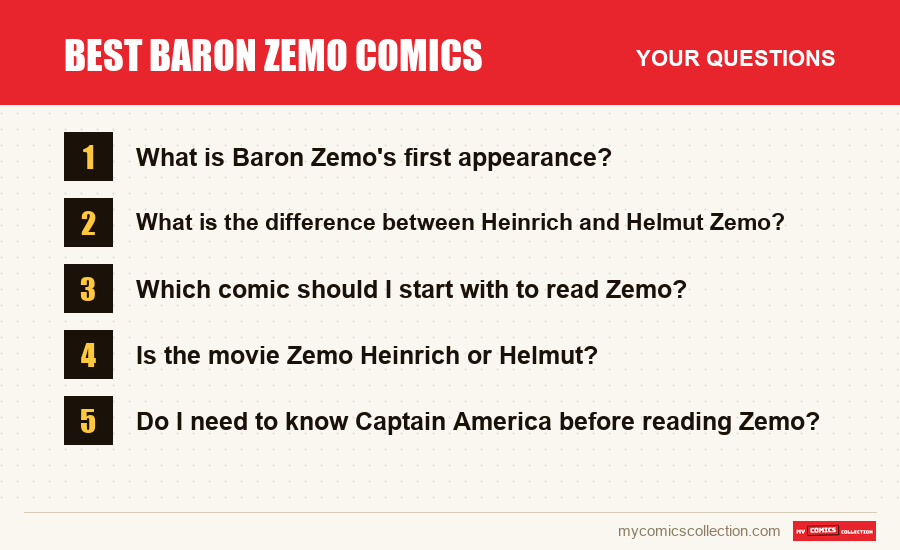
It depends on which Zemo. Heinrich bursts in with The Avengers #6 (July 1964), from the hands of Stan Lee and Jack Kirby. Helmut appears under the name Phoenix in Captain America #168 (December 1973), then as baron in #275 (November 1982). For an unambiguous entry point, count #6 for the father and #275 for the son.
Heinrich is the Nazi scientist of the sixties, who dies in The Avengers #15 (April 1965). Helmut is his son: he appears in 1973 under another name, takes over the baron's title in 1982, founds the Thunderbolts in 1997 and carries out his attacks through cunning rather than brute force alone.
Start with Thunderbolts #1 (April 1997), by Kurt Busiek and Mark Bagley: the story stands on its own and shows Helmut Zemo in full action. Continue with "Under Siege" in The Avengers #273 to #277, then go back to The Avengers #6 if you want to know where the title comes from.
The character seen in Captain America: Civil War (2016) is Helmut Zemo. So it is Helmut's stories you should read first: Thunderbolts for his overall plan, "No Escape" in Captain America #606 to #610 for his face-off with Bucky Barnes.
Not for Thunderbolts #1, which is accessible with no preparation. On the other hand, Captain America #275 to #278 and "Bloodstone Hunt" (#357 to #362) call for a few landmarks on the hero; see this article's starter list to find them.
Do you own an Avengers or a Captain America where Zemo appears? Get it appraised, after first checking which of the two barons is in it.
Appraise my comic