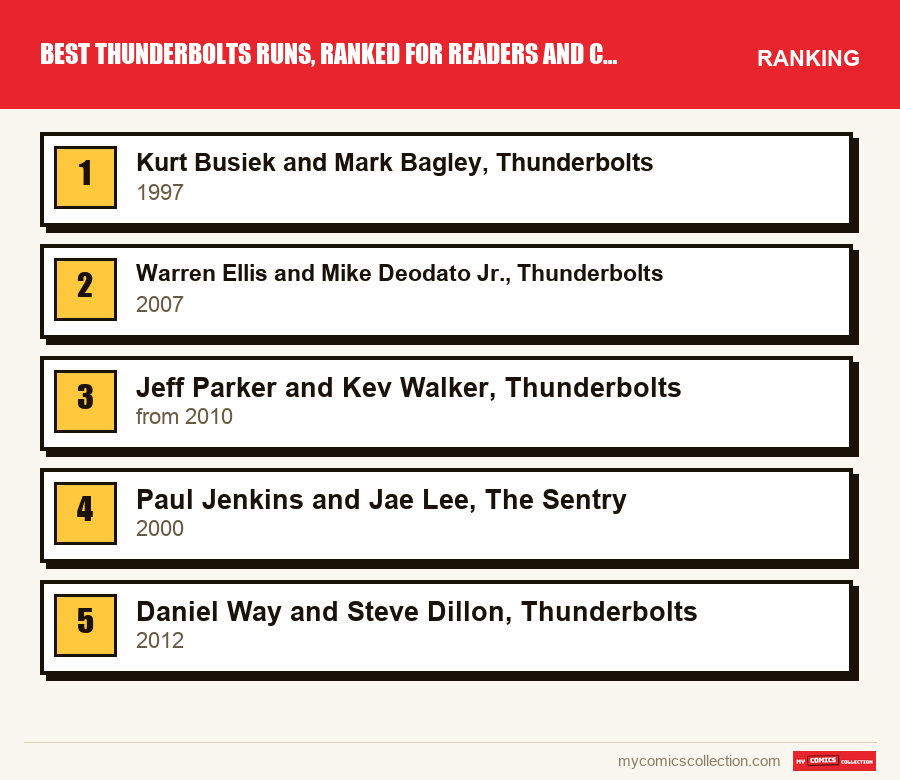
To read the Thunderbolts, start with the founding series by Kurt Busiek and Mark Bagley (1997), whose first issue hides a famous reversal. Next come the cynical version by Warren Ellis and Mike Deodato Jr. (2007), then the more whimsical one by Jeff Parker and Kev Walker (from 2010). Five readings appear here, including the miniseries The Sentry; each one indicates the format to aim for.
No Marvel team has changed its face as much as this one. The Avengers keep a recognizable core, the X-Men a mission, the Thunderbolts a single principle: bring together characters whose loyalty is doubtful and watch what that closeness does to them. Each writer answered in their own way, sometimes with redemption, sometimes with farce, sometimes with nightmare. Five readings deserve a rank, presented below with what each one demands of you.
As always on this guide, only verified information (creators, issue numbers, dates) is stated as fact; the analysis is our own, with no reproduction of protected art or dialogue.
How we ranked the teams
A team series is not judged by its fights but by what it does with a promise. For the Thunderbolts, the promise fits in one sentence: people who should not be there do something unexpected together. So in each period we looked for proof that a writer kept that promise with a fresh idea, and not by copying the previous one. Series too dependent on a crossover were left aside, as were miniseries where the team is only a backdrop.
This ranking judges the reading. The collecting side comes lower down, separately, because the most sought-after issue in this family belongs to a story everyone already knows by hearsay. A high rank means: if you could only open one, open that one.
Top 1: Kurt Busiek and Mark Bagley, Thunderbolts (1997)
The editorial context matters. At the end of 1996, Onslaught removes both the Avengers and the Fantastic Four from the main universe; their series pass into the hands of other teams, in a parallel world. The publisher thus leaves a void, and into that void, in spring 1997, steps a lineup of newcomers in gleaming costumes. They are called Citizen V, MACH-1, Techno, Atlas, Songbird and Meteorite, and their first issue, dated April 1997, ends on a last page the publisher had kept secret until it went on sale. We will not describe it here: it works better read for the first time.
What makes this series the best of the group is not the twist but what Kurt Busiek draws from it. Over dozens of issues, the story follows characters who play the role of heroes before public opinion and who, by repeating the gesture, discover they like the recognition. Some want to go further, others pull back, and the tension between those two impulses feeds the plot far more than any adversary. Songbird is the clearest example: her path, from comic-opera criminal to respected leader, remains one of the best character trajectories of the period. Mark Bagley draws the first issues with a scene clarity that makes each role instantly identifiable, which matters in a team of six masks.
There is no clean ending to point to, since Busiek builds over the long haul; the most coherent block is the first issues, starting from issue 1 and keeping in mind that the team's presentation plays out over a few episodes. As a preamble, Incredible Hulk #449 (January 1997, Peter David and Mike Deodato Jr.) shows the group for the first time, three months before its own series. No knowledge of the 1990s is needed to approach it. The opening collected edition carries the subtitle Justice, Like Lightning; the big bound volumes of the Busiek period also exist as omnibuses, which spares you from chasing a hundred single issues.
For the collector, two objects stand out: Hulk #449 for the real first appearance, Thunderbolts #1 for the series' starting point. To go deeper on that second issue, our file on the key Thunderbolts issues details what distinguishes a first printing from a reprinted copy.
Top 2: Warren Ellis and Mike Deodato Jr., Thunderbolts (2007)
Ten years after the group's birth, the series undergoes its biggest tonal break. The civil war between superheroes has just ended with a superpower registration law, and a government that wants to control what it does not understand needs a team tasked with hunting unregistered heroes. Warren Ellis takes over the series at issue 110 (2007) and reinvents it as a secret police. The lineup assembled is led by Norman Osborn, the former Green Goblin, and counts figures as disreputable as Venom, Bullseye, Moonstone, Penance, Radioactive Man and the Swordsman. The first two arcs, Faith in Monsters and then Caged Angels, cover about a dozen issues.
The strength of this reading is its economy. Warren Ellis does not explain; the pieces are simply placed. Each protagonist has a clear function, each scene advances a balance of power, and the black humor, far from lightening the whole, underlines the nature of what these characters are supposed to defend. Mike Deodato Jr. gives the whole a photographic texture, thick shadows, faces lit from the side, which suits an espionage story. The series does not try to move you: it shows what happens when national security becomes a trade.
This run is for the reader who already has an idea of the Marvel civil war context, or who agrees to rebuild it as they go. It reads better in two bound volumes than issue by issue, because the progression is that of a short novel more than a serial. On the single-issue side, the numbers in this block have the advantage of never having been hunted or speculated on: they are found without difficulty and make good ground for anyone who wants to complete the start of a series without aiming at the high end.
Top 3: Jeff Parker and Kev Walker, Thunderbolts (from 2010)
After the Osborn era and the big cleanup of the so-called heroic age, the team is taken over by Jeff Parker, whose approach turns it upside down. Luke Cage, a former Avenger, is given the mission of managing a group of inmates turned into field agents, and the premise becomes almost a workshop comedy: a boss who believes in second chances, teammates who never asked for theirs. The cast is deliberately odd, with Juggernaut, Man-Thing, Moonstone and Songbird. Kev Walker draws several arcs with a compact, very expressive line that makes this band of monsters in uniform believable.
This run serves as a perfect counterpoint to the previous two. Where Busiek played redemption and Ellis cynicism, Jeff Parker stages ordinary work: teaming up when you have nothing in common, accepting an everyday paycheck, learning to put up with one another. The result is often brilliant episodes that welcome science-fiction ideas without ever losing sight of each character. Luke Cage readers will find a mellowed yet still uncompromising version of the character; our analysis of Luke Cage, Hero for Hire #1 goes back to his origins to measure the distance.
It is for those who have read Busiek and want to see what the idea becomes under another gaze. The collected editions are enough to read everything. In single issues, the numbers in this block are easy to find, except those of a crossover: check that the volume covers the sequel you are aiming at.
Do you collect this series?
Track what you own, what you are missing and what your collection is worth. 7-day trial.
Start my trial →
Top 4: Paul Jenkins and Jae Lee, The Sentry (2000)
This is not a team series, and yet it is one of the best reasons to read today's Thunderbolts. Bob Reynolds, the Sentry, is born in September 2000 in a five-issue miniseries from the Marvel Knights imprint. The editorial staging plays on the rediscovery of a forgotten hero of the 1960s, as if the publisher had found a treasure in a cardboard box; the story itself is that of a man everyone has lost the memory of, and whose power comes with a shadow. Paul Jenkins writes a story of memory and shame, Jae Lee draws with stretched silhouettes and dense inking that turn each page into a painting.
If this title earns a rank, it is because it explains the character the 2025 film places at the center of the team. Reading it requires no prior knowledge, and its brevity makes it one of the easiest entries in this ranking. It is for those who prefer the dark tale to the battle of masks and who want to understand, before seeing the Sentry elsewhere, what he is made of. For the rest of his career, our file on the history of the Sentry takes over.
For collecting, the miniseries exists in five original single issues, in an elegant format, and in a collected edition. The first issue is the most coveted, and also the one whose versions multiply: beware of issues advertised as "special" without a clear indication of their origin, and prefer a copy whose cover, indicia and paper are consistent with a 2000 printing.
Top 5: Daniel Way and Steve Dillon, Thunderbolts (2012)
Launched in winter 2012-2013 as part of Marvel NOW!, this new series starts from scratch. Thaddeus Ross, now Red Hulk, leads a commando of antiheroes that includes the Punisher, Elektra, Deadpool and Venom, then embodied by Flash Thompson. The premise is that of an offbeat heist film: killers, an objective, a boss who does not mince words. Steve Dillon, artist of the first issues, brings a clean, highly narrative line, inherited from years of British comics.
This reading holds the last rank because it is the most uneven, not the least entertaining. The first arcs hold up through the mechanics and the pleasure of seeing characters associated with very different series cohabit; the rest drags. It is for the reader who knows the Punisher, Deadpool or Venom well and wants to see them somewhere other than in their own titles, or who is drawn to lighter team dynamics. The 2012 series runs about thirty issues, of which Daniel Way writes the first part before passing the baton; it reads in one go in collected editions; as single issues, the series is not sought after, and it is one of the blocks in this ranking where you can complete a collection without effort.
To extend toward the characters, see our pages on the best Punisher runs and on those of Venom, which usefully complement this reading.
Which one to start with, depending on your profile
If you are discovering the Thunderbolts after the 2025 film, the Busiek and Bagley series is the right door, because it contains the concept the film draws on. If you would rather go straight to the character who marked the film, open The Sentry, which reads in an afternoon and requires no prior knowledge. Readers coming from the Punisher or Venom will find what they want in Daniel Way's series, while those who enjoy espionage stories and politics will prefer Warren Ellis.
What these runs are worth in a collection
In this family, ratios matter more than figures. The 1997 first issue and the first appearance in Incredible Hulk #449 form the hard core: they concentrate the demand, and their gap with the rest of the series is wide. The following issues of the Busiek period are found at levels not comparable with that core, which makes the series easy to start from the middle. Always check, on a first-printing copy, the indicia inside the cover rather than relying on the look of the cover alone.
Three ratios serve as a compass for your budget: the single issue against the collected edition that reprints it, which tells you whether buying in volumes is economical; the average copy against the graded copy, which measures the condition premium; the same issue before and after the film, which isolates the share of the cinema effect. None of these ratios is stable, and recent series like Daniel Way's have no established market value: what will move them is the screen appearance of the characters in them and the lifespan of those characters' own titles. Work from completed sales rather than listings, and never subtract shipping and protection costs from your calculation.
Finally, remember that collected editions, omnibuses included, are often the best choice for reading a complete period: they cost less than the sum of the single issues, shelve better and leave money available for the two issues worth owning in their original form. The comparison bound albums vs single issues lays out the terms of this choice.
Frequently asked questions
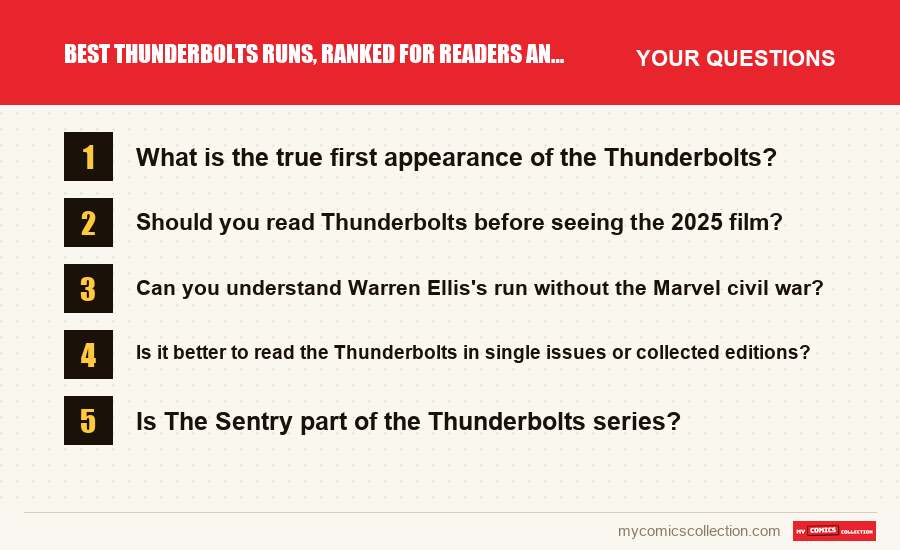
You have to go back to January 1997 and Incredible Hulk #449, written by Peter David with Mike Deodato Jr. on pencils. The regular series by Kurt Busiek and Mark Bagley only starts three months later, with Thunderbolts #1 dated April 1997, which nonetheless remains the reference issue.
No reading is required: the film builds its own group. The Busiek and Bagley series does supply the principle, however, and the Jenkins and Lee miniseries sheds light on Bob Reynolds, a central figure of the plot.
Yes, with a little patience. Warren Ellis sets up the context in a few pages: a superpower registration law, a team led by Norman Osborn tasked with hunting resistant heroes. The references to the civil war are backdrop, not required reading.
In collected editions for reading, in single issues for only a handful of landmarks: Incredible Hulk #449 and Thunderbolts #1. The omnibuses cover the Busiek period without chasing dozens of issues, and the Warren Ellis or Jeff Parker volumes are easy to find.
No, it is a five-issue miniseries, published in 2000 under the Marvel Knights imprint by Paul Jenkins and Jae Lee. It is tied to the team through the character, made central in the 2025 film, but reads entirely apart.
Do you own an Incredible Hulk #449 or a Thunderbolts #1? Have them estimated by first checking the printing and the condition of the copy.
Estimate my comic