
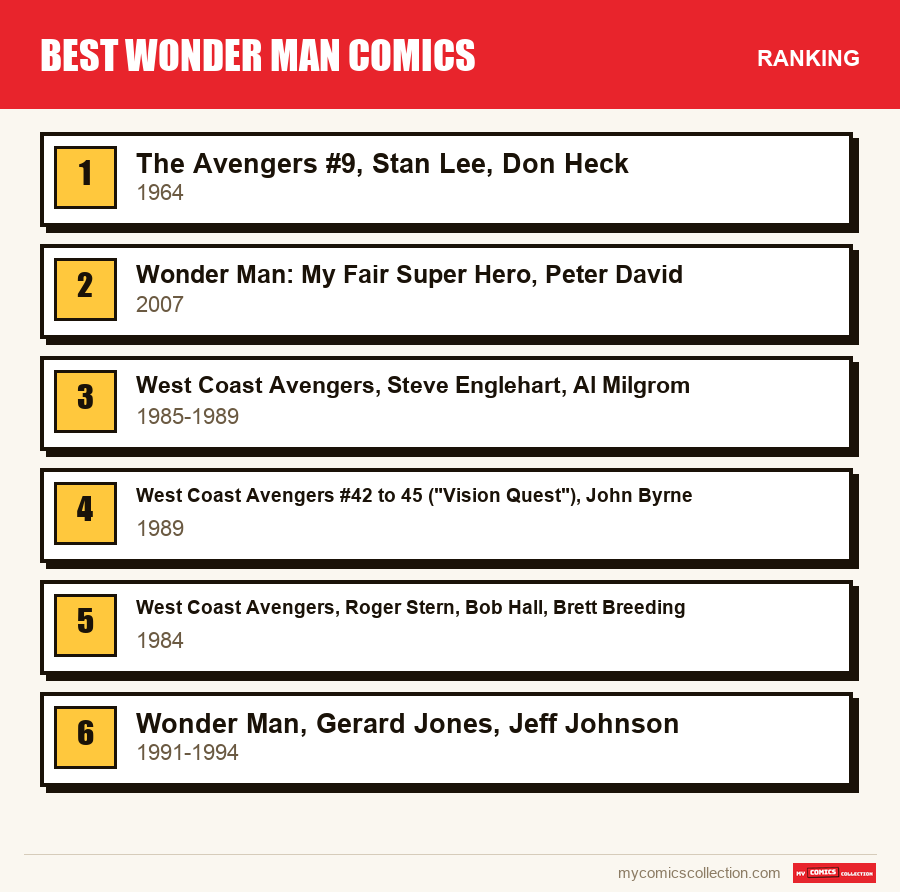
To find the best Wonder Man comics and know where to start, begin with The Avengers #9 (October 1964), by Stan Lee and Don Heck, where Simon Williams is born and dies in the same issue. Continue with Peter David's miniseries Wonder Man: My Fair Super Hero (2007), then with West Coast Avengers (1985-1989) by Steve Englehart and Al Milgrom and John Byrne's "Vision Quest" arc (1989). His first appearance is The Avengers #9, cover-dated October 1964.
Wonder Man is a special case: a hero the regular series long treated as a supporting player, so his best pages are found in team books, alongside a friend, a rival, or a double. Yet the character has a backbone of his own, that of a man who betrayed and then atoned, and whose mind served as the template for another. This selection picks six reads, tells you for each where he stands, and keeps you from paying for an issue where he only crosses a panel.
As always in this guide, only verified facts (creators, issue numbers, dates) are stated as fact; the analysis is our own, with no reproduction of artwork or protected dialogue.
His first appearance
Simon Williams's story opens with The Avengers #9, dated October 1964: Stan Lee on script, Don Heck on pencils. He is a struggling businessman, recruited by Baron Zemo and the Masters of Evil, who give him ionic energy powers so he can infiltrate the Avengers and destroy them from within. But at the decisive moment, he refuses to betray the team that took him in, and he dies a hero.
Birth and death coincide in this single issue, and it marks the hero: every later return leads back to that last-minute choice. Our page on Silver Age Avengers key issues places issue #9 among the other first appearances of the period.
The rest of his career comes down to a few milestones: the dead man's mind serves as the basis for the Vision's brain patterns, he is revived in 1975 by Kang in issues 131 and 132, returns as a zombie in 1976 in issues 151 to 153, and joins the team full time with issue 160 of June 1977.
1: The Avengers #9, Stan Lee, Don Heck (1964)
A single issue, but a complete Wonder Man story. Stan Lee writes, Don Heck draws. Simon Williams accepts Baron Zemo's bargain, receives his powers, turns against the Avengers, then backs out at the price of his life.
What this issue brings: the dilemma that will define the character. Wonder Man is a man who wanted money and glory, who betrayed, and who then redeemed himself. The rest of his path, with the Avengers as with the Vision, returns to that tension.
Who it's for: every reader, since it demands no prior knowledge. How to read it: as a period single issue if your budget allows, otherwise in a collected edition of the early Avengers. The Stan Lee profile rounds out the picture for anyone who wants to follow the writer.
2: Wonder Man: My Fair Super Hero, Peter David (2007)
Five issues, dated February to June 2007 and gathered in a collected edition of the same name. Peter David writes the series, and Andrew Currie draws it. Here, no other team hero competes with Simon Williams for the spotlight.
What this series brings: a complete five-issue story that carries the hero's name and gives him the room that team books don't always grant. It is the read to favor if you want to judge Simon Williams on his own terms rather than through others.
It is for anyone who wants a self-contained story without diving into the 1960s. How to read it: on its own, with no prerequisite other than knowing the character. Our page on Peter David places the writer within the rest of his work, and the writer's profile gathers his releases.
3: West Coast Avengers, Steve Englehart, Al Milgrom (1985-1989)
The ongoing series launched in October 1985 runs one hundred two issues, until January 1994. Steve Englehart writes its first cycle, from 1985 to 1988, and Al Milgrom draws most of it, with Joe Sinnott on inks. Wonder Man is among the original members, recruited by Hawkeye: it is a team role, not that of a central hero, and we say so openly here.
What this series brings: the period when Simon Williams operates in a team based in Los Angeles, far from the Avengers' New York base, alongside those who recruited him. Who it's for: the reader who likes teams whose members know each other well and bicker. How to read it: in collected editions, in order, starting from issue #1 of the 1985 series, after the 1984 miniseries (see below).
To place these issues in the history of the West Coast, the page on West Coast Avengers key issues gives the milestones, and the Hawkeye page shows what the team leader gained from it.
4: West Coast Avengers #42 to 45 ("Vision Quest"), John Byrne (1989)
John Byrne writes and draws these four issues, and he held both the script and the pencils of the series from issue 42 to issue 57. The arc dismantles the Vision on government orders; Hank Pym rebuilds him, chalk white and without the feelings inherited from Wonder Man's patterns.
Simon Williams's role is decisive without being central: he refuses to let his brain patterns be used again to give the Vision his emotional matrix, and it is that refusal which leaves him without emotion. A useful read for anyone interested in the link between the two men, one having supplied the other's mind. How to read it: after the 1985 series, or separately, in a collected edition.
The arc is worth reading for the moral tension Byrne puts into it, and it seemed fairer to rank it fourth, after the reads where Wonder Man is the subject. For the rest of the creator's work, see the John Byrne profile and his where to start page.
Do you collect this series?
Track what you own, what you are missing and what your collection is worth. 7-day trial.
Start my trial →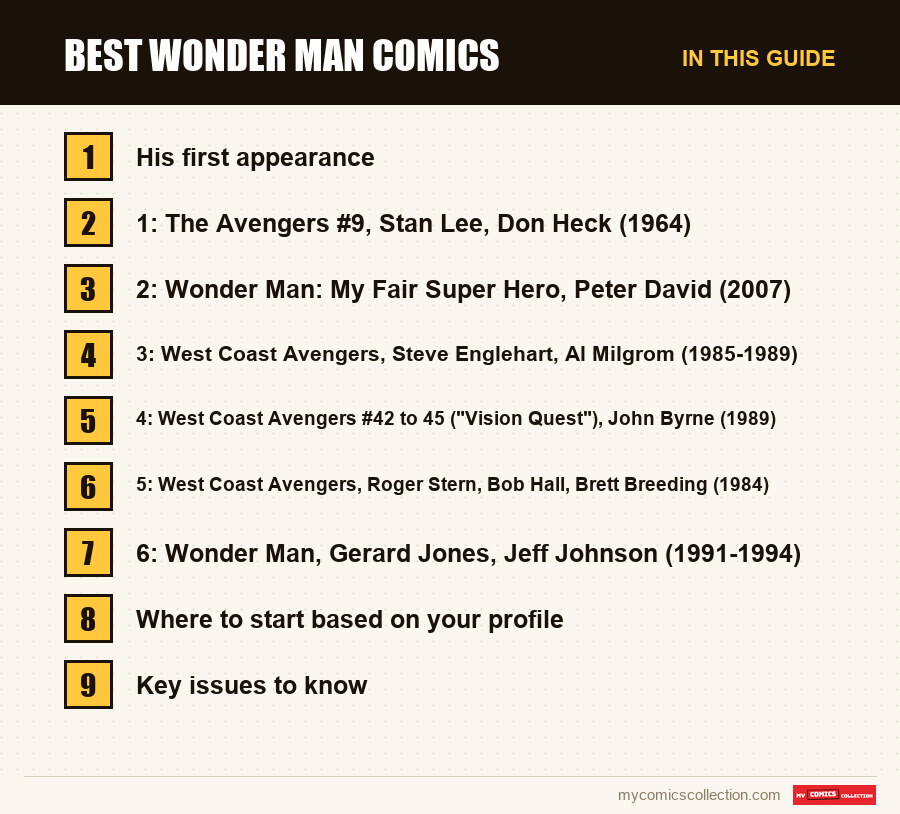
5: West Coast Avengers, Roger Stern, Bob Hall, Brett Breeding (1984)
Four issues, from September to December 1984, written by Roger Stern, with Bob Hall and Brett Breeding on art. The miniseries launches the West Coast: Hawkeye is given the job of founding a team on the other side of the country, and recruits its members himself, Wonder Man among them. He is a founding member here, not the hero.
What this series brings: the founding scene of a group Simon Williams will stay tied to for years. It will appeal to those who like a team's beginnings more than its peak. How to read it: before the 1985 series, as a single block of four issues. The Roger Stern profile gathers his other work for Marvel.
6: Wonder Man, Gerard Jones, Jeff Johnson (1991-1994)
Twenty-nine issues, from September 1991 to February 1994: the first ongoing series to carry Simon Williams's name. Gerard Jones writes all of it, and Jeff Johnson handles most of the art on the first twenty-five issues, a few fill-in episodes aside. Issues 7 to 9 tie into the Operation: Galactic Storm crossover, and a few others cross with the Infinity War event.
What this series brings: a hero finally alone at the center of every issue, away from the machinery of a team where he has to share space. Who it's for: 1990s readers and completists who want the character's whole path. How to read it: mostly in single issues, since only some of the issues were collected, in the volumes devoted to the two crossovers.
The series ends just before Force Works (July 1994), whose original team includes Wonder Man: he is disintegrated on the very first mission, in issue 1, and returns only in ionic form in 1998. That issue therefore interests the character's collector more than the reader looking for a story about him.
Where to start based on your profile
You want to understand the character in one evening: read The Avengers #9, then Wonder Man: My Fair Super Hero. You like easygoing teams: open West Coast Avengers (1984), then the 1985 series. You come from the Vision and want the flip side of his story: "Vision Quest" is the must-read. You follow the character through the 1990s: open the Wonder Man series launched in September 1991, whose issues 7 to 9 are part of Operation: Galactic Storm, then the first issue of Force Works.
If you collect the original single issues, the order of the hunt is the order of difficulty: the 1960s and 1970s issues are scarce and pricey in good condition, while the 1980s and 1990s ones are more accessible. If you prefer collected editions, the Wonder Man: The Early Years Omnibus, released in December 2023, gathers the early Avengers issues where he appears, including 9, 131 and 132, 151 to 153, and 160; the 2007 series has its own collected edition. The Avengers hub remains the place to set each of these titles against the parent series.
Key issues to know
The list remains a way to find your bearings and mentions no price. Before valuing a copy, use only completed sales of the same issue in comparable grade; a listing that doesn't state the edition proves nothing.
- The Avengers #9 (October 1964): first appearance of Simon Williams, by Stan Lee and Don Heck.
- The Avengers #131 and 132 (January and February 1975): he is revived by Kang.
- The Avengers #151 to 153 (September to November 1976): he returns as a zombie, under the hold of Black Talon and the Grim Reaper.
- The Avengers #160 (June 1977): he joins the team full time.
- West Coast Avengers #1 (September 1984): founding of the West Coast team, by Roger Stern, Bob Hall, and Brett Breeding.
- West Coast Avengers #42 to 45 (1989): "Vision Quest," by John Byrne.
- Wonder Man #1 (September 1991): start of the 29-issue series by Gerard Jones and Jeff Johnson, which runs until February 1994.
- Force Works #1 (July 1994): launch of the series by Dan Abnett and Andy Lanning, where Wonder Man is disintegrated on the first mission.
- Avengers volume 3, #10 and 11 (November and December 1998): the character's full return after his ionic form.
- Wonder Man volume 3, #1 (February 2007): My Fair Super Hero, by Peter David.
Almost all of these milestones predate the Disney+ Wonder Man television series, created by Destin Daniel Cretton and Andrew Guest. An adaptation lifts interest in older issues, but a single issue's scarcity doesn't depend on it: judge each copy by its condition and edition.
Frequently asked questions
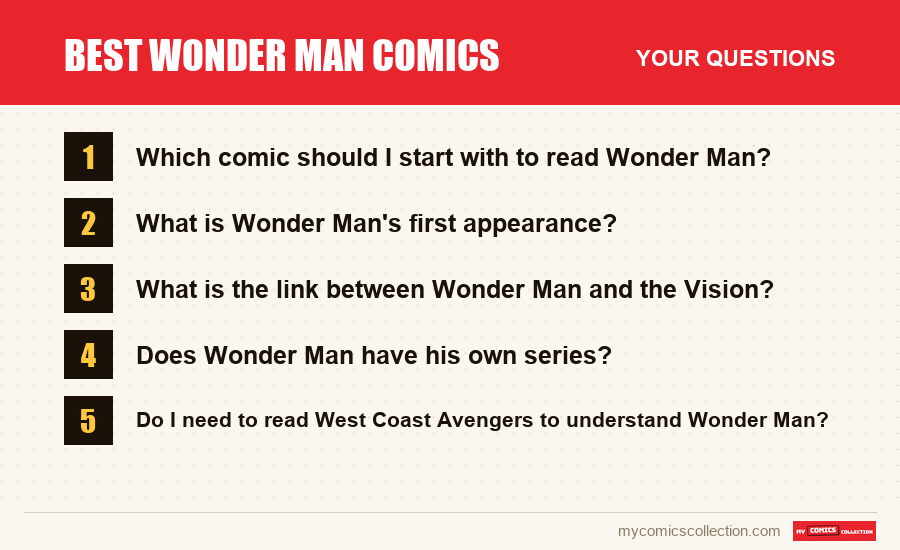
Start with The Avengers #9 (October 1964), by Stan Lee and Don Heck, which tells the birth and death of Simon Williams in a single issue. Follow with Peter David's miniseries Wonder Man: My Fair Super Hero (2007), which puts the character front and center without requiring prior knowledge.
The character is born in The Avengers #9 (October 1964), script by Stan Lee, art by Don Heck. Recruited by Baron Zemo and the Masters of Evil, he ultimately refuses to betray the Avengers and dies in that same issue. He will return later, in issues 131 and 132 of 1975.
The Vision's mind is built on Simon Williams's brain patterns. In John Byrne's run (West Coast Avengers #42 to 45, 1989), Simon Williams opposes any new copy of his mind for the Vision, and the Vision comes back stripped of feelings.
Yes, more than once: a 29-issue series launched in September 1991 and ended in February 1994, written by Gerard Jones and mostly drawn by Jeff Johnson, then the five-issue miniseries Wonder Man: My Fair Super Hero, starting in February 2007. The second, written by Peter David, is easier to read today.
Not to understand him, but to see him living as part of a team. Roger Stern's 1984 miniseries, then Steve Englehart and Al Milgrom's 1985 series, show him among the original members of the West Coast team, in everyday life rather than in the thick of battle.
Do you own a copy of Avengers #9 or an issue of West Coast Avengers? Get it appraised before you sell or insure it.
Appraise my comic