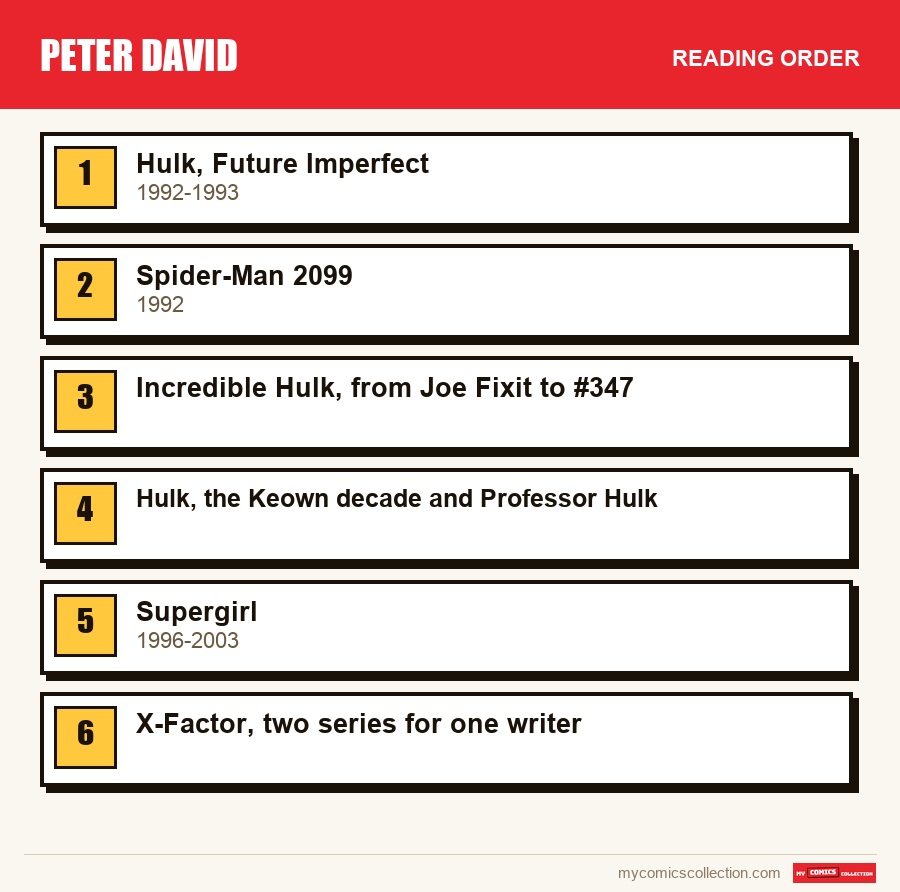
To read Peter David, open the miniseries Hulk: Future Imperfect (1992-1993) first, since it stands alone, then the 1992 Spider-Man 2099. Continue with Incredible Hulk from #331, with the 1996 Supergirl and finally with X-Factor. Six steps, from a closed story in two issues to series of more than seventy issues.
Peter David has written for almost every American publisher, but the reading comes down to a handful of titles: a long Hulk series, a futuristic launch, a rebuilt heroine and two versions of a mutant team. Rather than a career narrative, here are entry points arranged by the reading effort they demand.
As always in this guide, only verified information (creators, issue numbers, dates) is stated as fact; the analysis is ours, with no reproduction of protected pages or dialogue.
Why a six-step path
The difficulty with Peter David is scatter. A reader who types the name finds, all jumbled together, a Marvel series of more than one hundred thirty issues, a DC series of eighty, miniseries, tie-in novels from television licenses and independent comics. Each set has its own barrier to entry, and it is the barrier, not the quality, that serves here as the sorting criterion.
The order chosen therefore starts with what can be read in an afternoon, moves through series where each arc stands on its own, and ends with the sets that must be read in one go to feel their effect. To place the writer within the history of the character most tied to this name, lean on the ranking of the best Hulk runs, where this stretch is placed at the top.
Step 1: Hulk, Future Imperfect (1992-1993)
Two issues, a first-rate artist in the person of George Pérez, one closed story. Banner is thrown into a distant future ruled by the Maestro, a Hulk turned tyrant, and comes face to face with the darkest version of his own anger. The miniseries requires no prior knowledge: the setting is laid out from the first pages and the progression follows a simple logic, from which the final issue draws a clear conclusion.
It is the best introduction to David's method: take a character known for brute strength and make him talk about what he fears. If these two issues do not speak to you, there is no point investing in the regular series. If they hook you, you already know what tone awaits. The Maestro has since become a recurring adversary of the character, which gives this story landmark value in collector discussions.
Recommended format: a collected edition reprinting the two issues, or the single issues if you come across them at a reasonable price. The choice is risk-free, since the miniseries has been reprinted many times.
Step 2: Spider-Man 2099 (1992)
The series was born on September 1, 1992 under David's pen, with Rick Leonardi on art. Miguel O'Hara, a geneticist at Alchemax, becomes a vigilante in a city where large corporations stand in for government. The setting borrows from noir and speculative fiction, and the first issues lay everything out without requiring knowledge of Spider-Man.
For a David reader, the interest is seeing the same taste for heroes ill at ease in their situation applied to a new universe, with no legacy to manage. It is also a series where the writer builds an entire world alone, with Leonardi, which is a change from taking over a thirty-year-old title. The details of the issues, the 2014 and 2015 relaunches and the follow-ups are in the Spider-Man 2099 runs ranking.
Recommended format: the 1992 single issues are plentiful and pose no collecting difficulty for the first numbers. A collected edition remains the most economical way to read the rest of the early arcs.
Step 3: Incredible Hulk, from Joe Fixit to #347
David's Hulk run starts at #331, in 1987, and runs to #467 in 1998, which makes one hundred thirty-seven issues. Do not take it from the beginning: enter through the issues drawn by Todd McFarlane, including #340 which pits Hulk against Wolverine, then #347 which sets up Joe Fixit, the grey version of the character, as enforcer for a Las Vegas casino. The tone is more ironic than what you expect from a green monster.
These issues have a logic of investigation and black comedy that makes them readable without having followed the rest. The issue with the Wolverine clash has its own article, Incredible Hulk #340, which details editions and buying pitfalls. To measure what sets this period apart from earlier ones, read alongside it the overview of artists in the major Hulk artists.
Recommended format: collected editions that gather these issues in order. The McFarlane single issues are sought after and call for comparing several listings before buying.
Step 4: Hulk, the Keown decade and Professor Hulk
When Dale Keown takes over the art around #367, the series changes look: bodies are more massive, faces more mobile, and the plot pushes further its theme of Banner's dissociation. Issue #377 presents the merging of the personalities, often called Professor Hulk, while #418 remains cited for a grave episode devoted to the death of a supporting character. The subjects are hard, handled without caricature.
This step is more demanding than the previous one, because the effect builds over several years of continuity: the episodes of a single arc answer each other twenty issues apart. To find your way without leafing through the whole series, the Hulk reading guide offers milestones. Read #377 and its immediate neighbors first, then go back over what precedes if the psychology holds you.
Recommended format: collected editions in publication order, because the series has no obvious entry point in the middle and the cost of a complete single-issue collection bears no relation to the cost of reading it.
Do you collect this series?
Track what you own, what you're missing and what your collection is worth. 7-day trial.
Start my trial →
Step 5: Supergirl (1996-2003)
After Hulk, this DC title shows another facet. The 1996 series takes the Supergirl name for an artificial creature called Matrix who merges with Linda Danvers, a young woman in distress. David writes most of the eighty issues, with Gary Frank at the start and then Leonard Kirk over the long haul. The register mixes fantasy, teen drama and religious questions, which is surprising from a superhero publisher.
It comes here because it demands patience: the story moves in seasons, with recurring villains and rebounds. But the first cycle reads fairly well on its own, and many readers stop there. The question of the different Supergirls, which explains the presence of Matrix, is covered in the Supergirl reading guide.
Recommended format: single issues are common and inexpensive; buying one at a time suits you if you are testing the series, and collected editions exist for the first arcs.
Step 6: X-Factor, two series for one writer
The last step covers the X-Factor work. The first series, in which David writes from #70 to #89, from 1991 to 1993, follows a team of mutants employed by the American government, with tense relationships. The second, launched in 2005, centers on Jamie Madrox, the Multiple Man, turned private detective, surrounded by Layla Miller, Monet, Siryn, Rictor and Strong Guy. Both are long and require knowing the other mutant titles.
The tone is happily sardonic, with investigation plots that stretch over several issues. This step is not for beginners: it assumes you like teams, branching storylines and revivals of characters from other series. Without a mutant background, the 2005 relaunch is the more approachable of the two, so it is the first to open here.
Recommended format: collected editions of the 2005 series exist in good number; for single issues, favor the opening issues of each series and complete from there.
Three markers to avoid picking the wrong volume
The first has to do with numbering: David's Hulk series carries the Incredible Hulk label, but the series has been renumbered several times since, and a modern collected edition under a similar title can point to a different period. Always check the issues contained, which should start at #331 for the beginning of the period. The second concerns Spider-Man 2099, whose 2014 and 2015 relaunches, drawn by Will Sliney, do not make the same read as the 1992 series, even though the writer is the same.
The third marker concerns X-Factor: two series carry this title under David's pen, separated by several years, with different teams. If a listing says only X-Factor and a number, compare the cover and the publication date before paying. The most frequent mix-ups come from issues that are very close in form but not in content, and they mostly cost time for anyone building a want list.
How to read: single issues or collected editions
For reading, favor collected editions: since David's series are long, a volume gathering six to twelve issues keeps you from losing the thread. For collecting, two approaches compete. The first is to acquire the entry issues of each step: Future Imperfect, Spider-Man 2099 #1, Incredible Hulk #340 and #347. The second aims at the complete series, which only makes sense if you have already read the whole thing.
Off the path, several titles deserve a look if the writer hooks you: Young Justice at DC, with Todd Nauck, dating from 1998, and the 1994 Aquaman series, which you can find on the Aquaman hub. They are not among the six steps because they speak to a reader who is already won over. The novel Imzadi, published in 1992 around Star Trek: The Next Generation, belongs to another register, but it confirms that David's writing does not depend on one publisher.
A point on checking editions: the numberings of Hulk and X-Factor have been reprised in collected editions under different titles depending on the publishers and years. Before buying a volume, look at the list of issues contained, not just the cover title. And if a listing mentions a first printing, ask for a photo of the back and the barcode.
Recap: the recommended order
- Hulk: Future Imperfect (1992-1993), two issues with George Pérez.
- Spider-Man 2099 (1992), with Rick Leonardi, starting at #1.
- Incredible Hulk, from Todd McFarlane to Joe Fixit's #347.
- Incredible Hulk, the Dale Keown period, with #377 as the milestone.
- Supergirl (1996-2003), stopping at the first cycle if the tone suits you.
- X-Factor, the 2005 series first, the 1991 one afterward.
Frequently asked questions
Start with Hulk: Future Imperfect, two issues published in 1992 and 1993, drawn by George Pérez. The story is closed, requires no prior reading, and shows in a few pages David's way of making Banner's anger speak rather than just illustrating it.
No. The series is one hundred thirty-seven issues long and most readers stick to milestones: #340 with McFarlane, #347 for Joe Fixit, #377 for the merging of the personalities. One collected edition per period is enough to decide whether the rest is worth the time.
Yes, for the most part. The 1996 series introduces Matrix and Linda Danvers in its first issues, with Gary Frank on art, and its fantasy tone keeps it away from the Metropolis plots. A few references exist, but they do not get in the way of understanding the first cycle.
The 2005 relaunch, centered on Jamie Madrox and his investigation agency. It reintroduces its characters with enough distance to be understood without background. The series launched at #71 in 1991 reads well only with a good grasp of the 1990s mutant universe.
Collected editions for reading, because the series are long and a volume gathers several issues in order. Original single issues make sense for entry issues like Spider-Man 2099 #1 or Incredible Hulk #340, and for short series you want to own in full.
Do you own an Incredible Hulk from the McFarlane period or a Spider-Man 2099 #1? Have it estimated before choosing your next Peter David read.
Estimate my comic