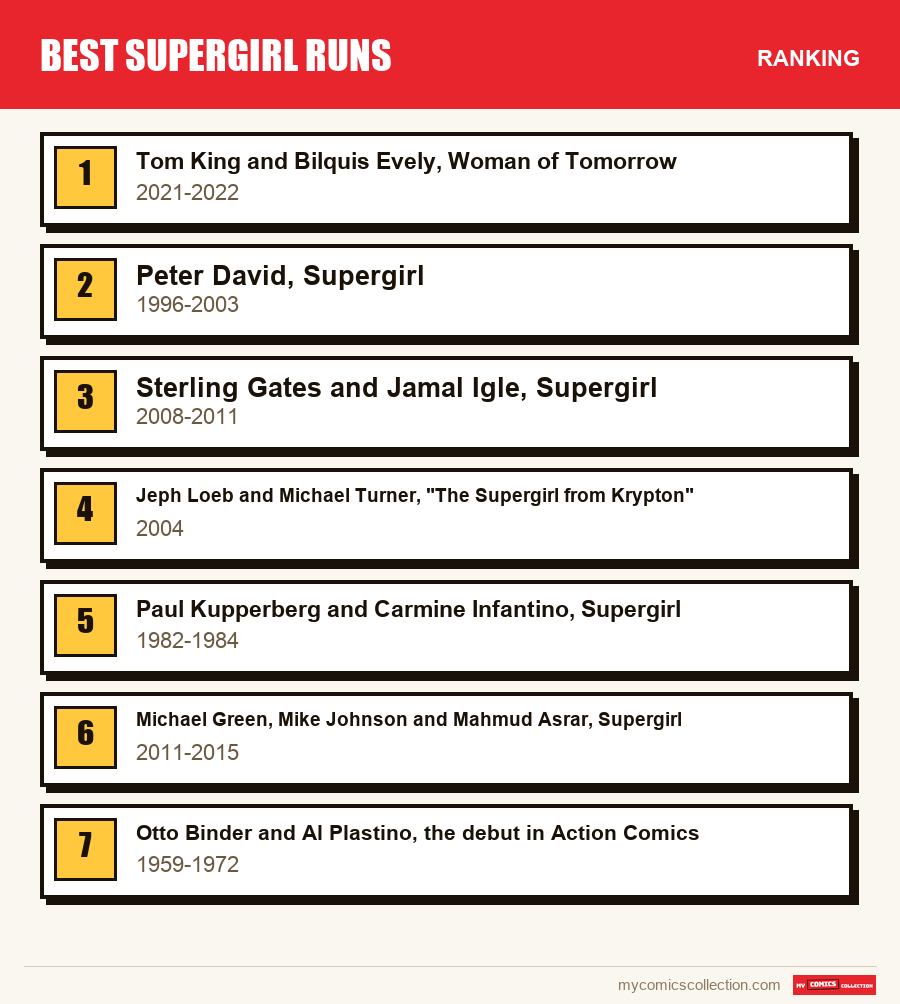
At the top of the ranking, the miniseries Woman of Tomorrow, by Tom King and Bilquis Evely in 2021 and 2022. It comes ahead of Peter David's series (1996-2003), then the work of Sterling Gates and Jamal Igle between 2008 and 2011. This ranking keeps seven sets, from the Action Comics stories of 1959 to the 2011 Supergirl, with the level of continuity expected for each and the format to favor.
Kara Zor-El has been through more reboots than almost any other DC heroine. Her death in Crisis on Infinite Earths, an absence of nearly twenty years, stand-ins, a return in 2004: each era built its own version, and each version had its writers. Our reading guide orders this path for discovering her; this article ranks, because not all these versions are equal.
As always in this guide, we only state verified information (creators, issues, dates); the analysis is our own, with no reproduction of protected pages or dialogue.
How we rank Kara
Supergirl has rarely kept the same title for long, so a "run" here means very uneven periods: three years for one series, forty issues for another, eight chapters for a miniseries. We therefore set length aside and kept three markers. The first is voice: does Kara speak like a character, or like an accessory to Superman? The second is autonomy, meaning whether you can read the whole without having opened another title of the El family. The third is legacy, that is, what later writers borrowed.
The rank does not measure market value. The most sought-after issue, Action Comics #252, opens a set ranked last, because it belongs to archaeology and not to sustained reading.
Top 1: Tom King and Bilquis Evely, Woman of Tomorrow (2021-2022)
Eight issues, one closed story. Kara travels far from Earth in the company of Ruthye, a teenager whose father was killed and who wants to find the murderer. Tom King writes the chase as a space western, in which the girl sees Kara as an ally of circumstance before recognizing something else in her. Bilquis Evely draws worlds that are either scorched or set with light, and Matheus Lopes colors them with a boldness that was enough to get the book talked about beyond the circle of DC readers.
Why first place? Because the book takes a rare stance: Kara is the survivor of a world that no longer exists, and the story makes her a subject rather than a backdrop. It requires no prior Superman reading. Whom to recommend it to? Everyone, but first of all someone who has not yet read a single episode of Kara. The details of the writer's bibliography are in our article on Tom King, where to start.
For the collection, the series is too recent to have settled pricing: see the section on value below. In French, the DC edition comes through Urban Comics, and a single collected volume is enough to read the whole.
Top 2: Peter David, Supergirl (1996-2003)
Eighty issues, the longest title devoted to the heroine. Peter David takes the Supergirl name for a protoplasmic entity named Matrix, who merges with Linda Danvers, a young Earth woman in danger, and the story makes of this an "earth-born angel." Gary Frank draws the beginnings, and Leonard Kirk takes over for the long haul. The whole takes on a fantastical and spiritual turn that DC rarely attempted with its heroines.
This run matters because it held the ground during the years when the real Kara Zor-El no longer existed: without it, there would be no bridge between the death of 1985 and the return of 2004. It suits readers who like long-running series and accept that they drift away from the original character. The original issues are accessible and cheap individually; the collected editions do not necessarily cover every arc, so check the contents before buying.
Top 3: Sterling Gates and Jamal Igle, Supergirl (2008-2011)
The most consistent of the runs devoted to the modern Kara. Sterling Gates takes over the series launched in 2005 at issue 34 and moves it forward alongside the New Krypton saga, in which Kara finds her surviving parents. The arcs "Who is Superwoman?" and "Bizarrogirl" set up the rhythm of a classic superheroine series, with a Kara ill at ease in her role, a family that protects her and a city that accepts her grudgingly. Jamal Igle draws a Supergirl whose costume and bearing are more sober than those of the Turner years.
The run matters because it finally gives the Kara of 2004 a character: it corrects Jeph Loeb's version without disowning it. It assumes you have read at least the Superman: Brainiac arc, which precedes New Krypton. Issues from the period are still affordable; the collected editions gather the arcs in order. This is the run to recommend to someone who wants the "ongoing series" Kara rather than the "book" Kara.
Top 4: Jeph Loeb and Michael Turner, "The Supergirl from Krypton" (2004)
A six-issue arc in Superman/Batman, from #8 to #13, in which Superman and Batman discover a young woman who has fallen to Earth with a fragment of kryptonite. She claims to be Kal-El's cousin; the story examines that claim before confirming it. Michael Turner draws; a very recognizable line gives Kara a short costume that will later be debated, reused, then dropped.
The arc is the modern pivot of the lineage: every Kara that follows flows from it. It sits in fourth place here because it is a starting point rather than an achievement, and because Kara shares the billing with the two other heroes. It suits the reader who wants to understand where the current version starts from; a single collected edition is enough. In single issues, the modern Kara arrives in Superman/Batman #8, the first episode of the arc; rather than an isolated piece, prefer the complete run from #8 to #13.
Do you collect this series?
Track what you own, what you're missing and what your collection is worth. 7-day trial.
Start my trial →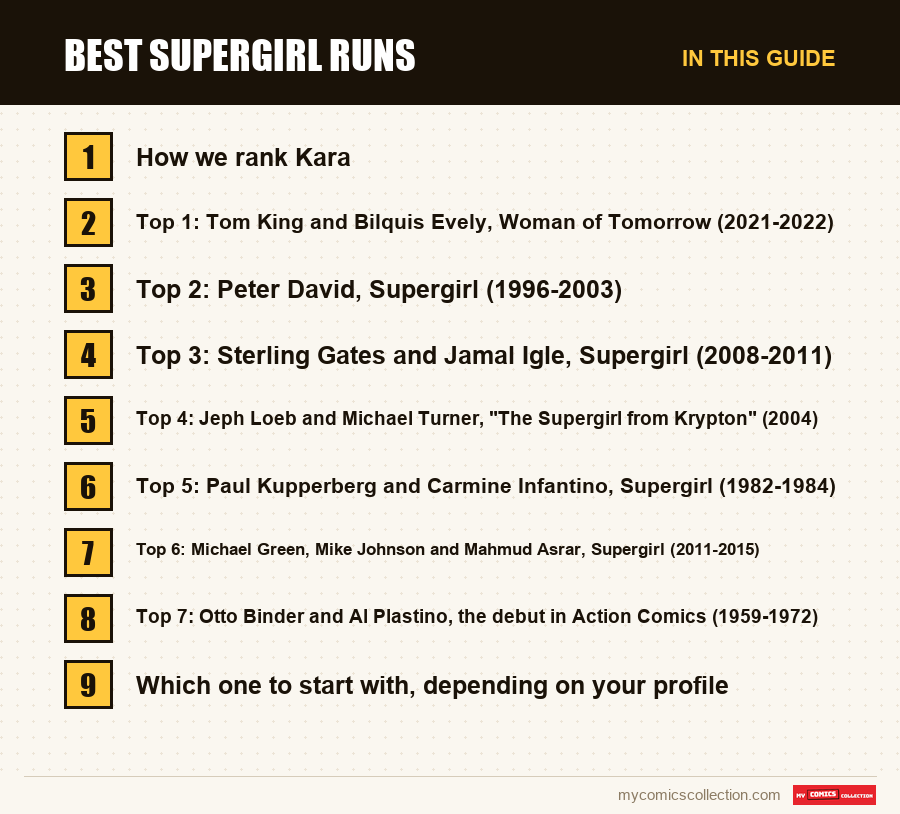
Top 5: Paul Kupperberg and Carmine Infantino, Supergirl (1982-1984)
Twenty-three issues in all: the title begins as The Daring New Adventures of Supergirl and then drops its preamble along the way. Linda Danvers pursues her studies at Lake Shore University; Paul Kupperberg writes a student heroine who changes settings, jobs and friends, and Carmine Infantino draws an elegant, slightly stiff line. The series stops before Crisis on Infinite Earths, but it gives the last portrait of the Kara of the previous era.
The run is nothing like a work on the scale of King or David, but it offers the best picture of the heroine before the death of 1985. It suits anyone who wants to understand what DC erased. The issues are scarce in modern points of sale, but prices remain contained; to go deeper into the sacrifice that closes this era, read our piece on Crisis on Infinite Earths #7.
Top 6: Michael Green, Mike Johnson and Mahmud Asrar, Supergirl (2011-2015)
Forty issues that came out of the 2011 reboot. Kara lands there without understanding where she is, without knowing whether she should believe what she is told, and her anger runs through a long stretch with the Red Lanterns. Michael Green and Mike Johnson write the first part, and Mahmud Asrar draws the beginnings with a precise, lively line that serves action scenes and silences alike.
The run is darker than the Kryptonian tradition and divides readers, which explains its sixth rank. It matters because it pushes the theme of grief to the extreme, a theme that feeds the following versions. We recommend it to anyone who appreciates angry heroines. The issues are abundant and cheap; an opening collected edition lets you judge the tone before committing.
Top 7: Otto Binder and Al Plastino, the debut in Action Comics (1959-1972)
Action Comics #252 (May 1959) introduces Kara, created by Otto Binder and drawn by Al Plastino at the request of editor Mort Weisinger. She arrives from Argo City, a fragment of Krypton that was spared, and joins her cousin Superman, who keeps her hidden. The stories that follow first appear as backups in Action Comics, then in Adventure Comics, where Kara takes the lead starting with #381 (1969) through #424 (1972), before her first title in November 1972.
This first set closes the ranking because the storytelling of the period, made of Kryptonian gadgets and time travel, has aged and now speaks only to the curious. It keeps its historical weight all the same: the double identity, the younger cousin kept secret and Kara's place in the Legion of Super-Heroes are born here. If you are aiming for the source, see our piece on Action Comics #252, Supergirl's first appearance.
Which one to start with, depending on your profile
For a first contact, Top 1 is the obvious choice: it is bought in a single volume and read in one evening. If you want an ordinary high schooler, Being Super (Mariko Tamaki, art by Joëlle Jones) fits, but this standalone story falls outside the frame of a run and so stays out of the ranking. For a child, the middle school story of Cosmic Adventures in the 8th Grade, by Landry Q. Walker and Eric Jones, does the job.
The long-haul reader will take the David route, then Gates and Igle, with New Krypton in the background. The completist will follow the ranking in reverse, from 1959 to 2011, to see how each era took up the previous one. Our reading guide arranges these itineraries in steps; this ranking is for choosing, not for ordering.
What these runs are worth as collectibles
Supergirl sets fall into three families of collectors. The archaeologists look for the issues from 1959 to 1972, scarce in high grade, whose value is judged one issue at a time. The series readers look for the 1982, 1996 and 2008 runs, which you complete in lots at a modest completion cost. The fans of modernity follow King's miniseries and the first appearances of the 2004 Kara.
To price a piece, note completed sales for the same edition and the same condition, without mixing main covers and variant covers. On a graded copy, the label's annotations count as much as the numeric grade. Between the pivotal issues and the ordinary issues of the same series, the price gap shows the extent of the demand, and it is the one to watch before starting a complete run.
Woman of Tomorrow has no settled pricing. What will move it comes down to how long the series stays in publishers' catalogs, successive printings, the attention the character draws on screen, and the place of variant covers, which we do not put figures on for lack of stable data. The collected edition is a reading book, whose value depends above all on condition and edition; the page of Supergirl key issues sums up the markers to know.

Frequently asked questions
It is Woman of Tomorrow: Tom King writing, Bilquis Evely drawing, eight issues published in 2021 and 2022. It is a complete story, readable without knowing Superman. It comes ahead of Peter David's series, which is longer, and of the Sterling Gates and Jamal Igle period, which is more classic.
No. Kara's sacrifice, in the seventh chapter of Crisis on Infinite Earths in October 1985, explains her absence, but the modern runs read without it. It mostly serves the reader curious about the mythology, or someone hunting the issue for a collection.
After 1985, DC left the name free and gave it to other characters: Peter David's Matrix version, notably, who merges with Linda Danvers. The real Kara Zor-El returns in 2004 in Superman/Batman, under Jeph Loeb's pen. Each set corresponds to one of these stages.
The series from 2005 to 2011 and from 2011 to 2015 are abundant and cheap individually, as is Peter David's run. Issues from 1959 to 1972 are scarcer and are negotiated copy by copy, depending on condition. For reading, a collected edition is enough in every case.
On the French side, DC is published by Urban Comics, most often in hardcover volumes. Before buying, check the publisher's catalog for the exact volume and its date, because release announcements change.
Own an Action Comics issue from the early 1960s, a Peter David Supergirl or a 2004 Superman/Batman? Have its condition and its place in the market estimated.
Estimate my comic