In short
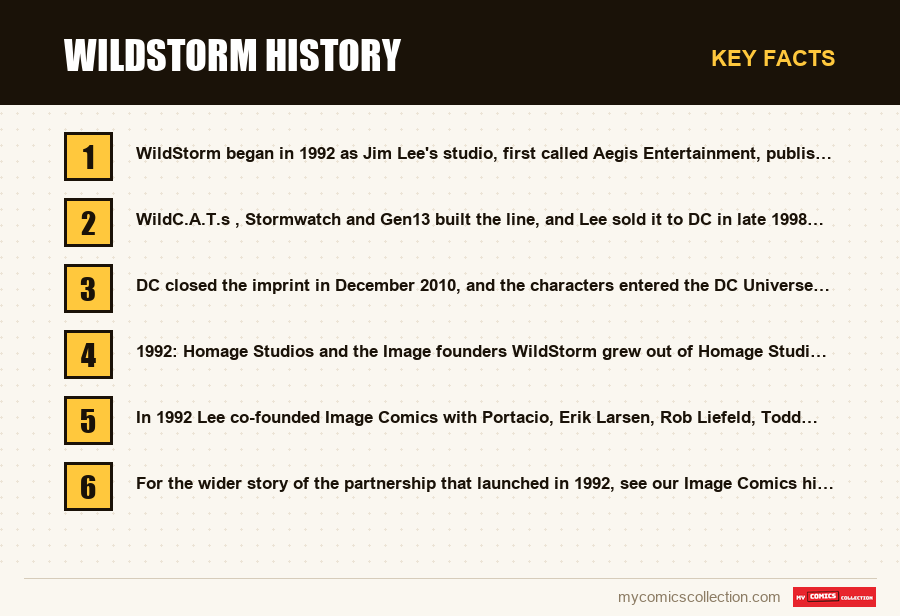
WildStorm began in 1992 as Jim Lee's studio, first called Aegis Entertainment, publishing through Image Comics, which Lee co-founded. WildC.A.T.s, Stormwatch and Gen13 built the line, and Lee sold it to DC in late 1998, with the deal effective January 1999. The Authority, Planetary and America's Best Comics followed. DC closed the imprint in December 2010, and the characters entered the DC Universe with the 2011 New 52.
WildStorm is unusual among closed imprints because it ended twice: once as an independent studio, when it was sold, and once as a DC imprint, when it was shut. Between the two endings sits one of the most distinctive superhero lines of the late 1990s.
Founding years, sale dates, series runs and creator credits here come from published histories of the studio and its main titles, with months given only where read; remarks about what a period meant for collectors are our analysis.
1992: Homage Studios and the Image founders
WildStorm grew out of Homage Studios, a shared San Diego workspace used by Jim Lee, Whilce Portacio, Scott Williams and others. In 1992 Lee co-founded Image Comics with Portacio, Erik Larsen, Rob Liefeld, Todd McFarlane, Marc Silvestri and Jim Valentino, although Portacio did not become a full partner. Lee also founded a company of the studio's own, originally named Aegis Entertainment, to publish through Image.
That structure is the key to the early history. Image was the banner on the cover, but the studio behind the books was a separate company with its own staff and its own plans. For the wider story of the partnership that launched in 1992, see our Image Comics history; this page follows only what happened inside Lee's studio.
As analysis, the lesson for a collector is that early WildStorm books are Image books in every catalog entry. A copy of WildC.A.T.s #1 lists Image as publisher even though the studio's name later became the label for the whole line.
1992 and 1993: WildC.A.T.s and the first wave
WildC.A.T.s was Lee's first project for Image and Aegis. Volume one began in August 1992 with Jim Lee and writer Brandon Choi credited as creators, and it ran 50 issues, numbered #0 to #50. The original team is Spartan, Grifter, Zealot, Voodoo, Maul, Warblade, Void and Lord Emp, and the premise is a centuries-long war between the Kherubim and the Daemonites.
The line grew in 1993 with Deathblow, Stormwatch and Union. In the same year Image and Valiant published the Deathmate crossover, and Homage Studios produced Deathmate Black, which was solicited for late summer but did not ship until October. The delay is a reminder that the studio's schedule was already stretched in its second year.
In late 1993 Lee renamed the company Wildstorm Productions. The name combines the titles WildC.A.T.s and Stormwatch, which shows which two books the studio considered its foundation.
1994 to 1997: Gen13, Alan Moore and the Homage imprint
Image published Gen13 #1 in 1994. Its teenage cast is credited to Jim Lee, Brandon Choi and J. Scott Campbell. The book became one of the line's anchors and spawned DV8 in 1996, a spin-off written by Warren Ellis with art by Humberto Ramos.
In 1995 Alan Moore began writing WildC.A.T.s with issue 21, and the first volume carries his run from #21 to #34. The credit is a good example of the studio's habit of recruiting established writers into a young line. Collectors who follow Moore's career will want those issues; our Alan Moore starting guide places them in the larger body of work.
In 1996 the studio produced Iron Man and Fantastic Four for Marvel's Heroes Reborn relaunch. In 1996 it launched the Homage Comics imprint for creator-owned work, with Astro City, Strangers in Paradise and Leave It to Chance as its first titles. In the same year Warren Ellis also took over Stormwatch.
The Homage imprint shows the second identity of the studio. WildStorm was both a house of studio-owned superheroes and a home for books by other creators, an idea that came back at DC in the America's Best Comics line.
1997 and 1998: Divine Right, Cliffhanger and the sale
In 1997 Lee launched Divine Right, a series slowed by delays: only seven issues appeared over 15 months. In 1998 the Cliffhanger imprint began with Crimson, Danger Girl and Battle Chasers. The studio was thus still growing in the year it changed hands.
Lee sold WildStorm to DC Comics in late 1998, with the deal taking effect in January 1999. The sale ended the independent chapter. From 1999 the new series carry DC as publisher under the WildStorm imprint name.
Analytically, the sale is the line that divides the collecting history into two parts. Image-era WildStorm books are the early 1990s boom; DC-era WildStorm books are a different publisher's imprint, and the key issues and reading orders differ.
1999: The Authority, Planetary and America's Best Comics
The first year under DC produced the imprint's best-remembered books. The Authority began with #1 in May 1999, written by Warren Ellis with art by Bryan Hitch. The founding team is Jenny Sparks, Apollo, Midnighter, the Engineer, Swift, Jack Hawksmoor and the Doctor, mostly characters Ellis had created in Stormwatch. The Ellis and Hitch run lasted twelve issues, in three four-issue arcs, before Mark Millar and Frank Quitely took over.
Volume one ran 29 issues. Tom Peyer and Dustin Nguyen handled a four-issue fill-in arc, and Ed Brubaker wrote the twelve-issue Revolution miniseries. The Millar and Quitely run was published after the September 11 attacks, and DC censored parts of it: red filters obscured violent panels, a President drawn to resemble George W. Bush was redrawn, and a kiss between Apollo and Midnighter was removed.
Planetary also launched in 1999, created by Warren Ellis and John Cassaday. The same year America's Best Comics began, publishing Alan Moore's Promethea, The League of Extraordinary Gentlemen, Tom Strong and Top 10. Together these books turned a former Image studio into a prestige label at the largest superhero publisher.
2002 to 2006: Eye of the Storm, creator-owned work and the multiverse
In 2002 DC created the Eye of the Storm imprint for more mature superhero titles. It included Wildcats 3.0 by Joe Casey and Dustin Nguyen, Stormwatch: Team Achilles by Micah Ian Wright and Whilce Portacio, and Sleeper by Ed Brubaker and Sean Phillips. The imprint closed by the end of 2004.
The creator-owned side kept working. Red by Ellis and Cully Hamner appeared in 2003, and Ex Machina by Brian K. Vaughan and Tony Harris debuted in 2004. Garth Ennis and Darick Robertson started The Boys there in 2006, and the series moved to Dynamite in 2007 because DC was uneasy with its anti-superhero tone. A collector reading the imprint's output will notice that its most celebrated books are often not about the WildStorm superheroes at all.
In 2006 Captain Atom: Armageddon placed the Wildstorm Universe into the DC multiverse as a parallel world, and the Worldstorm relaunch followed with titles including Deathblow, Gen13, Stormwatch: Post Human Division and Wetworks, the last written by Mike Carey with art by Portacio. The effort was a reset of the line.
Do you collect this series?
Track what you own, what you are missing and what your collection is worth. 7-day trial.
Start my trial →
Jim Lee at DC: Hush and the executive chair
While the imprint continued, Lee's own drawing board moved toward DC's flagship characters, Batman first among them. That chapter belongs to Lee's career rather than to the imprint's history, and it is covered in our Batman #608 guide and the Hush film comparison.
The sequence is worth noting as analysis: the founder of the studio kept working at the company that bought it, while the studio's own superheroes passed through relaunch after relaunch under other creative teams.
2008 to 2010: the apocalypse crossovers and the closing
In 2008, with sales declining, the Armageddon crossovers shifted the line in a new direction without producing a substantial increase in sales. The imprint's final period is therefore a story of an ending rather than of a launch.
In September 2010 DC announced that Wildstorm would be restructured. In December 2010 the imprint shut down, with Wildcats volume five #30 as its last issue. DC executives said the characters would reappear some time in the future.
For collectors, a December 2010 end date gives the DC-era imprint a clear span: from January 1999, when the sale took effect, to December 2010, almost twelve years of books under one imprint name.
2011 onward: the characters inside the DC Universe
In 2011 the New 52 relaunch integrated WildStorm characters into the DC Universe. Voodoo and Grifter launched as solo series, and a revived Stormwatch featured Jack Hawksmoor, Midnighter, Apollo, the Engineer and Jenny Quantum. Team 7 was revived with non-WildStorm characters Deathstroke, Amanda Waller and Black Canary alongside the WildStorm member Spartan, who appeared in issue #5, dated April 2013. Zealot appeared in Deathstroke #9 in 2012.
After DC Rebirth, Midnighter and Apollo received their own series in 2016, which ran through 2017. In February 2017 The Wild Storm #1 launched, written by Warren Ellis with art by Jon Davis-Hunt, opening a 24-issue series that reimagined the universe, and The Wild Storm: Michael Cray followed in October 2017 from writer Bryan Edward Hill. A planned Wildcats relaunch by Ellis, with art by Ramon Villalobos, was cancelled in 2019.
In 2021 Grifter, Apollo and Midnighter appeared in Future State: Dark Detective, and the characters were then reintroduced to main DC continuity in Batman: Urban Legends #5 and Superman and The Authority. A 12-issue WildC.A.T.S series by Matthew Rosenberg and Stephen Segovia ran from 2022 to 2023, and Zealot appeared in Birds of Prey in 2023. This is the clearest answer to what happened to the characters: they live inside the DC Universe, and the old imprint exists as a label on back issues.
The key issues across the line
- WildC.A.T.s #1 (1992): the Image debut of Jim Lee and Brandon Choi's team of Spartan, Grifter, Zealot and the rest.
- Gen13 #1 (1994): the debut of the team created by Lee, Choi and J. Scott Campbell.
- WildC.A.T.s #21 (1995): the first issue of Alan Moore's writing run.
- The Authority #1 (1999): the first issue by Warren Ellis and Bryan Hitch, with Jenny Sparks, Apollo and Midnighter.
- Planetary #1 (1999): the start of Warren Ellis and John Cassaday's series about archeologists of the impossible.
- Team 7 #5 (2013): Spartan's appearance in the New 52 version of the team.
- Wildcats volume five #30 (2010): the last issue of the imprint.
- The Wild Storm #1 (2017): Warren Ellis and Jon Davis-Hunt's DC-era reboot.
How to collect WildStorm
Divide your list by publisher before you divide it by character. Books from 1992 to 1998 list Image as publisher, and books from 1999 to 2010 list DC under the WildStorm imprint. The same title can sit on both sides, so check the first printing against the publisher line.
The strongest starting points depend on interest. For team superhero collecting, begin with WildC.A.T.s and Gen13 from the Image years. For writers, begin with Alan Moore's WildC.A.T.s issues or the Ellis and Hitch Authority run. For Lee's art alone, our Jim Lee starting guide maps his career across publishers.
A practical warning on numbering: Wildcats had several volumes, which is why the closing issue is volume five #30, and other titles of the line were relaunched more than once. Always record the volume with the issue, because "Gen13 #1" can mean more than one book. For the wider situation of DC's own history, see the DC history page.
Frequently asked questions
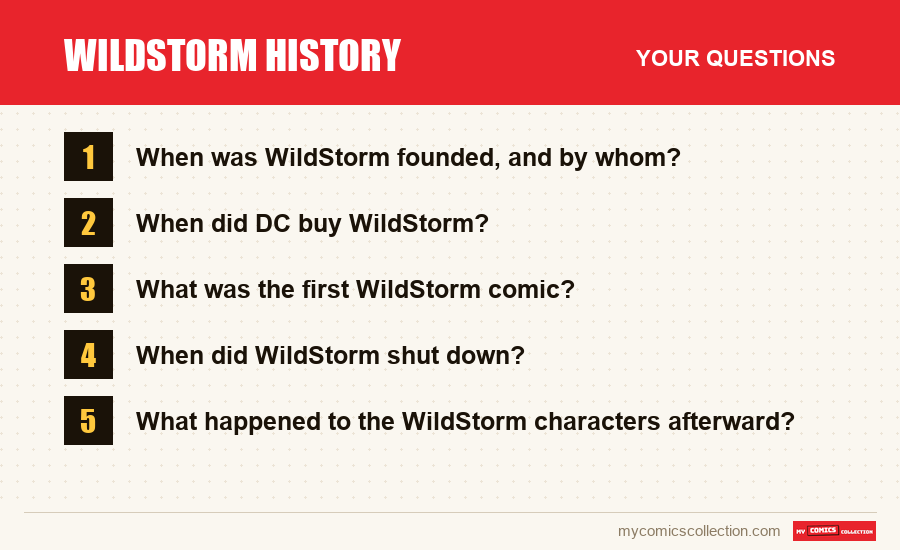
Jim Lee founded WildStorm in 1992 as an independent company, originally named Aegis Entertainment, to publish through Image Comics. It grew out of Homage Studios, a shared San Diego workspace. In late 1993 Lee renamed it Wildstorm Productions, combining the titles WildC.A.T.s and Stormwatch.
Lee sold WildStorm to DC Comics in late 1998, and the deal took effect in January 1999. Within months came The Authority from Warren Ellis and Bryan Hitch, Planetary from Ellis and John Cassaday, and Alan Moore's America's Best Comics line.
WildC.A.T.s was Lee's first project for Image and the studio, beginning in 1992 with Jim Lee and Brandon Choi credited as creators. The line expanded in 1993 with Deathblow, Stormwatch and Union, and Gen13 followed in 1994.
A September 2010 DC announcement said Wildstorm would be restructured; the imprint closed in December 2010. The last issue was Wildcats volume five #30. DC executives said the characters would reappear some time in the future.
The 2011 New 52 relaunch integrated them into the DC Universe, with Stormwatch, Grifter, Voodoo and Team 7. Midnighter and Apollo got a series in 2016, and The Wild Storm launched in 2017 under Warren Ellis. The characters returned to main continuity in 2021.
Hold a WildC.A.T.s, Gen13 or Authority first issue? Get an estimate of what your copy is worth.
Estimate my comic