
In short
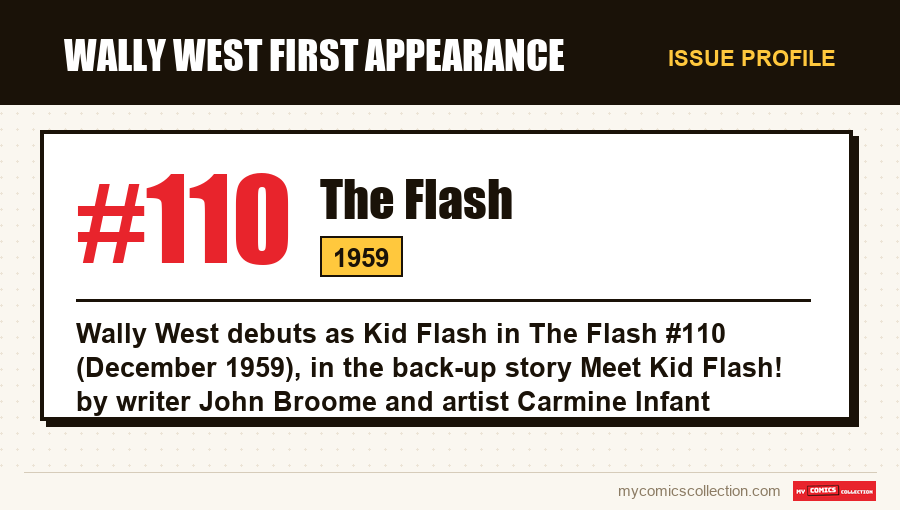
Kid Flash, the teenage identity of Wally West, arrives in The Flash #110 with a December 1959 cover date, in a back-up titled "Meet Kid Flash!" that Broome scripted and Infantino illustrated. Wally, the nephew of Iris West and a young admirer of Barry Allen, gains Flash-style powers when Barry's lab accident repeats. He is a sidekick here, not the Flash. The Flash name itself passes to him only in 1986.
Look at The Flash #110 and the two stories inside tell you something about how DC built its Silver Age line: a new villain in the lead feature, a new sidekick in the back. The same issue gives collectors the debut of the Weather Wizard and the debut of Kid Flash, and it is the second of those that explains why the book is still wanted decades later. This guide is about the issue as a physical object and as a piece of publishing history, not about Wally's career as a whole.
Page credits and dates here were read from catalog and encyclopedia pages on the issue and on Barry Allen's series; the buying advice is method, not data. Where this guide gives advice on condition and on how to compare copies, it is analysis and method, and it does not claim market values.
What The Flash #110 contains: cover date, stories and credits
The Flash #110 is cover dated December 1959. It belongs to the first volume of the series, which continued the numbering of the 1940s Flash Comics run, so a book in the 100s of the early Barry Allen era is not a long-running title in the way the number might suggest. Carmine Infantino was the series' regular artist at this point, and his figures define the look of the book inside and out.
The issue holds two stories. Up front sits the lead story, which pits the Flash, Barry Allen, against the Weather Wizard, Mark Mardon, in his debut. The second story, "Meet Kid Flash!", is the one that matters for Wally: John Broome wrote it and Carmine Infantino drew it. Julius Schwartz is the editor of the issue.
That makes #110 a two-debut book. Someone searching for the Weather Wizard first appearance is looking at the same issue as someone searching for Wally West, and some listings name just one of the two. If you are comparing copies or reading auction descriptions, check that the cover date reads December 1959 and that the contents include both stories.
How Wally West is introduced as Kid Flash
The setup is straightforward and tied to Barry Allen's own origin. Wally visits the Central City police laboratory where Barry works. In the lab, the chemicals and electrical charge that gave Barry his powers are brought together again, and Wally is bathed in the same kind of electrically charged chemicals. He gains Flash-style speed, and he puts on a smaller copy of Barry's costume.
Wally is presented as a young admirer of the Flash and as the nephew of Iris West, Barry's romantic interest in the series. The point of the introduction is to give Barry a junior partner who shares his power source.
The family link does real work in the story. Because Wally is Iris's nephew, he enters the series through Barry's private life rather than through a crime scene, and that gives the back-up a domestic tone that sets it apart from the villain story in front of it. In the role that Robin played beside Batman, Kid Flash gave younger readers a hero close to their own age, and the shared accident meant his powers needed no new explanation. For a collector, that tie to Iris is also a quick way to tell a genuine description of the issue from a careless one.
It matters to describe the character accurately. In this issue Wally is Kid Flash, a sidekick, and Barry Allen is the Flash. A listing that says "first appearance of the Flash Wally West" is mixing two things. The costumed identity that Wally uses in 1959 is Kid Flash, and he does not take the name Flash for more than a quarter of a century, as the sections below explain.
The creators and the editorial moment
John Broome and Carmine Infantino are the credited creators of Kid Flash. Broome was the writer for the Silver Age Barry Allen stories at this point, and Infantino drew them. Julius Schwartz edited the title, and he is the editor who had overseen the revival of the Flash name when Barry Allen appeared in Showcase #4, cover dated October 1956, with a script by Robert Kanigher, pencils by Infantino and inks by Joe Kubert.
By #110, the Barry Allen series had been running long enough for its writers to add to the cast. A pair of debuts in a single issue reflects that confidence: one was a new adversary and the other was a new ally. A couple of issues later, The Flash #112 brought in the Elongated Man, and the series continued to widen its cast in the early 1960s. Seen in that sequence, Kid Flash is one of several additions that shaped the way the book read in its early years.
The editorial lesson is useful for a collector. A character who arrives as a supporting player can become the lead later, and the original issue becomes the anchor for the character's whole career. The debut was not designed as a landmark; it is a landmark in hindsight.
Why the issue became a key issue
Two threads explain the demand for #110. The first is the Weather Wizard, who becomes a regular adversary in the Flash's gallery of rogues. The second, and the larger one, is Wally West, who grows from a sidekick into one of the central figures of the DC Universe.
Wally's trajectory follows a clear path in the published run. The Flash #135, cover dated March 1963, changes Kid Flash's costume to a primarily yellow design with red accents. In The Brave and the Bold #54, cover dated June to July 1964, Wally meets Robin and Aqualad in the encounter that leads to the formation of the Teen Titans, and he is one of the founding members.
The change that matters most arrives in the 1980s. Barry Allen dies in Crisis on Infinite Earths #8, cover dated November 1985, and in Crisis on Infinite Earths #12, cover dated March 1986, Wally takes on Barry's costume and identity. The new volume of The Flash that begins with issue #1 in June 1987 carries Wally as the lead. From that point, a generation of readers knew Wally as the Flash, and the 1959 debut became the origin of a lead character and not only of a sidekick.
Because the character's importance grew in stages, the demand for the debut has been tied to that history: each time Wally takes a new role, collectors look back to #110. For our overview of that later career, see the Wally West history guide, and for the sidekick period specifically, the Kid Flash story in comics.
Do you collect this series?
Track what you own, what you are missing and what your collection is worth. 7-day trial.
Start my trial →
Numbers that get confused with the debut
The most common confusion is between the debut as Kid Flash and the debut as the Flash. These are different issues. The first is The Flash #110 in 1959. The second is Crisis on Infinite Earths #12 in 1986, where Wally takes on Barry's costume. A listing that blurs the two is describing neither accurately, and a buyer who needs the Kid Flash debut should look at the 1959 book.
A second confusion involves the Teen Titans. The Brave and the Bold #54 is the issue in which Wally meets Robin and Aqualad and the Teen Titans take shape, and it is sometimes cited as his debut because it is a famous issue in its own right. It is not. It is a later appearance of a character who debuted years earlier. Our guide to the best Teen Titans runs places that book in context.
A third confusion concerns Barry Allen's own debut, Showcase #4 in October 1956, and the multiverse landmark The Flash #123 from 1961. Both are major Flash books, and neither introduces Wally. For the latter, read our guide to Flash #123. Finally, remember that later volumes of The Flash also have a #110, so confirm the 1959 cover date before you buy.
What to check before buying a copy
As with any book from this era, start with the structure of the comic. A Silver Age DC issue from 1959 is printed on paper that has aged, and the cover is the first area where condition shows. Look at the spine for stress lines, at the edges for wear and at the corners for blunting. Request clear scans of both covers, the spine and the centerfold.
Next, look for signs of restoration. Pressing, cleaning, color touch and spine repair can all change how a book looks without being obvious in a listing photograph. If the copy is graded, read the label as well as the number, because a restored book and an unrestored book at the same numeric grade are different items. Compare sales of like with like and avoid blending the two groups in your own research.
Confirm the identifiers. The cover date should read December 1959, the issue number is 110 and the contents should include the Weather Wizard lead story and "Meet Kid Flash!". If any of those is missing from a listing, ask the seller to confirm. For a general primer on what graders look for in books of this age, see our Flash grading guide.
A particular copy is best priced against completed sales that match it in grade and restoration. Because values shift with film and television news and with the broader Silver Age market, an article that prints a figure ages quickly, so this guide leaves figures aside and gives you a method instead.
Later appearances worth tracking
If you are building a Wally West run from the debut onward, the issues below are the ones that the reference pages identify as turning points. They are in publication order.
- The Flash #135 (March 1963): Kid Flash's costume is redesigned to a primarily yellow look with red accents.
- The Brave and the Bold #54 (June to July 1964): Wally meets Robin and Aqualad in the story that leads to the Teen Titans.
- Crisis on Infinite Earths #12 (March 1986): Wally takes on the costume and identity of the Flash after Barry Allen's death in issue #8.
- The Flash #1, volume 2 (June 1987): The relaunch that carries Wally as the Flash.
For a wider map of the books around these, our Flash key issues guide and the Flash character hub collect the other major entries.
Frequently asked questions
The debut is The Flash #110, dated December 1959, where Wally appears as Kid Flash. Its title is "Meet Kid Flash!", a back-up story by John Broome and Carmine Infantino, edited by Julius Schwartz. The same issue also introduces the Weather Wizard.
No. In issue #110 Barry Allen is the Flash and Wally is his sidekick, Kid Flash. Wally wears the Flash costume once Barry Allen has died in Crisis #8 and the story reaches Crisis #12, dated March 1986. His own run as lead follows in 1987.
John Broome and Carmine Infantino are the credited creators of Kid Flash. Broome wrote "Meet Kid Flash!" and Infantino drew it, giving Barry Allen a junior partner who shares his power source. Julius Schwartz edited the book. The issue, cover dated December 1959, also introduces the Weather Wizard in the lead story.
No. The Brave and the Bold #54, cover dated June to July 1964, shows Wally meeting Robin and Aqualad in the story that leads to the Teen Titans. By then Wally had already debuted in The Flash #110, in 1959, so #54 is an important later appearance and not his debut.
Confirm the December 1959 cover date and that the contents list the Weather Wizard story and "Meet Kid Flash!". Study the spine, corners and edges, ask about pressing or color touch, and read slab labels for restoration notes. Price against matching grade and restoration only.
Holding The Flash #110 or another Silver Age Flash issue? Run a free estimate from the issue and its condition.
Estimate my comic