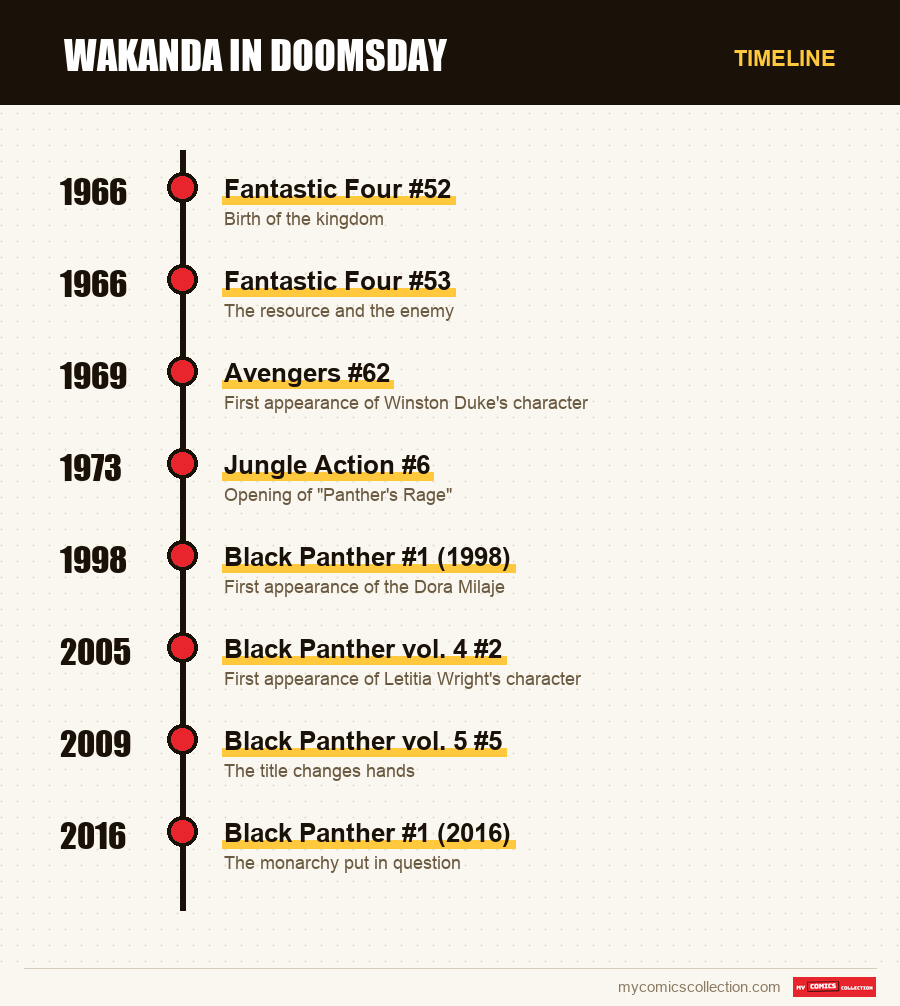
Avengers: Doomsday comes out on December 18, 2026, after a delay from May of the same year, and two faces of Wakanda are in it: Letitia Wright and Winston Duke, amid a very large cast. The country they represent has an editorial history of its own, distinct from that of its sovereign. It is born in Fantastic Four #52 (July 1966), signed Stan Lee and Jack Kirby, inked by Joe Sinnott. It becomes a political subject in 1973 with Jungle Action #6 and the thirteen chapters of Don McGregor's "Panther's Rage." It is rewritten as a diplomatic power by Christopher Priest starting with Black Panther #1 (November 1998), then as a contested nation by Ta-Nehisi Coates from April 2016. On the inhabitants' side, the gap is huge: Winston Duke's character appears as early as Avengers #62 (March 1969) under another name, Letitia Wright's only in Black Panther vol. 4 #2 (May 2005).
In nearly all the articles devoted to Wakanda, the country serves as the backdrop to a biography. We tell T'Challa's story, and the kingdom arrives by ricochet, as the hero's address. Yet it is one of the few fictional places in American publishing to have had its own trajectory: a territory invented for a handful of pages in 1966, which became over six decades a narrative object that successive writers rewrote from top to bottom, sometimes against their predecessors.
This distinction matters to collectors. The issues that count for the country are not exactly those that count for the man. An episode can be minor in T'Challa's life and foundational for the kingdom's geography, resource, factions or institutions. Conversely, some of the character's major stages take place entirely outside its borders, and teach nothing about the territory.
This article is written on October 1st, 2026. Avengers: Doomsday has not come out, nobody has seen the film, and it would be absurd to announce today what this or that scene will do to the market value of this or that issue. What exists, however, is a release date, an announced cast, and sixty years of verifiable bibliography. That is what we work with.
What Doomsday's cast says, and what it does not say
Only two pieces of information are solid about Wakanda in this film. The first is the date: December 18, 2026, after a shift from the May 2026 window initially chosen. The second is the presence of Letitia Wright and Winston Duke in the credits, alongside the Avengers, the Thunderbolts, the Fantastic Four and a group of mutants from another universe. The announced cast exceeds twenty names.
Everything else is conjecture, and this must be said clearly because the old comics market feeds precisely on conjecture. We do not know how long these two characters are on screen. We do not know whether the territory itself appears. A large cast statistically means short roles: on a bill with twenty-seven names, the expected presence per character is counted in minutes, not in acts.
What this does allow, however, is to look seriously at the printed origin of what will be shown. And there, the difference between the two announced Wakandan characters is spectacular: thirty-six years separate their respective first appearances, with all that implies in terms of scarcity, price and difficulty of acquisition. That is the real collector information of this casting.
The other franchises brought together in the film have their own bibliographies, which fall outside the scope of this article. The focus here is strictly on the kingdom and its inhabitants.
1966: a country invented for a single scene
Wakanda appears in Fantastic Four #52, dated July 1966, written by Stan Lee, drawn by Jack Kirby and inked by Joe Sinnott. The episode has no geopolitical ambition: an unknown African sovereign invites the Fantastic Four to his home and subjects them to a series of trials. The territory serves as a trap, a technological playground, a visual surprise. It is a backdrop, in the strict sense of the word.
This point must be stressed, because it explains everything that follows. Nothing in this episode suggests that a nation with a history, an economy, a religion and internal conflicts would be built on it. The country is a single-use narrative device. Its later fortune owes nothing to an initial intention and everything to the writers who chose to take it seriously.
The next episode, Fantastic Four #53 (August 1966), supplies the two bricks without which the kingdom would remain a curiosity: the resource and the enemy. We learn there of the existence of vibranium, and Ulysses Klaw appears, responsible for the death of the sovereign's father. The basic mechanism is laid down in a month: a country that owns something unique, and an outside world that wants to take it from it. Sixty years of stories fit in that sentence.
For the collector, these two issues form a pair, and it is common to see them sold separately with approximate descriptions. The technical difficulty of #52 is known: its very dark cover marks at the slightest rub, which makes high grades proportionally harder to find than on other titles of the same year. Any negotiation on this episode plays out on photos of edges and spines, not on a seller's promise.
1973: when the backdrop becomes a subject
Seven years later, the kingdom changes status. In Jungle Action #6 (September 1973), Don McGregor launches "Panther's Rage," a thirteen-chapter story that takes place entirely within the borders. Rich Buckler, Gil Kane and Billy Graham succeed one another on art. It is the first time the country is not a place one passes through but a place one talks about.
McGregor's choice is radical for the time: he writes an internal conflict. The adversary is not an invader but a claimant to the throne, Erik Killmonger, and the question posed is not "who will defend the kingdom" but "who should govern it, and in whose name." Tensions between communities, villages, landscapes, succession rites appear. The territory acquires a documentary thickness that no superhero episode had given it.
The other contribution is formal, and it has had a legacy that goes well beyond this title. "Panther's Rage" is considered the first example at Marvel of a long, self-contained story arc conceived in advance as a unit, with a beginning, a middle and an end spread over thirteen episodes. The chapters are first thirteen to fifteen pages, then lengthen to eighteen or nineteen from Jungle Action #14, and a seventeen-page epilogue closes the whole. The series then continues to #24 (November 1976).
Practical consequence: these issues are not collected one at a time. Owning #6 without the following twelve is owning a first page. It is one of the rare cases where the logic of the "isolated key issue" is frankly a bad adviser, and where issue-by-issue tracking of a complete series makes more sense than hunting a single cover.
1977: Kirby takes the country back and pushes it toward science fiction
In January 1977, Jack Kirby returns to the kingdom he had co-created eleven years earlier, this time as writer and artist, inked by Mike Royer, in a monthly series finally bearing the character's name. The inflection is clear and often misunderstood: Kirby does not continue McGregor's work, he takes the opposite tack. Where his predecessor had done political anthropology, he does technological adventure and wonder.
This discontinuity is useful data. The idea of a coherent kingdom, built layer by layer by writers who passed the baton, is a retrospective reconstruction. In fact, each generation pulled the country in a different direction, sometimes erasing the previous interpretation. A holding that claims to tell the history of the place must therefore include episodes that contradict each other, and that is precisely what makes it a subject of study rather than a mere list of covers.
1998-2003: sixty-two issues to make it a power
The relaunch signed by Christopher Priest starts with Black Panther #1 in November 1998, art by Mark Texeira, and ends with issue 62 in 2003. It is, in volume, the longest continuous exploration of the kingdom ever published, and also the one that most directly fed the visual imagination of later adaptations.
Priest shifts the center of gravity: his subject is not combat but sovereignty. The country acts there as a state, with intelligence services, economic interests, offensive diplomacy and an acknowledged capacity to harm supposed allies. The first issue introduces the female royal guard, the Dora Milaje, as well as several elements of the kingdom's material culture that have since become instant signs of recognition.
A clarification that almost all summaries gloss over: the American official who serves as witness and narrator of this run, Everett K. Ross, does not make his first appearance there. He is created by Christopher Priest with Kenny Martinez in Ka-Zar #17 (September 1998), two months before the launch. It is typically the kind of detail that separates a serious sale listing from an approximate one, and which shifts the real key to a title nobody thinks of.
This run also has a collecting particularity: it is long, and the middle issues of a sixty-two-episode series circulate in quantity, at levels unrelated to those of the 1966 episodes. Reassembling the whole takes patience more than means, the exact opposite of the problem posed by the two founding Fantastic Four issues.
2005-2009: the royal family widens
The series relaunched by Reginald Hudlin in 2005 returns to the dynasty. Its lasting contribution to the kingdom is the widening of the ruling family, and in particular the entry of the sovereign's younger sister, in Black Panther vol. 4 #2 (May 2005), art by John Romita Jr. She appears there in the course of a flashback story devoted to the ritual origins of royalty, within the run's opening arc.
The numbering detail is important and regularly costs hurried buyers money: the first appearance is in the second issue of this volume, not the first. A 2005 #1 bought in the belief of holding a first appearance remains a 2005 #1, nothing more.
Four years later, the character crosses a second stage, and this one directly concerns the kingdom: she accedes to the title of sovereign-protector. The passage plays out in the volume launched in 2009, where she first fails the ritual trials in the first two issues before succeeding in them over the following episodes; Black Panther vol. 5 #5 is generally retained as the issue of her first appearance in costume, the arc closing at #6 (September 2009). For a collection organized around the place rather than an individual, it is an institutional milestone: it establishes that the title can change hands within the family.
2016-2021: a contested nation, then an empire
In April 2016, Ta-Nehisi Coates takes the series with Brian Stelfreeze on art, for an arc titled "A Nation Under Our Feet." The subject is explicit from the title: the ownership of the soil. The kingdom is crossed there by a popular uprising led by a group that contests the very legitimacy of the monarchy. For the first time, the question posed is not who rules, but whether a king is needed.
It is the complete inversion of the 1966 device. The country is no longer an exotic backdrop whose technology amazes, nor even a powerful state whose diplomacy fascinates: it is a political regime whose story questions its validity. No other mainstream fictional territory has undergone such a reversal at the hands of its own publisher.
The same writer then leads the series relaunched in 2018 toward "The Intergalactic Empire of Wakanda," twenty-five issues that move the kingdom to the stellar scale by positing that it had established an extraplanetary colony two millennia earlier. The run ends with issue 25, illustrated by Daniel Acuña with an epilogue drawn by Brian Stelfreeze. We have gone, in fifty-five years, from a trap of a few pages to a galactic empire.
On the market side, these two series follow a radically different logic from the earlier ones: modern print runs, numerous alternate covers, reprints. The relevant question there is not scarcity but the exact identification of what you are buying, first printing or not, main cover or variant.
The issues that really count before December 18
Here are the episodes directly tied to the kingdom and to the two Wakandan characters announced in the cast. No amount is cited here: observed levels move fast around a release, and a figure dated this morning would be wrong in three months.
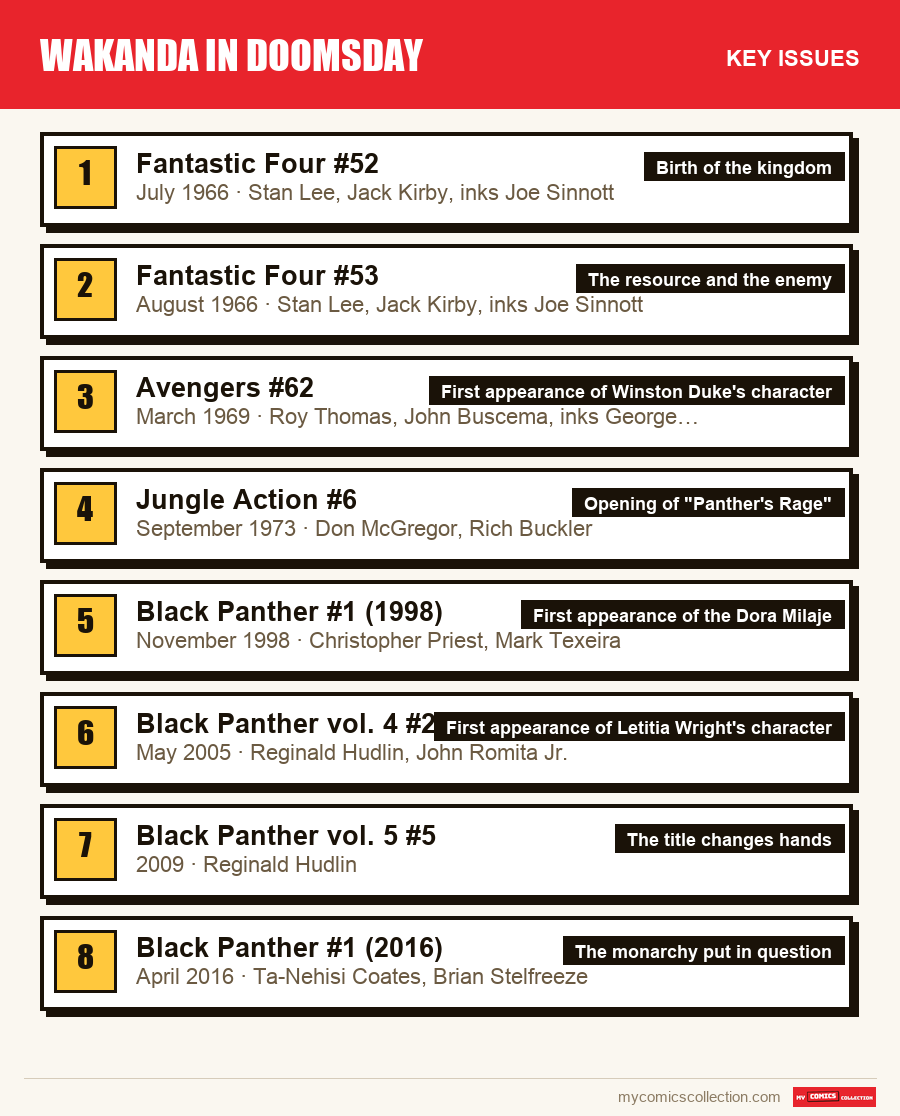
Fantastic Four #52
The territory's point zero. Everything the following six decades build starts from this episode where an unknown sovereign receives and tests the Fantastic Four. It is also, mechanically, the hardest piece of a holding devoted to the place: a 1966 title, strong demand, and a cover whose dark background forgives handling poorly.
Fantastic Four #53
Published a month after the previous one, it sets up the two elements that make the kingdom tellable over the long term: the metal that makes it wealthy, and the outside adversary who covets it, Ulysses Klaw. Without this issue, the country has neither economy nor motive for conflict.
Avengers #62
The episode "The Monarch and the Man-Ape!" introduces M'Baku, leader of a rival community inside the kingdom, who was seizing the throne. A crucial point for searching: in the comics, the character originally carries a code name, Man-Ape, which cinema did not keep. A sale listing indexed on the first name alone can therefore completely miss this episode, and vice versa.
Jungle Action #6
The issue that turns the backdrop into a subject, and which introduces Erik Killmonger. Thirteen chapters set entirely within the borders, devoted to a civil war and the legitimacy of power. Gil Kane and Billy Graham also take part on art for the rest of the arc.
Black Panther #1 (1998)
The start of a sixty-two-issue run that refounds the kingdom as a geopolitical actor. This first episode sets up the female royal guard and several cultural markers that became instantly recognizable. It is the most profitable entry, in reading volume per euro, of a holding devoted to the place.
Black Panther vol. 4 #2
Thirty-six years after the 1969 episode, the second Wakandan figure announced in Doomsday's cast enters continuity. The age gap changes everything: this is a 2000s title, printed in quantity, without the condition difficulty of a 1966 comic.
Black Panther vol. 5 #5
Generally retained as the new sovereign-protector's first appearance in costume, after ritual trials failed in the volume's first two issues then passed afterward; the arc closes at #6 (September 2009). Read from the kingdom's point of view, it is a constitutional episode as much as a narrative one.
Black Panther #1 (2016)
Opening of "A Nation Under Our Feet," the arc that subjects the regime to mass internal contestation. From the standpoint of the place's history, it is the text furthest from the 1966 episode ever published on the subject.
How to approach these issues until release
Decide whether you collect the place or the person
It is not the same list, nor the same budget. A "country" holding includes Avengers #62, the 1998 series and the 2016 arcs, and can perfectly do without some famous episodes of the sovereign. Settle before buying, not after.
Start with the long series, not the 1966 pieces
The sixty-two issues of 1998 and the thirteen chapters of 1973 represent most of the content truly devoted to the kingdom. They cost a fraction of the two founding episodes and give access to the material. The 1966 pieces can wait.
Note the characters' original names in your searches
The character who appeared in 1969 carries in the comics a code name that cinema dropped. Search under both designations: poorly written listings are often where the best deals are made, precisely because they are poorly indexed.
Check the number, volume and year before each offer
There are several same-named series relaunched in 1977, 1998, 2005, 2009, 2016 and 2018. A "#1" means nothing without its year. An inventory kept at the issue level avoids the duplicate bought at a key's price.
Buy nothing in the week following December 18
The periods immediately surrounding a release are the worst for buying and the best for observing. If an episode is going to rise, it will rise before; if it falls back, it will be a few months after. An estimate taken from observed sales is worth more than a decision made in the emotion of a trailer.
What six decades of rewriting teach the collector
The kingdom is a textbook case of what we might call retrospective value. In 1966, nobody could know that these few pages would found a major place. In 1973, nobody could know that a long arc published in a second-tier series would become a structural reference. In 2005, nobody could know that a supporting role appearing in a flashback would one day carry a franchise.
The practical lesson is uncomfortable for anyone buying in anticipation: none of the great keys of this subject was identifiable as such at publication. They became so through editorial and industrial decisions made decades later. Buying a modern episode today betting on a 2032 film reproduces the reasoning that enriched the people of 1966, but you must be aware that they were not reasoning, they were reading.
The reasonable consequence is not to give up, it is to separate the two gestures. Buying to read is an immediate and verifiable decision. Buying to resell is a bet whose deadline is unknown. Both are legitimate, provided you do not tell yourself they are the same.
It remains that the December 18, 2026 release is a good pretext for doing what few readers do: reading the history of a place in the order it was written, accepting the contradictions between creators. It is, at little cost, one of the most instructive reading paths superhero publishing has produced over sixty years.