Trade dress designates the set of visual elements that tell the public where a product comes from. On a comic cover, it is everything that is not the drawing: the title logo, the issue number, the date, the cover price, the barcode, the publisher logo, the rating mention and the credits. A so-called "virgin" variant is the same illustration printed without any of these elements. The word therefore indicates neither a print run, nor a scarcity, nor a quality: it describes an absence. Two practical consequences. First, the extra cost is only justified if the image truly gains from being seen alone. Next, a cover with no trade dress visually blends with a trimmed or retouched cover, and trimming is classified by CGC among restoration processes, that is, among attacks on the copy's integrity.
There is a moment, in the life of every buyer of modern comics, when a listing becomes unreadable. The same issue is offered there in six or seven versions, and the words used to tell them apart no longer describe the object but a position in an implicit ranking. "Virgin," "logo-less," "textless," "no trade dress," "full art": five phrasings for roughly the same thing, with price gaps that are not at all the same.
The problem is not the jargon. The problem is that this vocabulary describes an absence, and an absence is not verified in the same way as a presence. When a listing says an issue is a first printing, you can check it. When it says a cover never had a logo, you must know the publisher did produce a logo-free version, or you may be buying a copy whose logo was removed after the fact, with scissors or on screen.
This article therefore takes the problem from the other end. Rather than listing what such a version is worth by such an artist, it explains what cover trade dress is, what it is for, what its disappearance really removes, and how to tell an officially stripped version from a damaged copy presented advantageously. It is vocabulary work before being market work, and it is in this order that it must be done.
Trade dress: a legal term before a collecting term
The expression does not come from the comics world. It comes from trademark law, and this origin explains almost everything about what it designates.
In the United States, trade dress covers the characteristics of a product's or its packaging's visual appearance that tell the consumer the product's source. Protection flows from the Lanham Act, and more precisely its section 43(a), codified in title 15 of the United States Code, paragraph 1125(a). A notable feature: it requires no formal registration, which has led to its description as a federal common-law protection.
Two conditions frame this protection. The first is the absence of functionality: an element that fulfills a utilitarian function independent of public recognition cannot be protected on this ground. The second is distinctiveness, sometimes acquired through use, what judges call secondary meaning. Case law has specified these contours, notably in 1992 in a case where a restaurant's dressing was recognized as protectable, then in 2000 in a decision that required proof of secondary meaning for a product's very shape, as opposed to its packaging.
Retain the logic, because it illuminates what follows: trade dress is not decoration, it is a signature. It exists so that a reader recognizes in a fraction of a second the publisher, the series and the issue's place in that series. The title's logo, for its part, falls under a distinct protection, that of the trademark proper.
Now transpose to a shop. A comics rack is a wall of images. What lets you find your title is not the drawing, whose author you do not yet know. It is the banner at the top of the cover, always in the same place, with the same typography for decades. Trade dress is the tool that makes the drawing findable.
The precise inventory of what disappears
Before judging the price of a stripped version, you must know exactly what it is stripped of. On a contemporary American comic, the front cover's trade dress is made of eight families of elements, worth reviewing one by one.
The title logo. The central piece, the one occupying the most surface and whose removal changes the image's balance the most. It is drawn for the series, not for the issue, and returns identically month after month.
The number and the date. The data that places the copy within the series. Its removal is the most annoying loss for a collector, since it is the information you look for first when sorting a pile.
The cover price. Printed on the object, it constitutes a historical reference that depends on no price guide and ages with the comic.
The barcode or the box that stands in for it. We come back to it at length below: it is the most talkative element of the whole trade dress.
The publisher logo. Often a small corner block. It is the trademark in the strictest sense of the term.
The rating mention. The indication of the targeted readership, sometimes accompanied by a warning.
The credits. Writer, artist, inker, colorist, letterer. Their presence or absence on the cover varies by era and publisher.
The event banners. The small banner that ties the issue to a running crossover. It dates the copy with redoubtable precision.
A clarification that avoids a frequent misreading: a cover with no trade dress does not deprive the copy of its legal identification. The mandatory publication notices, the indicia, do not appear on the cover but inside. Traditionally printed on the first interior page, this block migrated, on American comics, to the inside of the back cover from 2006. It contains the publication's official name, its date, its number and information on its editorial direction. In other words: even without a single word on the cover, an authentic copy remains identifiable by opening it. It is the first check to make, and it is free.
What the barcode says about the copy
Of all the trade dress elements, the one deserving the most attention is the least decorative. The box reserved for the barcode, bottom left, is a marker of distribution channel.
The American market split in two in the early 1970s. To the traditional newsstand circuit, where unsolds went back to the publisher, was added a direct-sale circuit to specialty shops. The principle of this second circuit is simple and heavy with consequences: the retailer orders in advance, is not refunded for unsolds, and gets in exchange a bigger discount as well as, at the time, new releases a week before the newsstands. Since the risk is transferred to the retailer, shops found themselves with dormant stock, which gave birth to the organized trade in back issues.
Now publishers sometimes visually distinguished the copies of the two circuits, and they did it precisely in the barcode box. The clearest example is The Infinity Gauntlet, a six-issue series carrying cover dates spread from July to December 1991. Copies sold in specialty shops and those sold at newsstands carried the same illustration, but the former replaced the barcode with a drawing celebrating the publisher's thirtieth anniversary. Same drawing, same issue, two trade dresses, two circuits.
The lesson goes beyond this particular case. On an old comic, the barcode box often lets you say where the copy passed through, and the two circuits did not generate the same quantities or the same conservation states. Remove the trade dress, and this information disappears with it. On a modern variant produced with no trade dress, the question does not arise, since the version exists as such. On an old copy whose cover has been cleaned of its mentions, on the other hand, the loss is double: you lose the information, and you lose the ability to verify that nothing else is missing.
A listing's lexicon, term by term
The phrasings used in listings are not standardized. Here is what they usually designate, and the trap specific to each.
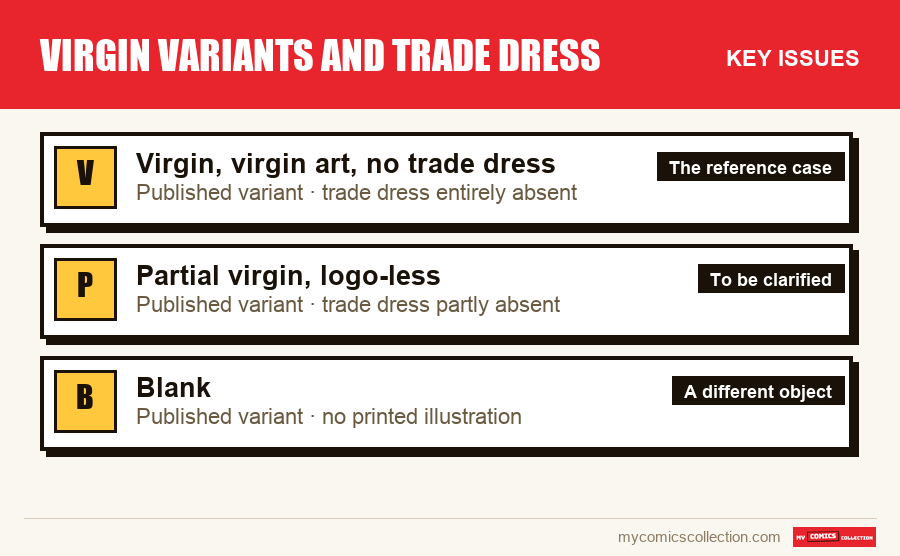
Virgin, virgin art, no trade dress
The illustration occupies the whole printed surface, with no logo, no number, no price, no barcode. It is a version produced by the publisher, from the same illustration file as the dressed cover, but without the text layer. Nothing else changes: the interior content is identical to that of all the issue's other versions.
Partial virgin, logo-less
Only part of the trade dress was removed. The combinations vary from one publisher to another and from one issue to another: logo kept but credits absent, or the reverse. It is the fuzziest category of the lexicon, and the one where a photograph of the whole object beats any description.
Blank
It is not a version of an existing cover, it is an empty cover, meant to receive a drawing. Confusion with a no-trade-dress version is frequent in poorly written listings, whereas the two objects have neither the same use nor the same market. The subject is covered separately in our guide on entirely blank covers.
Two labels deserve particular suspicion. "Textless" is used interchangeably for a published version without trade dress and for the raw illustration as it circulates in a gallery at the end of a collection, which never existed as a comic. "Full art" is not a publishing term at all: it is a sales argument. Neither exempts you from asking which exact version, at which publisher, for which issue.
Why these versions multiplied
Cover variation is an old practice, and its history explains why the no-trade-dress version became an almost systematic option.
The first alternate cover marketed as such is generally traced to The Man of Steel issue 1, published in July 1986, with two drawings signed John Byrne. The mechanism takes its industrial dimension five years later: X-Men issue 1, in 1991, sells more than 8.1 million copies, an absolute record, carried by five distinct covers whose drawings assembled into a single image when put together. The decade then runs away, up to issues offered in thirteen versions, like Gen13 issue 1 in 1995, or sold bagged with a promotional object, like Superman issue 75 in 1993.
The market collapses around 1997, then the practice restarts after 2004. The figures reached since give the measure of the phenomenon: The Walking Dead issue 1 has had 253 different covers, and Amazing Spider-Man issue 666 counted 145.
In this context, the no-trade-dress version has an advantage that has nothing artistic about it: it is the cheapest variation that exists. It requires no new drawing, no new artist, no new specification. It requires removing a layer in an already-ready file. For a publisher looking to offer an extra version without paying for its production, it is the obvious option, and that is why it became common rather than exceptional.
As for the distribution mode, it is most often that of conditioned covers: the retailer only gets access by committing an order volume on the main version. This mechanism is detailed in our article on covers conditioned on retailer orders and, for the detail of the calculation, in the one on ratios and what they do not say. The point to retain here is simpler: a no-trade-dress version is not rare because it has no trade dress, it is rare, or not, depending on the order threshold that conditioned its access.
Why some are sought after and others indifferent
At comparable ratio, two stripped versions of the same month can meet very different fates. The explanation comes down to one question: what does removing the trade dress reveal?
A cover is composed taking its trade dress into account. The artist knows a banner will occupy the top of the image and a box will eat the bottom-left corner. Many compositions are therefore built around these zones: an empty sky at the top because the logo will sit there, an underworked scenery element at the bottom left because it will be masked. Remove the trade dress from a cover designed this way, and you do not get a complete image: you get an image with a void at the top and a sloppy corner at the bottom.
Conversely, some illustrations are true paintings, whose subject fills the frame and whose composition reserves no service zone. On those, removing the trade dress does not create a void, it lifts a veil. It is the first variable, and it is judged by eye, for free, by looking at the dressed version and imagining the text erased.
The second variable is use. An image without text is destined to be framed, and this demand does not come only from comics collectors. It attracts buyers who own no other issue of the series and never will. This outside demand explains a good part of the price gap observed between a stripped version and its dressed equivalent, and it also explains why this gap concentrates on decorative images rather than on the story's important issues.
The third variable is the most unpleasant to hear: visual purity is paid for in grading severity. On a surface entirely occupied by the drawing, with no logo or box to break the uniformity, every flaw shows. A hint of a crease, a fingerprint, a light rub on a flat color: what would go unnoticed under a typographic banner becomes the first detail you notice. A stripped copy is, in practice, harder to keep in flawless condition than a dressed copy.
Trimmed, retouched, or truly without trade dress
We arrive at the main risk, and it is very real: a cover with no trade dress looks, in a photograph, like a cover whose trade dress was removed by some means.
The first means is physical. Trimming consists of cutting the edges of the cover or pages to erase defects and restore clean edges. CGC classifies it among restoration processes, and describes it as the only one that improves appearance through destruction, since it involves a loss of paper. It figures in the same list as color touch-up, filling in missing pieces, taping tears, reinforcement, staple replacement or gloss restoration. Trimming done on the top of a cover can make part of a logo disappear. The result is not a no-trade-dress version: it is an amputated copy.
The second means is digital, and it affects not the object but its representation. An illustration whose text was erased on screen produces a perfectly credible image, which can illustrate a listing actually about a dressed copy. It is not necessarily fraud, it is sometimes a posting negligence, but the result for the buyer is the same.
The grading framework gives useful landmarks. Since CGC's creation in 2000, usage has reversed: restoring a comic that could claim an ordinary grade has become unwelcome, whereas professional restoration could previously enhance a middling copy. The mentions on the label reflect this hierarchy. The blue label, called universal, corresponds to the grade as is. The green label, called qualified, signals a significant defect needing its own description. The purple label corresponds to restored copies, that is, those bearing the trace of repairs meant to give them back their original appearance. A blue-gray label distinguishes conserved copies, whose interventions aim at structural integrity with no aesthetic aim. Finally, a copy deprived of its entire cover does not receive a grade.
Check that the version exists
Before any examination of the copy, make sure the publisher did produce a no-trade-dress version of this precise issue. If this version does not exist in the catalog, the discussion about condition becomes pointless: what is offered is something else.
Open the comic
The mandatory publication notices are inside, not on the cover. They give the official title, the date and the number. An authentic copy remains identifiable even without a word on its front.
Measure
A trimmed copy is smaller than its neighbors of the same month. Compare height and width with an issue of the same series and year. A gap of a few millimeters on a single edge is a signal, not a fatality, but it demands an explanation.
Look at the printing's edges
On a published no-trade-dress version, the illustration runs to the edge under the same conditions as on the issue's other versions. An irregular white strip, an edge too sharp, an edge whose cut differs from the other three: all clues of an intervention.
Demand a photograph of the object
Not the publisher's promotional visual, not a catalog image: a photograph of the copy offered, taken head-on and at an angle, with the spine visible. Refusal to provide this photograph is in itself an answer.
Read the label in full
On a graded copy, the label's color and the mentions on it say what the grade alone does not. A high grade accompanied by a restoration mention does not describe the same object as an equivalent grade on a universal label.
Is the extra cost justified?
There is no general answer, but there is a method, and it comes down to three questions asked in this order.
Do you want the image or the object? If you want the image, because you like it and will frame it, the extra cost is appreciated like that of a print: it is justified if the pleasure lasts. If you want the object, that is, a copy of an issue in a collection, the no-trade-dress version is a less convenient choice than it seems, since it deprives you on the cover of the shelving information.
If you are looking for a raw illustration to hang, note finally that there is a more direct and much cheaper path, which is to buy the series' hardcover collection: the cover galleries very often appear there without text, full page. You gain no collectible object, but you pay no scarcity premium.
Does the image survive alone? The question is settled by looking at the dressed version. If the illustration looks unbalanced as soon as you imagine the logo removed, the stripped version will be disappointing, whatever the artist's reputation. This test costs nothing and avoids most bad purchases in this segment.
What would you pay for the dressed version? It is the only honest point of comparison. The two versions share the same content, the same series, the same month. If the gap seems out of proportion once put in these terms, it probably is. And if the listing justifies the gap by an announced scarcity, ask what it rests on: an order threshold, a numbered print run, or nothing.
The underlying trend, for its part, is documented: the continued multiplication of versions of the same issue for twenty years has made supply abundant and the hierarchy between versions unstable. What remains stable is the landmark illustration and the issue that matters in the story. Trade dress, or its absence, is a modality, not a reason to buy.
Record the right version, the same day
One last point, practical and underestimated. As soon as an issue exists in several versions, your collection stops being a list of issues and becomes a list of issue and version pairs. If this distinction is not recorded, it is lost, and lost quickly: six months are enough to no longer know which of the two versions sleeps in the box.
In the app, the useful reflex is to enter three things at purchase time, while the object is in your hands: the exact version as the publisher designates it, whether the trade dress is present or absent, and the observed condition. For a graded copy, add the mention on the label, not just the number. It is this line, not your memory, that will tell you in five years whether you hold the piece you think you hold.
The same reflex applies to the rest of the series. Once an issue is acquired in a particular version, the question becomes one of coherence: do you continue the series in the same variation, or return to the main version? Both answers hold up. What does not hold up is not having decided and discovering after ten issues a collection assembled at the mercy of availability.