To value your collection, identify each issue (series, number, edition), assess its condition, which is the most decisive factor, then compare against recent real sales rather than a single price guide, taking professional grading into account. This valued inventory also serves for insurance, resale and inheritance. The result remains an order of magnitude, not a guaranteed price.
⚠️ For informational purposes only: This information is provided for educational purposes only. My Comics Collection is not an investment advisor. Values vary with condition, scarcity and market trends. Always check recent eBay and GoCollect sales before any buying decision.
How much is your comic collection worth? The question sounds simple, but the answer is often fuzzy: even for experienced collectors. Between the Overstreet guide, eBay prices, the impact of the CGC grade and the variability of condition, estimating the value of your comics is an exercise that demands method and the right tools. And this valuation is far from trivial.
Properly insuring your collection, preparing for estate planning, selling at a fair price, or simply satisfying your curiosity: there are many reasons to know what your comics are worth. This guide gives you every method and tool you need to get there in 2026.
Why knowing your collection's value matters
Most collectors underestimate their collection's real value. They've bought comics over time, sometimes over decades, and never done a global check. And the reasons to know that value are concrete:
- Insurance: a standard home insurance policy rarely covers collections at their fair value. Without a valued inventory, you can't get suitable coverage.
- Resale: selling without knowing the real value means risking underpricing important pieces, or blocking a sale with too high a price.
- Estate planning: in case of death or gift, a correctly valued collection avoids disputes and losses for heirs.
- Curiosity and satisfaction: simply knowing what years of passion represent financially is information every collector deserves.
A concrete example: A collector who bought Amazing Spider-Man #300 at release in 1988 for $1.25 owns a comic that trades between $330 and $3,300 today depending on condition. Without regular valuation, they may not know, and their home insurance certainly doesn't cover it at that level.
The factors that determine a comic's value
A comic's value isn't fixed. It results from several factors that can evolve over time:
Condition
This is the most decisive factor, especially for key issues. The same issue can be worth ten, twenty or fifty times more in Near Mint (9.4) than in Good (2.0). The slightest tear, fingerprint, slightly detached cover or spine roll significantly affects value. The standard grading scale runs from Poor (0.5) to Gem Mint (10.0).
Scarcity
The fewer copies printed, the rarer and potentially more valuable an issue. Golden Age comics (1938-1955) were printed in small quantities and often destroyed or damaged over time. For modern issues, some cover variants have very limited print runs (sometimes a few hundred copies).
Cultural demand
A character's popularity fluctuates. A Marvel Studios film announcement can cause demand, and price, on a first appearance to explode in hours. Conversely, a character who disappears from current events sees value stagnate or fall. Demand is an external factor you don't control but can anticipate.
CGC grade
A CGC-certified comic is encapsulated in a rigid slab with an official grade. This certification adds a value premium: buyers trust the CGC grade without having to evaluate condition themselves. For major key issues, a CGC-graded copy can be worth 20 to 50% more than a raw (ungraded) copy in the same condition.
The standard condition scale: from Poor to Near Mint
Understanding the condition scale is essential for properly valuing your comics. Here are the main grades and their impact:
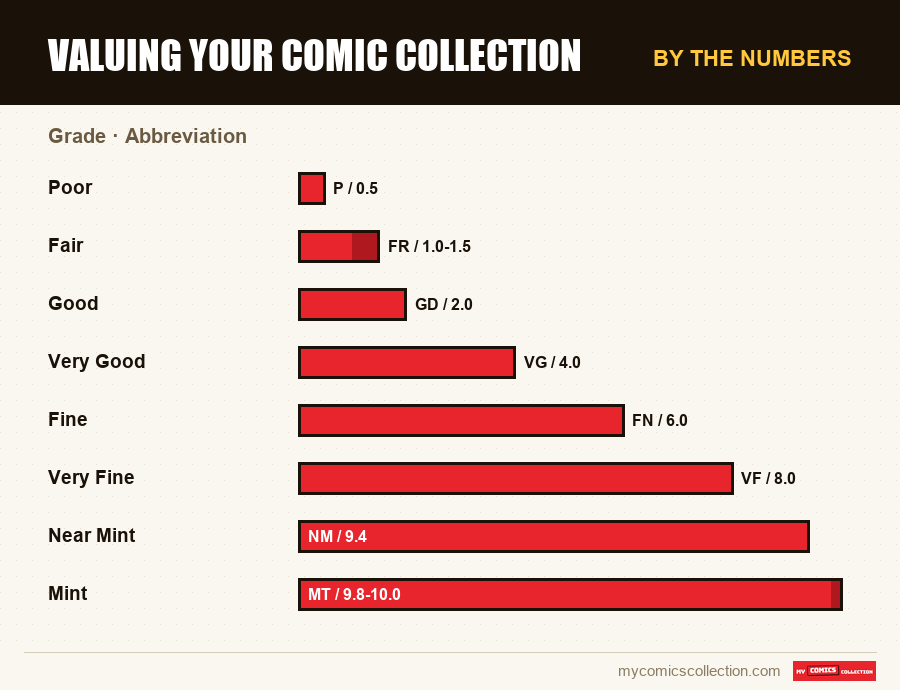
| Grade | Abbreviation | Description | Value impact |
|---|---|---|---|
| Poor | P / 0.5 | Heavily damaged, possibly incomplete | 5-10% of NM price |
| Fair | FR / 1.0-1.5 | Many defects, readable | 10-20% |
| Good | GD / 2.0 | Obvious defects but complete | 20-30% |
| Very Good | VG / 4.0 | Some defects, generally good condition | 35-50% |
| Fine | FN / 6.0 | Light use marks only | 55-70% |
| Very Fine | VF / 8.0 | Near perfect, very light marks | 75-90% |
| Near Mint | NM / 9.4 | Nearly new, a few micro-defects | 100% (reference) |
| Mint | MT / 9.8-10.0 | Perfect, often CGC-graded | 120-300%+ |
Valuation tools
Several tools can estimate your comics' value. They're not all equivalent:
eBay, Completed Listings
The most direct way to know a comic's real value: search the issue on eBay, then filter on "Completed Auctions" and "Sold Items." You'll see the prices actually paid by real buyers. Always use sold prices, never asking prices: they can be unrelated to the real market.
Overstreet Comic Book Price Guide
The collector's bible since 1970. Overstreet provides price ranges by condition and identifies community-recognized key issues. Its main drawback: it's published once a year and can lag market fluctuations. It remains indispensable as a base reference and for identifying important issues.
GoCollect
A site specialized in tracking CGC-graded comic sale prices. GoCollect aggregates real sales data and displays price evolution charts over time. Particularly useful for CGC key issues. The paid subscription gives access to full data and price alerts.
Heritage Auctions
The largest comics-specialized auction house in the US. Heritage publishes its complete auction results, making it a price reference for rare pieces and exceptional collections. Ideal for high-value key issues where few copies are sold on eBay.
GPA, Grade/Price Analyzer
A tool specialized in CGC price analysis. GPA (gocollect.com/analytics) lets you know a comic's average price by exact CGC grade over the last 30, 90 or 180 days. Especially precise for collectors who buy or sell CGC-graded comics.
Collecting this series?
Track what you own, what you are missing and what your collection is worth. 7 day trial.
Start my trial →CGC and its impact on value
CGC certification (Certified Guaranty Company) is the reference standard for comic certification in the US and Europe. The process: send a comic to CGC, which evaluates it, assigns a 0.5 to 10.0 grade, and encapsulates it in a sealed rigid plastic slab with the printed grade.
Graded comics vs. raw comics
A raw comic (ungraded, in its usual sleeve) and the same comic CGC-graded don't sell for the same price: even at equivalent estimated grade. CGC certification brings three things the market values:
- Objectivity: the CGC grade creates consensus, even between buyer and seller who don't trust each other
- Protection: the slab protects the comic indefinitely
- Liquidity: CGC comics sell more easily internationally
When should you grade your comic?
CGC certification is profitable starting around $110-170 of raw value. Below that, the certification fees ($30-65 per comic excluding international shipping) aren't covered by the CGC premium. For major key issues in very good condition, certification is almost always recommended.
Valuation via a dedicated app
Issue-by-issue valuation of an entire collection is tedious work done manually. That's exactly where a dedicated app like My Comics Collection makes sense.
The app integrates valuation data based on current eBay listings and lets you get an estimate of your collection's total value automatically, issue by issue, accounting for the condition you've entered. No more hours of searching eBay issue by issue: valuation is aggregated and regularly updated.
At a glance, you can identify your most valuable pieces, track your collection's evolution over time and export a valued inventory for your insurer. Discover all the collection valuation features in My Comics Collection.
When to have your collection valued by an expert
In some cases, a human expert valuation is preferable to a numeric estimate:
- For insurance: some specialized insurers require professional appraisal for collections over $11,000
- For estate planning: in case of gift or inheritance, a notarized appraisal may be required
- For a significant lot sale: if you're selling all or most of your collection, a specialized dealer can make you a global offer based on their own inventory
Auction houses like Heritage Auctions or specialized appraisers offer expertise services. Specialized comics dealers often propose free estimates in exchange for right of first refusal on the sale.
Valuation pitfalls to avoid
Basing decisions on asking prices
A seller can list any price on eBay. What matters is the price actually paid. Always filter on completed sales and sold items.
Confusing Overstreet with real value
Overstreet can be 12 to 18 months behind the market. For popular key issues, real value often significantly exceeds the guide, and vice versa for unpopular issues.
Overestimating condition
Every collector tends to overestimate their comics' condition. Be objective, or have your important pieces evaluated by a third party before selling.
Ignoring market fluctuations
A key issue's value can double or collapse in weeks depending on Marvel/DC news. A valuation done 6 months ago can be significantly outdated.
FAQ, valuing your comic collection
Calculate your collection's value
My Comics Collection automatically values each issue of your collection based on current eBay listings. Get a precise estimate in minutes.
🚀 Start 7-day free trial, no commitment