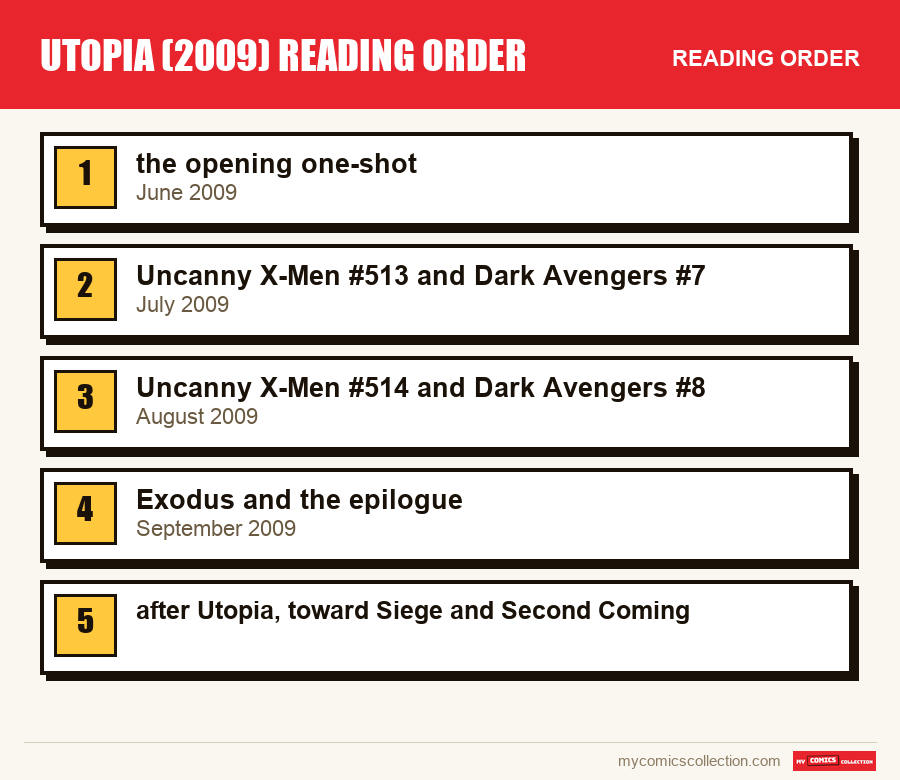
The Utopia (2009) reading order covers the summer 2009 crossover between The Uncanny X-Men and Dark Avengers, the X-Men vs. Dark Avengers showdown written by Matt Fraction in six installments, from June to September 2009. Open with the one-shot subtitled Utopia, then alternate Uncanny X-Men #513, Dark Avengers #7, Uncanny X-Men #514 and Dark Avengers #8. Close with the one-shot subtitled Exodus. Catch up on the tie-ins afterward.
Few events fit into a single stack of single issues as neatly as Utopia: an opening chapter, four regular-series issues that answer each other, and a closing chapter. The trap is not the length, it is the alternation between two series with different publishing histories, and the temptation to read one title all the way through before the other. This guide puts the six pieces back in release order.
As always on this guide, only verified information (creators, issue numbers, dates) is stated as fact; the analysis is our own, with no reproduction of protected art or dialogue.
What to read first
Utopia only makes sense inside Dark Reign, the Marvel publishing era in which Norman Osborn dominates the universe. The context weighs more than the mechanics of the plot: you meet alliances that only make sense if you know who serves whom. Four touchstones are enough before you begin.
- Secret Invasion, the event that comes before Dark Reign and sets up Osborn's rise; you will find its breakdown in our Dark Reign reading order.
- Dark Avengers #1 to #6: the series, written by Brian Michael Bendis, follows the formation of the Avengers under Osborn's control. Issue #1 dates from January 2009 and is drawn by Mike Deodato.
- The Uncanny X-Men before #513: the series Matt Fraction is writing at this point, and whose two crossover issues form the heart of the event.
- A quick scouting read of the X-Men section of Dark Reign, so you know why Emma Frost and Namor are standing next to Cyclops.
If you only have an hour, read just issues #1 to #6 of Dark Avengers: they set the scene on Osborn's side, which is the side you know least when you arrive from the X-Men. Conversely, a reader coming from Dark Avengers will benefit from skimming our X-Men reading guide to understand the mutants' ground.
Phase 1: the opening one-shot (June 2009)
In June 2009, a one-shot subtitled Utopia kicks things off; Marc Silvestri drew its cover. It is the opening chapter, the one that stages the meeting between the two camps; do not skip it just because the next issue carries the series title. It goes before everything else, including Uncanny X-Men #513.
A point of method: the one-shot's numbering does not fit into either series. File it separately in a storage box, or at its June 2009 date between Dark Avengers #6 and #7 if you shelve by release date. Many readers discover after the fact that they skipped it, because the series issues that follow seem to stand on their own; that is a reading mistake, not a collecting one.
The core of the story is written by Matt Fraction, with Brian Michael Bendis consulted on the main story without a writing credit. It is a useful detail: Dark Avengers changes writers for the length of the crossover, which explains why issues #7 and #8 of the series read differently from the run that precedes them. To place the writer in the rest of his work, see the Matt Fraction page.
Phase 2: Uncanny X-Men #513 and Dark Avengers #7 (July 2009)
In July 2009, two series issues form the first movement of the crossover. Put The Uncanny X-Men #513 first, then Dark Avengers #7. Both are written by Matt Fraction. Around them, release order places three supporting titles, which you can read or defer.
- The Uncanny X-Men #513, the series' entry into the crossover.
- Dark X-Men: The Beginning #1, the opener of a three-issue anthology written by James Asmus and Paul Cornell.
- X-Men: Legacy #226, written by Mike Carey, an optional tie-in that slips in at this point of the release schedule.
- Dark Avengers #7, the response from Osborn's camp.
- Dark X-Men: The Beginning #2, which closes out the month of July.
Reading direction matters: in Uncanny X-Men #513, the reader sits on the mutants' side, while Dark Avengers #7 flips the focus. Doing it the other way around does not hurt comprehension, but you lose the reverse-shot effect the alternation was designed for. The crossover works like a swap between series: the same event, seen from two different editorial rooms.
If you read in collected editions, check that your volume contains both July issues side by side rather than separated by unrelated issues. That single check tells you whether a volume respects the alternation or shelves things series by series.
Phase 3: Uncanny X-Men #514 and Dark Avengers #8 (August 2009)
The second movement runs through August 2009. Use the same pattern: The Uncanny X-Men #514, then Dark Avengers #8. Between them, in release order, comes X-Men: Legacy #227 by Mike Carey, while Dark X-Men: The Beginning #3 wraps up the month.
Spoiler warning: the crossover tips the balance of power between Osborn and his former allies. Emma Frost and Namor, who served him, turn against him, and the X-Men set up their own territory on the island of Utopia, built from Asteroid M, which Cyclops declares outside Osborn's jurisdiction. That is where the title comes from, and the reason Utopia matters for the rest of Dark Reign: from this point on Osborn is no longer the untroubled arbiter of the universe, and the road to Siege opens. Our page on the Siege reading order covers the arrival.
In practice, the watch-out at this stage is the same as in July: do not break up the reading between #514 and #8. The two single issues end on gestures that answer each other. Interrupting the thread with a full tie-in, for example the three issues of Dark X-Men: The Beginning back to back, breaks the rhythm the main series has built.
Phase 4: Exodus and the epilogue (September 2009)
September 2009 brings the conclusion: Dark Avengers/Uncanny X-Men: Exodus #1, a one-shot also written by Matt Fraction. It closes the crossover the way the June one-shot opened it: you therefore read Utopia #1 on the way in and Exodus #1 on the way out, with the four series issues in the middle.
The same month also brings the epilogue Dark X-Men: The Confession #1, a one-shot by Christopher Yost and Craig Kyle. It extends the reading on the side of the characters from the Dark X-Men miniseries; it is useful if you followed that miniseries, negligible otherwise. Another September one-shot, Dark Reign: The List - X-Men, serves as the immediate follow-up to the crossover and belongs to the The List one-shot series, to be slotted in with our general guide to this period.
Do you collect this series?
Track what you own, what you are missing and what your collection is worth. 7-day trial.
Start my trial →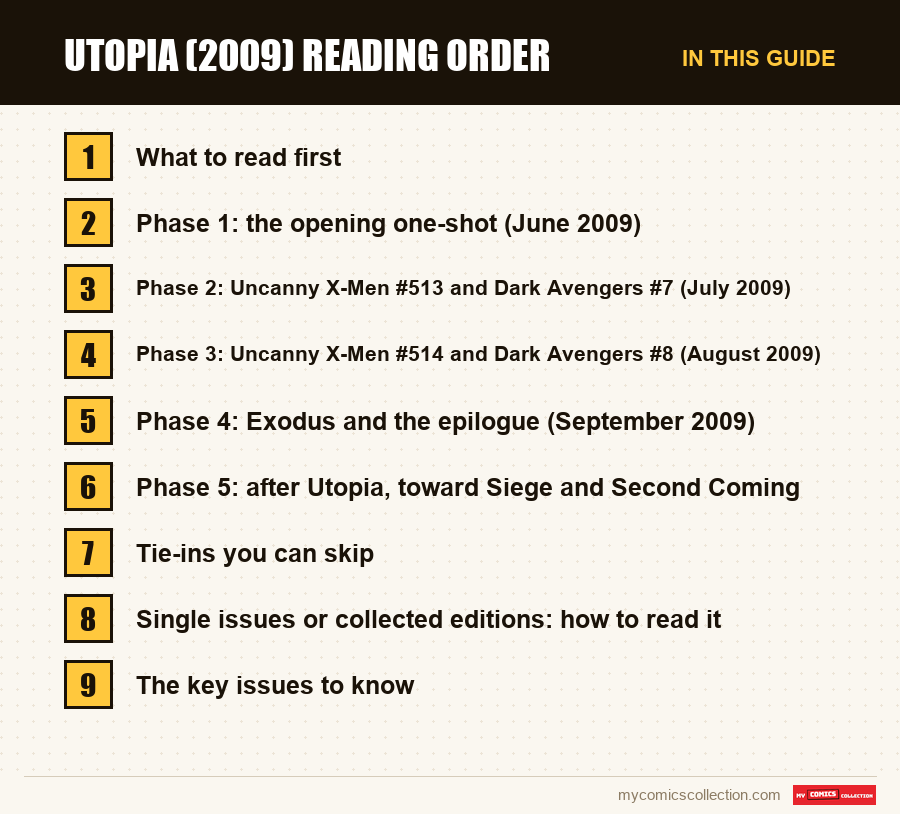
Phase 5: after Utopia, toward Siege and Second Coming
Two directions open up once Exodus is closed. On Osborn's side, the thread continues through the following issues of Dark Avengers and leads to Siege, which concludes the era in 2010. On the mutants' side, the island becomes the place where the X-Men live and face their enemies in the following seasons; that sequel is detailed in our Second Coming reading order.
If you have to choose, follow the direction of your core series: Avengers readers should continue with Dark Avengers and then Siege; mutant readers should go through the Uncanny X-Men issues that follow, then join Second Coming. The two paths meet again in the shared universe, and our Avengers reading guide shows how to link them.
Tie-ins you can skip
Three titles orbit the core, and none is needed to follow the event. Skipping them costs you no step of the main series; they widen the angle, nothing more.
- X-Men: Legacy #226 and #227, written by Mike Carey: two issues of a regular series that connect to the crossover. Read them if you follow Carey's series, otherwise pass.
- Dark X-Men: The Beginning #1 to #3, a miniseries by James Asmus and Paul Cornell: an anthology approach built around the mutants of Dark Reign. A curiosity-driven extra.
- Dark X-Men: The Confession #1, an epilogue by Christopher Yost and Craig Kyle: save it for the end, after Exodus.
The simple rule: if a title is not written by Matt Fraction and is not on the list from Phase 1 through Phase 4, it is optional. This list is deliberately short: only titles confirmed as tied to the crossover are cited, and nothing else is claimed.
Single issues or collected editions: how to read it
In single issues, the reading is straightforward: six pieces, one alternation, and a release window from June to September 2009. The pleasure lies in the month-by-month flow and the contrast between two series with different flavors: one is a mutant title, the other a series about manipulated heroes. Keep the opening one-shot with the July issues so you do not lose it.
In collected editions, the test is to read the table of contents before you buy or start. Look for the four series issues, the two one-shots (opening and closing) and the order in which they are printed. A volume that puts all the Uncanny X-Men issues before the Dark Avengers ones turns the reading into two stories in sequence rather than one crossover. If you run into that, reorder it yourself using the list in the recap below.
On the American collected editions side, the Dark Avengers/Uncanny X-Men: Utopia hardcover from November 2009 gathers the two one-shots, the four series issues and all the tie-ins cited below; the April 2010 trade paperback is limited to the core. In every case, compare the contents against the complete-order list and you will know right away whether a piece is missing.
The key issues to know
This crossover is not about first appearances: its collector value rests on the readability of the whole and on the relative scarcity of the smaller formats. Here are the benchmarks for method.
- The two one-shots: Dark Avengers/Uncanny X-Men: Utopia #1 and Exodus #1 bookend the event; these are the issues to hunt first for a complete collection.
- The Marc Silvestri cover on the opening one-shot: it is the image that identifies the event in a shop window; check in the catalog which covers were printed for this issue before you sign off on a copy.
- The Uncanny X-Men #513 and #514: the two series issues at the heart of the crossover, to keep in clean condition as a pair.
- Dark Avengers #7 and #8: also to be treated as a pair, because the change in writing sets these issues apart from the rest of the series.
The method is the same for every piece: compare several copies, check the condition under light, look for a possible variant in the catalog, then measure the asking price against a series of completed sales. No dollar figure appears here, because a number ages faster than an issue.
Recap: the complete order
- Dark Avengers #1 to #6 (Dark Reign, Bendis, Mike Deodato at launch), for context.
- Dark Avengers/Uncanny X-Men: Utopia #1, opening one-shot (June 2009).
- The Uncanny X-Men #513 (July 2009).
- Dark X-Men: The Beginning #1 (optional).
- X-Men: Legacy #226 (optional).
- Dark Avengers #7.
- Dark X-Men: The Beginning #2 (optional).
- The Uncanny X-Men #514 (August 2009).
- X-Men: Legacy #227 (optional).
- Dark Avengers #8.
- Dark X-Men: The Beginning #3 (optional).
- Dark Avengers/Uncanny X-Men: Exodus #1, closing one-shot (September 2009).
- Dark X-Men: The Confession #1, epilogue (September 2009, optional).
- Next: Siege (2010) or Second Coming, depending on your core series.
Frequently asked questions
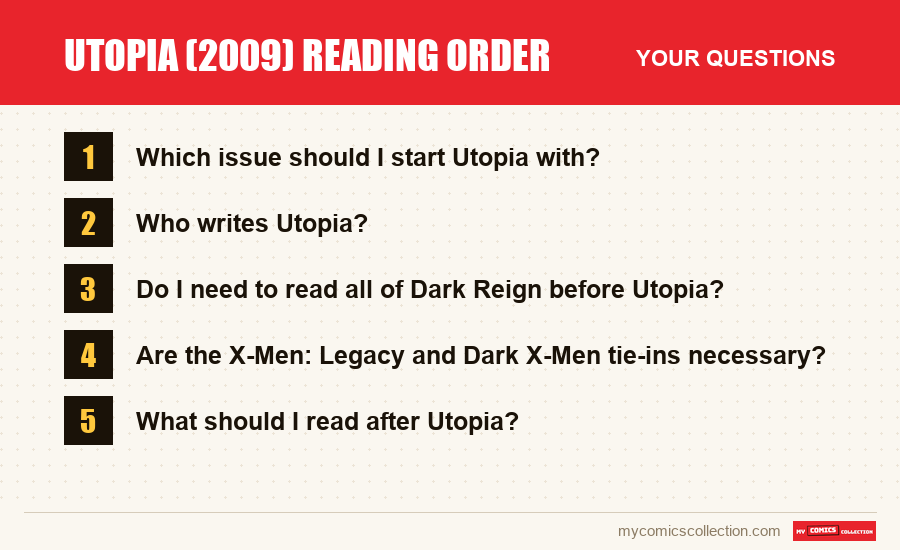
Enter through the June 2009 one-shot that carries Utopia in its title. It opens the crossover. Then follow with The Uncanny X-Men #513, which opens the event on the regular-series side, and alternate with Dark Avengers #7.
Matt Fraction writes the core of the crossover, that is Uncanny X-Men #513 and #514, Dark Avengers #7 and #8 and the opening and closing one-shots; Brian Michael Bendis was consulted on the main story. The tie-ins have other writers: Mike Carey, James Asmus, Paul Cornell, Christopher Yost and Craig Kyle.
No. The first six issues of Dark Avengers and a scouting read of our Dark Reign reading order are enough to understand who serves whom. You can then read Utopia without going through every miniseries of the era.
None is essential. X-Men: Legacy #226 and #227 (Mike Carey) and Dark X-Men: The Beginning #1 to #3 are read as supplements, if you follow those series or want to widen the reading. The core fits in six pieces.
Two paths open up: Dark Avengers then Siege (2010) if you follow Osborn's camp, or the continuation of the X-Men on their island, up to Second Coming. Each has its own guide on this site: pick the one that matches your core series.
Your Utopia and Dark Reign single issues are sitting in a box: get them appraised before you rebuild the run.
Estimate my comic