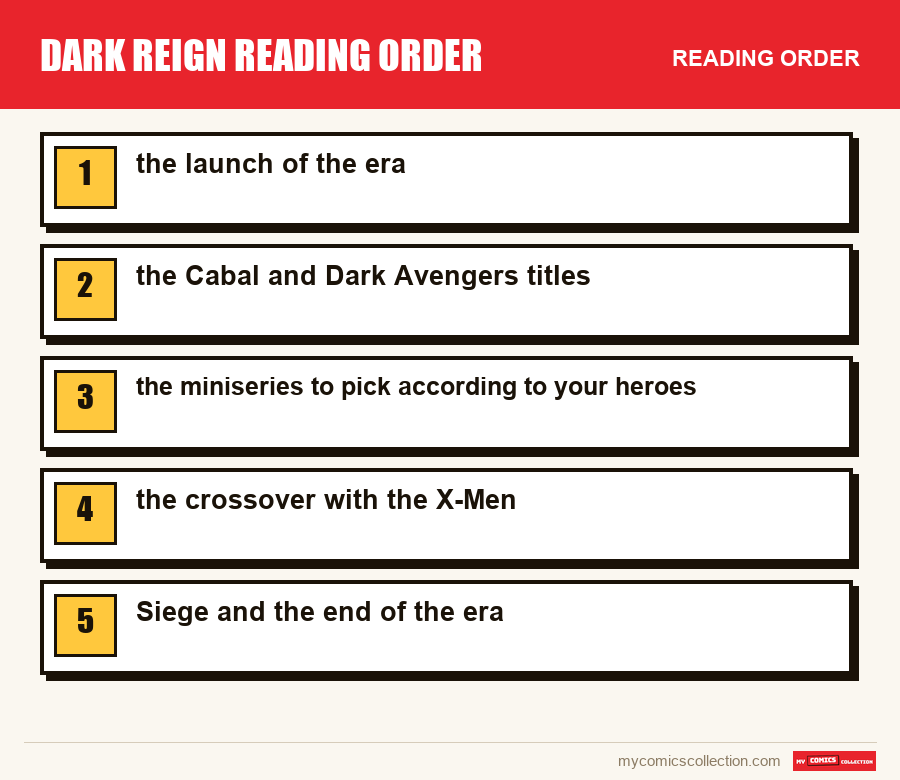
The Dark Reign reading order starts with a catch: it is not a miniseries but a Marvel publishing era, from late 2008 through 2009, with Norman Osborn's era unfolding step by step. Read Secret Invasion #1-8 first (Brian Michael Bendis, Leinil Francis Yu), then the one-shot Secret Invasion: Dark Reign (Bendis, Alex Maleev), then Dark Avengers #1-16 (Bendis, Mike Deodato). Add Dark Reign: The Cabal and a few miniseries of your choice, and close with Siege #1-4 (Bendis, Olivier Coipel, 2010).
Unlike a classic event, Dark Reign has no issue one and no closing issue of its own: it is a state of the Marvel universe, told through a crowd of regular series and miniseries. The trap for a reader is therefore twofold: not knowing where to jump in, and drowning in a list of titles, many of them peripheral. This guide sorts out the essentials and offers a short path.
As always on this guide, we only state verified facts (creators, issue numbers, dates); the analysis is our own, with no reproduction of protected artwork or dialogue.
What to read before you start
You enter Dark Reign through Secret Invasion, eight issues by Brian Michael Bendis (writer) and Leinil Francis Yu (artist). The miniseries ran in 2008 and its last issue is the pivot of the whole era: that is where the situation the following series will exploit is set up.
Warning, spoiler: at the end of the invasion, Norman Osborn shoots down the Skrull queen Veranke. He gains control of national security, replaces S.H.I.E.L.D. with H.A.M.M.E.R. and forms a secret group, the Cabal, which brings together Emma Frost, Namor, Doctor Doom, The Hood and Loki. You can skip this paragraph if you would rather discover the scene yourself, but keep the reading point in mind: Secret Invasion #8 is read before everything else.
For a comfortable path, four reference points are enough:
- Secret Invasion #1-8: essential, in order. Our page Secret Invasion: the series versus the comics helps place the event.
- A basic knowledge of Norman Osborn, the Green Goblin: his journey is summarized in our reading guide to the character.
- A sense of the Avengers of that period, whose main series Bendis was writing at the time: the Avengers reading guide gives the landmarks.
- No reading is required for the miniseries: each one can be understood with what comes before.
Phase 1: the launch of the era
The era opens with a one-shot, Secret Invasion: Dark Reign, published in December 2008 and created by Brian Michael Bendis and Alex Maleev. It bridges the event that is ending and the one that is beginning: read it right after Secret Invasion #8, before any series of the era. It is easy to miss, because its title makes it look like a Secret Invasion tie-in, when it actually serves as a true prologue.
Follow up with Dark Avengers, the flagship series of the era. On the creative side: Bendis writing, Mike Deodato on art, Rain Beredo on colors; issue #1 comes out in 2009 under the Dark Reign banner. The first run of the series, #1-16, runs from 2009 to 2010 and ends at the moment of the Siege climax. It is the backbone of the path: if you read only one title from the era, read this one.
A note to avoid numbering confusion: the title Dark Avengers is also used later for another series. Thunderbolts takes the title Dark Avengers starting with #175 and ends at #190. It is not the same series as the one by Bendis and Deodato: when you buy single issues, check the volume and the date.
Phase 2: the Cabal and Dark Avengers titles
The second block revolves around the secret group Osborn assembles at the start of the era. The one-shot Dark Reign: The Cabal illustrates this circle directly, with five short stories by Peter Milligan, Kieron Gillen, Matt Fraction, Jonathan Hickman and Rick Remender. It is a short, easy-to-read format, a good way to taste the spirit of the era without committing to a miniseries.
This one-shot is reprinted in the collected edition Siege Prelude, which is useful if you prefer reading in trades: it is one of the few collected editions whose contents are clearly tied to the era. Reading Dark Reign: The Cabal at this point, right after the first issues of Dark Avengers, works well, because you then have both faces of Osborn's power: the official team and the secret circle.
A third title deserves a mention here: Secret Warriors, whose plot is co-planned by Bendis and written by Jonathan Hickman. It is the series that shows the resistance to this situation. Our page on Jonathan Hickman gathers his other Marvel series.
Phase 3: the miniseries to pick according to your heroes
The era spawned many miniseries, which let you see how the new order touches every corner of the Marvel universe. None is essential; you choose them according to the characters you collect. Here are the ones whose creators are established:
- Dark Reign: Elektra, 5 issues, Zeb Wells writing and Clay Mann on art;
- Dark Reign: Fantastic Four, 5 issues, by Jonathan Hickman;
- Dark Reign: Hawkeye, 5 issues, Andy Diggle writing and Tom Raney on art;
- Dark Reign: Young Avengers, 5 issues, Paul Cornell writing and Mark Brooks on art;
- Dark Reign: The Hood, 5 issues, by Jeff Parker;
- Dark Reign: Lethal Legion, 3 issues, Frank Tieri writing and Mateus Santolouco on art;
- Dark Reign: Zodiac, 3 issues, by Joe Casey and Nathan Fox;
- Dark Reign: Mister Negative, 3 issues, by Fred Van Lente;
- Dark Reign: The Sinister Spider-Man, 4 issues, Brian Reed writing and Chris Bachalo on art.
The Fantastic Four reader will probably find that one the most interesting, with Hickman at work, while the reader who follows Hawkeye or the Young Avengers will pick the matching titles. In addition, the era also includes one-shots: Dark Reign: Made Men, by Frank Tieri, and M.O.D.O.K.: Reign Delay, by Ryan Dunlavey, as well as the one-shot collection Dark Reign: The List, where each installment is tied to a series and carries a complementary story.
Phase 4: the crossover with the X-Men
One of the genuinely useful tie-ins is the 2009 Utopia crossover. It opens with the one-shot Dark Avengers/Uncanny X-Men: Utopia (August 2009), continues in Uncanny X-Men #513 and #514 and in Dark Avengers #7 and #8, then closes with a concluding single issue. It slots in between #6 and #9 of Dark Avengers: read the one-shot, then the four single issues of the two series in release order, before returning to #9. The hardcover Dark Avengers/Uncanny X-Men: Utopia (December 2009) collects the whole thing, so you do not miss a piece.
This passage illustrates the general method for Dark Reign well: the links between series exist, but they are few, and it is better to place each tie-in in the right spot than to follow a global list. Our page on X-Men crossovers places this one within the broader history of mutant events.
Do you collect this series?
Track what you own, what you are missing and what your collection is worth. 7-day trial.
Start my trial →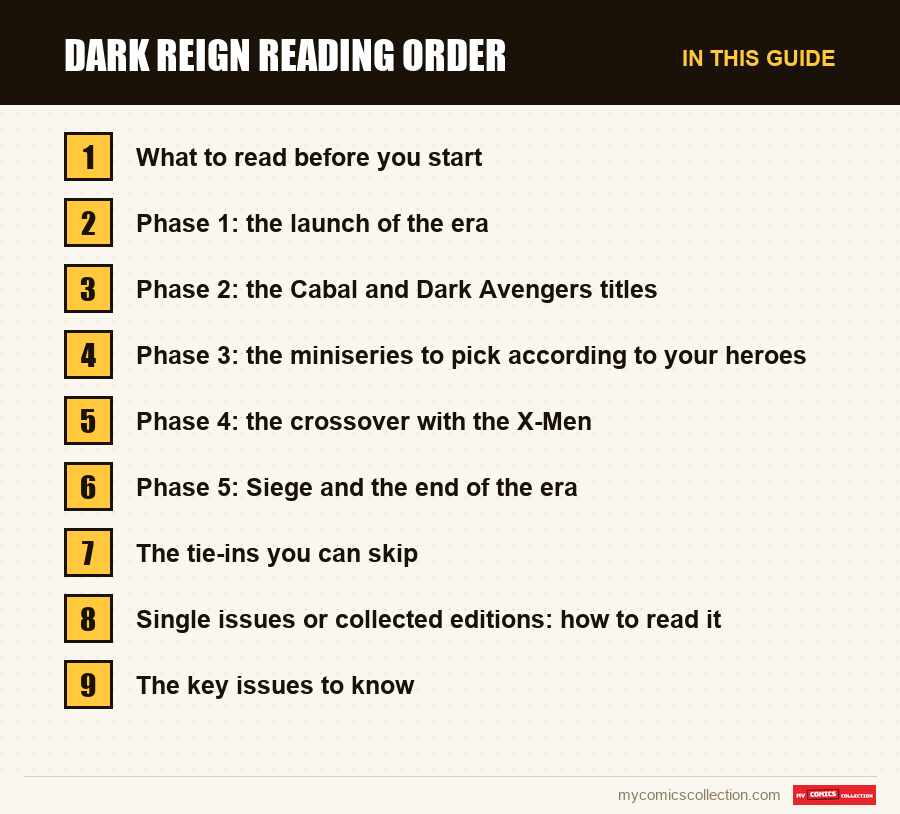
Phase 5: Siege and the end of the era
The era leads into Siege, a four-issue miniseries published in 2010: Bendis writes, Olivier Coipel draws. It is the end of the Osborn era: Dark Avengers #16 ends at the moment of the Siege climax. The collected edition Dark Avengers: Siege gathers issues #13-16 and Dark Avengers Annual #1.
For Siege, the tie-ins are more numerous; the easiest to place are the single issues bearing its name: Siege: Embedded (4 issues), Siege: Loki, Siege: Young Avengers, Siege: Secret Warriors and Siege: The Cabal (1 issue each), as well as Siege: Captain America and Siege: Spider-Man. The direct follow-up is Avengers Prime: Siege Aftermath (five parts, June 2010), then the new cycle called Heroic Age. We do not detail what happens in Siege, because the story reads better blind.
The tie-ins you can skip
Almost everything, truth be told, except the core of Dark Avengers and the two one-shots mentioned above. The miniseries are standalone stories: each features a character or a group in the context of the era, but the main story depends on none of them. Regular titles like Punisher (2009), Thunderbolts, Deadpool and Uncanny X-Men also carry plotlines tied to the era, but they are best read as part of their own series.
Likewise, other titles of the era have miniseries of their own: New Avengers: The Reunion (4 issues), Doctor Voodoo: Avenger of the Supernatural (5 issues), Dark X-Men: The Beginning (3 issues), Skrull Kill Krew (5 issues, Adam Felber), Dark Avengers: Ares (3 issues). They are optional: they enrich the whole without conditioning your understanding of Dark Avengers or Siege.
If you collect the character of Norman Osborn, our best comics of the Osborn family offers more leads around the clan.
Single issues or collected editions: how to read it
For a publishing era, reading in collected editions has a clear advantage: it spares you from chasing dozens of small series. The collected editions that accompany the era generally group one series or one narrative thread. We do not claim to list every volume, but two are solidly tied to the reference points of this guide: Siege Prelude, which reprints Dark Reign: The Cabal, and Dark Avengers: Siege, which gathers issues #13-16 and the annual.
In single issues, the safest method is to build the backbone: Secret Invasion #1-8, the one-shot Secret Invasion: Dark Reign, Dark Avengers #1-16 and Siege #1-4. These twenty-nine single issues and their reading order form a coherent whole. The miniseries are then added in small blocks of three to five issues, according to your interests.
For preservation, shelve the single issues of a given miniseries together: a complete set sells and files better than isolated issues. And for condition, judge the single issue first, then the printing notation: the same issue can exist in several printings.
The key issues to know
For an era that spans so many titles, the key issues are counted in landmarks rather than stars. Here are the reference points to follow:
- Secret Invasion #8: the issue that sets up the situation, by Bendis and Yu. Look for it preferably in near-mint condition, since it is the link between two events.
- Secret Invasion: Dark Reign (December 2008): the one-shot that officially launches the era.
- Dark Avengers #1 (2009): the first issue of the series by Bendis and Deodato, whose printing and cover you should check when buying.
- Dark Reign: The Cabal: the ensemble one-shot, which brings together five acclaimed writers.
- Siege #1 (2010): the opening of the final miniseries.
Method for valuing one of these single issues: first identify the exact printing and cover, then compare only completed sales covering the same reference and the same stated condition. A cover variant is never compared with the standard printing. Apply the same method to Jonathan Hickman's series, whose work often attracts collectors.
Recap: the complete order
- Secret Invasion #1-8 (2008).
- Secret Invasion: Dark Reign, one-shot (December 2008).
- Dark Avengers #1-6 (2009).
- Dark Reign: The Cabal, one-shot.
- Utopia: the one-shot Dark Avengers/Uncanny X-Men: Utopia, then Uncanny X-Men #513 and #514 and Dark Avengers #7 and #8, and the conclusion.
- Dark Avengers #9-12.
- Dark Reign miniseries of your choice (Elektra, Fantastic Four, Hawkeye, Young Avengers, The Hood, and others).
- Dark Avengers #13-16 and Dark Avengers Annual #1.
- Siege #1-4 (2010), with its tie-ins of your choice.
- Avengers Prime: Siege Aftermath (June 2010), then Heroic Age.
Frequently asked questions
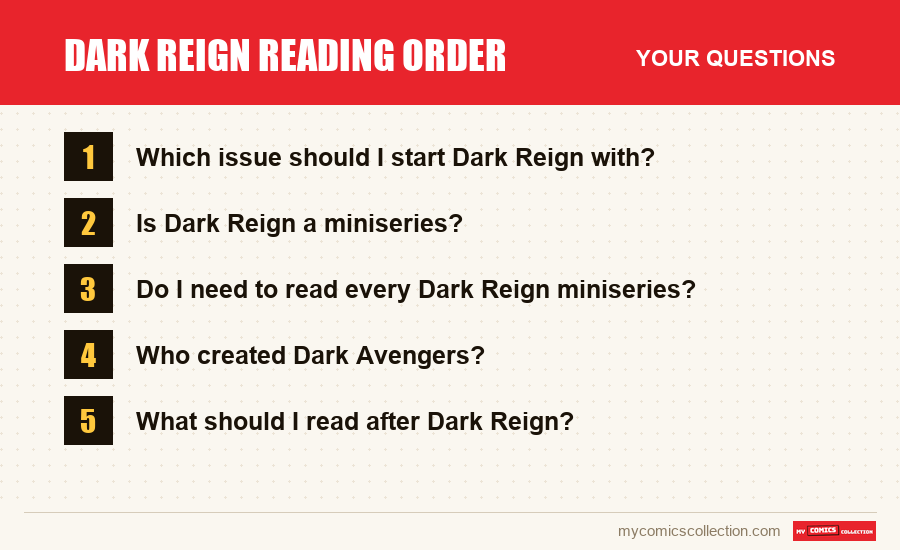
Open Secret Invasion #1-8 (Bendis, Yu): the eighth issue sets up the situation for the entire era. Then read the one-shot Secret Invasion: Dark Reign, followed by Dark Avengers #1, which is the flagship series of the era.
No, it is a Marvel publishing era, from late 2008 through 2009, carried by regular series, one-shots and many miniseries. It has no opening or closing issue of its own, and it leads into the Siege miniseries in 2010.
No. They are independent of one another and are chosen according to the characters you follow: Elektra, Hawkeye, the Young Avengers, the Fantastic Four and others. The main reading fits inside Dark Avengers, the one-shot The Cabal and Siege.
Dark Avengers: Bendis writing, Mike Deodato on art, Rain Beredo on colors. Its first volume runs sixteen issues, published from 2009 to 2010, and ends at the moment of the Siege climax.
Read Siege #1-4, by Brian Michael Bendis and Olivier Coipel, which concludes the era in 2010. The direct follow-up is Avengers Prime: Siege Aftermath, in five parts, published in June 2010, then the cycle titled Heroic Age.
Do you own single issues of Secret Invasion, Dark Avengers or Siege? Get them appraised.
Estimate my comic