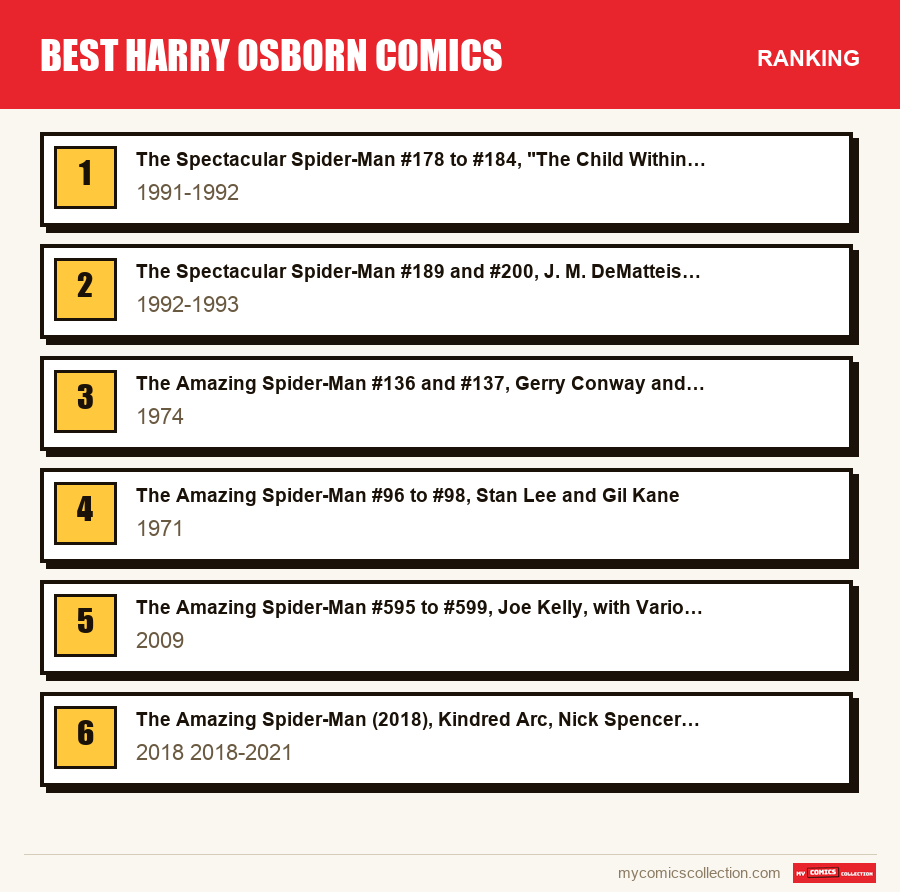
The best Harry Osborn comics to read start with The Spectacular Spider-Man #178 to #184, "The Child Within" (1991-1992) by J. M. DeMatteis and Sal Buscema, then #189 and #200 (1993), which close out his life as the Goblin. Then go back to The Amazing Spider-Man #136-137 (1974) by Gerry Conway and Ross Andru, and to #96 to #98 (1971) by Stan Lee and Gil Kane, where his addiction caused a scandal. His first appearance is in #31 (December 1965).
Harry Osborn is the son of a man Spider-Man has fought since 1964, the friend of a hero who hides his identity from him, and, twice over, a full-fledged Green Goblin. His best stories live in the Spider-Man titles, in sequences of a few single issues. Six sequences spread between 1971 and 2021 put him front and center: for each, you will find what it adds to the character, the reader it targets, and how to read it.
As always in this guide, we only state verified facts (creators, issue numbers, dates); the analysis is our own, with no reproduction of protected artwork or dialogue.
His First Appearance
Harry Osborn first appears in The Amazing Spider-Man #31, cover-dated December 1965, an issue with Stan Lee on script and Steve Ditko on art. He meets Peter Parker at Empire State University, just as Gwen Stacy enters the series. Harry starts out resenting Peter, before understanding that Peter is shy and preoccupied with his Aunt May. From this misunderstanding grows a friendship that will lead them to share an apartment.
The issue sets a scene more than a destiny: a classmate of Peter's, soon his roommate, with nothing yet hinting at his future. The link to Norman Osborn will be played up later. For the collection, keep in mind that #31 is a two-faced first appearance, since Gwen Stacy debuts there too, which makes it a sought-after landmark for two characters.
1: The Spectacular Spider-Man #178 to #184, "The Child Within," J. M. DeMatteis and Sal Buscema (1991-1992)
The series The Spectacular Spider-Man then opens up to a writer who will stay on it through #203: J. M. DeMatteis. Sal Buscema has been the regular artist since 1988. The opening arc, "The Child Within," runs from #178 of July 1991 to #184 of January 1992, and brings Harry back as the Green Goblin. In issues #180 and #181 (September and October 1991), the memories of his Goblin years come back to him.
The context is that of a man at peace. Harry has married Liz Allan, and their son Normie has a name that recalls Norman (Web of Spider-Man #67, August 1990). The arc destroys this stability from within: the story cares less about the blows exchanged than about the weight of a legacy Harry cannot shake. What it gives the character is a psychology: Harry stops being the son of an enemy and becomes an adult with his own cracks.
This story will please readers who prefer family tragedy to a brawl. How to read it: from #178 to #184, without tie-ins. The page on the best Green Goblin runs places it in a wider panorama.
2: The Spectacular Spider-Man #189 and #200, J. M. DeMatteis and Sal Buscema (1992-1993)
These two single issues form the conclusion of Harry's trajectory. In #189, cover-dated June 1992, he faces Spider-Man again. In #200, cover-dated May 1993, he takes another dose of the Goblin formula, goes after Spider-Man, and succumbs to its effects. J. M. DeMatteis writes these issues, Sal Buscema draws #200. Both issues are collected in the trade paperback Spider-Man: Son of the Goblin.
What stands out is the restraint. Sal Buscema has said the last two pages were grueling to draw, and J. M. DeMatteis chose to put no dialogue in them. The issue trusts the image, and that sobriety explains why it is still cited today. It suits any Spider-Man reader, including those who haven't followed the previous arc. How to read it: after "The Child Within" ideally, but #200 stands alone if you're after the conclusion.
On the shelf side, the key issues of the series place #200 among the other landmarks of the title.
3: The Amazing Spider-Man #136 and #137, Gerry Conway and Ross Andru (1974)
After Norman Osborn's death in #122 of July 1973, Gerry Conway sets in motion the tipping of his son. Issue #136, cover-dated September 1974, shows him donning the Green Goblin costume; #137, from October 1974, ends with his arrest after he is knocked out. Ross Andru draws these issues, and John Romita Sr. does the cover of #136. The writer has noted that he did not mean to remove the Goblin from the mythology for good.
Harry is here a young man in crisis: dumped by Mary Jane Watson, he suffers an amphetamine overdose and receives a diagnosis of schizophrenia. The story gives him a villain role, but also a tragic dimension. Harry is then released, suffers a concussion, and forgets that Peter is Spider-Man; the memories of this period will come back in 1991. Another character, the psychologist Bart Hamilton, becomes the third Green Goblin in #151 of December 1975.
It answers the question of where Harry's mask came from and will appeal to fans of Conway's period stories. How to read it: as two consecutive issues, after optionally reading #122 on the page about the death of the Green Goblin. Gerry Conway's work is detailed on his hub.
4: The Amazing Spider-Man #96 to #98, Stan Lee and Gil Kane (1971)
These three issues, cover-dated May to July 1971, remain famous for an editorial reason. Harry is hospitalized there after abusing pills, in a story Stan Lee writes in response to a request from federal health authorities. The Comics Code Authority refuses its seal, because the code forbids depicting drugs, even in a cautionary message. Publisher Martin Goodman gives the go-ahead to publish without the seal, and the single issues sell well. Gil Kane draws these issues, and the code is loosened afterward.
In #98, from July 1971, Spider-Man shows Norman the state of his son, which brings him back to his senses and halts the fight. Harry is here the pivot of a story bigger than he is: he doesn't fight, but his condition drives everything. What the entry gives him is the face of a victim, which precedes his tipping point of 1974.
It suits readers who are as interested in industry history as in the character. How to read it: as three consecutive issues, accepting the tone of the era. To place the writer, the page on Stan Lee is a good starting point.
Do you collect this series?
Track what you own, what you are missing and what your collection is worth. 7-day trial.
Start my trial →
5: The Amazing Spider-Man #595 to #599, Joe Kelly, with Various Artists (2009)
Harry's death in 1993 was erased by the Brand New Day revisions: he reappears as early as The Amazing Spider-Man #545, published in late 2007, an issue by J. Michael Straczynski with Joe Quesada on art that closes out One More Day. This Harry later turns out to be a clone, and the original Harry stays dead. In 2009, during Dark Reign, Joe Kelly writes #595 to #599, from May to September: Harry opposes his father Norman, now in power.
Issue #597, cover-dated August 2009, also sees the debut of the American Son armor, which Harry puts on. The arc gives him a payback: after decades in Norman's shadow, he faces him down. It targets the Brand New Day era reader and anyone who wants to see Harry fight as an adult. How to read it: in order, skipping the Dark Reign tie-ins, reading #544-545 first if you want to understand his return.
6: The Amazing Spider-Man (2018), Kindred Arc, Nick Spencer, with Humberto Ramos and Mark Bagley (2018-2021)
From 2018 to 2021, Nick Spencer writes The Amazing Spider-Man from #1 to #74 of the fifth series, with several artists including Humberto Ramos and Mark Bagley. An antagonist named Kindred, who appears masked from the start of the series, torments Peter for three years, and finally presents himself to him in the guise of Harry Osborn.
The follow-up: in Sinister War, from July to September 2021, Nick Spencer and artists Mark Bagley and Federico Vicentini run the story across four dedicated issues and three issues of the ongoing, #71 to #73. Issue #73 reveals that Kindred is Sarah Stacy and that she and her brother Gabriel are clones of Gwen and Harry; Doctor Strange offers Mephisto one last wager there. In #74 of November 2021, this wager is over the soul of the original Harry, while the Harry who returned in 2007, Harry Lyman, is revealed to be a clone and dies after helping Peter, Norman, and Mary Jane. Zeb Wells writes #75.
What the arc gives him is a final chapter, that of a Harry whose death stays at the heart of the story. It suits anyone who followed the series in the 2010s, since reading it assumes you know Norman and the rogues gallery. How to read it: in issue order, preferably in a collected edition. Note that Harry is not the hero of every page: the arc is an ensemble story of which he is the key.
Where to Start Based on Your Profile
You're new to the character. Open "The Child Within" (#178 to #184), then #200. These two reads are enough to understand who Harry is and what he becomes.
You like period stories. Conway and Andru's #136-137, then Lee and Kane's #96 to #98, give you the two landmarks of the 1971-1974 period.
You're after recent stories. Joe Kelly in 2009, then Nick Spencer's arc. For the latter, keep the Green Goblin reading guide within reach.
You collect. Hunt for the 1965 #31 first, then the 1974 and 1993 issues. Judge each single issue on its actual condition, not on the issue number alone.
The Key Issues to Know
The landmarks below are based on creators and dates, with no market value attached.
- The Amazing Spider-Man #31 (December 1965). His first appearance, by Stan Lee and Steve Ditko.
- The Amazing Spider-Man #96 to #98 (1971). Harry's addiction, by Stan Lee and Gil Kane.
- The Amazing Spider-Man #136 (September 1974). Harry becomes the second Green Goblin.
- The Amazing Spider-Man #151 (December 1975). Bart Hamilton, the third Green Goblin; not to be confused with Harry.
- Web of Spider-Man #67 (August 1990). The marriage to Liz Allan and the birth of Normie.
- The Spectacular Spider-Man #200 (May 1993). Harry's death, by J. M. DeMatteis and Sal Buscema.
- The Amazing Spider-Man #545 (late 2007). His return, at the end of One More Day.
- The Amazing Spider-Man #597 (August 2009). The American Son armor.
- Amazing Spider-Man Presents: American Son (July to October 2010). A four-issue miniseries, by Brian Reed and Phil Briones.
- The Amazing Spider-Man (2018) #74 (November 2021). Harry's death in the Kindred arc.
Shelving method: sort Harry by function rather than by date. One shelf for Peter's friend (1965-1971), one for the Goblin (1974-1993), and one for the returns (2007 to 2021). That way you separate the single issues where Harry is the subject from those where he is merely scenery.
Frequently Asked Questions
Osborn's son makes his debut in late 1965, in issue 31 of the main series, scripted by Stan Lee and drawn by Steve Ditko. The same issue introduces Gwen Stacy, which is why it draws interest for two characters at once.
Harry takes on his father's identity in The Amazing Spider-Man #136, cover-dated September 1974, after Norman's death in #122. Gerry Conway writes the episode, Ross Andru draws it. Issue #137 ends with his arrest.
He dies in The Spectacular Spider-Man #200, cover-dated May 1993, written by J. M. DeMatteis and drawn by Sal Buscema. The Brand New Day revisions then brought him back, before a new death in The Amazing Spider-Man #74 of the fifth series, in November 2021.
No. The entries in this ranking can be read directly. For the period stories, the Conway and Andru two-parter (#136-137) gives the useful context. Norman's other stories are a supplement, not a prerequisite.
Stan Lee deals there with Harry's addiction, at the request of a US public agency. The Comics Code Authority refused its seal, because the code forbade showing drugs. The publisher released the issues without approval, and the code was later loosened.
Do you own an Amazing Spider-Man #31 or a Spectacular Spider-Man #200? Get it appraised before you shelve it.
Appraise my comic