
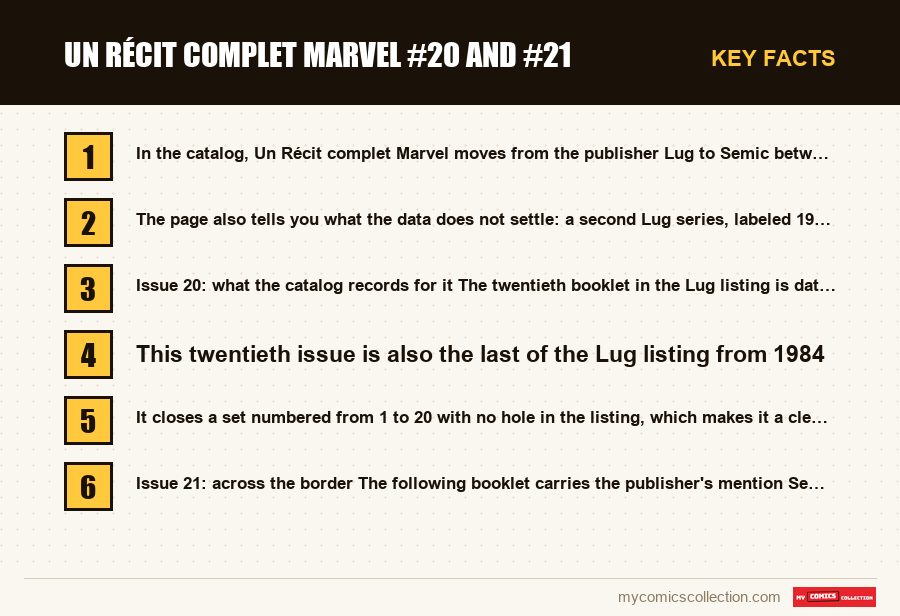
In the catalog, Un Récit complet Marvel moves from the publisher Lug to Semic between issue #20, dated 1988 and titled "Fantastiques contre X-Men," and issue #21, dated February 1989 and titled "La Panthère Noire." The numbering continues with no jump and no reset to one. The page also tells you what the data does not settle: a second Lug series, labeled 1982, exists in the listing but leads to no other sequel.
A collector who completes this magazine quickly runs into the same difficulty: several listings, two publishers, and a single counter. Knowing where one ends and the other begins keeps you from buying the same booklet twice or looking for a number that never existed.
As always on this guide, only verified information (creators, issue numbers, dates) is stated as fact. The analysis is ours, with no reproduction of panels or protected dialogue.
Issue 20: what the catalog records for it
The twentieth booklet in the Lug listing is dated 1988, with no month. Its story is titled "Fantastiques contre X-Men," the script is credited to Chris Claremont and the art to Jon Bogdanove. The title does not say which pages the booklet contains, or whether other stories accompany it. The record guarantees only one title; the rest of the table of contents is read on the copy.
This twentieth issue is also the last of the Lug listing from 1984. It closes a set numbered from 1 to 20 with no hole in the listing, which makes it a clean stopping point in that listing.
Issue 21: across the border
The following booklet carries the publisher's mention Semic, dated February 1989. The story title is "La Panthère Noire," with Peter B. Gillis on script and Denys Cowan on art. As the first issue of a series of 32 booklets, numbered 21 to 52, it does not start anything over: its number continues that of issue 20, and it has no "number one" of its own.
For someone who sorts their magazines by publisher, this is where the pile changes hands. For someone who sorts by number, nothing happens: 21 slides in after 20. Both logics are valid, but they do not produce the same list of gaps, and you have to choose before you start checking.
Two Lug launches, one sequence: what the data settles
The catalog contains two Lug listings, one opened at 1982 and the other at 1984, each starting again from 1. The data lean toward a single sequence rather than two separate collections. The 1982 listing is incomplete and redundant: three rows are missing and four appear twice, so 21 lines share 17 distinct rows.
Its match with the 1984 listing is clear. Ten lines carry the same row and the same story title, four carry a known title under another row, and only seven find no counterpart there.
The simplest reading: the 1982 listing would be a second, noisier cataloging of the same sequence of booklets. The booklet at row 1 is titled "Serval" there, with Claremont and Frank Miller in the credits; the one in the 1984 listing is titled "Le prix de l'honneur," with Claremont and, among the artists, Frank Miller. The coincidence of creators is consistent with a single booklet recorded under two titles, but it does not prove it, and we therefore do not assert it.
The point that matters for the border: both Lug listings stop at the same row, 20, on the same title, "Fantastiques contre X-Men," dated 1988. The catalog holds only one Semic listing, and it begins at 21. Whichever reading is retained for 1982, the Semic sequence continues from a single twentieth issue. What the data do not allow is claiming that a second, distinct Lug launch existed and restarted at 1: it does not show it, and it does not rule it out either.
A rhythm that does not change, dates that change precision
On the Lug side, the 1984 listing places four booklets in each of the five years, from 1984 to 1988. On the Semic side, the 32 booklets fall in groups of four across the following eight years, and their months are February, May, August and November, without exception. The move from one publisher to the other therefore did not change the tempo: one issue roughly every three months, on either side.
The precision of the dates, however, changes clearly. At Lug, 14 of the 20 booklets have only a year; the others carry a month, a quarter, or a month in brackets. At Semic, all of them carry a month, some in brackets, meaning inferred rather than read on the cover. In practice, you cannot measure in months the gap between issue 20 and issue 21, because the first boundary has no month.
Do you collect this series?
Track what you own, what you are missing and what your collection is worth. 7-day trial.
Start my trial →
The immediate neighbors
Before the border, the three previous issues carry the same year, 1988, with no month: "Diablo" (Dave Cockrum), "X-Men contre Vengeurs" (Roger Stern) and "Méphisto" (Al Milgrom). Only the row makes it possible to order them, and issue 20 is the fourth of the block.
After the border, the next three are dated May, August and November 1989: "Niveau Zéro" (Ann Nocenti), "Posséder un lycaon" (Chris Claremont) and "4ème de couverture" (Louise Simonson).
A search detail: Claremont is credited on four Lug booklets, including issue 20, then on four Semic booklets, starting from issue 23. The 1982 listing, for its part, spells this name in two different ways, "Christopher Claremont" and "Chris Claremond." A search by exact string therefore misses some of them; it is better to search by row and story title.
What to check on the copy
The listing gives the story title, credits at booklet level and a cover date; it gives neither the complete table of contents, nor the American counterpart, nor a character's first French publication. The details to note on the copy are therefore: the publisher's name printed on the copy, the printed number, and the date if it is written.
A 1988 booklet with no month is not thereby misdated: the data holds no more than that. Titles in the catalog can also differ from one listing to another: "Un Récit Complet Marvel," with a capital on "Complet," in the 1984 listing and "Un Récit complet Marvel" in the 1982 listing designate the same magazine here. Do not sort your piles on spelling alone.
Entering 20 and 21 in a gap list
The safest method is to keep a single list, ordered by row from 1 to 52, with a "publisher" column beside it. Rows 1 to 20 are ticked as Lug, rows 21 to 52 as Semic. This avoids launch duplicates: a line from the 1982 listing that finds its title in the 1984 listing is not another booklet, unless the object itself proves otherwise.
For the two issues on the border, note the story title as an observation ("Fantastiques contre X-Men" and "La Panthère Noire"): it is a useful marker for telling them apart from a neighboring booklet when the condition of a cover makes the number unreadable. If you are searching for these themes by character, the pages on the Fantastic Four and on Black Panther give reference points on those characters, without prejudging the contents of these booklets.
To follow an entire magazine collection, the other guides on the site are gathered in the blog.
Frequently asked questions
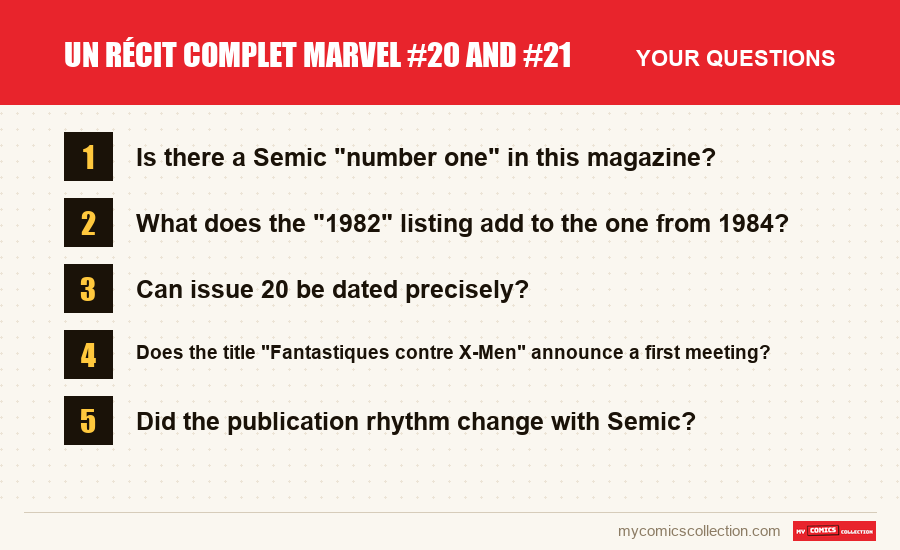
No, according to the catalog. The first Semic booklet carries row 21 and continues row 20 from Lug. The Semic listing contains no row below 21.
It gives title and date variants for booklets already known, with missing and duplicated rows. It helps with cross-checking, not with counting: to establish a list, start from the 1984 listing, which runs continuously from 1 to 20.
Not to the month. The catalog gives 1988 only, as for issues 17 to 19. Look on the copy for a printed date; without one, row 20 and the story title remain the reliable markers.
The data do not allow us to say so. It carries a story title and booklet-level credits, not the table of contents or the history of appearances. Check on the copy what it actually contains.
Not in the listings: four booklets per year at Lug, four per year at Semic. Only the precision of the dates changes, with a readable month on each of the Semic issues.