In short
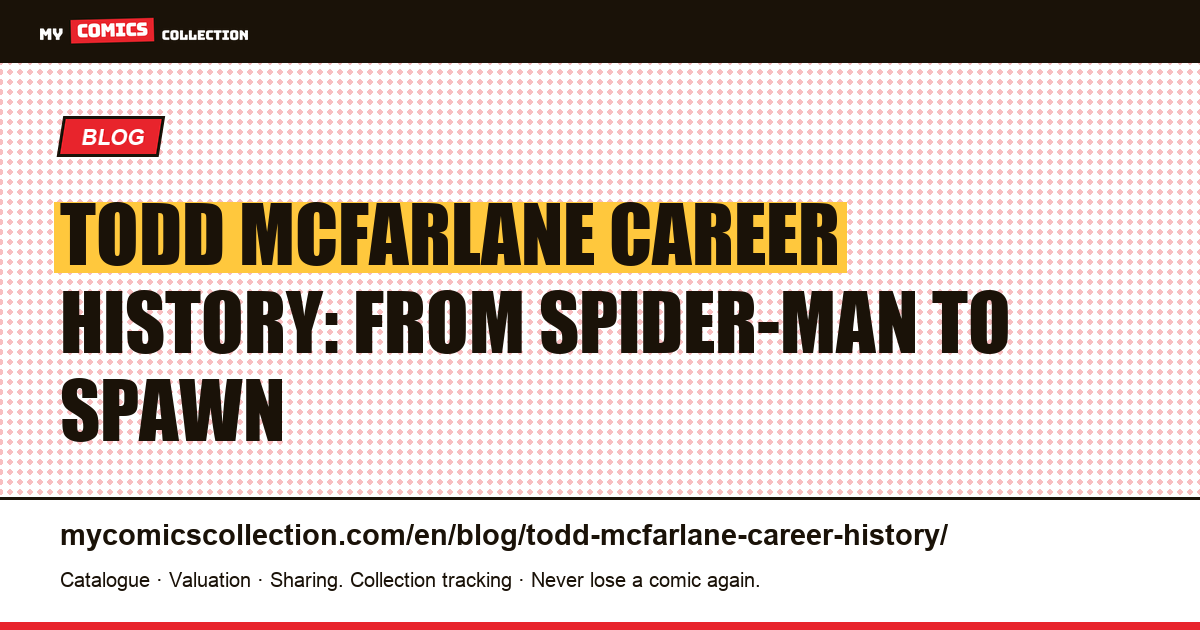
Todd McFarlane broke in with a back-up story in Coyote #11 (1984), then drew DC's Infinity, Inc. and Marvel's The Incredible Hulk with Peter David. The name was made on The Amazing Spider-Man from #298 to #328 (1988 to 1990), with Venom's full debut in #300, and then on the 1990 launch of Spider-Man #1. In 1992 McFarlane cofounded Image Comics and launched Spawn #1, then built a toy company, film and animation work around it.
Todd McFarlane's career is unusual because the biggest change did not come from a better assignment but from a different kind of ownership. The artist moved from small back-up pages to a famous Spider-Man run, then to a solo Spider-Man title written and drawn on the same pages, and finally to a creator-owned character. This page follows that sequence period by period, as a career timeline rather than a ranking of issues.
The issue ranges and years here come from biographical and character sources, with months given only where confirmed; the remarks about what each step did for McFarlane's standing are interpretation.
Coyote and Infinity, Inc. (1984 to 1987)
In 1984 writer Steve Englehart offered McFarlane the first comics job, a back-up story in Coyote #11. McFarlane then drew Coyote issues #11 through #14 in 1985. These are the earliest published pages in the timeline.
The next step was DC's Infinity, Inc., where McFarlane drew full art on issues credited from #14 through #37, from 1985 to 1987. A monthly team book gives an artist two things a back-up page cannot: a steady schedule and a regular readership. For a collector, Infinity, Inc. is the place to see the line before the Marvel years.
Detective Comics and The Incredible Hulk (1987 to 1988)
In 1987 McFarlane illustrated the last three issues of the "Batman: Year Two" story in Detective Comics, issues #576 through #578. The assignment placed McFarlane on a flagship character at DC, though only for a short stretch. Batman would return to the artist's career later as a cover subject and in crossovers, and the Batman #423 cover guide picks up that thread.
Also in 1987 and 1988 McFarlane drew The Incredible Hulk for Marvel with writer Peter David. This is the pivot from DC to Marvel and the stretch that gets collectors' attention first, because it connects the artist to a character with a long catalog. The Hulk pages are the last major step before Spider-Man, and they are discussed alongside the rest of the early work in the starting guide.
The Amazing Spider-Man, issues 298 to 328 (1988 to 1990)
McFarlane joined The Amazing Spider-Man with issue #298 in 1988, working with writer David Michelinie. The run lasted 28 issues and ended with #328 in 1990, during the "Acts of Vengeance" crossover, when Erik Larsen took over as artist. Larsen later became one of the Image cofounders, which is part of why the two names appear together in many Image histories; Larsen has a page of the same kind, the Erik Larsen author page.
The run is best known for Venom. The lead-up was gradual: Web of Spider-Man #18 (1986) showed only a hand, #298 kept the villain in shadow, the last page of #299 had the character face Mary Jane Watson, and The Amazing Spider-Man #300 (1988) gave the first full view. Michelinie is credited with the idea of the villain, and McFarlane devised the monstrous features. That division of credit is why Venom pages are catalogued under both names. The newsstand edition of the issue has its own considerations, covered in the Amazing Spider-Man #300 newsstand guide, and the character's history is in the Venom first appearance article.
What changed in this run is the look of the title itself: for the first time McFarlane's name, and not a writer's, was the main draw on a Spider-Man monthly. Collectors who want the highlights can go straight to the Spider-Man key issues guide, and the broader Spider-Man reading lives on the Spider-Man hub.
Spider-Man #1: writer and artist (1990 to 1991)
In 1990 Marvel launched Spider-Man #1, a new series with no subtitle, which McFarlane wrote and drew. Of the first sixteen issues, McFarlane wrote and illustrated fifteen. The storylines include "Torment," along with "Masques" and "Perceptions." McFarlane left after issue #16, in 1991, which was part of an X-Force crossover.
This is the point where the career changes from artist to author. Until 1990 the stories came from writers such as Peter David and David Michelinie, and from here on the stories on the page are McFarlane's own. It is also the clearest preview of what came next: a lead character, a monthly schedule and one person responsible for plot, script and art. Collectors who want to see that preview in order will find it in Spider-Man #1 through #16, and the later Spawn issues show the same one-person approach carried forward for decades.
The run from #298 to #328 (the bibliography lists #298 to 323, #325 and #328) is a tidy unit for a collector: one artist, a regular writing partner in David Michelinie, and a clear start and end. Because the run overlaps with the early Venom story, it also attracts readers who care less about McFarlane and more about the character, so checking the credit line before buying a lot of issues is sensible. The Venom hub collects the wider reading on the character, from the 1988 debut onward.
Image Comics and Spawn #1 (1992)
Image Comics came together in 1992 as a partnership of seven artists, McFarlane alongside Jim Lee, Rob Liefeld, Marc Silvestri, Jim Valentino and others. The same year, Spawn #1 appeared in May under McFarlane's own studio, Todd McFarlane Productions. Spawn's first appearance is in that issue, and McFarlane is credited as the creator.
For the career timeline, the important element is ownership. On a Marvel or DC title the publisher holds the character and the artist is engaged for a run. With Spawn the character belongs to the creator, and the title does not depend on a company assigning the artist to it. The broader picture of the imprint is in the Image Comics history, and a practical look at the first issue is in the Spawn #1 collector guide.
Do you collect this series?
Track what you own, what you are missing and what your collection is worth. 7-day trial.
Start my trial →
Guest writers and Greg Capullo (up to 1998)
An early signal of how McFarlane would run the series came with issues #8 through #11, where guest writers took over the scripts: Alan Moore on #8, Neil Gaiman on #9, Dave Sim on #10 and Frank Miller on #11. Bringing in other well-known names early in a creator-owned title is an editorial choice, and it set a pattern of mixing McFarlane's own storytelling with outside voices.
Greg Capullo became the regular penciler with issue #26, while McFarlane remained writer and inker through issue #70. The bibliography lists McFarlane as writer on issues #1 through #7, #12 through #15 and #21 through #150, and again from #185 onward. For a collector, the Capullo years are the era most people think of as classic Spawn, and the best Spawn runs page covers how the story arcs break down.
The series also crossed over with DC in 1994: Batman-Spawn: War Devil, written by Doug Moench, Chuck Dixon and Alan Grant and drawn by Klaus Janson, and Spawn/Batman, written by Frank Miller and drawn by McFarlane.
For collectors of the early run, the Batman crossovers are a separate shelf from the main series: the two 1994 books have different writers, a different penciler from the monthly Spawn title, so they are easiest to track as one-shots next to the numbered issues.
Toys, film and animation (1994 to 1999)
In 1994 McFarlane founded Todd Toys, which was renamed McFarlane Toys after a cease-and-desist from Mattel. In 1997 Todd McFarlane Entertainment produced a Spawn film with New Line Cinema, and the animated series Todd McFarlane's Spawn aired on HBO from 1997 to 1999.
Seen as a career move, the toy line and the screen projects turned a comic into a multi-platform property that McFarlane controlled. This is the part of the timeline where the work leaves the page: a collector who follows the artist across toys, film and print is following one brand with a single owner.
Back to plotting, Haunt and the Spawn Universe (2008 to today)
In 2008 McFarlane returned to co-plot Spawn with Brian Holguin starting with issue #185. In 2009 Haunt, a series co-created with Robert Kirkman, launched with McFarlane on inks; the finale, issue #28, was co-written by McFarlane and Joe Casey. The premise follows two brothers, one a ghost and one human, who fuse to become Haunt, and the character appears in other Spawn stories.
Issue #300 of Spawn lists McFarlane, Greg Capullo, Jerome Opeña, guest artist J. Scott Campbell and guest writer Scott Snyder among its creators, and with it the series became the longest-running independent comic book series. Issue #301, dated October 2, 2019, then passed Cerebus as the longest-running creator-owned series. In 2021 a one-shot, Spawn's Universe #1, launched three new ongoing titles, among them King Spawn (Sean Lewis wrote the first 24 issues) and Gunslinger Spawn (McFarlane writing, Brett Booth illustrating). McFarlane also announced a new Batman and Spawn crossover with Capullo for December 2022.
The recent period shows a different pattern from the early one. In the 1980s McFarlane was the artist hired onto other people's titles; in the 2020s McFarlane is the person who decides which writers and artists populate a shared Spawn universe, with Sean Lewis on King Spawn and Brett Booth on Gunslinger Spawn. The same pivot appears at the start of the Image years, when guest writers took over four consecutive issues of the flagship. Across forty years, the career moves from taking assignments to handing them out.
The key issues across the career
- Coyote #11 (1984): the back-up story that started the career, offered by Steve Englehart.
- Infinity, Inc. #14 (1985): the start of the credited run at DC.
- Detective Comics #576 (1987): the first of the last three issues of "Batman: Year Two."
- The Amazing Spider-Man #298 (1988): McFarlane's first issue on the title with David Michelinie.
- The Amazing Spider-Man #300 (1988): the full first appearance of Venom.
- Spider-Man #1 (1990): the new series that McFarlane wrote and drew.
- Spawn #1 (1992): the first appearance of Spawn, under Image.
- Spawn #8 to 11: four consecutive guest scripts, from Moore, Gaiman, Sim and Miller.
How to collect Todd McFarlane's work
The career divides into three buying paths. The Marvel and DC years are about a handful of single issues from the early assignments, and a short run of The Amazing Spider-Man #298 to 328 is easy to track by number. The Spider-Man volume from 1990 has a clear start and end (#1 through #16 for McFarlane's own stories). The Image years are a long continuous series, where the issue count and the creative team changes are the main things to record.
Method matters more than any single title. Keep a checklist per period, record the printing and any variant cover for each issue, and note the credit line, because the writer and artist roles change repeatedly between issues. For Spawn, the writer credit, the penciler and the inker are separate columns in a good checklist. When in doubt, the Spawn collecting guide walks through the ordering step by step.
Frequently asked questions
In 1984 Steve Englehart offered McFarlane a back-up story in Coyote #11. McFarlane then drew Coyote issues #11 through #14 in 1985, before moving to DC's Infinity, Inc. and later to Marvel's The Incredible Hulk with Peter David.
Venom's full first appearance is in The Amazing Spider-Man #300 (1988). Before that, the character appeared in shadow in #298 and on the final page of #299. David Michelinie is credited with the idea and McFarlane with the monstrous design.
McFarlane left The Amazing Spider-Man with #328 in 1990, then wrote and drew Spider-Man #1 to #16 through 1991. In 1992 McFarlane cofounded Image Comics with six other artists, and Spawn #1 appeared in May of that year under Todd McFarlane Productions.
Alan Moore wrote Spawn #8, Neil Gaiman wrote #9, Dave Sim wrote #10 and Frank Miller wrote #11. The four issues came between McFarlane's own scripts on #1 to 7 and #12 to 15.
McFarlane writes Gunslinger Spawn, launched in 2021 with artist Brett Booth, after Spawn #301 made the series the longest-running creator-owned comic in 2019. King Spawn also launched in 2021. A Batman and Spawn crossover with Greg Capullo was announced for December 2022.
Holding a McFarlane issue from Amazing Spider-Man #300 or Spawn #1 and curious where it stands in your collection?
Estimate my comic