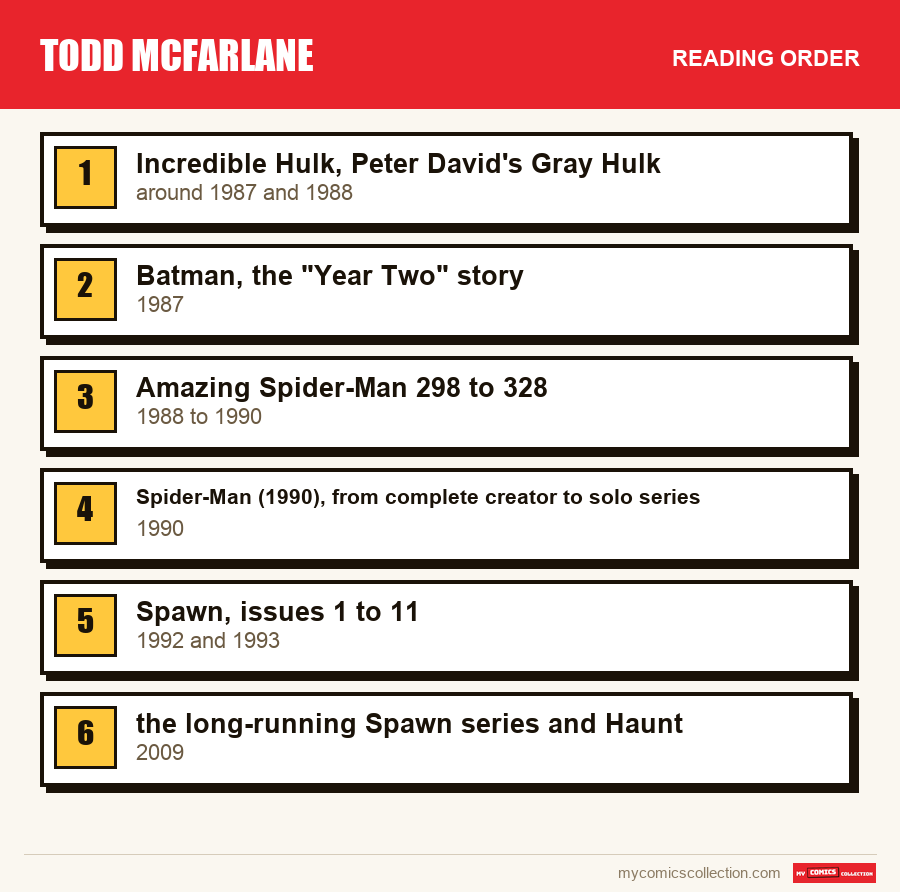
Enter McFarlane through the Gray Hulk of Incredible Hulk (issues 330 to about 346, scripted by Peter David) and the Year Two story in Detective Comics (575 to 578, in 1987). Move on to Amazing Spider-Man 298 to 328 (1988 to 1990), the 1990 Spider-Man series, then Spawn from 1992. Save the long-running Spawn series and Haunt (2009) for the end.
Todd McFarlane is a case apart in comics reading: an artist whose way of drawing weighed more than the stories handed over, then a complete creator, master of the whole script. Reading McFarlane means following two curves at once, that of a style that radicalizes between 1985 and 1992, and that of a writer learning the trade in public. Here there is no career chronology, but an order for entering twelve years of pages.
As always on this guide, only verified facts (creators, issues, dates) are stated as fact; the analysis is our own, with no reproduction of protected art or dialogue.
What to look for in McFarlane, and how to recognize it
Three traits recur from one title to the next and serve as the thread of the path. The first is the cape, the web or the chain: McFarlane readily draws flowing elements that take up half the panel, wrap around the body and carry the motion well beyond the silhouette. The second is heavy inking, with masses of black that swallow the background. The third is the close-up on a distorted face or a mask with oversized eyes, which gives Spider-Man and Spawn alike a very physical presence.
These traits are not equal everywhere. On Hulk or Batman, McFarlane draws a character who already exists and offers a graphic reading of it. On Spider-Man, the interpretation becomes a reference. On Spawn, McFarlane's own character, everything converges: script, art, cover, editorial direction. The path follows this rise in autonomy, and that is what makes it legible for a collector torn between buying period single issues, collected editions or a selection of covers.
No biographical article is devoted to McFarlane on this site: the profile on McFarlane's key issues at Spider-Man places the artist in time, from the collecting side. This guide asks a different question: what to start with to understand what these books bring, without committing to forty issues at once.
Step 1: Incredible Hulk, Peter David's Gray Hulk (around 1987 and 1988)
The gentlest way in is also the shortest. McFarlane draws The Incredible Hulk on issues 330 to 346, with Peter David on script. The hero is the Gray Hulk, craftier and more cynical than the green giant of the early days, and McFarlane gives him a mass and an expression the title had not known. You read these issues to watch an artist who is not yet a star settle into a manner on solid material, carried by a writer who holds the series over the long term.
Issue 340 is the most famous of the sequence, thanks to its face-off between the Hulk and Wolverine, and we devote a separate profile to it: Incredible Hulk #340. For a reader, the advice is not to stop at that single issue. The reading value lies in the continuity of the period, where McFarlane's art accompanies a story still turned toward dark humor and twists, not toward posing.
This step is for the reader curious to see the line before the big series, and for the collector who follows Peter David (see our Peter David reading path). It is not a mandatory stop: if the Gray Hulk leaves you cold, go straight to the next one.
Step 2: Batman, the "Year Two" story (1987)
In 1987, McFarlane draws "Batman: Year Two" in Detective Comics, on issues 575 to 578, with Mike W. Barr on script. It is a four-part story, so easy to place and to buy, which follows Frank Miller's Year One chronologically (see Batman #404) without taking up its tone. Barr writes a tale of adventure and vengeance; McFarlane draws an immense cape, agitated folds, a city crossed by backlighting.
This step has a specific interest for reading: it shows McFarlane facing the most-published DC character, a few months before becoming the figurehead of Spider-Man. The cover of Batman #423, dated 1988, extends this dialogue in a single image, but it is not part of the reading: it is a cover collectible, not a chapter of the story.
If you are discovering the character, read Miller's Year One first, then come back to Barr and McFarlane to compare two ways of drawing the same city. Our Batman reading guide places these issues in the whole.
Step 3: Amazing Spider-Man 298 to 328 (1988 to 1990)
This is the heart of the path. McFarlane arrives on Amazing Spider-Man at issue 298, dated 1988, and stays until 328, in 1990. It is the period when Spider-Man's image transforms: the webs become a tangle, the poses defy anatomy, the mask grows. The scripts are then handled by David Michelinie, who writes the title at the time, and the pair bring into the series a character destined to become famous in the following decade, whose full first appearance is in issue 300.
To read this sequence without being overwhelmed, go in blocks: 298 to 300 for the setup of the new adversary, 301 to 315 for a more uneven period, 316 to 328 for the conclusion of McFarlane's stint. Not all the issues are on the same level: the art carries the whole, the script is more uneven.
The editorial work matters to a collector: these single issues are followed both by Spider-Man fans, who want the complete sequence, and by McFarlane fans, who are after the artist. The detail of what to hunt for, issue by issue, is in our dedicated profile. For simple reading, a collected edition is enough, and our ranking of the best Spider-Man runs places this passage among the others.
Step 4: Spider-Man (1990), from complete creator to solo series
With Amazing Spider-Man behind him, McFarlane launches a monthly titled simply Spider-Man, whose inaugural issue dates from 1990. For the first time at Marvel, McFarlane writes and draws the same title. The first arc, "Torment", runs through issues 1 to 5 and features a reptilian adversary in a darker atmosphere than usual, with little dialogue and many full pages. The series counts sixteen issues under McFarlane's pen and pencil before the departure.
It is the best step for gauging McFarlane's writing. Readers are divided: some see a graphic showcase, others regret a thin script. Both judgments are fair, and that is exactly the reason to read these issues after the earlier ones rather than before. You will know what the artist brought when another writer held the pen, and therefore what the complete creator gains or loses by taking it up.
A concrete tip for single-issue fans: the 1990 series was sold in several editions of issue 1, which complicates buying. For reading, pick the easiest to find; for collecting, our profile on key issues details these variants.
Do you collect this series?
Track what you own, what you're missing and what your collection is worth. 7-day trial.
Start my trial →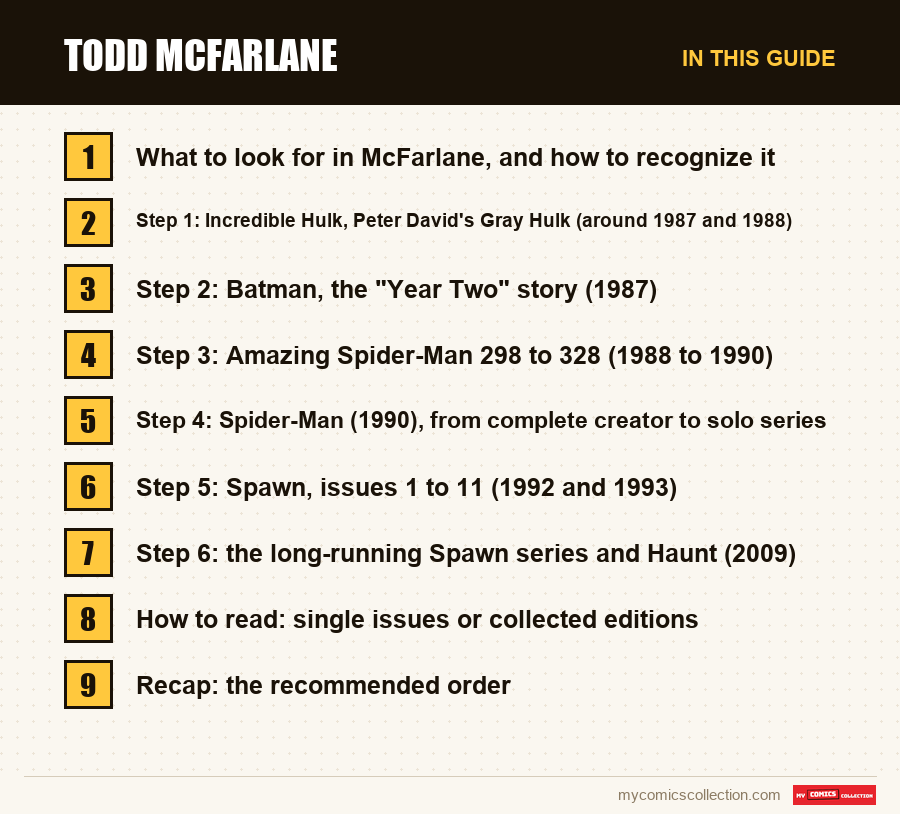
Step 5: Spawn, issues 1 to 11 (1992 and 1993)
In 1992, McFarlane is among the artists who found Image Comics to keep the rights to their creations. The first Spawn is dated May 1992: McFarlane does everything, cover included, and features Al Simmons, a dead man who returns without understanding what he has become. The founding issue is studied in Spawn #1; here, just remember that the first issues should be read back to back to feel the setup.
The first useful set stops at issue 11. After seven issues held by McFarlane alone, the series invites well-known writers: Alan Moore in issue 8, Neil Gaiman in 9, Dave Sim in 10, Frank Miller in 11. This run of guests is a peculiarity of Spawn: it gives the series the status of a showcase, and it lets you read side by side voices you follow elsewhere. Issue 9 introduces Angela, Medieval Spawn and Cogliostro, detailed in our profile on Spawn #9.
If you are discovering the character, these eleven issues are a complete entry in themselves. You can stop there, or continue with the Spawn reading guide, which sorts the following arcs. To find Moore, Gaiman or Miller elsewhere, our paths devoted to Alan Moore, Neil Gaiman and Frank Miller give the logical next step.
Step 6: the long-running Spawn series and Haunt (2009)
The last step is the most demanding, because it changes in nature. Spawn is a long-haul series, published without interruption since 1992: reading it all is a project of several hundred issues, with changes of artists, writers and tone. In the 1990s, Greg Capullo draws the title, and Capullo will later turn up on Haunt. The series also gave rise to several spin-offs, including Hellspawn, written by Brian Michael Bendis, and to more recent series that widen the universe.
Haunt, launched in 2009 at Image, ties Robert Kirkman and Todd McFarlane to the story; Ryan Ottley draws it over layouts by Greg Capullo, before a change of team along the way. It is a chance to read McFarlane as the designer of a story whose art is handed to others, which highlights what in Spawn comes from the line and what comes from the construction. Our path devoted to Robert Kirkman gives the context of this collaboration.
This step is for the reader who enjoyed the earlier ones and wants to go all the way: pick an arc, read it, judge. The ranking of the best Spawn runs helps you choose where to enter this mass of issues.
How to read: single issues or collected editions
The choice depends on what you are after in McFarlane. For the art, the original single issue has an advantage: the paper and the reproduction of the era render the deep blacks well, and it is the format in which the great covers of 1988 to 1992 were conceived. For continuous reading, the collected edition is simpler: it gathers the issues in order, saves you from chasing a missing number and travels better.
Here is a reasonable split. Take collected editions for steps 1, 2 and 3, which are sequences of several issues with no rarity at stake. Take single issues for step 5 if you collect Spawn: issue 1, dated May 1992, was printed in considerable quantities, so the condition of the copy weighs more than rarity. For step 6, favor collected editions or omnibuses, which keep you from scattering your budget over hundreds of single issues.
On the French editions side, a Spawn or Spider-Man volume must be checked against the catalog: the cover does not say which American issues it reprints.
Recap: the recommended order
- Incredible Hulk, around 330 to 346 (Peter David, 1987 and 1988): McFarlane's line on an established character.
- Detective Comics 575 to 578 ("Batman: Year Two", Mike W. Barr, 1987): four issues, a cape turned legend.
- Amazing Spider-Man 298 to 328 (1988 to 1990): the period that fixes the hero's image.
- Spider-Man, issues 1 to 16 (1990 and 1991): McFarlane writes and draws.
- Spawn, issues 1 to 11 (1992 and 1993): the complete creator, then the guest writers.
- Spawn over the long haul and Haunt (from 1992 to today, then 2009): the widest project.
If you only have a single evening to give it, read issue 300 of Amazing Spider-Man and its immediate neighbors, then issue 1 of Spawn. You will have seen the two versions of McFarlane that matter most: the Marvel artist and the Image creator-owner.
Frequently asked questions
Start with the Gray Hulk issues drawn around 1987 and 1988, or go straight to Amazing Spider-Man from issue 298. No preparation required: these issues show McFarlane's line from the time when other writers wrote the stories, and they fit in a few single issues.
No. Issues 298 to 328 of Amazing Spider-Man can be understood by simply knowing the hero and his circle of journalist and city. A reader who wants the big picture can browse our Spider-Man reading guide first, but it is not essential to enjoy the art.
At the start, yes: McFarlane writes and draws the first seven issues of 1992 and 1993. Then come Alan Moore, Neil Gaiman, Dave Sim and Frank Miller for issues 8 to 11. For the rest of the series, the credits change over the years; check them issue by issue in the catalog.
No, the reverse is more logical. Frank Miller's Year One, in Batman 404 to 407, sets up the character's beginning; Year Two, in Detective Comics 575 to 578, drawn by McFarlane over a script by Mike W. Barr, comes next. The two read separately, but chronological order makes comparison easier.
Yes, for the most part. The Marvel titles first appeared in magazines, then were collected in volumes; Spawn has had several French editions, in different formats and splits. Before buying a volume, check in the catalog which American issues it contains, since the content varies from one edition to another.
Do you own an Amazing Spider-Man or a Spawn drawn by McFarlane? Get a starting point for its value.
Estimate my comic