In short
A cameo in The Incredible Hulk #449 (January 1997) introduces the Thunderbolts, and in April 1997 Kurt Busiek and Mark Bagley launch the series. The last page of Thunderbolts #1 reveals a team of heroes that is really the Masters of Evil, led by Baron Zemo. The concept survives three great pivots: Warren Ellis and Norman Osborn in 2007, Luke Cage's redemption squad in 2010, and the Red Hulk team of Marvel NOW!
Few Marvel teams have been rebuilt as often as the Thunderbolts, and fewer still have changed their premise each time. The founding idea is a lie told to the public: criminals dressed as heroes. Every later era keeps the lie in some form, then turns it into redemption, government control, or an outlaw squad.
For this timeline we confirmed each writer, artist and issue number against published credit lists, and we name a month only when we saw the cover date. Our comments on what each phase does to the premise are interpretation, nothing the books themselves claim.
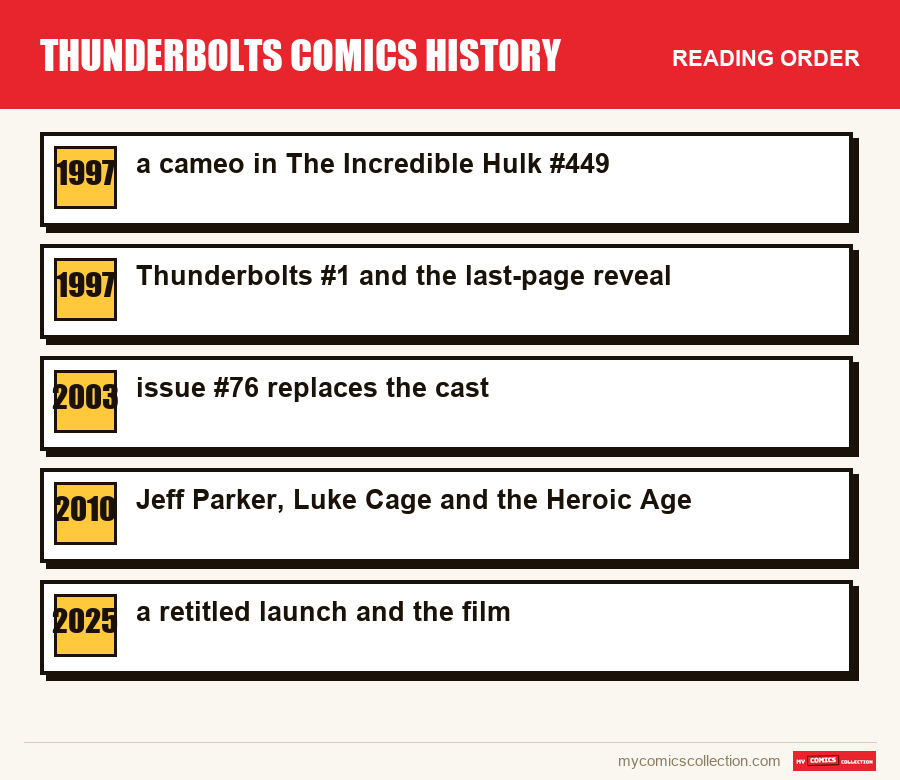
January 1997: a cameo in The Incredible Hulk #449
The team's first appearance is not in a Thunderbolts book at all. Dated January 1997, The Incredible Hulk #449 shows the group to readers months before any Thunderbolts title exists, with Peter David scripting and Mike Deodato Jr. on art. Kurt Busiek and Mark Bagley are credited as the creators of the team, which means the concept was planted in a Hulk comic by one set of hands and then handed to another.
That split matters for collecting. A reader who wants the debut buys a Hulk issue, and a reader who wants the series buys a different book three months later. The two are routinely mixed up in listings, which is why this page keeps them apart from the first paragraph.
April 1997: Thunderbolts #1 and the last-page reveal
Thunderbolts #1 is dated April 1997, with Kurt Busiek writing and Mark Bagley drawing. The setup is that the Avengers and the Fantastic Four have apparently died fighting Onslaught, and a new group of heroes steps into the vacuum. The final page reveals what the rest of the issue hides: the newcomers are the Masters of Evil in disguise, and Baron Helmut Zemo is the man who built the team.
The mechanism is worth stating plainly, because it is what the series spends years paying off. Zemo recruits former Masters of Evil to rescue Goliath, then gives them new identities and a public reputation. The disguise is not a cover for a single heist but a long con on the entire Marvel Universe. In our reading, that is what separates the team from every earlier group of villains: the criminals are betting that being admired is more profitable than being feared.
Marvel guarded the twist carefully until the issue reached shelves. The reveal is built into the first issue, not added later. The detailed look at that first issue is in our guide to Thunderbolts #1.
1997 to 2001: the team turns on Zemo
The first era is a story about a plan that works too well. Jolt, a teenager whose family was killed by Onslaught, joins the team. The members then reject Zemo's leadership and recruit Hawkeye to replace him, and as fugitives they are joined by Charcoal. Out of the con comes a team that has started to behave the way it pretends to behave.
Busiek writes the opening stretch, and Fabian Nicieza takes over with #34 in 1999. Nicieza then writes through #75, with Mark Bagley drawing at the start and Patrick Zircher and Chris Batista following. The long stretch includes the arrival of Jack Monroe as Scourge and a nanite plot involving Gyrich, and it ends with Hawkeye turning himself in during issue #50, dated May 2001, which disbands the team.
Once the public knows the heroes are criminals, the series has to ask whether they can stop being criminals. For the villain at the center of this phase, the page on Baron Zemo covers the two men who have held the title.
2003: issue #76 replaces the cast
With Thunderbolts #76, dated March 2003, the cast and the creative team are replaced, and John Arcudi becomes the writer. It is the first time Marvel tries the series without the people who defined it, and the experiment does not hold. The revamp is generally described as unsuccessful, and the original team returns in 2004.
The first trap for a collector sits right here. The run from #76 onward belongs to a different cast than the one most readers mean by the name, and a complete set of the first volume contains two distinct books under one title. The Arcudi issues are best treated as their own short chapter, not as a continuation of the 1997 premise.
2004 to 2007: rebirth, Photon and Civil War
The return arrives in 2004 with the six-issue Avengers/Thunderbolts limited series, in which Zemo's team uses Moonstone to drain superhuman powers and Iron Man convinces Hawkeye to lobotomize her to save the planet. New Thunderbolts follows in 2005, with Nicieza again writing, and after its 18 issues the title returns to its original count with #100.
MACH-IV, Atlas and Songbird join the new team, which learns that Photon will destroy the universe in the future. In Thunderbolts #100, dated May 2006, Zemo cuts Photon's body up and banishes him to the Darkforce dimension. During Civil War, the team is recruited to capture super-villains and offer them a choice, and after the Wellspring storyline it disbands in #109.
Our reading is that this is the stretch where the name stops meaning a particular lineup and starts meaning a particular tension: pretending to be heroic in 1997, trying to become heroic in 2005, and serving the state after Civil War.
2007 to 2009: Warren Ellis, Mike Deodato and Norman Osborn
The biggest reset comes with Thunderbolts #110, when Warren Ellis becomes the writer and Mike Deodato the artist. Norman Osborn leads the team, and the series becomes the book where a famous villain is handed an official uniform. The run includes the Penance limited series and the specials Breaking Point and International Incident, the last of which is dated February 2008.
The storylines then connect to the Marvel-wide events of the period. Issues #123 and #124 (2008) tie into Secret Invasion, and issues #125 to #127, running from December 2008 to February 2009, open with Songbird furious at Osborn for leaving her to face a dangerous Skrull. The sequence is the clearest example of the series as a mirror of the larger line: when the Marvel Universe is fighting over registration and control, the Thunderbolts are the book where the argument gets personal.
The 1997 team was a fraud run by a villain. The 2007 team is a program run by the state, with a villain as its public face, so the lie becomes official instead of secret.
Do you collect this series?
Track what you own, what you are missing and what your collection is worth. 7-day trial.
Start my trial →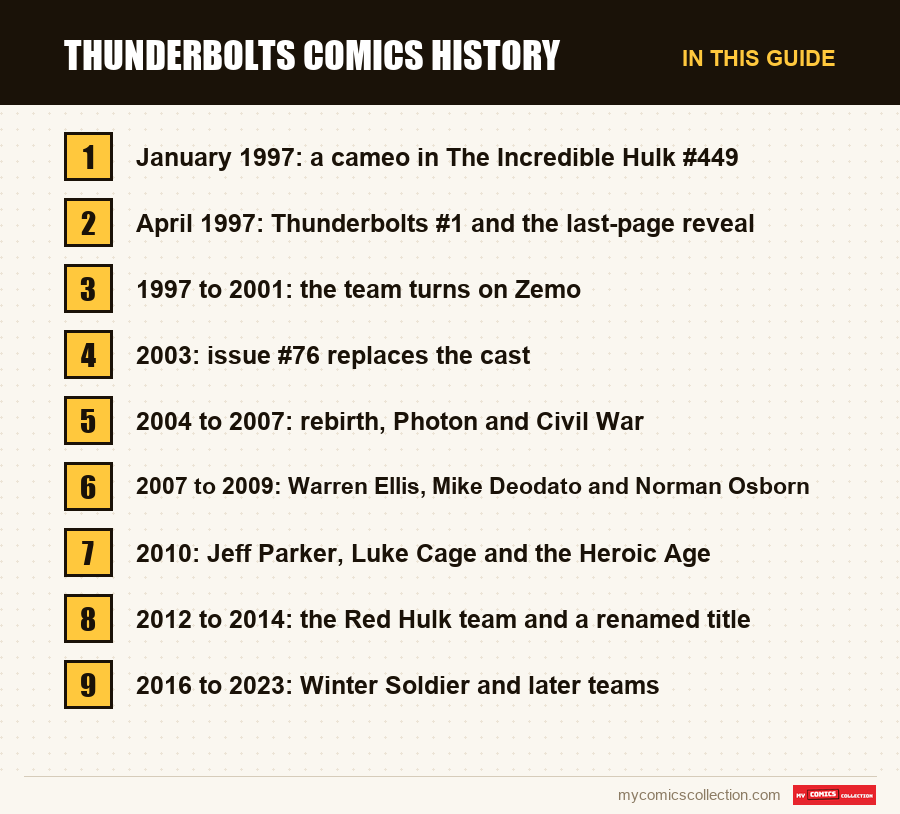
2010: Jeff Parker, Luke Cage and the Heroic Age
After Siege, the Heroic Age relaunch begins with Thunderbolts #144. Luke Cage and Steve Rogers form a team of redeemed criminals, and Jeff Parker becomes the writer of the series in 2010, with artists including Kev Walker and Declan Shalvey on his run.
The Cage version inverts the founding premise. In 1997 the criminals pose as heroes to profit from the public's trust. In 2010 a hero takes in criminals and tries to make the pose real, with Rogers alongside him. The original con is replaced by a program with a stated purpose, which is the most direct answer the series ever gives to its own question.
The numbering in this stretch is unusually clean, because the series continues the original count. A reader following the issue numbers from the first volume reaches the Luke Cage team without a renumbering, and that continuity makes the Luke Cage team an easy entry point.
2012 to 2014: the Red Hulk team and a renamed title
The next change is a rename. Issue #175 renames the series Dark Avengers, and that book ends with #190, which closes the original numbering. Under Marvel NOW!, Daniel Way writes and Steve Dillon draws a new Thunderbolts.
The new team is led by Red Hulk and includes Deadpool, Elektra, Agent Venom and the Punisher. It is a squad of unsanctioned members with no pretense of heroism, and its later issues bring in the Leader. The series closes in October 2014 with issue #32, and the issues most often cited from it include #2, #3, #5, #13, #19, #20, #27 and #28.
This era drops the disguise entirely: no cover story and no redemption program, only unsanctioned members under Red Hulk.
2016 to 2023: Winter Soldier and later teams
The third volume comes in 2016, announced with Zub and Malin as its creators, and it puts Bucky Barnes in charge as the Winter Soldier. In the lead-up to Secret Empire, Zemo attacks the team's base, and in issue #12 Fixer, Moonstone and Atlas leave with Zemo's Masters of Evil. The echo is deliberate: the group that began as the Masters of Evil in disguise now has members who simply go back to it.
After that, the name moves through smaller crossovers. Mayor Fisk's Thunderbolts appear in King in Black and Devil's Reign, a fourth volume follows with Hawkeye's team, and a fifth volume has the Revolution's team. In July 2023 a new series centers on Winter Soldier and Valentina Allegra de Fontaine with an espionage tone. Thunderbolts: Doomstrike runs five issues during One World Under Doom, and Barnes goes on to lead the New Avengers.
The name now works as a flexible label, so the first question when buying is always which volume and which team.
2025: a retitled launch and the film
In March 2025, Sam Humphries and Ton Lima's New Thunderbolts was announced. In May the title was changed to New Avengers, volume 5. The renaming is a useful reminder that the Thunderbolts name and the Avengers name have been traded back and forth for years.
The 2025 film has its own page, and our separate piece on the 2025 film versus the comics sets out which comics it draws on. This page stays with the books.
The key issues across the team's history
- The Incredible Hulk #449 (1997): the team's first appearance, by Peter David and Mike Deodato Jr., credited to Busiek and Bagley as creators.
- Thunderbolts #1 (1997): Kurt Busiek and Mark Bagley open the series, and the last page reveals the Masters of Evil.
- Thunderbolts #50 (2001): Hawkeye turns himself in and the original team disbands.
- Thunderbolts #76 (2003): the cast and creative team are replaced, with John Arcudi as writer.
- Thunderbolts #100 (2006): Zemo cuts Photon's body up and banishes him to the Darkforce dimension.
- Thunderbolts #110 (2007): Warren Ellis and Mike Deodato start the Norman Osborn run.
- Thunderbolts #144 (2010): the Heroic Age relaunch with Luke Cage and Steve Rogers.
- Thunderbolts #175 (2012): the series is renamed Dark Avengers.
For ranking the best stories, not just the key issues, our guide to the best Thunderbolts runs works from the reader's side instead of the timeline.
How to follow the Thunderbolts in a collection
Begin by choosing an era, because the name covers several unrelated books. A collector who wants the original concept should assemble the first volume from #1 and keep The Incredible Hulk #449 as the separate debut copy. A collector who prefers the Osborn period should start at #110, and one who prefers redemption should start at #144.
Two traps recur. First, the series was renamed Dark Avengers at #175, so a complete run of the Thunderbolts title stops earlier than the numbering suggests. Second, later volumes restart at #1 several times, so a listing that reads only Thunderbolts #1 can describe a book from several decades.
The annuals and miniseries are best collected last: the Annual of 1997, the Annual 2000, the six-issue Avengers/Thunderbolts and the Penance limited series. Before buying a Thunderbolts issue, check its volume number against a written list of what you already own.
The same method applies to the team's members. Taskmaster, for example, joins the group at one point in his career and has his own history elsewhere, which our Taskmaster history traces. Reading a member's own history first often explains why a given issue matters.
Frequently asked questions
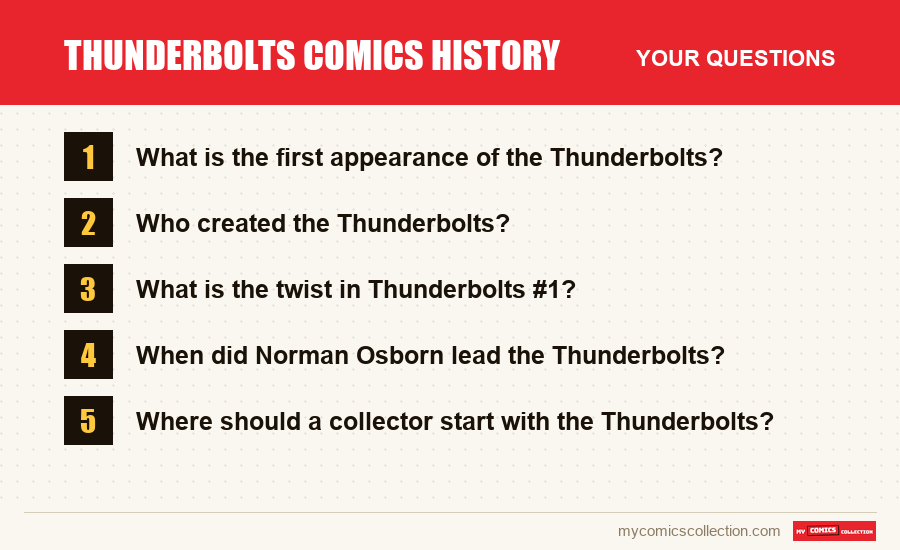
Look for The Incredible Hulk #449 (January 1997), the Peter David and Mike Deodato Jr. issue where the group shows up. Their own title opens three months later with Thunderbolts #1, from the credited creators Kurt Busiek and Mark Bagley.
Kurt Busiek and Mark Bagley are credited as the creators of the team. Busiek wrote the opening issues, and Fabian Nicieza wrote the series from issue #34, in 1999, through #75. Peter David and Mike Deodato Jr. made the team's debut in The Incredible Hulk #449.
The final page of Thunderbolts #1 reveals that the heroes who replaced the fallen Avengers and Fantastic Four are the Masters of Evil in disguise. Baron Zemo built the team to expand his criminal power. The members later turned on him and recruited Hawkeye.
Osborn leads the team from Thunderbolts #110, when Warren Ellis became the writer and Mike Deodato the artist. The run includes the Penance limited series, ties into Secret Invasion in issues #123 and #124, and sets Songbird against Osborn in issues #125 to #127.
Pick the era first. The original concept starts with Thunderbolts #1 from 1997, the Osborn period with #110, and the Luke Cage redemption squad with #144. Check the volume number on every listing, because the title restarts at #1 several times.
If a Thunderbolts issue from any of these volumes is sitting in your boxes, you can get a free estimate in a few clicks.
Estimate my comic