
In short
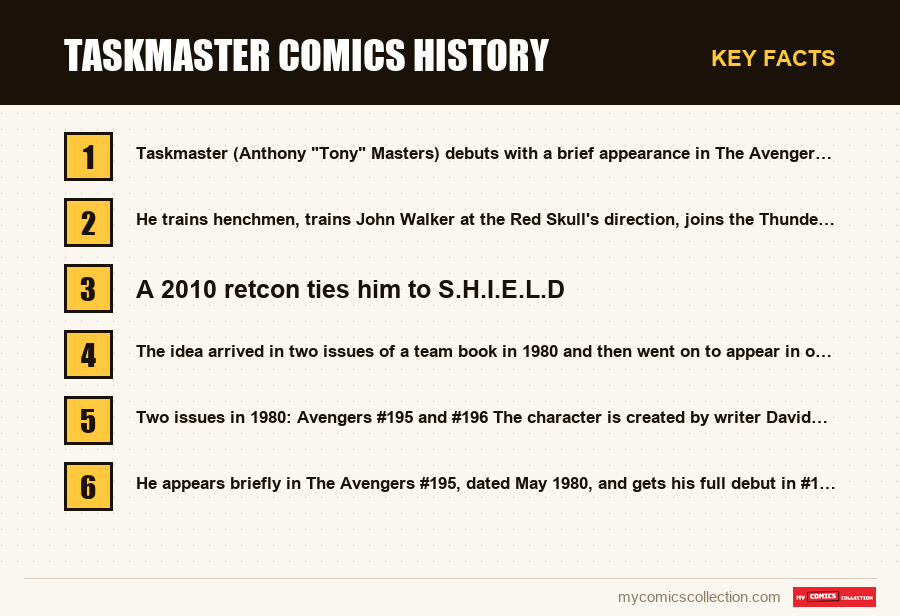
Taskmaster (Anthony "Tony" Masters) debuts with a brief appearance in The Avengers #195 (1980) and a full one in #196, created by David Michelinie and George Pérez. His photographic reflexes let him copy any movement he sees. He trains henchmen, trains John Walker at the Red Skull's direction, joins the Thunderbolts, runs drills at the Initiative's camp, and gets his own series in 2002, 2010 and 2020. A 2010 retcon ties him to S.H.I.E.L.D. and to his former handler, Mercedes Merced.
Taskmaster is a character defined by a single trick: he watches a fighter and then fights exactly that way. The idea arrived in two issues of a team book in 1980 and then went on to appear in other heroes' books before a series carried his name. That slow climb is what makes his history useful to a collector, because the valuable early issues sit far from the later series that built his reputation.
Every credit, issue number and cover year below was checked before it went in, and a month appears only where the cover date itself was read. Where this page says what an era means for the character, that is our own analysis and not a claim made by the books.
Two issues in 1980: Avengers #195 and #196
The character is created by writer David Michelinie and artist George Pérez. He appears briefly in The Avengers #195, dated May 1980, and gets his full debut in #196, dated June 1980. The split matters to a collector, because the second issue holds the full debut while the first holds only the earlier glimpse. For the details of that single issue, its cover and the copies that circulate, our Avengers #196 guide covers the buying side. This page follows what happens next.
The team book he enters was already a long-running monthly when Michelinie and Pérez brought him in. Taskmaster is therefore not a creation of a launch or a relaunch. He is one more antagonist in a monthly team book, and that context may explain why nothing in 1980 hints that he would carry a title of his own.
What the debut does establish is the premise that stays constant. The character is a mercenary whose skill is borrowed, not trained, and who sells that skill to whoever pays. Because he is built on other people's techniques, he works as a mirror for whichever hero he faces, which is the reason writers kept returning to him. That design makes him easy to reuse across other characters' books.
A borrowed gift and a retained identity
The power is photographic reflexes. Taskmaster can copy any physical movement after seeing it, without practice. The limit built into the idea is as important as the gift: the ability transfers the motion but not the knowledge behind it, so copying a swimmer's movement does not mean he knows how to swim. His weapons echo the heroes he studies: a bow and trick arrows based on Hawkeye's gear, wrist-mounted web shooters based on Spider-Man's.
There is also a cost. Each new technique displaces personal memories, which makes the later retcons about his past possible: a character whose memory is physically traded away for skills can plausibly hold a hidden history. That is analysis of the setup, but the setup itself is on the page of the stories, and it is the hinge for the biggest change in his career, discussed below.
The academies, the Red Skull and John Walker
Between his debut and his first series, the character is defined by what he does with his gift commercially. He establishes criminal academies across the United States that produce henchmen for hire. Among the students are the future Crossbones, Diamondback and Snapdragon. A man who sells a training service rather than only his fists is a more durable kind of villain, and it gives the character a way to touch many other series without being the main threat in any of them.
In one clash with the Avengers, the unfamiliar fighting style of the robotic Jocasta throws him off. The detail is worth keeping because it shows the weakness the writers use against him: a movement he has never seen cannot be copied. Another storyline has the Red Skull manipulate a government official into reducing Masters's prison sentence, so that he can train John Walker as a replacement Captain America. For the Skull's own trajectory, see our Red Skull comics history.
His first series and Agent X in 2002
In 2002 Taskmaster headlines a four-issue limited series, Taskmaster #1 to #4. In the same period he has a supporting role in Agent X #1 to #15, which ran from 2002 to 2003. The pairing marks a change of function. He is no longer a one-issue antagonist or a trainer in the background; he is a lead character in a miniseries, and then a recurring figure in another character's monthly.
The second point is a collector's problem of naming. Several books carry the same title across the years, so when you hunt for the 2002 run, search the full title of the Marvel series and filter by year. Confirm that the item is the four-issue Taskmaster miniseries and not a later series that shares the name, and treat Agent X as a separate monthly with its own numbering, #1 to #15.
Registration, the Thunderbolts and the Initiative
The Superhuman Registration Act conflict changes his position. He joins the government-sanctioned Thunderbolts during that conflict; after he is rearrested, Deadpool frees him. He then becomes the Initiative's drill instructor at Camp Hammond and, after the Skrull invasion, is reassigned to the Shadow Initiative. The wider team history is in our guide to the best Thunderbolts runs, which is the right companion if you want to follow the team rather than the man.
The Initiative is the series where Taskmaster gets a long stretch as a regular. Avengers: The Initiative, written by Dan Slott and Christos Gage, launches on April 4, 2007 and runs 35 issues. The character first appears in issue #8, dated February 2008, as a drill instructor and the Shadow Initiative's field leader, replacing Gauntlet while Gauntlet is in a coma. He trains the second recruit group. Issues #20 to #22 handle Dark Reign: after Secret Invasion the Initiative is shut down, Norman Osborn reopens the training camp as Camp H.A.M.M.E.R., and issue #24 shows Taskmaster as its camp director and senior instructor.
Across the run, he is a supporting character in #8 to #19 and in Annual #1, and a central one in #20 to #35 (2009 to 2010). The progression is the story: a man who spent his career training criminals becomes the person who drills government-backed heroes, and the series never resolves whether that is a reformation or a new angle on the same job. It is the clearest example in his history of the same skill set being repointed without any change to the man himself.
For collectors, this era is the one where a set is long. Thirty-five issues plus an annual is a real commitment, but the issues in which he is a central presence form a contiguous block, #20 to #35, so that block can be sought as a unit.
Do you collect this series?
Track what you own, what you are missing and what your collection is worth. 7-day trial.
Start my trial →
Finesse and the 2010 rewrite
The next change arrives in two places at once. Christos Gage writes and Mike McKone draws Avengers Academy, published from June 2010 to November 2012, and there the student Finesse goes looking for Taskmaster, helped by Quicksilver, in issue #9, "Teach Your Children," dated February 2011, believing he is her biological father. Within days of their meeting he has no memory of the encounter or of her, which is the memory cost of his power turned into a scene.
In the same stretch, a 2010 to 2011 limited series by Fred Van Lente and artist Jefte Palo retcons his history. It ties him to S.H.I.E.L.D. and introduces his wife, Mercedes Merced, a S.H.I.E.L.D. handler. The recovered memories trace his reflexes to a serum built on a Nazi formula, and show that the Org, run jointly by Masters and Merced, was a S.H.I.E.L.D. front all along. Our analysis: this is the largest rewrite in the character's history, because it turns the mercenary into a long-term agent whose crimes were partly cover. It also uses the memory-loss limit from the original design to explain why he did not know. He also received a solo graphic novel collecting a four-issue story.
Secret Avengers, a 2020 mystery and Devil's Reign
Later, the character joins a new incarnation of the Secret Avengers. He appears there as a team member rather than a headliner, which makes this era a case of reading by series, not by single issue.
In 2020, Jed MacKay writes a five-issue Taskmaster series with art by Alessandro Vitti. It was solicited for April 2020 and moved to November 2020. The plot makes him the prime suspect in the apparent murder of Maria Hill, and the series was timed to the release of the Black Widow film. The relevant thing for a collector is the date shift: a series announced for spring and delivered in the autumn can carry solicitation information from one month and a cover date from another, so match the listing against the issue itself.
In December 2021, Devil's Reign begins. Chip Zdarsky writes it and Marco Checchetto draws it, and the main series runs six issues, from December 8, 2021 to April 6, 2022. Mayor Wilson Fisk sets up Thunderbolts units to enforce his new law, and Taskmaster is a member of that team; in the event he fights Spider-Man and leaves him severely injured. Later, Helen Astrantia, a public relations specialist tasked with rebranding the Thunderbolts, suggests Clint Barton as the team's leader.
On screen, Olga Kurylenko plays a version in the film Black Widow, and the later film Thunderbolts* shows her killed by Ava Starr. That version is Antonia Dreykov, not Tony Masters, and the film is a separate story. We mention it only because it drives search traffic: the buyers who arrive through the films should not confuse the screen character with the Michelinie and Pérez creation when they look at issue numbers.
The key issues across his history
These are the issues a collector can anchor the character to, in the order of the story:
- The Avengers #195 (1980): Taskmaster's brief debut, by David Michelinie and George Pérez.
- The Avengers #196 (1980): his full debut and the issue that anchors the character.
- Taskmaster #1 (2002): the first issue of his four-issue limited series.
- Avengers: The Initiative #8 (2008): his first appearance in the series, as drill instructor and Shadow Initiative field leader.
- Avengers: The Initiative #24: he appears as camp director and senior instructor at Camp H.A.M.M.E.R.
- Avengers Academy #9 (2011): Finesse seeks him out in "Teach Your Children."
- Taskmaster #1 (2020): the first issue of Jed MacKay's five-issue series, with Alessandro Vitti.
- Devil's Reign #1 (2021): the opening of the event in which Taskmaster serves in Fisk's Thunderbolts.
How to collect Taskmaster
Start with the two 1980 issues of The Avengers, because they are the anchor of the character, and a reprint does not replace the original issue. Then add the solo books in order: the 2002 miniseries, the 2010 to 2011 series, the graphic novel, and the 2020 series. Each is short, so the set is quick to finish.
The trap is the shared title. Several different books carry his name or a near match, and a 2020 listing, a 2010 listing and a 2002 listing can all read "Taskmaster #1." Check the cover year and the writer before you add a listing to a collection. The same caution applies to the Avengers issues themselves, which belong to a long-running first series, so confirm the volume and the year. A broader view of the team's key books is in the Avengers key issues guide, and the Captain America key issues guide helps with the hero whose style he copies most often.
Frequently asked questions
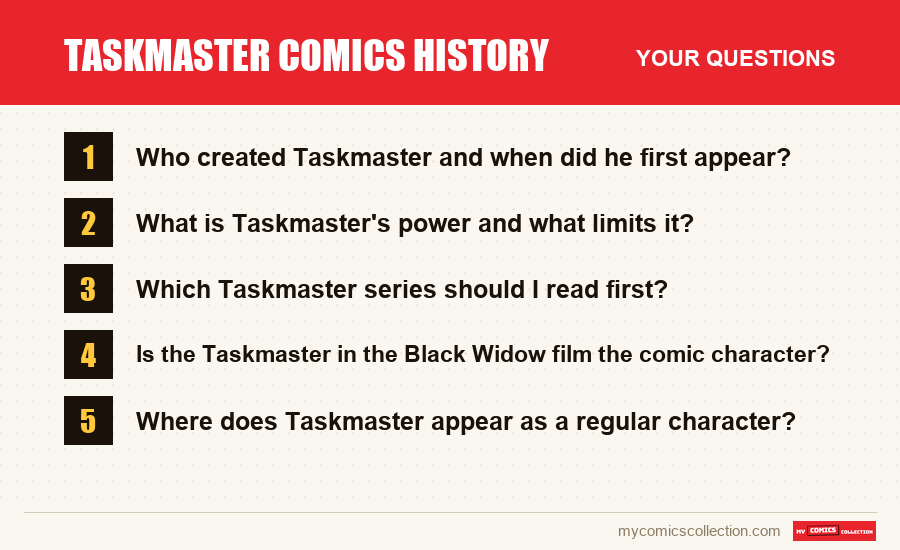
David Michelinie, the writer, and George Pérez, the artist, created Taskmaster. He appears briefly in The Avengers #195, dated May 1980, and makes his full debut in The Avengers #196, dated June 1980. The second issue is the one that collectors treat as the anchor for the character.
He has photographic reflexes that let him copy any physical movement he sees, without practice. The limit is that the gift does not carry the knowledge behind the move, so a copied dive does not teach him to swim. Each new technique also displaces personal memories, which the later retcon uses.
Read the two 1980 Avengers issues, then the 2010 to 2011 limited series by Fred Van Lente and Jefte Palo, which rewrites his past and introduces Mercedes Merced. After that, the five-issue 2020 series by Jed MacKay and Alessandro Vitti gives a self-contained story that is easy to follow.
Not exactly. In the film Black Widow, the role is played by Olga Kurylenko and the character is Antonia Dreykov, not Tony Masters. The comic character created by Michelinie and Pérez is a male mercenary, so the film does not change which issues are his first appearances.
His main regular stretch is Avengers: The Initiative, where he first appears in issue #8 (2008) and is a central character in issues #20 to #35. He is also a supporting character in Agent X #1 to #15 and later joins a new incarnation of the Secret Avengers.
If a 1980 Avengers issue with Taskmaster's debut is sitting in your boxes, check its condition and edition before you decide what to do with it.
Estimate my comic