The Mask (1994) Chuck Russell , with Jim Carrey, adapts the comic book of Dark Horse Comics (1989-1991). The film transforms an ultraviolent horror story into a crazy comedy, keeping only the mask that transforms its wearer. Here is the detailed comparison, film versus comics.
A surprising adaptation of a horror comic, The Mask illustrates how a tone can be completely reversed on screen. Source-by-source decryption.
As in each article in this series, only verified information (creators, distribution, dates, publishers) is stated; the comparative analysis is ours, without reproducing dialogue or protected images.
Title : The Mask (1994)
Director: Chuck Russell
Actors: Jim Carrey (Stanley Ipkiss), Cameron Diaz (Tina), Peter Riegert (Kellaway)
Exit : July 1994
Studio: New Line Cinema
The Mask (1991): from Dark Horse Comics
Dark Horse Presents #10 (1987): origin of the concept
A mask: transforming its wearer
A horror story: ultraviolent
- Stanley Ipkiss, an ordinary man who finds the mask.
- Le mask which transforms its wearer.
- THE cartoon powers and omnipotence.
- The green head and the disproportionate grin.
- La release of impulses repressed.
- Ultraviolent horror becomes a comedy.
- Stanley stays friendly (in the comics, he becomes a killer).
- The mask no longer pushes bloody murder.
- The tone becomes family and burlesque.
- The black satirical spirit is softened.
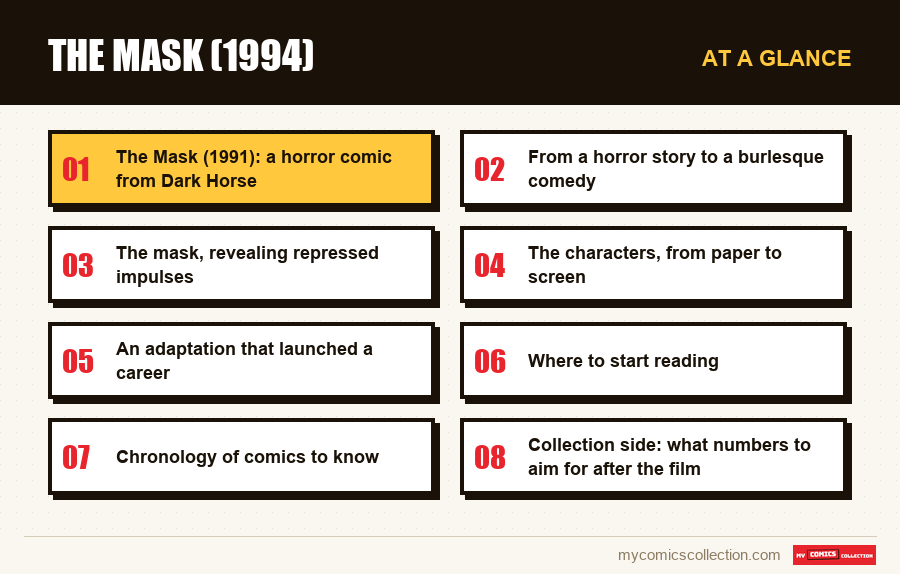
The Mask (1991): a horror comic from Dark Horse
The Mask adapts the comic strip published by Dark Horse Comics, the concept of which appeared in 1987 in Dark Horse Presents, before an eponymous series in the early 1990s. Created in particular by Mike Richardson, John Arcudi and the artist Doug Mahnke, the comic is a dark and ultraviolent horror story. It features an ancient and mysterious mask which, when worn, gives its holder almost unlimited and cartoonish powers, but also unleashes his darkest impulses, transforming him into a chaotic and murderous being nicknamed "Big Head". Stanley Ipkiss, one of the first bearers, becomes a merciless killer under the mask, taking bloody revenge on those who humiliated him. The comic explores the corruption of absolute power and repressed violence, in a resolutely adult and disturbing tone.
Chuck Russell's film takes up the central concept: Stanley Ipkiss, an ordinary and self-effacing man, finds a mask which transforms him into an all-powerful character, green, with an enormous smile, capable of cartoonish feats defying the laws of physics. The film retains the idea of the mask releasing the repressed desires of its wearer and giving him almost unlimited powers. Jim Carrey embodies this transformation with boundless comic energy. The film, however, carries out a radical transformation of tone: where the comic book is an ultraviolent horror story, the film makes it a burlesque family comedy, erasing the murderous and bloody dimension of the original.
From a horror story to a burlesque comedy
The most striking transformation between the comic and the film concerns tone. The Dark Horse comic is a dark horror story: under the mask, Stanley Ipkiss becomes a sadistic killer, engaging in bloody murders and extreme violence. The mask is a corrupting force that reveals the darkness of its wearer, in a disturbing exploration of vengeance and omnipotence. The film completely reverses this approach: it transforms The Mask into a family and burlesque comedy, carried by Jim Carrey's facial expressions. Under the mask, Stanley becomes a wacky and harmless character, with cartoonish powers inspired by classic cartoons, without ever falling into murder. Humor replaces horror, and the hero remains sympathetic.
This inversion of tone, one of the most radical in the history of adaptations, can be explained by the desire to create entertainment for the general public and to highlight the comedic talent of Jim Carrey. The film exploits the cartoonish potential of the mask (distortions, visual gags, unbridled energy) to make a spectacular visual comedy, rather than a horror story. This approach made the film successful, but completely distanced it from the spirit of the comic strip. For the reader, this contrast is striking: the sympathetic and hilarious character of the film has almost nothing to do with the bloody killer of the comics. The film invites you to discover the original comic strip, whose darkness and violence offer a much darker and more disturbing vision of the concept of the mask, revealing an unsuspected facet of a work that the general public associates with comedy.
The mask, revealing repressed impulses
Beyond the tone, a fundamental theme connects the comic and the film: the mask as a revealer of repressed impulses. In both works, the mask does not create a personality, but releases what its wearer represses. Stanley Ipkiss, a shy, self-effacing and frustrated man, sees beneath the mask his buried desires and desires expressing themselves without restraint. This psychological concept (the liberation of the unconscious, the hidden side of the personality) is at the heart of the work. It evokes the idea that everyone carries a repressed part within themselves, which the mask reveals without filter. This dimension gives the concept a depth that goes beyond the simple fantastic gadget.
The film maintains this theme, but takes a different direction. Beneath the mask, the shy Stanley becomes bold, seductive and exuberant, releasing his confidence and pent-up desires in comical ways. Comics reveal much darker impulses (violence, revenge, cruelty) making the mask a mirror of human darkness. This difference in orientation illustrates the opposite choices of the two works: the film celebrates joyful liberation, the comic strip explores corruption. For the reader, this common theme, treated in such different ways, is fascinating. It shows how the same concept can serve comedy or horror depending on the angle chosen. The Mask invites you to discover Dark Horse's comic strip, where the mask reveals the abysses of the human soul, offering a dark reflection on the impulses that civilization forces us to repress, in contrast to the colorful exuberance of the film.
Collecting this series?
Track what you own, what you are missing and what your collection is worth. 7 day trial.
Start my trial →The characters, from paper to screen
- Stanley Ipkiss: The self-effacing man who finds the mask, faithful to the comics... until the transformation.
- The Mask / Big Head: The transformed porter, killer in the comics, prankster in the film.
- Tina Carlyle: The love interest, character in the film.
- Lieutenant Kellaway: The policeman, present in both versions.
- The mask: The central artifact, revealing impulses.
An adaptation that launched a career
The Mask holds a special place as one of the films that catapulted Jim Carrey to comedic superstardom. Released the same year as other of his hits, the film showcased his unique talent for physical comedy, his elastic facial expressions and boundless energy, perfectly suited to the cartoonish character of the mask. The role, cut out for his style, made the film a phenomenon and consolidated his career. This match between the actor and the character largely contributed to the success of the film, to the point that The Mask is today inseparable from Jim Carrey. This dimension illustrates how an adaptation can be shaped around the talent of a performer.
This choice to put the actor at the center partly explains the transformation of the tone. By tailoring the character for Jim Carrey's comedic style, the film necessarily moved away from comic book horror in favor of visual comedy. This performer-centered approach produced successful entertainment, but very different from its source. For the reader, this story illustrates how casting and production choices can entirely redefine an adaptation. The Mask is as much a film about the mask as it is a vehicle for Jim Carrey's talent. He reminds us that adaptations are shaped by multiple factors (commercial, artistic, linked to casting) which can radically transform a work. The Dark Horse comic book remains to be discovered for those who want to know the true, much darker, nature of the mask.
Where to start reading
To explore the source, Dark Horse Comics' The Mask collections feature the original horror story. Early appearances in Dark Horse Presents (from 1987) and the early 1990s series reveal the darkness of the concept. These comics, in contrast to the film, reveal an ultraviolent and disturbing universe, to be discovered to measure the gap with comedy.
Chronology of comics to know
- 1987: Dark Horse Presents #10: the origin of the mask concept.
- 1991: The Mask: the eponymous series from Dark Horse Comics.
- 1994: The film transforms the horror story into a successful comedy.
Collection side: what numbers to aim for after the film
The Mask points to Dark Horse keys. The numbers of Dark Horse Presents containing the first appearances of the concept (from 1987) are sought after by collectors. The first issue of the series The Mask (1991) is another popular target. The collections are accessible to readers. These numbers cover generally affordable budgets. As always, condition and gradation determine value; relying on real recent sales is strongly recommended.
Its place in the saga and for the collector
The Mask will remain as an example of a total inversion of tone, transforming an ultraviolent horror comic into a successful family comedy. For the collector, it highlighted the Dark Horse publications that originated the concept. It illustrates the power of cinema to radically reinvent a source, here in the service of the talent of Jim Carrey. Beyond the film, the original comic book deserves to be discovered for its unexpected darkness. The Mask reminds us that the same concept can serve horror or comedy, and that behind family entertainment can hide a much darker work.
The verdict: a faithful concept, an inverted tone
- Loyalty: Stanley Ipkiss, the transforming mask, the cartoonish powers, the green head with the disproportionate grin and the release of repressed impulses come from comics.
- Freedoms: the ultraviolent horror turned comedy, Stanley remained sympathetic (killer in the comics), the bloody murder removed, the family and burlesque tone, the black satire softened.
- Collectible numbers: Dark Horse Presents (1987), The Mask #1 (1991).
The Mask adapts an ultraviolent horror comic from Dark Horse by transforming it into a crazy family comedy, made for Jim Carrey. Faithful to the concept of the mask revealing impulses but completely reversing the tone, from the bloody killer to the harmless prankster, the film illustrates a radical reinvention. For both the reader and the collector, it is an invitation to discover the original comic strip.
Frequently asked questions
Yes. The film adapts The Mask, published by Dark Horse Comics, the concept of which appeared in 1987 in Dark Horse Presents before a series in the early 1990s. Unlike the film, the original comic is a dark and ultraviolent horror story.
No, on the contrary. The comic is an ultraviolent horror story: under the mask, Stanley Ipkiss becomes a sadistic killer carrying out bloody murders. The film completely reverses this tone, making a burlesque family comedy where the mask never leads to murder.
It grants its wearer almost unlimited and cartoonish powers, while releasing their repressed impulses. In the film, the shy Stanley becomes bold and prankster; in the comics, the mask reveals much darker impulses, making him a killer. It is a revealer of the unconscious.
To create mainstream entertainment and showcase Jim Carrey's comedic talent. The character was cut for his burlesque style, which necessarily moved the film away from comic book horror in favor of cartoonish visual comedy.
Issues of Dark Horse Presents containing early appearances of the concept (from 1987) are sought. The first issue of The Mask series (1991) is another popular target, and the collections are accessible to readers.
Does the film make you want to collect? Estimate the value for free of your issues (The Mask, Dark Horse Presents…) with our tool based on current eBay listings.