The best mythology comics are, at the top, The Sandman by Neil Gaiman, Thor by Walter Simonson, Wonder Woman and The Wicked + The Divine by Kieron Gillen. This tier list classifies stories that draw on myths and pantheons according to their quality and inventiveness, from epic retellings to modern mythological fantasy. Facts (authors, publishers, dates) checked, no invented ratings.
Mythology has irrigated comics since their origins: Nordic gods, Greek pantheon, reinvented deities. This tier list brings together the series that best exploit this material: epic breath, intelligent rereading, coherent universe. Criterion: the success of the mythological story.
Editorial Ranks, Facts verified. Each entry refers to a site file when it exists.
Collecting this series?
Track what you own, what you are missing and what your collection is worth. 7 day trial.
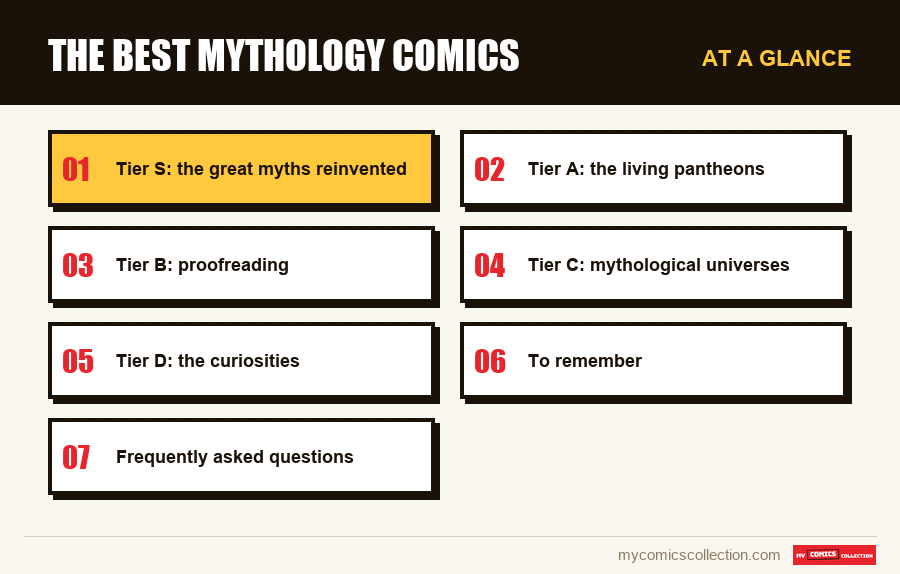
Start my trial →Tier S: the great myths reinvented
The Sandman by Neil Gaiman brings together all the mythologies of the world around the Dream: the mythological summit of the medium. THE Thor by Walter Simonson (1983) is the absolute reference for Norse mythology in comics. Wonder Woman draws from the Greek pantheon since 1941, and The Wicked + The Divine imagine gods reincarnated as pop stars.
Tier A: the living pantheons
American Gods (according to Gaiman) confronts old and new gods. The New Gods by Jack Kirby created an original mythology (Apokolips, Darkseid). Age of Bronze recounts the Trojan War with rigor, and The Immortal Thor by Al Ewing brilliantly renews the god of thunder.
Tier B: proofreading
Loki: Agent of Asgard , the youth series Olympians , the adaptation of Norse Mythology by Gaiman and the Hercules from Marvel offer varied approaches to the myth.
Tier C: mythological universes
God of War , Ares , Sandman: Overture and Marvel: The End complete the selection between video games, divine war and cosmogony.
Tier D: the curiosities
Ka-Zar , Beowulf (DC adaptation) and The Eternals by Kirby closes this tier list: more confidential, but very real, rereadings or mythological creations.
To remember
- Gaiman and Simonson dominate mythology in comics.
- Kirby created an original mythology with the New Gods and the Eternals.
- Simonson's Thor concentrates key sought-after numbers (Thor #337, 1st by Beta Ray Bill).
- Each entry refers to a site file when it exists.
Frequently asked questions
The Sandman by Neil Gaiman is the reference for his blending of all mythologies. THE Thor by Walter Simonson dominates the Nordic mythology side.
Some issues from his run are sought after, notably Thor #337 (first appearance of Beta Ray Bill), a key issue popular with collectors. Always check condition before purchasing.
Speak Thor by Simonson (epic Nordic mythology) or The Sandman (mixed mythologies). Both exist in collections.
Do you own Thor #337 or another mythological key issue? Estimate its value for free with our tool based on current eBay listings.
Four reading routes depending on the mythology that draws you
A tier list ranks, but it does not say where to enter. Here are four routes built from the series on the list, depending on the kind of myth you are after.
The Norse route
Start with Walter Simonson's Thor (1983), the absolute reference for Norse mythology in comics, and its key issue Thor #337, the first appearance of Beta Ray Bill. Continue with Loki: Agent of Asgard (Al Ewing and Lee Garbett, 2014), then The Immortal Thor (Ewing, 2023), which renews the god of thunder. To return to the sources, Neil Gaiman's Norse Mythology, adapted into comics with Russell (2020), tells the myths themselves.
The Greek route
Wonder Woman (DC, 1941) has drawn on the Greek pantheon since its beginnings. For a more rigorous angle, Eric Shanower's Age of Bronze (1998) tells the story of the Trojan War. On the younger side, George O'Connor's Olympians (2010) offers an accessible way in, while Marvel's Hercules (1965) and Ares (Marvel, 2006) show how the publisher reinvented these gods.
The mixed mythologies route
Neil Gaiman's The Sandman (1989) makes all the world's mythologies converse around Dream. American Gods (2017) pits old gods against new, and Sandman: Overture (2013) returns to the origins. Kieron Gillen and Jamie McKelvie's The Wicked + The Divine (2014) takes the opposite tack with gods reincarnated as pop stars.
The original mythologies route
Jack Kirby did not reread existing myths: he invented new ones. The New Gods (1971) creates Apokolips and Darkseid, and The Eternals (1976) builds another pantheon. Jim Starlin's Marvel: The End (2003) pushes the logic to cosmogony.
Tips for collecting
- Separate reading from collecting. To read Simonson or Gaiman, collected editions exist. For collecting, the original single issues follow a logic of their own.
- Target the key issues first. In Simonson's run, Thor #337 draws the collectors' attention: always check the condition before buying.
- Keep an editorial thread. Mixing Marvel, DC and independent titles in one collection calls for clear sorting: choose a pivot (an author, a god or a pantheon) and stick to it.
A mythology collection is more satisfying when it follows an idea. The simplest way is to choose one pantheon, read its reference work, then work back through its reinterpretations.