The best gods and deities in comics are, at the top, Thor , Odin , Hercules and Zeus. This tier list classifies the divine figures of the comics universe according to their importance, their power and their stories. Facts (publisher, creation) verified, no invented ratings; each character refers to its file when it exists.
Pantheons have populated comics since their origins, especially at Marvel with Asgard and Olympus. This tier list ranks these deities according to their narrative importance and their power. Criterion: the weight of the character in his universe, not just his raw strength.
Editorial Ranks, Facts verified. Each character refers to its file when it exists.
Collecting this series?
Track what you own, what you are missing and what your collection is worth. 7 day trial.
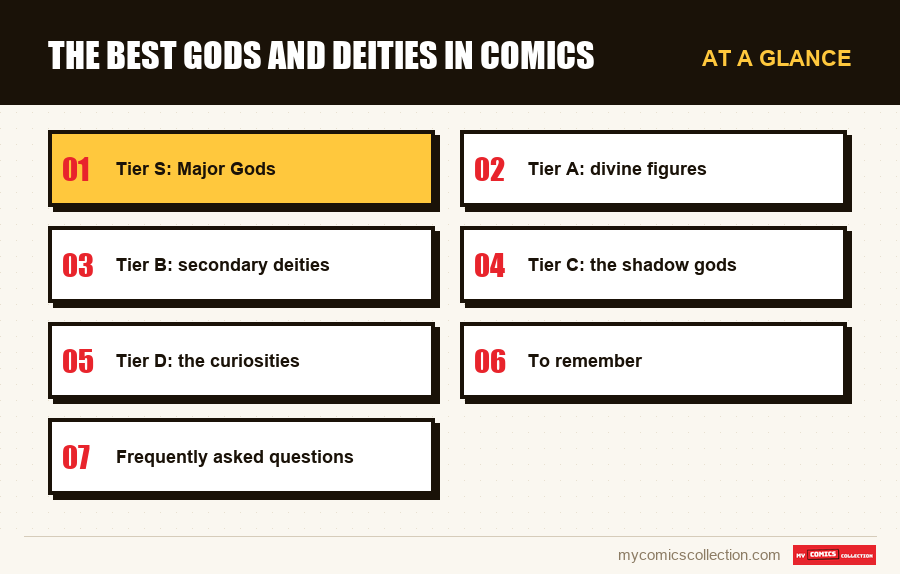
Start my trial →Tier S: Major Gods
Thor, god of thunder, is the most emblematic deity in comics. Odin, the All-Father, reigns over Asgard. Hercules, Olympian demigod, is one of the great Marvel pillars, and Zeus embodies the king of the Greek gods, present at Marvel as at DC.
Tier A: divine figures
Loki, god of mischief, is one of the richest characters in the pantheon. Ares (god of war), Hela (goddess of death) and Sif complete this tier.
Tier B: secondary deities
Balder , Athena , Pluto (Hades) and Amatsu-Mikaboshi (Japanese god of chaos) enrich the pantheons of comics.
Tier C: the shadow gods
Frigga , Heimdall , Neptune and Apollo embody more discreet but very present deities.
Tier D: the curiosities
Tire , Hogun (one of the Three Warriors) and Ass Borson (the God of Fear) closes this tier list: more obscure but very real deities.
To remember
- Marvel dominates the subject via Asgard and Olympus.
- Thor and Loki are the most developed deities.
- Journey into Mystery #83 (1st of Thor) is a major key number.
- Each character refers to its file when it exists.
Three landmarks for reading Marvel's gods in order
The top of the ranking is dominated by the pantheons of Asgard and Olympus, and their print entry point is simpler to locate than it seems. Three landmarks are enough to find your way through the bibliography of Thor, the most developed deity on the list.
Journey into Mystery #83 (August 1962). This is where Stan Lee and Jack Kirby introduce Thor, hence the mention in the "To remember" section: it is the major key issue of the subject. Journey into Mystery was then an anthology title, and Thor was only one feature among others. From #97 he becomes the title's protagonist, with the addition of the "Tales of Asgard" backups, which give a framework to Asgardian mythology.
Thor #126 (1966) and the Kirby era. The title becomes The Mighty Thor at #126. Issues #126 to #177 correspond to Kirby's peak on the series, with the Galactus saga (#160 to #162) and the introduction of Adam Warlock (#165 and #166). They offer the most epic image of the pantheon, and are the best entry point if you are looking for gods in their original setting.
Thor #337 (November 1983). Walter Simonson both writes and draws it, and the issue presents the first appearances of Beta Ray Bill and Lorelei. His run, which continues at least until #380 (June 1987), is cited in the FAQ above as one of the best entry points for discovering the whole Asgardian pantheon in an epic and accessible way.
What this changes for the collector
- Distinguish origin pieces from reading copies. The founding issues of 1962 are the most sought after, while later runs read just as well in collected editions.
- Check the numbering. The title goes from Journey into Mystery to The Mighty Thor at #126 while keeping the numbering, which can be confusing in listings.
- Target by theme. For the Norse gods, stay on Thor; for the Greek deities on the ranking, look first for their first appearances listed in the site's profiles, since they are not all found at the same publisher.
One last practical landmark: cover dates come a few weeks before or after the actual release. When you compare two copies of the same issue, rely on the printed date to confirm it is the right one.
Frequently asked questions
Odin is among the most powerful in the Marvel pantheon, alongside Zeus. Above exist abstract entities (like the Living Tribunal) that go beyond the scope of classical gods.
Yes, in the Marvel Universe, Thor is the Asgardian god of thunder, inspired by Norse mythology. His divine nature is a pillar of his stories.
Speak Thor by Walter Simonson or that of Jason Aaron, which showcase the entire Asgardian pantheon in an epic and accessible way.
Do you own Journey into Mystery #83 or another divine key issue? Estimate its value for free with our tool based on current eBay listings.