In short
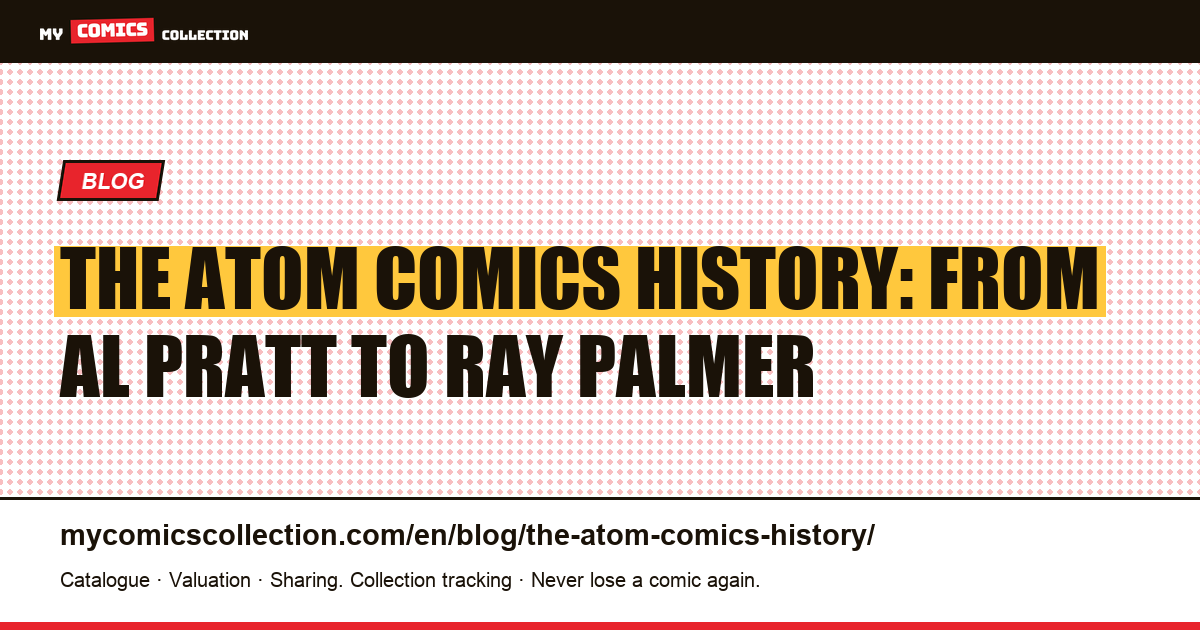
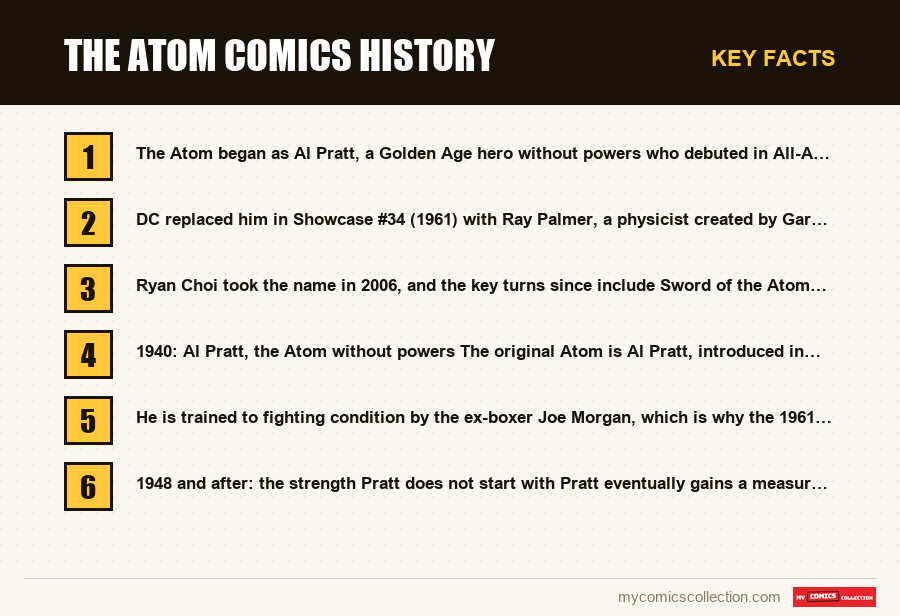
The Atom began as Al Pratt, a Golden Age hero without powers who debuted in All-American Comics #19 (1940) by Bill O'Connor and Ben Flinton. DC replaced him in Showcase #34 (1961) with Ray Palmer, a physicist created by Gardner Fox and Gil Kane who shrinks with white dwarf matter. Ryan Choi took the name in 2006, and the key turns since include Sword of the Atom, Identity Crisis and Choi's death and return.
Search for the Atom and you land in three different decades at once. The name has belonged to a Golden Age brawler, a Silver Age scientist, a physicist from a later generation and several others, and each has his own issues, creators and place on the shelf. This history follows the name through time, so you can see where one character stops and the next begins.
Cover dates, creator credits and issue numbers here were checked one by one, and no letterer or colorist is named where that could not be confirmed. The comments on what each change means for a collector are our own analysis.
1940: Al Pratt, the Atom without powers
The original Atom is Al Pratt, introduced in All-American Comics #19 with an October 1940 cover date. The character is credited to writer Bill O'Connor and artist Ben Flinton, and the book came from All-American Publications. Pratt initially has no superpowers. He is trained to fighting condition by the ex-boxer Joe Morgan, which is why the 1961 Atom, with a scientist's tools and a shrinking belt, reads as a different concept despite sharing the name.
Pratt joins the founders of the Justice Society of America, and he is also a founding and active member of the All-Star Squadron. In World War II he serves as a tank driver for the United States Army. The Golden Age Atom is a team player more than a solo star, and his best-known stories sit inside Justice Society books rather than in a single long run.
1948 and after: the strength Pratt does not start with
Pratt eventually gains a measure of super strength. In 1948 he gains it as the latent effect of his 1942 battle with the reluctant supervillain Cyclotron, after whose costume Pratt redesigns his own. This is a small but useful correction for anyone who thinks of the Golden Age Atom as a pure brawler: the strength is a later development, tied to a specific fight, and not part of his debut.
His family tree also matters for later stories. Pratt is the godfather of Atom Smasher and the father of Damage, two characters who carry the legacy into the modern Justice Society. Those connections explain why the name keeps returning in team books long after the original Atom disappears from the newsstand.
1961: Fox, Kane and the scientist Atom
Ray Palmer debuts in Showcase #34, cover-dated October 1961. Writer Gardner Fox and penciler Gil Kane created him, and editor Julius Schwartz said he and Fox together plotted the early stories. Kane's cover for Showcase #35 is dated November 1961. Palmer works as a physicist, and the lens that lets him shrink is made with a mass of white dwarf star matter, and his home is the fictional New England city of Ivy Town. The detailed premise, with the cave and Jean Loring, is covered in our Showcase #34 guide.
The background is a small piece of fan history. The fan Jerry Bails had proposed an updated Al Pratt, and in a letter to Bails dated January 1, 1961, Fox wrote that an Atom book might start within a month or so. Schwartz had already asked Kane for designs. The character who emerged was a new hero rather than a revised Pratt. Our Gardner Fox page lists his other DC credits.
1962 to the 1970s: his own title and the team-up books
The Atom series begins in June 1962, written mainly by Gardner Fox and Frank Robbins, with pencils by Gil Kane and Mike Sekowsky. Murphy Anderson and Sid Greene inked the series. Ray Palmer is a member of several incarnations of the Justice League, and the Atom and Hawkman series, written by Robert Kanigher, Gardner Fox and Denny O'Neil, pairs him with Hawkman. For collectors, the sequence is easy to follow because the run is a single long title rather than a succession of restarts.
Palmer's personal life produces a lasting change. Jean Loring, his girlfriend and later his wife, has an affair with fellow lawyer Paul Hoben, and Palmer divorces her. He heads for the jungles of South America and bequeaths his size-changing belt and his role as Ivy Town's protector to Hoben, Jean's new husband. The marriage and its collapse become the emotional core for everything that follows.
1983 to 1988: Sword of the Atom and a new costume
Sword of the Atom (1983) is a short-lived limited series written by Jan Strnad and penciled by Gil Kane, the same artist who co-created Palmer in 1961. It finds Palmer living among the six-inch Morlaidhans, where he becomes consort to their princess, Laethwyn. Loggers from a group associated with the US government threaten the colony, and Palmer later travels via the telephone to North America. The miniseries is followed by three specials.
Power of the Atom #1, dated June 1988, introduces a new costume with an encephalotronic grid in its headpiece. The series runs 18 issues, written by Roger Stern and Tom Peyer with pencils by Dwayne Turner and Graham Nolan, and it includes a mission called Operation: Fireball and the Micro/Squad. The Roger Stern author page covers his other work. Later, Palmer becomes a Teen Titans field leader during Zero Hour.
1990 to 1999: other Atoms and the end of Pratt
The name passes to other characters in these years. Adam Cray first appears as the Atom in Suicide Squad #44 by John Ostrander, dated August 1990, and joins the Squad. A future version, Atom One Million, appears in DC One Million 80-Page Giant #1,000,000 in August 1999. Pratt dies in the charge against Extant during Zero Hour.
Pratt is later reanimated as a member of the Black Lantern Corps in Blackest Night. For a reader tracking every Atom, the 1990s are the point where the name stops meaning one person. Cray and the One Million Atom belong to separate stories, and none of them is a replacement for Palmer or for Pratt.
Do you collect this series?
Track what you own, what you are missing and what your collection is worth. 7-day trial.
Start my trial →
2004 to 2005: Identity Crisis
In the limited series Identity Crisis (2004 to 2005), Jean Loring kills Sue Dibny, and a hit on Jack Drake is carried out by Captain Boomerang. Jean is committed to Arkham Asylum, and Palmer shrinks to a microscopic size and disappears. It is a hard turn for a character who began as a clean Silver Age scientist, and it sets up the search for Palmer that runs through the next several years.
2006 to 2008: Ryan Choi and The All-New Atom
Ryan Choi first appears in DCU: Brave New World #1, dated August 2006, as the fourth character to use the Atom name in the DC Universe. Gail Simone is credited with developing him; she has said she envisioned him, developed him and named him, and Grant Morrison is also listed among his creators. Eddy Barrows is credited as artist on The All New Atom #4 (December 2006), and the series ends with issue #25.
Choi is Palmer's longtime protégé, writing to him by letter before taking Palmer's place at Ivy University. Palmer later gives him his blessing, and when Palmer resumes using the Atom name, Choi wants a new identity of his own. The series offers a modern way into the legacy, and it is a good entry point, as our best Atom comics guide notes.
2009 to 2015: Brightest Day, Choi's death and Convergence
In Justice League: Cry for Justice #1, Palmer joins Hal Jordan's League, and in that book he asks Choi to keep using the Atom name. During Brightest Day, Deathstroke and his new Titans murder Choi on their first mission, and his corpse is sent to Dwarfstar in a matchbox. Issues of Titans vol. 2 in 2011, including #33 (March 2011) and #37 (July 2011), belong to this period.
Palmer's own story moves in parallel. Brightest Day: The Atom Special (July 2010) is written by Jeff Lemire with art by Mahmud Asrar, and his co-feature runs in Adventure Comics #516 to #521 (July to December 2010). Convergence: The Atom #1 and #2 (April and May 2015) then bring Choi back: he gets a new body by appropriating the flesh from Palmer's severed hand.
2011 to today: The New 52, Rebirth and a joint series
When DC reboots in September 2011, Palmer turns up as science advisor to S.H.A.D.E. in Frankenstein, Agent of S.H.A.D.E. #1 (September 2011). In DC Universe: Rebirth (May 2016) he reveals his secret identity to his friend and apprentice Choi, and then disappears into the Microverse. Justice League of America: Rebirth (February 2017) has Batman recruit Choi as Palmer's successor, and Palmer's whereabouts are later shown in Hawkman vol. 5 #6 (October 2018). Choi's own Rebirth one-shot is Justice League of America: Atom - Rebirth #1 (January 2017). In 2025 the two characters share the series Justice League: The Atom Project.
The key issues across the Atom's history
- All-American Comics #19 (1940): debut of Al Pratt, by Bill O'Connor and Ben Flinton.
- Showcase #34 (1961): debut of Ray Palmer, by Gardner Fox and Gil Kane.
- Atom #1 (1962): start of Palmer's own series.
- Sword of the Atom #1 (1983): Jan Strnad and Gil Kane send Palmer to the Morlaidhans.
- Power of the Atom #1 (1988): new costume, with Roger Stern writing.
- Suicide Squad #44 (1990): debut of Adam Cray, written by John Ostrander.
- DCU: Brave New World #1 (2006): debut of Ryan Choi.
- Convergence: The Atom #1 (2015): Choi's return.
How to follow the Atom in a collection
Pick a character before you pick a book. Pratt belongs to All-American Comics, All-Star Comics and the Justice Society; Palmer belongs to Showcase, Atom and the limited series of the 1980s; Choi belongs to The All New Atom and the Rebirth books. The three eras share a name and little else.
Titles repeat. Atom (1962), Power of the Atom (1988) and The All New Atom (2006) are different runs with different numbering, and Atom and Hawkman is a separate book again. Keep a list of start years next to your want list. For the Golden Age foundation, see our Golden Age collecting guide, and for the Silver Age context, the Justice League history.
Frequently asked questions
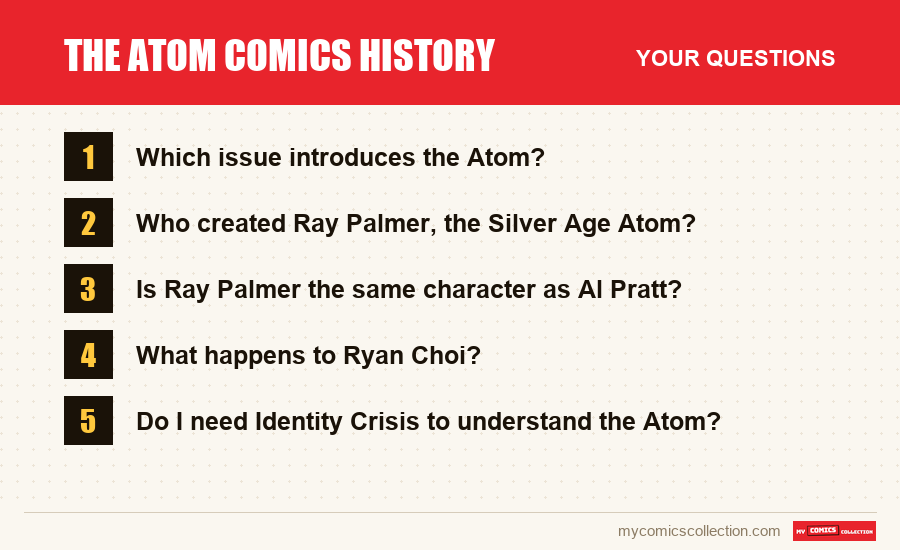
The answer changes with the wearer. All-American Comics #19 (October 1940) brings Al Pratt, Showcase #34 (October 1961) brings Ray Palmer, and DCU: Brave New World #1 (August 2006) brings Ryan Choi. Each is a distinct character with his own creators and issues.
Writer Gardner Fox and penciler Gil Kane created Ray Palmer, while editor Julius Schwartz plotted the early stories together with Fox. Palmer appears in Showcase #34 (October 1961), and his own Atom series begins in June 1962, written mainly by Fox and Frank Robbins.
No. Al Pratt is the powerless Golden Age Atom of 1940, later a Justice Society founder and godfather of Atom Smasher. Ray Palmer is a physicist introduced in 1961 who shrinks using white dwarf matter. They share a name only, which is why searches mix their books.
During Brightest Day, Deathstroke and his new Titans murder Ryan Choi on their first mission, in the Brightest Day era of Titans vol. 2. In Convergence: The Atom (2015) he returns with a new body made from flesh of Ray Palmer's severed hand, and in the Rebirth era Batman recruits him.
Not to enjoy the earlier books. Identity Crisis (2004 to 2005) explains why Ray Palmer disappears, since his former wife Jean Loring kills Sue Dibny and is committed to Arkham Asylum, and he shrinks away. It matters if you follow the stories that come after, including the search for Palmer.
Holding an All-American Comics or Showcase issue with an Atom story? Find out what your copy is worth.
Estimate my comic