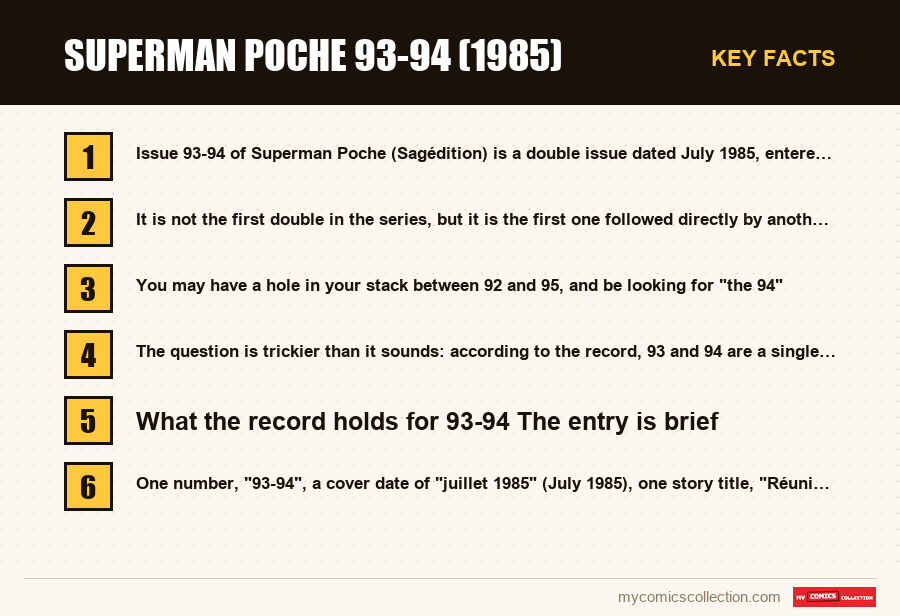
Issue 93-94 of Superman Poche (Sagédition) is a double issue dated July 1985, entered in the record under the title "Réunion tragique". It is not the first double in the series, but it is the first one followed directly by another double, with no single issue between them: 95-96 comes out the following month. In a list of gaps, it takes up one line, not two.
You may have a hole in your stack between 92 and 95, and be looking for "the 94". The question is trickier than it sounds: according to the record, 93 and 94 are a single object, and this numbering detour repeats after that at a pace that changes how you count what you are missing.
As always on this guide, only verified information (creators, numbers, dates) is stated as fact; the analysis is ours, with no reproduction of panels or protected dialogue.
What the record holds for 93-94
The entry is brief. One number, "93-94", a cover date of "juillet 1985" (July 1985), one story title, "Réunion tragique", and credits at the level of the issue: Cary Bates and Paul Kupperberg on writing, Eduardo Barreto, Curt Swan and Carmine Infantino on art. Three artists for a single title: the record does not say which of them signs which part of the issue.
What the entry does not say matters just as much. It does not give the table of contents, it does not indicate which episode carries the cited title, and it does not link the issue to any American number. So take "Réunion tragique" as the label of only one of the stories, the one the catalog retained, and check the rest on the copy.
The context: a series that counts two numbers in one issue
The series covers numbers 1 to 110 across 96 entries. The arithmetic is simple: 110 numbers minus 14 double issues gives 96 objects. No number from 1 to 110 is missing, including the second numbers of the doubles, which do not appear on a separate line but inside a double entry.
The first fifty entries are all single issues. The first double in the record, 51-52, is dated November 1981. So 93-94 did not open the practice of doubles: it is the ninth of the fourteen, after 89-90 of January-February 1985.
Around it, the dates are irregular. 91 and 92 both carry "mars 1985" (March 1985). The record then offers no issue dated April, May or June 1985: 93-94 arrives in July. This absence does not prove an interruption, and nothing can be concluded from the cover date alone about the actual day the issue reached the newsstands. It does show, however, that on the date side the July double fills an interval with no other dated entry.
Why this issue matters: the first double followed by a double
Before 93-94, two successive doubles are separated by at least two single issues in the record. Between 51-52 and 89-90, there are twenty-four single issues spread over seven intervals, a little over three on average. The shortest of these intervals has two (numbers 82 and 83, between 80-81 and 84-85).
93-94 is separated from 89-90 by two singles, numbers 91 and 92. So far, nothing new. The break comes right after: 95-96 follows directly, with no single between the two, and it is dated August 1985, one month after July. The same case recurs later with 106-107 and 108-109, dated September and November 1986. These two adjacencies are the only ones in the record.
This is what makes 93-94 a useful marker: it is the first entry whose immediate neighbor in the record is itself a double issue. Four numbers (93, 94, 95, 96) fit into two objects, released a month apart by their cover dates.
The table of intervals, read another way
Count in single issues between two doubles. From 51-52 to 89-90: 4, 3, 5, 3, 4, 2, 3. From 89-90 onward: 2, 0, 1, 2, 2, 0. The average drops from about 3.4 to about 1.2, roughly from three singles to one between two doubles.
Read by proportion, the shift is even clearer. From 51 to 92, the record lists 34 entries, 8 of them doubles, a little under a quarter. From 93 to 110, it lists 12, 6 of them doubles: exactly half. This should be stated with care: half the entries are not all of them, and six singles remain in this last stretch, numbers 97, 100, 101, 104, 105 and 110.
One might think that double-numbered issues "become the rule" from 93-94. The data qualify this: they exist from 51-52 onward, and in the last part of the record they represent half of the issues, not all of them. Speaking of a rule would be excessive; speaking of a growing frequency is accurate.
Do you collect this series?
Track what you own, what you are missing and what your collection is worth. 7-day trial.
Start my trial →
What drives the value
The value of an issue cannot be measured from the record line alone. Several factors play a part, of different kinds.
The first concerns the object itself: the spine, the folds of the cover, the separation of the pages. The second is whether the original covers, the central pages and a full spine are present. These points can only be assessed in hand, not on a screen.
Keep in mind that a value does not come from the title "Réunion tragique": the record says nothing about a story that would be a first appearance, a conclusion or a turning point. Avoid paying for a title as if it guaranteed a content value.
Recognizing the copy and avoiding the traps
On the object, look for the printed numbering: that is what counts, not the date. A copy that bore only "93" or only "94" does not match the record line and should be examined closely before being filed as a single.
The first trap is the single line: counting numbers from 1 to 110, you think you must look for 110 objects, when the series contains 96. The second is the false gap. If your shelf goes from 92 to 95-96, that is not a two-number hole: it is an issue 93-94 that is missing. The third is the wrong list: someone who notes "I am missing 94" thinks they are looking for a single issue; they should note "I am missing 93-94", because looking for 94 alone makes no sense when both numbers share the same object.
Finally, the cover date does not tell you the exact order at the newsstand. 91 and 92, for example, carry the same month. So do not sort by date alone: sort by number.
The neighboring numbers, and how to enter them in a list
Read the three lines before and the three lines after, because that is where the shift shows. Before: 89-90 (January-February 1985, "Une grenouille volante"), 91 (March 1985, "Le garçon qui dirige Superman") and 92 (March 1985, "L'homme qui vit périr Superman"). After: 95-96 (August 1985, "Les origines de Terra Man"), 97 (December 1985, "Les Maîtres de l'Univers") and 98-99 (February 1986).
For a list of gaps, there are two methods. The first is to note the line as the record gives it: "93-94", "95-96", "98-99". The second, useful if you cross-check with another numbering, is to add a "numbers covered" column and write 93 and 94 in it. In both cases, the final count is read in objects, not numbers: across the block from 91 to 99 you are looking for six objects (91, 92, 93-94, 95-96, 97, 98-99) for nine numbers.
To place this issue among the other titles from the same house, go through the blog; for the heroes gathered in the magazine, the Superman hub brings together the key references.
Condition and tracking your copy
Look at the spine first. Open it flat without forcing it, spot the white creases on the cover, and check the binding and the corners. Do not try to flatten a fold or clean the paper: these actions are irreversible and lower the condition more than they improve it.
In your records, create one entry per object, with the mention "93-94", the cover date "juillet 1985" as printed, and a free note on condition. If you manage the collection in an app, enter the double as a single entry and, if the tool allows, specify that it covers two numbers. A double entry avoids counting a phantom gap.
In short, 93-94 should not be taken as the start of the doubles, but as the first time a double precedes another double with no single in between. It is a reading marker for the record, useful for counting correctly, and nothing more should be asserted about it without the copy in hand.
Frequently asked questions
In the record, 93 and 94 form a single issue, dated July 1985. So you cannot own one without the other: the object carries both numbers. If you have a copy marked only 93 or only 94, check its cover before concluding anything.
No. The first double in the record is 51-52, dated November 1981. 93-94 is the ninth of the fourteen doubles, and the first one directly followed by another double, 95-96 dated August 1985.
Six issues are enough for nine numbers: 91, 92, 93-94, 95-96, 97 and 98-99. Counting in numbers distorts the picture, since three of these issues each cover two numbers in the record.
Nothing says so. The record keeps only one title per issue, although three artists are credited on 93-94. The title cited is a catalog label, not the table of contents: that is read on the copy.
Sorting by number is better. 91 and 92 carry the same month, March 1985, and 93-94 arrives in July with no issue dated April to June in the record. The date places an issue, but it does not give its exact order.