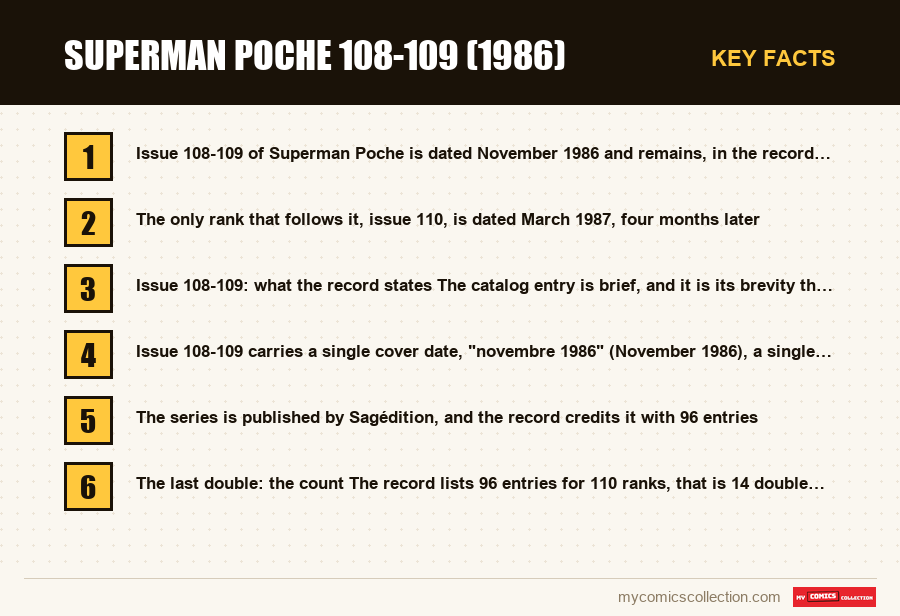
Issue 108-109 of Superman Poche is dated November 1986 and remains, in the record, the fourteenth and last double-numbered issue. The only rank that follows it, issue 110, is dated March 1987, four months later. Its story title announces a "3ière partie" (third part): the record says nothing more about the contents.
A collector looking for the end of a series often starts with the last line of the list. Here, the last line is preceded by an object that invites confusion: an issue that takes up two ranks at once and can be filed in more than one way.
As always on this guide, only verified information (creators, numbers, dates) is stated as fact; the analysis is ours, with no reproduction of panels or protected dialogue.
Issue 108-109: what the record states
The catalog entry is brief, and it is its brevity that needs to be read. Issue 108-109 carries a single cover date, "novembre 1986" (November 1986), a single story title, "3ière partie - L'heure de la revanche de Kandor", three writers (Edmond Hamilton, Cary Bates, Elliot S! Maggin) and two artists (Curt Swan, Eduardo Barreto). The series is published by Sagédition, and the record credits it with 96 entries.
Three writers for two artists: the credits are given at the level of the issue, not the episode, so you cannot match a name to a story. The record does not give a table of contents either. What this issue actually contains, apart from the story whose title is cited, can only be read on the copy itself and nowhere else.
The last double: the count
The record lists 96 entries for 110 ranks, that is 14 double-numbered entries and 82 single ones: 14 times two ranks, 82 times one, 110 in total. The fourteen doubles are, in order, issues 51-52, 57-58, 62-63, 69-70, 74-75, 80-81, 84-85, 89-90, 93-94, 95-96, 98-99, 102-103, 106-107 and 108-109. So 108-109 closes the list, and the only issue in the record that comes after it is a single one.
The series does not begin with doubles: the first fifty ranks are all single issues, and the first double does not appear until 51-52. From there on, 28 of the remaining 60 ranks, about 47%, are absorbed by doubles. For someone completing a list of gaps, the consequence is practical: from issue 51 onward, nearly one rank in two exists only in an issue shared with its neighbor.
An end of series that becomes more and more double
In 1986 alone, the record lists eight entries: 98-99 in February, 100 in March, 101 in April, 102-103 in May, 104 in July, 105 in August, 106-107 in September and 108-109 in November. Four of these eight entries are doubles, and they cover twelve ranks, from 98 to 109. In other words, the numbering moves faster than the releases: twelve ranks for eight issues.
The 108-109 is also one of only two cases in the record where two doubles follow each other with no single issue between them: 93-94 then 95-96 on one side, 106-107 then 108-109 on the other. A reader who reads "107" and then looks for "108" therefore does not find one more page but the next issue, which itself contains the 109.
November 1986, March 1987: what separates 108-109 from 110
Issue 110 is dated March 1987. Between "November 1986" and "March 1987", December, January and February have no entries: four months apart, the largest gap the record reaches, tied with two other passages, from issue 92 to 93-94 and from 95-96 to 97. The calculation takes the last month for two-month entries and sets aside issue 41, which is dated by a quarter.
This gap proves nothing in itself. A month without an entry can come from the date printed on the cover, which is not always the release date, or from an issue missing from the record. The ranks, for their part, run in sequence from 1 to 110 with no gap: no number is skipped, which makes the gap in dates a matter of calendar before it is a matter of content. It also says nothing about why the series stops there, and this page does not venture to deduce it.
Do you collect this series?
Track what you own, what you are missing and what your collection is worth. 7-day trial.
Start my trial →
A title that announces a third part
The title of 108-109 is the only one in the record that mentions a part number: "3ière partie". The spelling, with this unusual "ière", is the catalog's own and should be compared with the cover or the table of contents of the copy before being copied into a list.
The title announces a third part; it does not say where the first two are. They may be in the previous issue, 106-107, or elsewhere: the record for 106-107 cites only "Clark Kent licencié". A collector who wants to read this sequence in order must therefore open the neighboring issues rather than rely on the entry. The name of Kandor is the only clue to the story that the record provides.
The immediate neighbors: 106-107, then 110
Before it, 106-107 is dated September 1986, two months earlier, and it too is a double. Issue 105, dated August 1986, is a single, and issue 104 from July 1986 is also a single. After it, issue 110 is the last rank in the record: a single, dated March 1987, whose title is "Le jour et la nuit !", with two writers (Kurt Busiek, Alan Moore) and three artists (Ed Hannigan, Curt Swan, George Tuska).
Curt Swan is credited on 108-109 as on 110; no writer, and no other artist, appears on both. This says neither that he drew the same kind of story in both, nor that they form a sequel: the credits are grouped by issue. For a list of gaps, the most useful thing is to record 108-109 and 110 as two separate objects that follow each other.
Recognizing the issue and entering it in a list
To avoid mistakes, check three things on the copy in hand. The first is the printed double number: "108-109", not an isolated "108" or "109". The second is the date: November 1986. The third is the title cited above, which should match the opening page of the story announced on the cover or in the table of contents.
In a list of gaps, there are two possible ways to write it: one line "108-109" that counts for two ranks, or two lines "108" and "109" that point to the same object. The first avoids believing that an issue is missing. The second, riskier, leaves a false gap on the 109 line once the 108 has been bought. Choose the first and repeat it for the fourteen doubles in the record. A binder or an app that counts ranks rather than issues will show 110 for a complete collection, when there are 96 real objects.
Condition and tracking a copy from this period
The record says nothing about the physical condition of the issue. On the copy, check the spine, then the corners, then the condition of the interior pages. Do not clean anything: what is irreversible stays irreversible.
On the question of value, the record says nothing and neither does this page: the price of a copy depends on its condition and on the market of the moment, not on a rank. For everything else about the character's universe, the Superman hub and the blog link to the useful guides.
Frequently asked questions
In the record, yes: of the fourteen double-numbered entries, it is the latest, and issue 110 that follows it is a single. The record is not the entire series, so the exact wording is "the last double in the record".
Four months: November 1986 for the first, March 1987 for the second. No issue is skipped between them, since the ranks run from 1 to 110. The reason for this gap is not given in the record.
The catalog records this title as it is. It signals that the story in question is the third installment of a narrative, but it does not say where the first two appear. The copy has to be compared with the neighboring issues.
No: it is one issue, one object to acquire. A well-kept list of gaps carries one "108-109" line rather than two, otherwise a false gap stays displayed after the issue has been bought.
No. It cites only one story title, a date and credits grouped for the issue. The detail of what the issue contains, stories and supplementary pages included, can only be read on the copy itself.