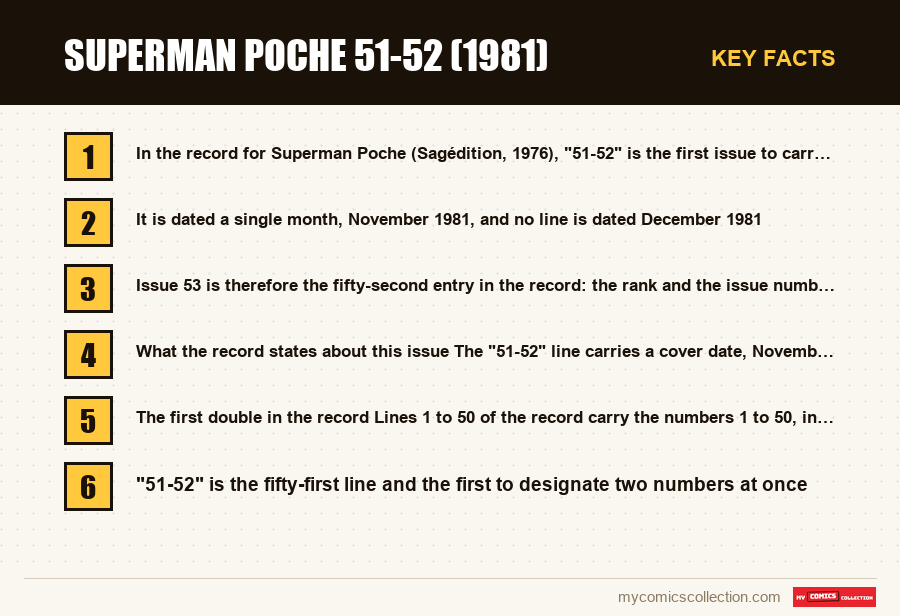
In the record for Superman Poche (Sagédition, 1976), "51-52" is the first issue to carry two numbers: each of the fifty previous issues has one line. It is dated a single month, November 1981, and no line is dated December 1981. Issue 53 is therefore the fifty-second entry in the record: the rank and the issue number drift apart by one from here on.
Your list of gaps may ask for a "No. 51" and a "No. 52" of Superman Poche. In the record, these two numbers do not have two lines but one, and looking for them as two is the easiest way to get the count wrong for everything that follows.
As always on this guide, only verified information (creators, numbers, dates) is stated as fact; the analysis is ours, with no reproduction of panels or protected dialogue.
What the record states about this issue
The "51-52" line carries a cover date, November 1981, one story title, "A maligne, malin et demi !", and three names each for writing and art: Bob Rozakis, Marv Wolfman and Cary Bates on writing; John Calnan, Bob Oksner and Kurt Schaffenberger on art. These credits are given for the whole issue, not for each of the stories it contains.
The record gives only one title. It therefore does not say how many stories the issue brings together, which one opens the table of contents, or whether "A maligne, malin et demi !" is the longest. You can treat this title as an identification marker, not as a description of the contents.
The first double in the record
Lines 1 to 50 of the record carry the numbers 1 to 50, in order and without a hyphen. "51-52" is the fifty-first line and the first to designate two numbers at once.
The next one, "57-58", comes on the fifty-sixth line, after four single issues (53, 54, 55 and 56). The double is therefore at first an isolated accident, then soon recurs: the record counts fourteen in all, between this issue and the "108-109" of November 1986. Calling it the "first double-numbered issue" is accurate for the record; calling it "the first time the magazine appeared as a double" is not necessarily so, because a record is not the series, and only the copy in hand can confirm that.
One date for two numbers
This is where the reading needs precision. Among the later doubles, several are dated over two months: "May-June 1982" for 57-58, "Oct-Nov 1982" for 62-63, "January-February 1985" for 89-90. This one carries only "November 1981". Several other doubles are also dated to a single month (74-75 in October 1983, 93-94 in July 1985), but 51-52 is the first to do so.
Around it, the rhythm is monthly and easy to follow: issue 44 is from April 1981, then May, June, July, August, September, and issue 50 from October 1981. Then comes November 1981 for the double. Then issue 53 jumps to January 1982. No line in the record carries the date December 1981.
Two readings remain open, and the record does not settle between them. Either the November issue in practice covers two months of publication and its cover year keeps only one. Or December did have an issue, absent from the record. The first reading is the most economical, since it is exactly what the hyphen suggests, but it remains an inference.
What the double does to the count
Between issue 50 and issue 53, you have three issues for four numbers. This gap is never made up: from there on, the number and the rank in the record diverge by one, then by two after 57-58, and so on. At the end of the record, issue 110 is the ninety-sixth line, that is fourteen numbers more than there are issues.
For a collector, the consequence is concrete. A count of "I am missing issues 51 to 60" does not correspond to ten objects, but to eight issues: 51-52, 53, 54, 55, 56, 57-58, 59 and 60. Counting numbers and counting issues gives two totals, and only the second tells you how many copies to look for.
Do you collect this series?
Track what you own, what you are missing and what your collection is worth. 7-day trial.
Start my trial →
The neighbors nearby
Issue 50, "Le trublion de la nouvelle Metropolis", and issue 53, "Superboy rencontre Clark Kent", carry exactly the same three writers as the double, in the same order: Bob Rozakis, Marv Wolfman, Cary Bates. The three lines follow one another. Issue 49, however, lists others (Cary Bates, Gerry Conway, Ed Dodd), and issue 48 only two. On art, John Calnan appears on 51-52 as on 53, and Denys Cowan on 50 only.
Note also that the double has no more names in its credits than its single neighbors: three on art, three on writing, like the issues around it. The record therefore does not let us read the thickness of the double in its credits. Pagination and price are not part of the data, and we do not state them.
A neighboring trap: the title "Sommaire" (table of contents) appears in place of a story title, for example on issue 47 and issue 49. These two lines identify nothing by their title. For them, the date and the credits serve as the markers.
Recognizing the copy and noting the gap
On the object, look for the mention "51-52" where the other issues carry their number, along with the November 1981 date. A cover that shows only a "51" or a "52" should be examined closely before drawing any conclusion: the record has no separate line for either.
In a listing, expect variable spellings: "51-52", "51/52", or even a simple "51". They may refer to the same issue. Match them against the date and the title "A maligne, malin et demi !" before buying, and ask for a photo of the cover if the listing shows nothing but a number.
In your list of gaps, enter one "51-52" line, not two. If you keep a spreadsheet by number, keep the two cells linked. Otherwise one of them will stay open forever, and your total of gaps will be off by one.
What this issue does not allow us to say
The record contains neither a complete table of contents, nor a verified first French publication date, nor a match with an American issue. It does not say that this double is rarer or more sought after than its neighbors, and we do not claim it. What you can say is modest and solid: it is the first of fourteen, it is dated to one month, and it moves the counter ahead of the lines in the record.
To track your whole series, keep a spreadsheet with one row per issue, its condition, its date and its number mention: that is what lets you spot at a glance the doubles that a count by number would have you count twice.
Frequently asked questions
Not in the record: there is only one line, "51-52", dated November 1981. If you have in hand a copy that bears only one of the two numbers, check the cover and the date before concluding that it is a separate edition.
It is the first in the record: the fifty lines before it carry only one number each. The next one is 57-58, four issues later. Since the record is not the series, the wording stays "in the record".
Issue 50 is from October 1981, 51-52 from November, and 53 from January 1982: no line carries December 1981. The record does not say why; the double may have stood in for two releases, but this is not established.
Three: 50, 51-52 and 53, for four numbers. The offset is one from there on, and it grows with each following double, up to fourteen at the end of the record.
The record does not say so: it gives only one story title per issue and the credits for the whole, three names for writing and three for art, as for its neighbors. The table of contents can only be checked on the copy.