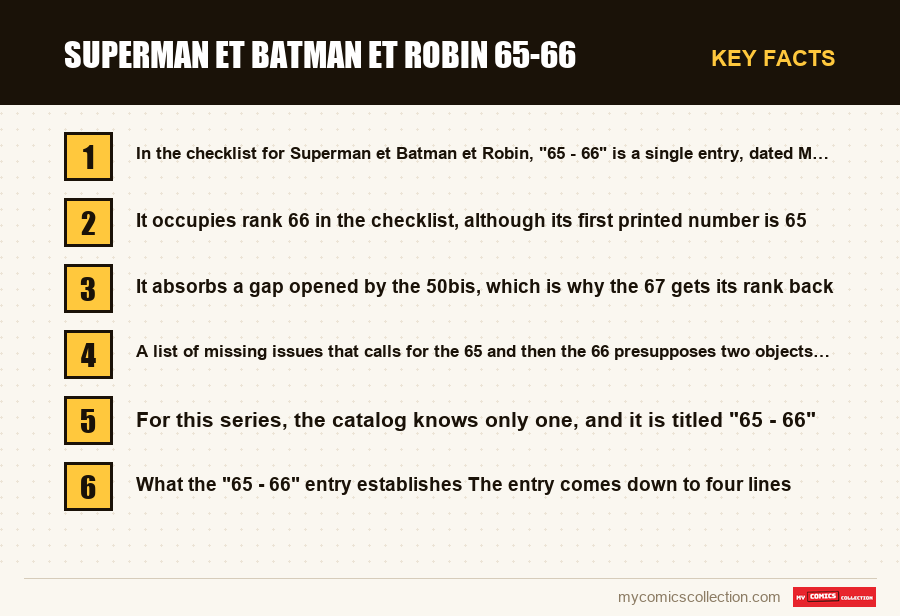
In the checklist for Superman et Batman et Robin, "65 - 66" is a single entry, dated May 1974, which carries a single story title: "The Cannibal Planet". It occupies rank 66 in the checklist, although its first printed number is 65. It absorbs a gap opened by the 50bis, which is why the 67 gets its rank back. The checklist does not say whether the object is one comic or two: that is verified on the copy.
A list of missing issues that calls for the 65 and then the 66 presupposes two objects to find, two lines to tick, two slots to prepare on the shelf. For this series, the catalog knows only one, and it is titled "65 - 66". Before searching, you therefore need to know what you are looking for.
As always in this guide, only verified details (creators, issue numbers, dates) are stated as fact; the analysis is our own, with no reproduction of panels or protected dialogue.
What the "65 - 66" entry establishes
The entry comes down to four lines. Its number is labeled "65 - 66", its cover date is "May 1974", its story title is "The Cannibal Planet", and its credits are Elliot S! Maggin and Cary Bates for writing, and Nick Cardy, Dick Dillin and Curt Swan for art. The catalog files the series under the publisher Sage - Sagédition, with a launch year of 1969.
What the entry does not establish weighs just as much. It gives only one title for two printed numbers, and credits at the level of the issue, not of the story. It is impossible to write that "The Cannibal Planet" opens the 65 or closes the 66, or that the title covers the entire contents. The contents must be read on the copy, and that is the only source that settles it.
May 1974 and its neighbors: reading the date
The date says more than the title, provided it is put back into sequence. Issue 62 is dated February 1974, issue 63 March, issue 64 April, then the double entry in May. Issue 67 jumps to July: no entry in the checklist is dated June 1974. The missing month falls where a second printed number, the 66, would have had to go if it had its own monthly release.
The series follows a rule of almost bookkeeping regularity. In the checklist, 70 of the 71 single-number entries carry the month their number implies, counting January 1969 as number 1: issue 13 in January 1970, issue 49 in January 1973, issue 64 in April 1974. Only one is an exception, issue 69, dated July 1974 where the rule would expect September. It therefore falls after issue 68, dated August, and shares its month with issue 67.
The double entry follows the rule through its first number: May 1974 is indeed the month of the 65. As a precaution, note that this is a reading of the date, not proof of what was printed. The checklist contains no entry for "65" alone or "66" alone: the May date is the only one the catalog associates with these two ranks.
One comic for two printed numbers: the arithmetic of the count
The checklist counts 74 entries and runs from number 1 to number 75. If every printed number had its own entry, there would be 75, plus one more for the 50bis, that is 76 slots. There are two entries fewer, because two entries group two printed numbers: "65 - 66" and "71 - 72". Each double entry swallows one slot, hence 76 minus 2.
For anyone keeping a spreadsheet, the consequence is clear. The number of entries is not the same as the last printed number, and the number of printed numbers is not the same as the number of objects. A collector who compares their 74 entries with the 75 printed numbers thinks they have a gap: they do not, the difference is the sum of two double entries (two fewer) and the 50bis (one more).
One nuance the data does not allow us to settle: a single entry proves that only one record was kept for these two printed numbers, not that one physical comic exists. Counting the double as "one object" is consistent with the entry, but it must be checked with the cover in hand: does it carry both numbers, and is the spine continuous?
The title and credits of the double, compared with 64 and 67
Issue 64 is titled "The Case of the Murder of Bruce Wayne", with two writers, Denny O'Neil and Cary Bates, and three artists, Neal Adams, Dick Dillin and Curt Swan. Issue 67 is titled "Supergirl's Great Ordeal", with three writers (Cary Bates, Leo Dorfman, Bob Haney) and three artists (Kurt Schaffenberger, Nick Cardy, Dick Dillin). The double sits between the two: two writers like the 64, three artists like both neighbors.
The fact that the double carries no more credits than its neighbors reads backward from what one would expect: two printed numbers do not carry twice as many signatures. One title, five names in all, which is the total for the 64. If the entry reflected two complete contents placed end to end, one would expect a longer list. It is calibrated like an ordinary issue, which says nothing about the actual page count, and that must be measured by hand.
The overlapping names mainly show team continuity. Cary Bates appears in the credits of the 64, the double and the 67, three consecutive entries. Dick Dillin as well, on the art side. Nick Cardy appears on the double, then on each of the issues 67 to 70, and Curt Swan on the 64 and the double. The title, for its part, shifts register at every rank: murder, cannibal planet, Supergirl's ordeal.
Do you collect this series?
Track what you own, what you are missing and what your collection is worth. 7-day trial.
Start my trial →
The rank and entry offset for the rest of the series
You need to distinguish the printed number from the rank of the entry in the checklist. The first 49 numbers occupy the first 49 ranks. The 50bis takes rank 50 and the 50 takes rank 51, so the 64 is the 65th entry. The "65 - 66" entry is the 66th: its leading number is 65, but its rank is 66.
This is where the offset closes. The 67 is the 67th entry, the 68 the 68th, the 69 the 69th, the 70 the 70th. Over this stretch, printed number and rank coincide, because the double absorbed the lead taken at the 50bis. The difference is zero for four entries. This is not a general rule for the series: it is a temporary balance between an addition and a merger.
It then reopens in the opposite direction. The "71 - 72" entry is the 71st, the 73 becomes the 72nd, the 74 the 73rd and the 75 the 74th and last entry of the checklist. From 73 onward, the rank is one lower than the printed number. Writing "the 73rd entry" to designate issue 73 would therefore be wrong, whereas "the 69th entry" does designate issue 69. The "nth entry" formula is correct for numbers 1 to 49 and for the 67 to 70 stretch, and offset between the two, as well as afterward.
Recognizing the copy and placing the double in a list of gaps
Three checks are enough, all on the object itself. Do the cover or the spine carry "65 - 66", "65" alone or "66" alone? Is the printed date indeed May 1974? And does the cover title match "The Cannibal Planet", or only part of the contents? The entry has only one title: it will not tell you whether the copy in front of you advertises more.
In a list of gaps, write the line as the catalog does: "65 - 66", once. If your listings or your file mention "65" or "66" on their own, link them to this entry before concluding that there are two gaps. Doing the reverse risks buying again what you already own, or searching for a "66" that has no entry of its own.
Think also about the neighboring line, the 67 dated July, and the 69 which carries the same month: the date alone is not enough to put the stack in order, and neither is the rank. Sort by printed number, record the date separately, and keep a column for the rank of the entry if you cross-reference your file with the catalog.
What moves the value, and what the data cannot say
The value of a copy depends on its condition and on the market at the time, two things this guide does not quantify. The catalog contains no price data, and this guide assumes none.
As for the place of this issue in the series, the checklist only tells you that it falls between the Bruce Wayne affair and the Supergirl ordeal. For other reference points, the blog gathers the guides to magazines and publishers.
Frequently asked questions
In the checklist it is a single entry, covering two printed numbers. On your shelf, count one object if the cover carries both numbers, and two if you have two separate issues. The entry does not settle it: the copy alone does.
Because the catalog attaches the 66 to the "65 - 66" entry, dated May 1974. The checklist contains no separate "65" or "66" entry, and no entry dated June 1974. A listing that mentions a "no. 66" therefore most likely refers to this entry.
If you extend the series' monthly cadence, May corresponds to the 65 and June to the 66. The entry only carries "May 1974". The "71 - 72", dated December 1974, falls on the month of the 72: the dating convention does not seem to be the same from one double entry to the next.
From 67 to 70, rank and number coincide. From 50 to the "65 - 66", the entry is one rank ahead because of the 50bis. After the "71 - 72", it is one rank behind: the 75 is the 74th entry in the checklist. Outside this zone, do not take the rank for the number.
No. It describes only one story title retained for the entry, whereas the credits cover the whole issue with several names. Compare the cover, the spine and the printed date with the label "65 - 66" and May 1974 before concluding.