In a magazine this long, an issue does not count because a reputation says so, but because a fact sets it apart from the others. The catalogue lets us point to a few without inventing anything: the bounds of the run, those the publisher celebrated itself, the one where it announces its own redesign, the creator hinges, the dating breaks, the calendar accidents and the serials some of whose parts are missing. Everything else is opinion.
You have a stack of Strange on a shelf and would like to know which of these issues deserve a sleeve, a separate place in the sorting, or a targeted search when missing. The temptation is to copy a list found elsewhere, except that none of them says what it rests on. This guide starts from what is written in black and white in the magazine's catalogue, and asserts nothing beyond it.
As always in this guide, only verified information (creators, issue numbers, dates) is stated as fact; the analysis is ours, with no reproduction of artwork or protected dialogue.
What the catalogued contents allow us to state, and what they do not
For each issue, the catalogue gives a number, a cover date, a story title and a handful of writer and artist names. That is a lot, and it is not enough: a French magazine of that era bound several episodes under a single cover, and the recorded title names only one. In other words, you have a sample of the contents, not the contents.
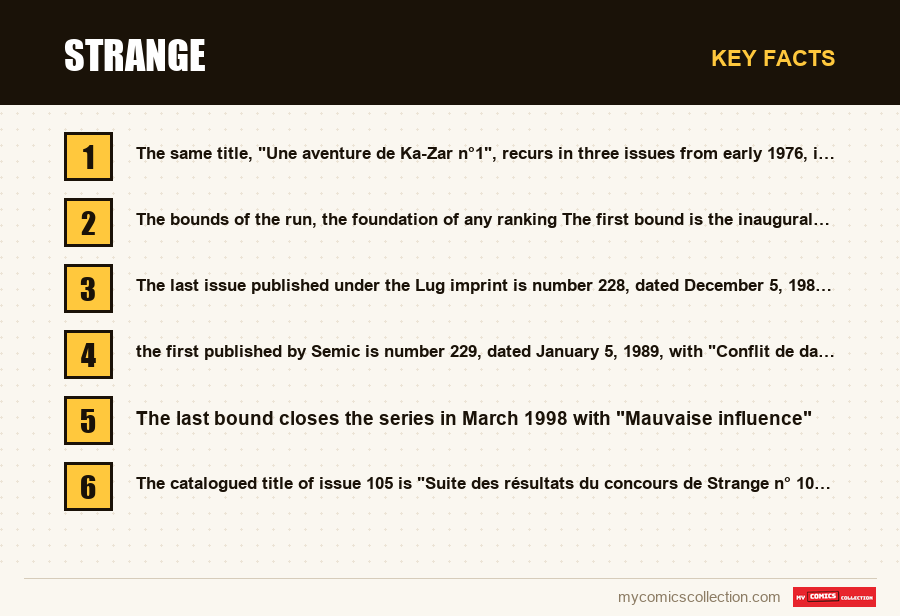
The proof is in the data. The same title, "Une aventure de Ka-Zar n°1", recurs in three issues from early 1976, including issues 73 and 76, which are not consecutive. A title repeated in this way is not the headline story: it is sometimes a column, sometimes an announcement for a neighbouring release.
Hence the method adopted here. All the criteria we use lie outside the content of the episodes: dates, credits, announcements the publisher printed in its own magazine, serial labels. They have one decisive advantage for you: they can be checked on the copy you are holding, without knowing its American equivalent.
The bounds of the run, the foundation of any ranking
The first bound is the inaugural issue, dated January 5, 1970, whose catalogued title is "L'héritier de Frankenstein !". It counts for a simple and sufficient reason: there is only one, and no collection can claim to be complete without it. On the other hand, nobody can deduce from the catalogue what that first contents actually contained beyond this single story, and a dedicated article examines this case more closely.
The second and third bounds go together. The last issue published under the Lug imprint is number 228, dated December 5, 1988, with "Bénis soient les innocents..." in its contents; the first published by Semic is number 229, dated January 5, 1989, with "Conflit de dames". The count does not restart from zero. This is a point to bear in mind before any search: a collector looking for a supposed first issue of the Semic era is looking for an object that never existed.
The last bound closes the series in March 1998 with "Mauvaise influence". Final issues often become scarce on the second-hand market, the magazine having already lost points of sale. The catalogue does not measure print runs: this is an observation from practice, not an established fact.
The issues the publisher singled out itself
A round number does not count because it is round, but if the publisher made it an event. The catalogued title of issue 105 is "Suite des résultats du concours de Strange n° 100": the magazine therefore later publishes the results of a contest organised around its hundredth issue. The event is attested by the editorial team itself.
The same mechanism applies to the two-hundredth, whose issue 203 announces "Les gagnants du concours de Strange 200". Here is a criterion you can apply on its own to any series: look not for the round number but for the trace the publisher left around it. What cannot be asserted, however, is the nature of the contest, its prize pool, or the real scale of the operation.
The three-hundredth, dated December 1994, stands out in another way. Its artist credit line is not nominative as it is everywhere else in the series: it is collective, and explicitly mentions a plurality of creators. A collective credit is a sign of a composite issue, assembled for the occasion. The indication is solid; it does not tell you what that issue contained, and only the copy in hand will say.
The issue where the magazine announces its own redesign
A single catalogued title announces a change of format instead of telling a story: that of issue 181, dated January 5, 1985, "A nouvelle année, nouveau look !". The magazine speaks about itself there and warns its reader that it is changing. For ranking a collection, nothing is more useful: here is a boundary visible to the naked eye between two states of the object.
A detail that should not be interpreted too quickly: Frank Miller's name appears in the artist credits of this particular release, whereas he appears mainly in the writing credits in the neighbouring years. The catalogue records a name and a position, not an attribution of artwork. What you cannot assert, therefore, is what the announced new look consisted of, or who drew it.
Creator hinges, measurable to the name
Two French names structure the series far more reliably than any American headliner. Jean Frisano first appears in the credits of issue 21, dated September 5, 1971, and for the last time in issue 212, dated August 5, 1987. Between these two bounds, he is present in the vast majority of releases. These two issues therefore count as markers: they open and close the period in which the magazine had a French graphic identity.
Jean-Yves Mitton, for his part, is credited from the inaugural issue and for the last time in issue 219, dated March 5, 1988. The departure of both men a few months apart, just before the change of publisher, is one of the rare correlations the data allows. The data does not say why, and we must stop there.
The third hinge is the most abrupt. From issue 325, May 1997 onward, the names credited for writing and art are almost entirely renewed, with only three appearing in earlier years, and the titles change world, such as "Le Flash des deux cités". A collector who buys a "lot of Strange" without looking at the issue numbers may thus receive two very different sets of objects. What the catalogue does not allow us to say is which licence or agreement this switch corresponds to.
Do you collect this series?
Track what you own, what you are missing and what your collection is worth. 7-day trial.
Start my trial →
When the printed date changes shape
The magazine was long dated the fifth of the month, which makes it a very convenient dating marker. This is not a rule without exceptions, and each exception is an identifiable issue. In autumn 1983, three consecutive releases, from issue 165 to issue 167, lose the day mention and carry only the month; the next one returns to the usual format. A trio of this kind is a sign of wavering in production.
More singular still: only one release in the whole series carries a day other than the fifth, issue 188, dated August 10, 1985. It is the only anomaly of this kind, and it is enough to distinguish this issue from all the others. What cannot be asserted is whether this offset reflects a printing delay, a postponed newsstand release or a simple cover error.
The decisive break occurs in September 1994, at issue 297: the day disappears, and it never returns until the end of publication. For you, this has an immediate practical consequence. If a copy without a dust jacket carries a date reduced to the month, it almost certainly belongs to the last phase of the magazine, and you can set it aside from a lot supposed to cover the Lug years without even opening the issue.
Calendar accidents
A monthly that lasts three decades eventually stumbles, and its missteps leave usable traces. Issues 279 and 280 both carry the same cover date, March 5, 1993, while no issue is dated April of that year. Two releases for one month, then a skipped month: here is a pair of issues that can legitimately be filed apart, because their dating does not follow the logic of the rest of the series.
The second accident is a silence. After a December 1996 release, the next one is dated May 1997, that is four months without publication. This gap coincides exactly with the complete renewal of the teams mentioned above. Two independent facts falling in the same place make a solid hinge; they do not make an explanation, and the catalogue provides none.
Hence a useful reflex: count the months as well as the issues. A well-meaning seller may advertise perfect continuity without knowing that the magazine was interrupted, and the blog returns to this reading through chronology.
Issues announcing a part whose remainder is missing
Some catalogued titles carry a part number, and this is valuable because it creates a verifiable expectation. Issue 268 announces "La guerre des mers, 2ème partie" and issue 270 a fourth part of the same serial. The first and third parts appear nowhere in the titles of the series. The intermediate issue, for its part, carries an unrelated title.
The case repeats with "Operation AIM", whose second chapter appears in May 1996 and whose conclusion in July, without the intermediate links. The data does not settle between two readings: parts hidden under another title, or publication in a neighbouring magazine from the same house.
The counter-example is instructive. The serial that opens the magazine's final phase, in May and June 1997, appears with its two consecutive, complete chapters. When a series of parts is continuous in the listing, it is a sign of reliability; when it has holes, it is an issue to open before buying. In both cases, you know what to look for on the contents page.
Issues that announce something other than their own contents
The magazine also served as a showcase for the house's other titles, and this produces landmark issues. The recorded title of issue 66, dated June 5, 1975, refers to the first issue of the sister magazine devoted to special series. That of issue 98, dated February 5, 1978, announces three superheroes in another monthly publication from the publisher. These releases date the house's launches better than any reconstructed chronology.
One curiosity deserves mention for what it proves. Issue 204, dated December 1986, is the only one in the whole series whose catalogued title contains the name of the historic publisher, with "Club Lug des héros Marvel !". At that date, the imprint is therefore still alive in the magazine's pages, two years before the numbering switch. What this does not prove is the existence of a structured club or its duration.
Finally, beware of the most common trap. A title like that of issue 132, which features a space knight, or that of issue 116, which names a well-known hero, reads as an announcement of content and nothing more. It is in no way proof of a character's first French appearance: the listing contains only one title per issue, and the hubs devoted to the Fantastic Four or to Thanos place these appearances in their real editorial history.
Ranking without telling yourself stories
Three levels emerge from this sorting, and they are not equal. At the first, the facts that can be proven on the copy: the bounds of publication, the change of publisher, the issue that announces its redesign, the dating breaks, the two twin dates of March 1993. These deserve a separate place, because nobody can challenge them.
At the second level, serious but incomplete clues: the contests around round numbers, the collective credit of the three-hundredth, serials with missing parts, the creator hinges. They point to issues to examine, not to certainties. At the third, everything circulating about the supposed rarity of a given issue without any source to back it up: to be treated as a research hypothesis, never as a sales argument.
One last reflex, which follows directly from the data. Several titles recur identically in the series, such as "Vengeance !", "Trahison" or "Premier contact", years apart and under two different imprints. Identifying an issue by its story title is therefore a bad habit. Always cite the number and the printed date: that is the only pair of information that designates a copy without ambiguity.
Frequently asked questions
No. The listing shows continuous numbering: the series stops at 228 under Lug and resumes at 229 under Semic, without a reset. However, two releases carry the same cover date, March 5, 1993. It is the date that duplicates, never the number, and that is why both should be cited together.
Look first at the shape of the date rather than its content. A date mentioning the fifth of the month places the copy before September 1994; a date reduced to the month alone places it after, with rare exceptions in 1983, 1986 and 1987. Only then cross-check with the credited names, which change over long stretches.
The catalogue proves that a contest was organised around it, since a later release publishes the results. A round number celebrated by its editorial team is often sought after more than an ordinary issue. But the price depends above all on condition, and no contents data allows us to quantify a gap between two issues.
Not from this listing. It records only one story title per issue, whereas the magazine published several. A title naming a hero announces a presence, not a first appearance. The only reliable method is to open the copy, read its complete contents page and compare it with the neighbouring magazines from the same publisher.
Treat them as priority issues to verify. When a second and a fourth part appear without the others, either the missing links are in the same issues under another title, or they were published elsewhere. In a lot, these are the copies whose contents page deserves a photo before purchase.