
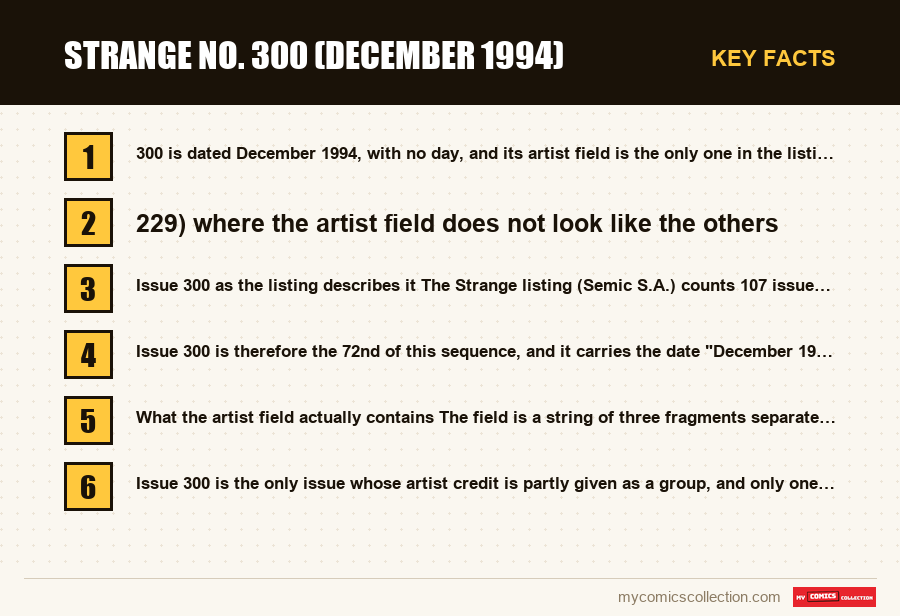
Strange no. 300 is dated December 1994, with no day, and its artist field is the only one in the listing to contain the mention "divers" (various): that is where the credit is vague, not with the writers, whose trio is ordinary. Its single story title, "En kiosque", tells us nothing about the real contents. For the rest, you have to open the copy.
A round number draws the eye on a list of gaps, and this one deserves more attention: it is the only line in the Strange listing (Semic, starting at no. 229) where the artist field does not look like the others. What that field actually contains can be measured, and the details follow.
As always in this guide, only verified information (creators, issue numbers, dates) is stated as fact; the analysis is ours, with no reproduction of artwork or protected dialogue.
Issue 300 as the listing describes it
The Strange listing (Semic S.A.) counts 107 issues, from 229 to 335, with no gap in the numbering: 335 minus 229, plus one, gives exactly 107. Issue 300 is therefore the 72nd of this sequence, and it carries the date "December 1994". Its story title is "En kiosque", its writers are Bob Harras, Len Kaminski and David Michelinie, and its artists are listed as "divers [various], Hercule), Liam Sharp".
That is all the line contains. It gives no contents, no page count, and no mention of a special cover: nothing indicates that this round number was treated differently from its neighbours. The roundness is a fact of numbering, not information about the object.
What the artist field actually contains
The field is a string of three fragments separated by commas, as in 105 of the other 106 lines of the listing (the last one has only two). But here the three fragments are not three names. The first, "divers [various]", is a group mention, and it is the only time the listing uses one. The second, "Hercule)", has a closing parenthesis with no opening one: the text was evidently cut somewhere, and the remaining word does not tell us whether it refers to a person, a character or a title. Only the third, "Liam Sharp", reads as a proper name.
That name is itself isolated: Liam Sharp does not appear in any other line of the listing. What the data establishes is therefore modest. Issue 300 is the only issue whose artist credit is partly given as a group, and only one artist is named there without ambiguity. How many artists actually worked on this issue, the line does not say.
The writers: a trio already seen, in another order
On the writing side, the field names three people, as do 102 of the 107 issues in the listing (the other five name two). More importantly, this trio is not new: Harras, Kaminski and Michelinie appear together in seven other issues, 288, 290, 291, 293, 294, 297 and 303. What sets issue 300 apart is the order: Bob Harras opens the field, which happens in no other issue of the listing.
This position should be read with caution. The listing does not say what the order of names means, and we cannot claim that it reflects a share of the work. It only shows that the entry for issue 300 differs from those of its neighbours. Across the twelve issues from 295 to 306, David Michelinie opens the field in eight (295 to 299 and 301 to 303), Fabian Nicieza in three (304 to 306), and Harras in only one, issue 300.
A story title that does not look like the others
The listing gives only one title per issue. "En kiosque" is unique in the listing: no other issue carries it. The titles of the neighbouring issues read like episode names ("Pour un empire perdu" at 299, "Indiscrétions" at 301). The one for 300 reads more like a distribution mention, and nothing in the data allows us to decide between a real episode title and a label entered in its place.
For your record, the consequence is simple: do not copy "En kiosque" as if it described a story. Note it as the title carried by the catalogue, then check the contents on the copy itself.
Do you collect this series?
Track what you own, what you are missing and what your collection is worth. 7-day trial.
Start my trial →
Dates: December 1994, and the day that disappeared
The form of the date matters as much as the credit. In the listing, 67 issues carry a full date, and all of them fall on the 5th of the month. The series runs from 229 to 296, with one exception, issue 232, given as "April 1989" with no day. From issue 297 onward, no issue has a day: 39 issues, from 297 to 335, carry only the month and year.
Issue 300 is therefore the fourth consecutive issue with no day (297, 298, 299, 300). This is not an anomaly specific to 300: it is the date format for the whole final stretch of the series. In a list of gaps, write "December 1994" and do not invent a "5 December" by analogy with the earlier issues, which the data does not allow you to write. The rhythm stays monthly around 300: November 1994 for 299, January 1995 for 301.
The neighbours, for orientation
Issue 299 ("Pour un empire perdu") is credited to Michelinie, Steven Grant and Kaminski, with Mark Bagley, Jeff Johnson and Kevin Hopgood on art. Issue 301 ("Indiscrétions", January 1995) has as writers Michelinie, Ann Nocenti and Kaminski, and as artists Eleonor Duport, Mark Bagley and Mike Mignola. Both artist fields are complete, with three readable names each: it is this contrast that makes the one for 300 stand out.
A point of attention for completists: from 304 to 307, the writer field opens with Fabian Nicieza, then with Mark Waid from 308 to 311. If you sort your copies by creator rather than by number, issue 300 falls in with its Michelinie neighbours; it is the numbering, not the credit, that should govern the filing.
Recognising the copy and recording it correctly
Three checks are enough on the object. The printed number: 300, with no suffix. The cover date: month and year, with or without a day, and note exactly what is printed. The contents: this, not the catalogue title, will say what the copy contains and whether the word "divers" has an explanation.
In your tracking sheet, keep three separate columns: the number, the date as printed, and the contents you note down yourself. Do not put the string "divers [various], Hercule), Liam Sharp" in the creators column, since it is a state of data entry and not an identity. If your copy shows names that the listing does not have, your own observations take precedence.
What the listing establishes, and what it leaves open
The listing establishes three things. The artist field is partly collective, with the mention "divers" and a single readable name. The writers form an ordinary trio, which recurs in seven other issues. The date presents nothing unusual for this period.
Everything concerning the object remains open: the number of stories, the full list of artists, and any special nature of this round issue. None of these questions is answered in a catalogue line, and it is the copy in hand that settles them.
Frequently asked questions
The data does not say so. Its date is regular (December 1994, between November and January), and it carries a single story title. Only its artist field stands out. Any special nature would be read on the cover and the contents of the copy, not in the catalogue.
The catalogue clearly names Liam Sharp, preceded by a "divers" mention and a truncated fragment "Hercule)". The actual number of artists is therefore not established by the data. For a complete credit, note the names printed in the issue.
In the listing, no issue shows a day from 297 onward. Issue 300 follows the same format as the 39 last issues, from 297 to 335. So record "December 1994" as it is, without adding a day that the listing does not give.
Nothing allows us to say so. No other issue in the listing carries this title, and it reads more as a mention than as an episode name. Note it as the catalogue title and check the actual contents on the copy.
By its number, 300, and its printed date, month and year. Add a contents column that you fill in yourself. Leave aside the catalogue's artist string: it is incomplete and does not serve as an identifier.