
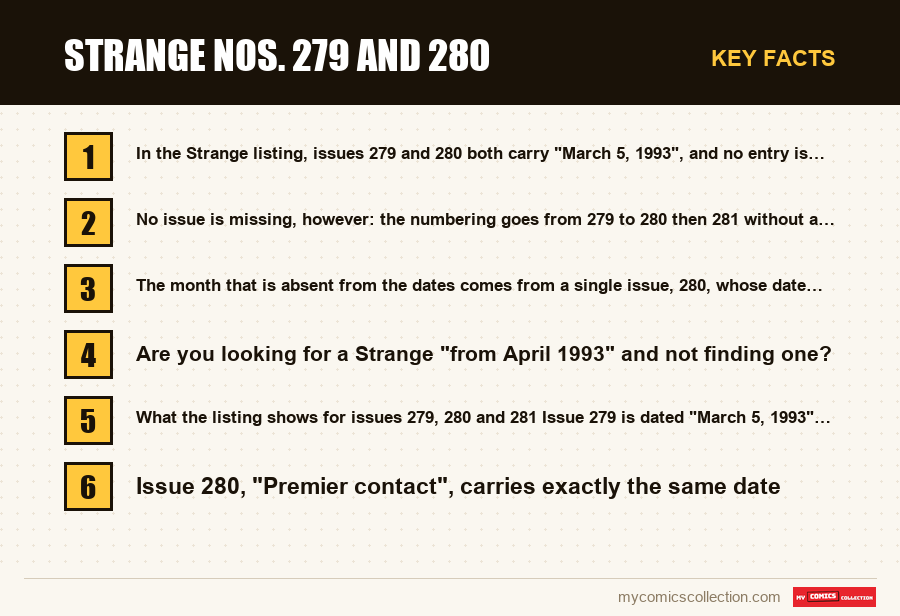
In the Strange listing, issues 279 and 280 both carry "March 5, 1993", and no entry is dated April 1993. No issue is missing, however: the numbering goes from 279 to 280 then 281 without a gap. The month that is absent from the dates comes from a single issue, 280, whose date did not follow the monthly pace. To place a copy, rely on the number, then read the printed date.
Are you looking for a Strange "from April 1993" and not finding one? Do you find two March issues instead? The reflex is to conclude that an issue is missing somewhere. The data tells a different story, and the difference matters as soon as you are holding a list of gaps.
As always in this guide, only verified information (creators, issue numbers, dates) is stated as fact; the analysis is ours, with no reproduction of artwork or protected dialogue.
What the listing shows for issues 279, 280 and 281
Issue 279 is dated "March 5, 1993" and opens with the story "Et la fête continue !". Issue 280, "Premier contact", carries exactly the same date. Issue 281, "Mission de reconnaissance", jumps to "May 5, 1993". That is the trio concerned: two consecutive issues on an identical date, then a two-month jump.
The credits are given at the level of the issue, with three writer names and three artist names. For 279: Al Milgrom, John Byrne and Chris Cooper on writing, Mark Bagley, Paul Ryan and John Romita Jr. on art. For 280: Al Milgrom, John Byrne and Bob Harras, with Andy Kubert, Mark Bagley and Paul Ryan. The listing does not say which name matches which episode, and it does not give the full contents: one story title per issue only.
A month missing from the dates, no issue missing from the numbering
Two questions are mixed together here, and they need to be separated. The first concerns the calendar: is there a month without an issue? Yes, in terms of dates: April 1993 does not appear in any of the 107 entries of the listing. The second concerns the sequence of numbers: is one missing? No: the numbers run from 229 to 335, and the 107 entries occupy the 107 places.
In other words, the absence of April is an absence of date, not an absence of an issue. The issue that should occupy April exists: it is 280, and it carries the date of the previous month. A reader searching for "April 1993" in a date-sorted list would wrongly conclude that an issue was never published.
A local anomaly, not a shift that spreads
The question remains whether this duplicate date contaminated what followed. It did not. Between issue 268 (April 5, 1992) and issue 279 (March 5, 1993), each issue falls one month after the previous one. After 280, issue 281 is dated May 1993, and issue 281 does sit thirteen months after 268, as its rank would suggest. The calendar found its pace again from the next issue.
Of the 106 transitions from one issue to the next in the listing, only three do not fall exactly one month apart: 279 to 280 (zero months), 280 to 281 (two months) and 324 to 325 (five months, covered below). The first two are two sides of the same anomaly: a repeated date, then a two-month jump that compensates for it. Without 280, issues 268 to 296 would follow one another at one month each.
What the data does not tell us is the cause. The date of 280 may have been printed identically on the object, or copied from its neighbour when the catalogue was entered: the listing does not allow us to decide. The simplest reading is that 280 should have carried April, but that is a deduction, not a data point.
What this changes when dating a copy
Two principles follow. First, rank takes precedence over date when the two contradict each other: 280 is the issue that comes after 279 and before 281, whatever date is attributed to it. Second, a date is only proof if it is read on the object itself. Check the printed mention on your copy rather than relying on a sales listing or a sorted list.
In practice, three cases arise. If your copy is a 280, its publication date most likely falls between the March 279 and the May 281: a tight range, but not an established date. If a listing sells a "Strange from April 1993", ask for the number: it is very probably 280. And if a seller claims to have two March 1993 issues, they are 279 and 280, not a duplicate.
Do you collect this series?
Track what you own, what you are missing and what your collection is worth. 7-day trial.
Start my trial →
The two issues side by side: titles, credits and a namesake
Issues 279 and 280 are told apart by their title and their team. Issue 279 counts John Romita Jr. among its artists and Chris Cooper among its writers; 280 replaces them with Andy Kubert and Bob Harras. These replacement names are enough to separate them when reading the credits, even if the cover does not help you.
An additional trap awaits the reader of the listing: the title "Premier contact" also appears at issue 288, dated December 5, 1993. It is the only story title repeated across the 107 issues of the listing. The credits differ (288 gives David Michelinie, Len Kaminski and Bob Harras on writing), so this is not a line duplicated by mistake. The listing does not say why two issues carry this title. Simply remember that the title alone does not identify an issue: the rank does.
Do not confuse it with the real gap of 1997
Another spot in the listing looks like a missing month, and that one is of a different nature. Issue 324 is dated December 1996, and 325 is dated May 1997: four calendar months (January to April 1997) have no entry, even though the issue numbers follow one another. Here, no neighbouring issue shares a date, and the gap is clear.
The distinction is useful for anyone who sorts their collection by date. From issue 297 onward, the listing only gives the month, with no day, which makes these gaps harder to spot by eye. The principle stays the same: a gap in dates is not proof that an issue is missing, and only the rank can prove it. As long as the numbers follow one another, the series is complete at that point.
Recording 280 in a list of gaps
Note it by its number, not its date: "Strange no. 280", with a margin note "March 1993 on the record, April expected". This line protects against two errors: looking for a "280 bis" that does not exist in the listing, and believing there is a hole between 279 and 281.
As for condition, nothing in this data distinguishes these two issues from any other: the listing says nothing about paper, binding or variants. Examine the copy on its own merits, and record the date you read on it, whatever it is, in your tracking. In your tracking, enter the number as the key and keep the printed date as a comment: a date typed from memory spreads poorly from one list to another.
Frequently asked questions
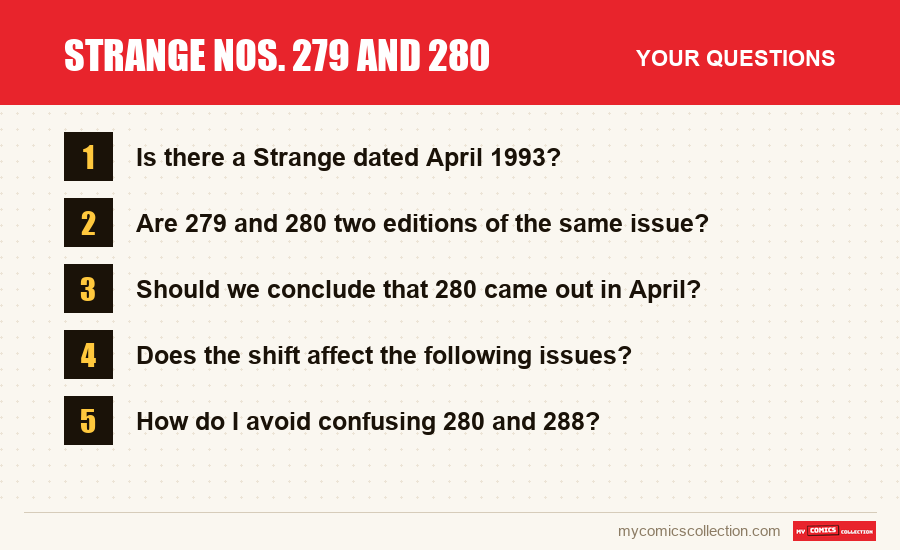
Not in the listing: none of the 107 entries is dated April 1993. Issue 280, which should occupy that month, is dated March 5, 1993 like 279. The numbering, for its part, shows no gap between 279 and 281.
No. They are two distinct issues, with different story titles ("Et la fête continue !" and "Premier contact") and different credits. Only the date shown in the listing is identical.
The data does not establish it. It is the simplest reading, since 281 is dated May, but the actual publication date of 280 still needs to be confirmed on the copy itself.
No. Issue 281 is dated May 1993, thirteen months after 268 of April 1992, as its rank implies. The listing shows no lasting shift after 280.
Both carry the title "Premier contact". Issue 280 is dated March 1993 and credits Andy Kubert; issue 288 is dated December 1993 and credits Kevin Hopgood as first artist. Compare the printed issue number, not the title.