Jeff Smith is the American cartoonist (born February 27, 1960 near Pittsburgh, raised in Columbus, Ohio) creator of Bone, a fantasy series in 55 issues, self-published via his own house, Cartoon Books, between July 1991 and 2004. Rewarded with around ten Eisner Awards and eleven Harvey Awards, the work made Smith one of the absolute references in independent comics, alongside authors like Alan Moore or Frank Miller in terms of influence. In 2026, he is among the sixteen nominees for the Eisner Awards Hall of Fame, the winners of which are announced on July 24 in San Diego. On the collection market, it is Bone number 1 in first printing which concentrates most of the value, a CGC 9.8 copy having crossed the $15,000 mark.
There are authors who write superheroes, and there are authors who build an entire world by hand, without an editor, without a studio, without anyone to tell them no. Jeff Smith belongs to the second category. For more than thirteen years, alone with his wife Vijaya Iyer at the head of their small structure, he drew, inked, printed and distributed himself the adventures of three round-headed cousins exiled from their village of Boneville. The result, Bone, is today considered one of the most accomplished and influential comic strips of the modern era of American comics, compared both to Peanuts that at Lord of the Rings for the scale of its narrative ambition.
But the story of Jeff Smith cannot be reduced to a single series. It is also that of a pioneer of self-publishing who proved, before the explosion of webcomics and crowdfunding, that a creator could keep full rights to his work while reaching a mass audience. Finally, it is the story of a man who saw his work coveted by Hollywood for more than twenty years without ever making it to the screen, a parallel soap opera almost as long as the series itself.
In this article, we retrace the complete journey of Jeff Smith: his beginnings at Ohio State University, the birth of Cartoon Books, the step-by-step construction of the success of Bone, his other major works such as RASL or Shazam! The Monster Society of Evil, the endless series of audiovisual adaptations, and what all this means concretely for those who want to collect their comics today.
From Thorn to Bone: the birth of an independent author
Jeff Smith was born on February 27, 1960 in McKees Rocks, Pennsylvania, before growing up in Columbus, Ohio, where he graduated from Worthington High School in 1978. It was at Ohio State University that he laid the very first stones of what would become his universe: for the student newspaper The Lantern, it creates a strip entitled Thorn, in which certain characters and certain visual ideas already appear which will later migrate into Bone. This university strip, then compiled into a fanzine printed in a very small number of copies, today constitutes the very first printed trace of the Boneville universe, an extremely confidential collector's item that most collectors will never come across.
Before devoting himself fully to comics, Smith also dabbled in animation: in 1986, he co-founded with Jim Kammerud the Character Builders studio in Columbus, where he worked until 1992. This dual culture, that of the university press cartoonist and that of the professional animator, largely explains Bone's very particular style: a round, cartoonish line, a direct heir to Walt Kelly (Pogo ) and Charles Schulz ( Peanuts), serving an epic plot bordering at times on Tolkienian tragedy.
In 1991, Jeff Smith took the decisive step: he founded his own publishing house, Cartoon Books, with the sole aim of publishing Bone according to its own conditions, without going through the major publishers of the time. Number 1 was released in July 1991, in bimonthly format, at a cover price of $2.95. At a time when the independent comics market remains largely dominated by superhero productions, Smith's approach stands out: a black and white story, drawn in a style close to classic anime, mixed with a complex narrative framework borrowing from epic fantasy. Success will not be instantaneous, but it will be lasting.
Cartoon Books: self-publishing as an economic and artistic model
The first lesson from Jeff Smith's career is his editorial structure. Unlike the vast majority of creators of his generation, Smith never ceded the rights to his flagship character to a third party publisher. He managed everything himself, or almost: the writing, the drawing, the inking, the layout, but also, at the beginning, the printing and physical distribution of each issue. This total versatility comes at a cost: Smith quickly falls behind his own publishing schedule, overwhelmed by administrative and logistical tasks that take him away from the drawing board.
The solution will come from his partner, Vijaya Iyer, who leaves her job in a Silicon Valley company to join Cartoon Books and become its president. This sharing of roles, one in creation, the other in management of the business, is today presented as a model in the history of self-publishing in comics: it allowed Smith to concentrate on writing and drawing while Iyer built a commercial structure capable of surviving in the long term, well before crowdfunding or digital self-publishing made this type of path more common.
The distribution of Bone was not a smooth ride. The series went through different distribution circuits between 1991 and 2004, and was even briefly republished via Image Comics in the mid-1990s to broaden its audience beyond just the specialized circuit. This transition period, associated with a deliberately restricted initial distribution of the original number 1, largely explains why the very first prints are today so difficult to find in good condition.
Bone, the work: thirteen years of publication and nine volumes
In total, Bone will have been serialized in 55 issues published irregularly between 1991 and 2004, a rhythm very different from the usual monthly payments of the American market, dictated by the constraints of an author who draws, inks and letters the entirety of each page without a studio of assistants. The story follows three cousins, Fone Bone, Phoney Bone and Smiley Bone, chased from their hometown of Boneville and stranded in a valley populated by fantastical creatures, red dragons and worrying rat creatures, where they will find themselves involved in a conflict whose magnitude far exceeds their little round and naive selves.
The very cartoonish features of the main characters, almost childish at first glance, enter into permanent tension with the increasing darkness of the story as the series progresses: it is precisely this contrast, between graphic lightness and thematic gravity, which has earned Bone almost unanimous critical recognition and a readership that spans generations, from very young readers to fans of adult fantasy. The entire saga was collected in nine paperback volumes, then in a single omnibus volume in black and white, Bone: The Complete Cartoon Epic in One Volume, which compiles more than a thousand pages in a single work that has become a reference in comic book libraries.
A major editorial turning point came in 2005: Bone became the first series to launch Graphix, the new comic book imprint from children's publishing giant Scholastic, with color editions designed to reach a much wider school and general public readership than just the comic shop circuit. This arrival at Scholastic marks a real change in scale for Smith's work, which goes from the status of cult success in the independent world to that of a classic recommended in American libraries and classrooms, in the same way as series like Amulet or smile.
In terms of awards, Bone's track record is impressive for a self-published series: the saga has received around ten Eisner Awards and eleven Harvey Awards over the years, two of the most prestigious distinctions in the American comics industry, awarded respectively during San Diego Comic-Con and in tribute to Harvey Kurtzman. Few independent series from the 1990s can claim such a level of institutional recognition while having retained all of their rights in the hands of their creator.
Beyond Bone: RASL, Shazam! and other works by Jeff Smith
Reducing Jeff Smith to Bone would, however, be a mistake, even if this series remains, by far, his most collected work. In 2003, the author accepted a foray into a major superhero publisher: DC Comics entrusted him with a mini-series featuring Captain Marvel (the future Shazam), entitled Shazam! The Monster Society of Evil. Published in four issues in prestige format in 2007 before being compiled into a bound album, this rereading of the Captain Marvel myth by Bone's father was hailed for its ability to rediscover the spirit of childish wonder of the character's origins created by C. C. Beck and Otto Binder in the 1940s, while injecting Smith's recognizable visual touch.
In 2008, Smith returned to self-publishing with RASL, a much more adult and darker sci-fi series than Bone, centering on an art thief who can jump between parallel dimensions. Still published via Cartoon Books, RASL confirms that the author is not a man of only one universe: the radical change of register, between general fantasy and mature science fiction thriller, surprised part of Bone's readership while attracting a new audience more oriented towards author's science fiction.
The rest of Jeff Smith's bibliography includes: Little Mouse Gets Ready!, a more tender children's album published by Toon Books, PINK, a prequel to the Bone universe created in collaboration with illustrator Charles Vess, as well as Bone: Tall Tales, a collection of short stories set in the same universe. This diversity of registers, from the tale for toddlers to the SF thriller through the classic superhero comics, illustrates the extent of the know-how of an author who remains above all identified, in the eyes of the general public and collectors, with his founding creation.
A sign of the lasting recognition of his work: in 2026, Jeff Smith will be among the sixteen nominees for the Eisner Awards Hall of Fame, alongside figures like Mark Waid, Chris Ware and the late Akira Toriyama. The four winners selected by the vote of professionals in the sector must be announced on July 24, 2026 during Comic-Con in San Diego, where Smith is also expected to speak publicly on July 26. This nomination to the Hall of Fame, the highest honorary distinction in the sector, confirms the historic author status that Smith now occupies in the American comics industry, more than thirty years after the launch of Bone.
The impact of adaptations on the rating
The history of attempts to adapt Bone to cinema and television constitutes, in itself, a serial almost as long as the publication of the original series, and its influence on the collection market deserves to be nuanced. From the end of the 1990s and the beginning of the 2000s, several studios were interested in the rights to adapt Bone, with successive projects at Nickelodeon then at Warner Bros., none having ever progressed beyond the development stage.
The most advanced project to date remains the animated series adaptation announced by Netflix in 2019. Jeff Smith then obtained, according to his own public statements, the creative team he hoped for to bring his universe to the screen. The project was, however, abandoned in 2022, as part of a vast reduction in Netflix's investments in its original animation departments, which took place at a time when the group was going through a major stock market crisis linked to the loss of subscribers. Smith publicly reacted to this cancellation with a new comic strip featuring Fone Bone and Phoney Bone in a reinterpretation of the famous football gag from Peanuts, accompanied by the disillusioned comment “never again”.
Concretely, for a collector, this persistent absence of cinema or television adaptation on the scale of a Marvel or a DC changes the very nature of the demand on the market: unlike licenses whose price rises occasionally with the release of films, the value of Jeff Smith's comics rests almost exclusively on the critical and literary reputation of the work itself, on its relative rarity in first printing and on the loyalty of a community of readers who discovered Bone in a bookstore or library rather than at the cinema. It is a more stable market, less subject to speculative peaks, but also less likely to experience a sudden surge as long as no adaptation really sees the light of day.
Collecting this series?
Track what you own, what you are missing and what your collection is worth. 7 day trial.
Start my trial →Bone #1 and the other key numbers: what really makes them valuable
The first impression of number 1, the centerpiece
On the secondary market, it is undoubtedly Bone's number 1 in very first impression which concentrates most of the attention of serious collectors. This very first edition from July 1991 must be distinguished from later reprints, the series having been reissued more than a dozen times over the years as its popularity grew. Published with a deliberately restricted distribution by a publisher then unknown to the general public, this first printing became, in hindsight, one of the most sought-after independent comics of the entire 1990 decade, its value having been assessed at more than 150 times its original cover price of $2.95 by certain specialized market observers.
On the certification side, a CGC 9.8 grade copy crossed the symbolic five-figure mark for the first time with a record sale of around $15,000, a remarkable performance for an independent black and white comic book never brought to the screen. Copies in intermediate condition, around 9.0, obviously trade in very lower ranges, of the order of a few hundred to a little over a thousand dollars depending on the period and the platforms, which illustrates the extent to which the gap in value between the very high grades and the average condition can be marked on this specific title. There are also signed copies accompanied by an original sketch by Jeff Smith, a variant very popular with collectors looking for a unique piece rather than a simple listed copy.
Other milestones in the series
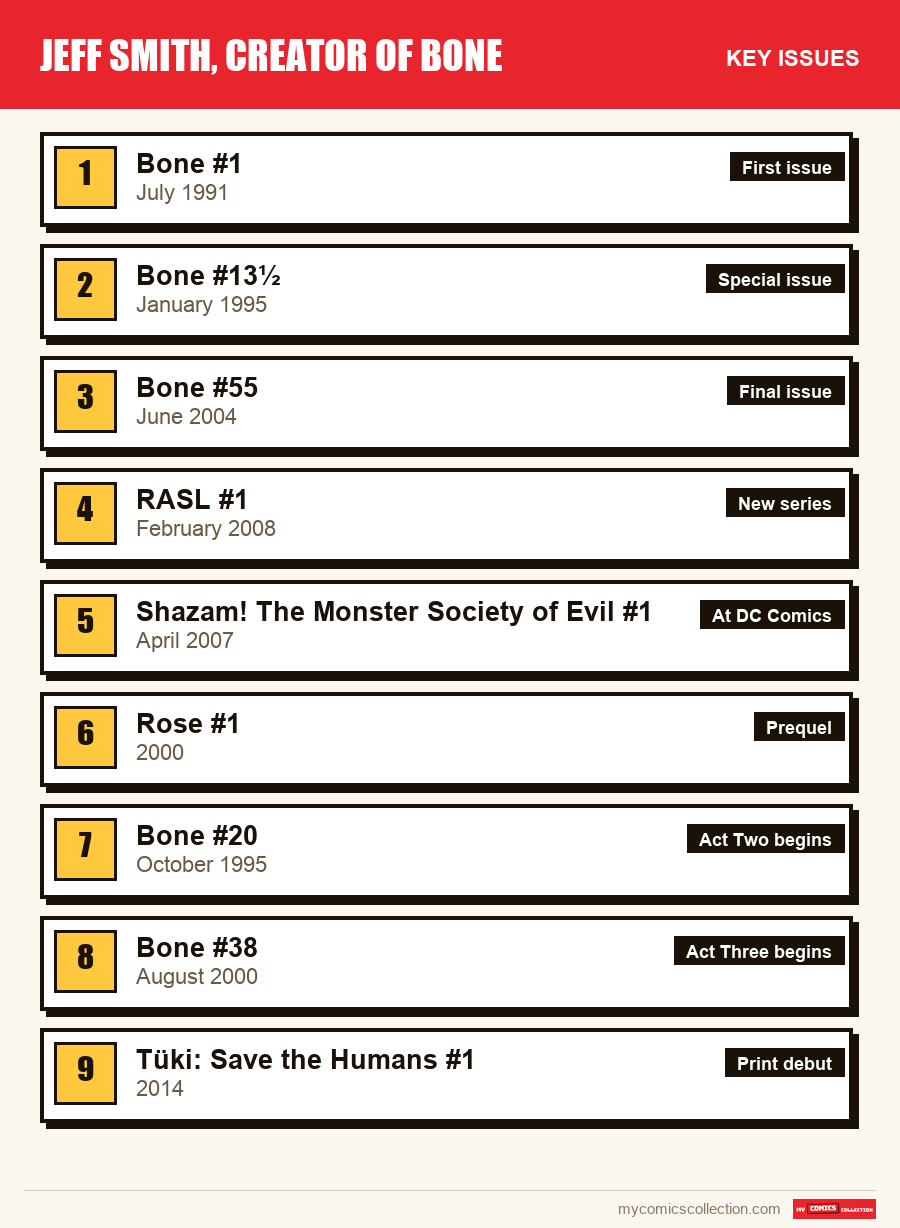
Beyond number 1, several other issues of Bone attract the attention of series specialists. Number 13 1/2, offered by mail through Wizard magazine in January 1995, constitutes one of the most confidential editions of the entire Smith bibliography, originally reserved for the readers who had requested it. Further in the series, The Dragonslayer arc (issues 20 to 27) introduces the character Bartleby, one of the most endearing rat creatures in the saga.
As for the author's other works, number 1 of RASL (2008), still published via Cartoon Books, interests a more restricted but loyal fringe of science fiction-oriented author collectors, while the four issues of Shazam! The Monster Society of Evil at DC Comics (2007) attract collectors of classic superheroes more than purists of the Bone universe. These titles remain, in terms of trading volume, very largely secondary to the demand concentrated on Bone's original number 1.
Read the census before buying
As for any independent comic from the 1990s that is currently being sought, the best compass remains the population census of certification bodies like CGC: the lower the population certified in the very high grades (9.6, 9.8, 9.9) remains compared to the intermediate grades, the more the premium paid for a high-end copy is justified. Conversely, a recent influx of new submissions in a given grade can moderate a too rapid price increase. Before any significant purchase on this security, consulting the updated census with a recognized certification service remains the most reliable reflex, much more reliable than a simple observation of the latest sales displayed on a general market place.
Buying Guide: Collecting Jeff Smith Smartly
- Check the printing of Bone #1: only the very first printing of July 1991 is the reference; later reprints, even old ones, do not enjoy the same status on the market.
- Distinguish the distribution periods clearly: an issue published during the distribution phase via Image Comics in the mid-1990s does not have the same status of rarity as an issue from the very first period self-published by Cartoon Books, even if it is still a first printing in the strict sense.
- Don't neglect the condition of the pages, particularly on this title printed in black and white on vintage paper quite sensitive to yellowing: the whiteness of the pages (white pages) weighs heavily in the price difference between two copies of the same digital grade.
- Favor copies accompanied by a clear provenance for confidential prints such as number 13 1/2 in mail-away, the authenticity of which may be more difficult to establish than for an issue conventionally distributed on newsstands or in comic shops.
- Do not base your purchasing decision on a hypothetical adaptation: unlike other licenses, the value of Bone is based on its established literary reputation and not on cinema or streaming news, a fact to be integrated into any medium-term purchasing strategy.
- Broaden your view to related works like RASL or Shazam! The Monster Society of Evil if your budget does not allow access to the very first printings of Bone: these are less expensive titles which remain signs of the same author and indirectly benefit from his growing recognition, particularly since his nomination to the Eisner Hall of Fame.
- Always compare several recent sales before setting a budget, keeping in mind that a single record result, such as selling a CGC 9.8 for $15,000, does not necessarily represent the average market price for that grade.
To follow the evolution of your own collection over the course of your acquisitions, whether it is a number 1 of Bone or a simple reading copy, the collection management application allows you to centralize your numbers, their status and their estimated value in one place, rather than juggling between several spreadsheets or notebooks.
Key issues to know
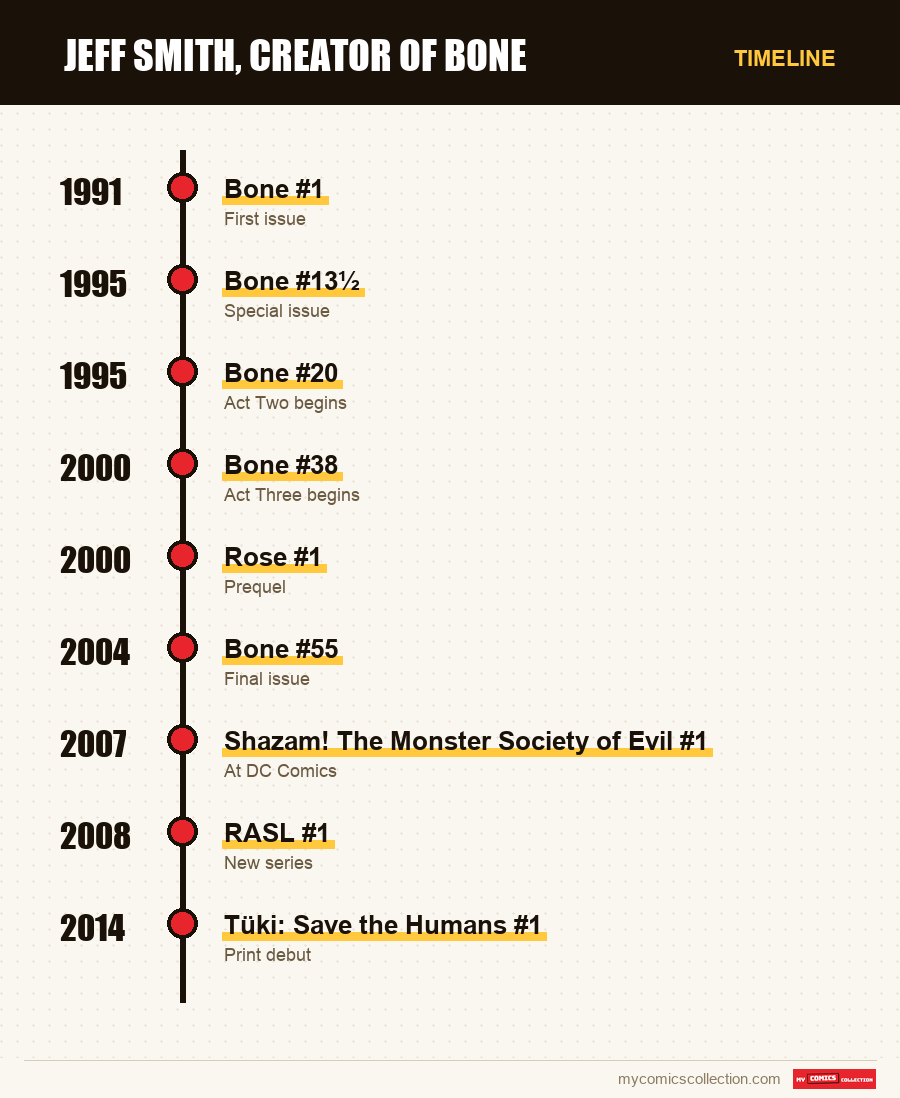
Bone #1
The issue that started it all: Jeff Smith publishes Bone under his own label, Cartoon Books, founded for the occasion. Readers meet Fone Bone, Phoney Bone and Smiley Bone, run out of Boneville and lost in the desert. It opens a 55-issue self-published saga and remains the cornerstone of any Jeff Smith collection.
Bone #13½
A free mail-in issue offered through Wizard magazine, with a variant featuring a gold foil embossed title, shipped in a rigid sleeve with a certificate of authenticity. Its short story, “Up on the Roof”, fits between issues 13 and 14 and was later included in The Great Cow Race. It also features a Jeff Smith interview and sketches.
Bone #55
The last issue of Bone closes thirteen years of irregular publication. Instead of the usual comic panel, the back cover carries a photo of Jeff Smith in his studio drawing the final page on May 10, 2004. It concludes the story collected in the ninth volume, Crown of Horns.
RASL #1
Four years after Bone ended, Jeff Smith returns to self-publishing with a black-and-white, ad-free sci-fi noir about an art thief who jumps between parallel dimensions. It marks a clearly more adult turn for the cartoonist. The series ran for 15 issues, until 2012.
Shazam! The Monster Society of Evil #1
The first of four prestige-format issues that Jeff Smith wrote, penciled and inked on his own for DC Comics. He retells the birth of Captain Marvel, drawing on the 1940s serial that gives the miniseries its title. It is the Bone creator's main foray into superhero comics.
Rose #1
The first of three issues of Rose, the Bone prequel written by Jeff Smith and illustrated by Charles Vess. It tells the story of young Rose Harvestar, the future Gran'ma Ben, facing her sister Briar and the Lord of the Locusts. Charles Vess earned an Eisner nomination for his work on it.
Bone #20
It opens “Solstice”, the second of Bone's three major acts, right after the first, “Vernal Equinox”, ended with issue 19. It is also the first chapter of The Dragonslayer (issues 20 to 27), the volume that introduces Bartleby, the baby Rat Creature adopted by Smiley Bone.
Bone #38
The first issue of “Harvest”, Bone's third and final act, which runs through issue 55. It opens the Ghost Circles volume (issues 38 to 43) and arrived a year after issue 37, cover-dated August 1999.
Tüki: Save the Humans #1
First published online from November 2013, Tüki tells the story of the first human to leave Africa. The first print issue came out in July 2014. The fourth followed in February 2016, delayed by a hand injury Jeff Smith suffered, and the series went on hiatus in June 2016.