
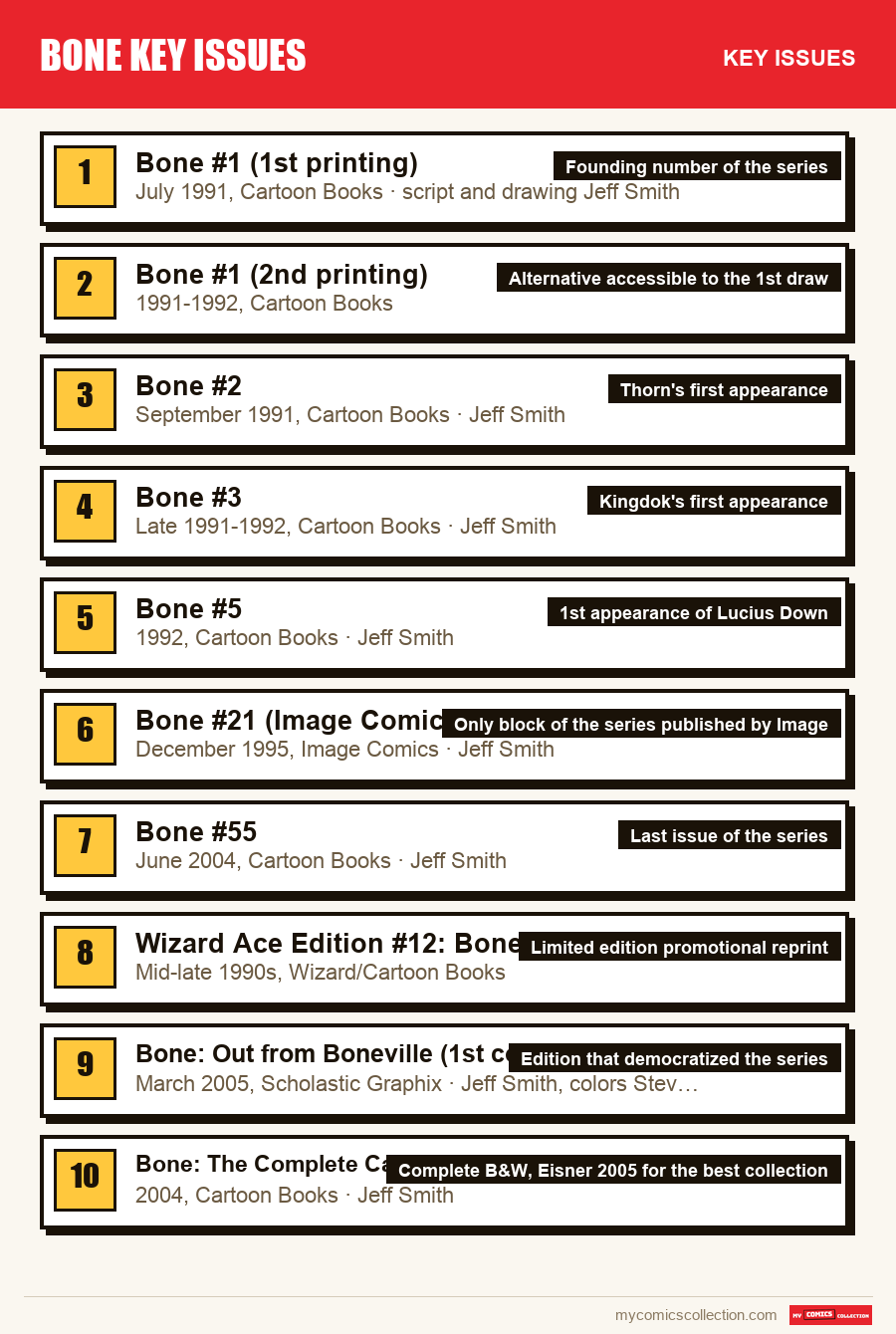
The absolute key number of the series Bone by Jeff Smith is the Bone #1 (Cartoon Books, July 1991), recognizable by its red logo on first printing: a CGC 9.8 copy sold for $15,000 in 2024, a record for the series. Behind him, issues #2 (first appearance of Thorn), #3 (first appearance of Kingdok, historically more sought after than #1 at the time) and the very last issue, #55, complete the hard core of prints to watch. The rest of the value of the character is mainly played out on editions and special prints rather than on an outbreak linked to a film, since Bone has never had a cinema adaptation or series broadcast to date.
There are few independent comic book series from the 1990s that have survived three decades without ever losing their audience, and even fewer that have been carried from start to finish by a single author, on his own account, without a studio behind him. Bone is one of them. Jeff Smith wrote, drew and inked each of the 1,300 pages of the series solo, from July 1991 to June 2004, self-publishing each issue under his own structure, Cartoon Books. This simple editorial fact explains a good part of what makes certain issues difficult to find today: the initial print runs, notably that of issue 1, were those of an independent publisher without a distribution network comparable to that of Marvel or DC, distributed almost confidentially in comic shops in 1991.
For a collector discovering the series via its Scholastic color reissues or via the complete black and white, the most common question is simple: which original issues are actually worth tracking down, and why? This guide answers point by point, relying only on verifiable editorial facts and actually documented CGC sales and ratings, without making up a single number.
We will detail the editorial history of the series, the issues which bear the first appearances of the central characters of the Boneville universe, the particular case of the passage to Image Comics in the mid-1990s, and the recurring question of aborted adaptations, which distinguishes Bone from most cult comics whose popularity explodes after a film.
Bone, the independent epic that changed children's comics
Bone #1 was released in July 1991, bimonthly, at a cover price of $2.95, for 28 black and white pages. The story follows three cousins, Fone Bone, Smiley Bone and Phoney Bone, chased from their hometown of Boneville and separated in a desert before Fone Bone finds refuge in a valley populated by fantastical creatures. Smith's trait, inherited as much from Walt Kelly (Pogo) as from Carl Barks (the Disney universe of ducks), contrasts immediately with the "grim and gritty" offensive which then dominated the American comic book market in the early 1990s. This graphic and tonal singularity is precisely what built, from the first issues, a loyal readership and an image of a cult series rather than a simple niche product.
Production remained entirely artisanal for several years: Smith wrote, drew, inked and managed distribution himself via Cartoon Books, which eventually overwhelmed him to the point that he asked his wife, Vijaya Iyer, to leave her job in tech to take over as president of Cartoon Books and manage the commercial side of the series. This human-scale organization, without the promotional means of a large publisher, is the structural reason why the very first issues were never printed en masse: we are far from the millionaire print runs of mainstream comics of the same period.
Notable fact in the history of the series: between December 1995 and 1997, the publication of Bone switched to Image Comics for issues #21 to #27, before returning to Cartoon Books for the continuation and end of the series. This short stint with a third-party publisher, in the midst of the explosion of the independent market post-foundation of Image, created a one-off editorial break in the series' print run which is today of interest to collectors seeking to assemble a complete run with all its publisher logo variations.
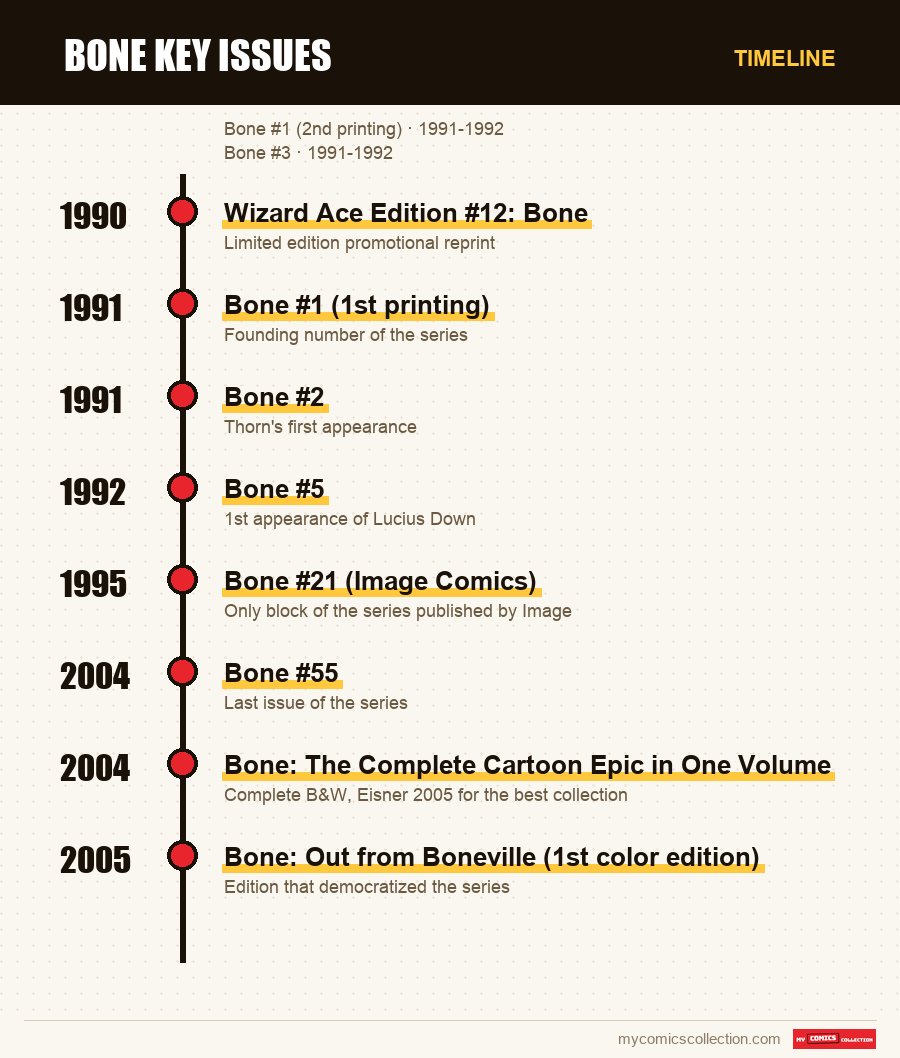
The series concluded with issue #55 in June 2004, after thirteen years of irregular publication. In total, Bone won ten Eisner Awards and eleven Harvey Awards, a harvest which remains, even today, one of the most impressive in the history of independent American comic books. The same year, Time magazine called the series "the best general graphic novel ever published" by critic Andrew Arnold, a critical recognition that went far beyond the circle of comic book readers and brought Bone to the shelves of children's literature in the United States.
It is precisely this shift towards the general public that changes the commercial situation of the series: in 2004, Cartoon Books published a complete one-volume, "Bone: The Complete Cartoon Epic in One Volume", which covers the entire 55 issues in black and white and won the Eisner Award for best collection in 2005. Then, between 2005 and 2009, Scholastic's imprint Graphix republished the series in nine color, colorized volumes by Steve Hamaker, starting with “Out from Boneville” which brings together the first six original numbers. It is this colorized version, widely distributed in American schools and libraries, which introduced Bone to a whole generation of readers born after the original publication of the comic books, and it is this same readership, now adults, which fuels the current demand for the original black and white booklets.
Key issues of the Bone series
Bone #1 (1st printing)
The very first issue of the series suddenly introduces the three Bone cousins, the Red Dragon, the Rat Creatures and Ted the firefly. It can be recognized by its “Bone” logo printed in red lettering on the cover; later printings use other logo colors, making identification relatively simple for an attentive buyer. The original distribution, typical of a very young independent publisher without a national network, was very limited, which explains the current rarity of very high grade printing.
Bone #1 (2nd printing)
Faced with demand, Cartoon Books quickly reprinted issue 1, with a logo in a different color from the original red and a modified edition notice on the interior pages. This second printing remains significantly easier to authenticate than the first but itself remains difficult to find in very high grade, the series never having benefited from distribution comparable to that of the major publishers of the time. This is often the entry point chosen by collectors who want to own a vintage Bone #1 without aiming for the original print.
Bone #2
This second issue marks the entry on the scene of Thorn, the young heroine who will become one of the narrative pillars of the entire saga alongside Fone Bone, and whose destiny structures the intrigue until the final outcome of the series. As with issue 1, the original print remains a confidential issue from an independent publisher, making it a sought-after piece by collectors who are building a run of the very first appearances of characters rather than limiting themselves to issue 1 alone.
Bone #3
Issue #3 introduces Kingdok, the feared leader of the Rat Creatures and one of the most prominent antagonists in Boneville mythology. Interesting fact for the history of the market of the series: according to sector specialists, this issue has historically been, upon its release, even more sought after than issue 1 itself by the first readers, before the hierarchy of value is rebalanced in favor of issue 1 with hindsight and the central place that the latter occupies as the starting point of the series.
Bone #5
This issue introduces Lucius Down, the gruff keeper of the Barrelhaven tavern, a recurring character who serves as the social anchor of the plot in the valley, and develops the role of Grandma Ben in the narrative. Like issues 2 and 3, it is part of the block of very first issues from 1991-1992 which will then compose the arc "Out from Boneville" once republished in bound volume, and which remain today the most difficult to bring together in a complete collection in their original comic book form.
Bone #21 (Image Comics)
Between issues #21 and #27, the series temporarily changed its publisher logo: it was distributed by Image Comics before returning under the Cartoon Books banner for the remainder of its publication. This issue #21, the first of this Image bracket, is sought after by collectors who want to bring together a complete run with all the publisher's variations of the Bone story, a rather rare editorial feature for a series entirely written and drawn by a single creator from start to finish.
Bone #55
The issue that concludes thirteen years of publication and the entirety of the Boneville Valley story arc. As is often the case for the last issues of significant independent series, this end-of-series booklet is of particular interest to collectors who want to own the complete run in its editorial integrity, from the first to the last issue published by Cartoon Books.
Wizard Ace Edition #12: Bone
This Ace edition of Wizard magazine reproduces issue 1 of Bone as part of the magazine's promotional program, with an expected print run of less than 5,000 copies. This is not a canonical issue of the series but a collector's item in its own right, distinct in its number and its interior, prized by collectors specializing in promotional editions from the Wizard Magazine years rather than readers looking only for the main run.
Bone: Out from Boneville (1st color edition)
First of nine volumes in the color republication which introduced Bone to an audience massively wider than that of comic shops, via American bookstores and school libraries. This edition is not a speculative object in the sense of the original issues, but it plays a direct role in the current value of the 1991 issues: it is what created, fifteen to twenty years later, the wave of new adult collectors who are today looking for the original black and white issues.
Bone: The Complete Cartoon Epic in One Volume
This book of more than 1,300 pages, published the same year as the series ended, brings together for the first time all 55 issues in a single black and white volume. He won the Eisner Award for best collection in 2005, establishing Bone as a benchmark work of the American graphic novel. The first printing of this complete, now out of print in its original edition, remains sought after by collectors who favor the original black and white reading experience over Steve Hamaker's later colorization.
Collecting this series?
Track what you own, what you are missing and what your collection is worth. 7 day trial.
Start my trial →Aborted adaptations: why Bone never exploded in cinema (and what that changes for the rating)
Unlike most cult comics whose value jumps after the announcement or release of a film, Bone presents a special case: the series has been the subject of repeated adaptation attempts since the end of the 1990s, without any ever resulting in broadcast. Nickelodeon considered a first film project in the late 1990s, which Jeff Smith himself refused. Warner Bros. takes up the file between 2008 and 2016, with several versions of the script and the director Mark Osborne (the future director of “The Little Prince”) attached to the project for a time, without the film ever seeing the light of day.
The most successful attempt remains that of Netflix: an animated series was officially announced in 2019, with Jeff Smith himself involved in the writing of the first episode alongside animator James Baxter. The project advanced to the animatics and storyboards stage during the summer of 2021, before being abruptly canceled in April 2022 as part of an internal restructuring at Netflix Animation. At the start of 2023, the adaptation rights remain held by Netflix while Jeff Smith seeks to relaunch the project with other studios, without any official announcement having followed since.
For a collector, this repeated absence of adaptation to the screen has a direct and quite rare consequence on this type of cult series: the price of Bone #1 and other key issues has never been driven by a speculative peak linked to a film or a television series, contrary to what we regularly observe on superhero comics as soon as a casting is announced. Current demand therefore rests almost exclusively on three organic and more stable drivers over time: the historical critical recognition of the series (ten Eisner Awards, eleven Harvey Awards), the structural rarity of the very first self-published prints from 1991-1992, and the nostalgia effect of readers who have become adults who discovered the series via the Scholastic color editions from 2005-2009. It is a collection dynamic closer to that of a classic graphic novel than to that of a comic book driven by the box office, which also explains why the price differences between grades remain, in comparison with other flagship series of the 1990s, relatively progressive rather than subject to sudden jumps.
Buying Guide: How to Collect Bone Smartly
- Systematically check the color of the logo on number 1. The first print can be recognized by its “Bone” lettering in red on the cover; any other shade indicates a reprint, less rare but still difficult to find in high grade.
- Check the edition notice on the interior pages. Beyond the color of the logo, the indicia (the legal notices page inside the booklet) generally specifies the printing number: an essential reflex before any purchase of an issue 1 or 2 sold as "1st edition".
- Don't overlook numbers 2, 3 and 5 in your search. The market often focuses on issue 1 alone, while the print runs of issues 2 to 5, equally limited at the time, carry the first appearances of Thorn, Kingdok and Lucius Down.
- Choose condition over quantity if your budget is limited. In a series where most of the value of a copy depends on the margin between two neighboring grades, a single well-preserved number 1 is better than a pile of damaged booklets. To understand precisely what a difference in grade changes on the rating, our comparison CGC 9 vs 9.8 details the difference in value between these two levels.
- Clearly distinguish the original booklets from the Scholastic color reissues. The color Graphix volumes, very common second-hand, are excellent entry points to reading the series but do not have the collector's value of the black and white comic books from 1991-2004.
- Locate the Image Comics bracket (#21-#27). If you're aiming for a full run, these issues published by Image between late 1995 and 1997 deserve special attention because they break the visual continuity of the Cartoon Books logo on the shelf.
- Don't confuse Bone with its derivatives, like "Rose." The prequel "Rose", written by Jeff Smith and painted by Charles Vess, published in three volumes between 2000 and 2002, is a work in its own right which is not part of the main numbering of the series.
- Follow the market before buying piecemeal. Having an estimate calculated before buying or selling remains the best reflex on a series where the differences between neighboring grades can represent several thousand dollars; This is precisely what our free estimate based on current eBay listings.
- Organize your collection from the first purchase. On a long series of 55 issues spread over thirteen years of irregular publication, keeping precise track of what you own (print run, condition, source of purchase) avoids duplicates and facilitates resale; OUR collection management application is designed for this type of long-term monitoring.