Bone is a comic book series created and self-published by Jeff Smith beginning in July 1991, through his own imprint Cartoon Books. Told in black and white over 55 issues published until 2004, it was republished in color by Scholastic Graphix in 2005 and has sold more than 8 million copies worldwide. Number 1 in the first printing (red logo) is today one of the most sought-after independent comics of the 90s, a CGC 9.8 copy having reached $15,000, while the comic sold for $2.95 upon its release.
There are few examples, in the history of American comic books, of a series capable of starting from a garage in Ohio to end up praised by Time Magazine, won ten times at the Eisner Awards and published by both a small independent structure and by a giant of children's publishing like Scholastic. Bone, the creation of Jeff Smith, is that rare case. What began as an artisanal adventure, drawn and distributed by hand by a young author convinced that no one would want his story of ghost cousins lost in a medieval-fantasy valley, has become one of the most respected works of the American "all-ages", alongside the great children's series of the genre.
For comic collectors, Bone occupies a special place: it is a series resolutely apart from Marvel or DC production, born outside the system of major publishers, with a completely different printing economy. This original rarity, coupled with almost unanimous critical recognition, explains why the first issues from the early 90s are actively sought after today, even though the series has never benefited from a successful film or television adaptation to artificially boost its popularity.
This article traces the complete editorial history of Bone: its genesis at Jeff Smith, its chaotic self-publishing journey through Cartoon Books then Image Comics, its transformation into a youth phenomenon in color, the awards that have marked its journey, the extended universe that was built around it, the attempts at adaptation that never came to fruition, and finally what this means in concrete terms for those who today wish to collect or invest in the first printings of the series.
Bone, the birth of an independent comics legend
In July 1991, a young cartoonist from Ohio named Jeff Smith published the first issue of Bone, a bimonthly black and white comic strip, selling for $2.95. He doesn't know it yet, but this little booklet, printed in very few copies, will become, more than a decade later, one of the most awarded and imitated independent comics in American history. To publish his story, Smith founded his own structure, Cartoon Books, refusing to entrust his project to a traditional publisher who could have modified its tone or rhythm.
The idea for Bone actually dates back to Jeff Smith's childhood. The main character, Fone Bone, was born from a simple scribble resembling a telephone receiver that the young Smith drew on the margins of his school notebooks in the 1970s. Decades later, while working as an animator and animating independent short films, Smith takes this character and builds an entire universe around him: three Bone cousins, driven out of their hometown of Boneville after a financial scandal involving one of them, Phoncible P. "Phoney" Bone, find themselves separated in a desert then reunited in a valley populated by fantastical creatures, dragons, wererats and a young farmer named Thorn whose destiny turns out to be much greater than it seems.
Smith's graphic style owes a lot to his claimed influences: the Mark Twain of Huckleberry Finn for the structure of the initiatory journey, the ducks of Carl Barks for the sense of visual gag and movement, the first Star Wars trilogy for the architecture of the adventure story, and Tolkien's Lord of the Rings for the scale of the fantastical fresco which gradually reveals itself behind an apparently light comedy. This hybridization between cartoon humor and heroic epic is precisely what allowed Bone to appeal to a much wider audience than the usual readership of American comic books, from children to adults including the most demanding comic book critics.
Self-publishing, a risky bet that shaped the series
Publishing your own comic strip in 1991 was not an easy choice. Jeff Smith must write, draw, ink, letter, manage production and ensure the distribution of each issue through Cartoon Books. This colossal workload had a direct effect on the publication schedule: the series, initially thought to be bimonthly, quickly fell behind schedule and the 55 issues were ultimately spread out irregularly over thirteen years, from 1991 to 2004, sometimes with several months difference between two publications.
Faced with this untenable load, Smith asked his wife, Vijaya Iyer, then employed in a Silicon Valley start-up, to leave her position to take over as president of Cartoon Books and manage the commercial and logistical side of the company. This two-headed organization, one dedicated to creation, the other to the editorial structure, is often cited as one of the founding models of modern self-publishing in the independent comic book industry, long before crowdfunding or digital self-publishing became common options for young authors.
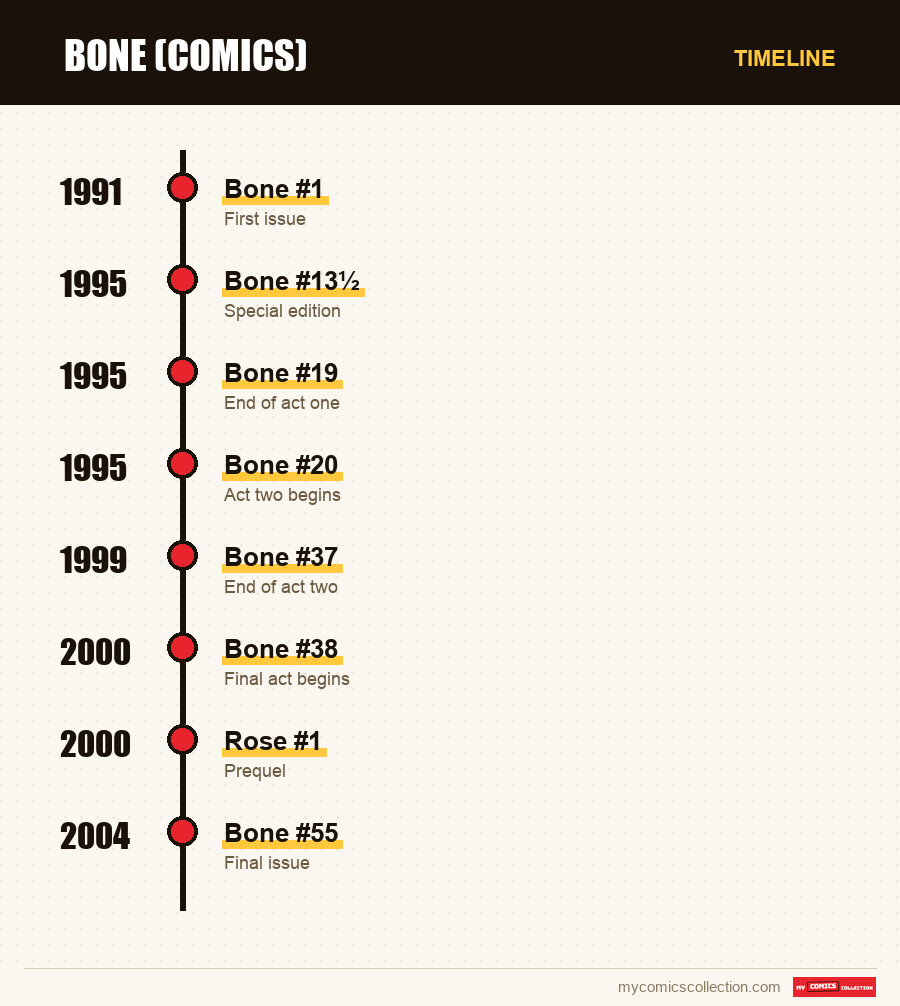
Notable fact in the editorial career of the series: between 1995 and 1996, issues 21 to 27 were occasionally published via Image Comics, then in full expansion and willing to offer better distribution on newsstands and in comic shops to independent creators while leaving them ownership of their characters. This interlude at Image only lasted seven issues before Smith returned to entirely in-house publishing via Cartoon Books until the series' conclusion in June 2004, with issue 55.
From the cult series in black and white to the youth phenomenon in color
The most important commercial turning point in Bone's history came after the end of the original series. In 2004, Cartoon Books published all 55 issues in a single black and white volume, "Bone: The Complete Cartoon Epic", which saw more than thirteen reprints as demand remained strong year after year. But it is the decision to recolor the entire work that will truly increase its audience.
From 2005, the children's publisher Scholastic, via its Graphix label, republished the series in the form of nine color volumes, entrusted to the artist Steve Hamaker for all the coloring work. This version, designed to reach a much wider school and family readership than the traditional comic shop circuit, is accompanied by distribution in classic book covers, in general bookstores and American school libraries. In the United Kingdom, HarperCollins took over in 2006 to distribute these same colorized editions. Hamaker's work on this recolorization earned him several Eisner Award nominations.
It is this republication strategy which largely explains the extent of Bone's long-term commercial success: all editions combined (original issues, collected black and white volumes, color, omnibus), the series has more than 8 million copies printed around the world, an exceptional figure for a work born outside the system of the major superhero publishers. In November 2011, a full color omnibus further expanded the offering available for new readers discovering the series for the first time.
A shower of awards which built the critical legitimacy of the series
Few independent comics can boast a track record as dense as that of Bone. The series has won around ten Eisner Awards, including those for best humorous publication between 1993 and 1995, as well as that of best continuing series in 1994 and 1995, then that of best collection-reissue in 2005 for the complete black and white. At the Harvey Awards, Jeff Smith was crowned best cartoonist almost every year between 1994 and 2005, bringing the total to eleven Harvey awards for the franchise.
In 1993, Smith also received the Russ Manning Award for Best New Talent, a rare distinction for a completely self-published author at that time. In 2004, at the time of the release of the complete book, Time magazine called Bone "the best graphic novel for all audiences ever published", a media recognition that went well beyond the usual circle of comics readers. The IGN site, for its part, would later rank the characters from the series in its list of the hundred greatest comic book heroes, alongside figures from the Marvel and DC universes, proof of the lasting cultural imprint left by Smith's work well beyond its original niche.
Rose, Tall Tales, Quest for the Spark: The Expanded Universe of Bone
The success of the main series quickly gave birth to a true extended universe. “Rose”, a prequel drawn in collaboration with illustrator Charles Vess, returns to the youth of Thorn's grandmother and the origins of the central conflict of the saga. “Stupid, Stupid Rat-Tails”, co-written with Tom Sniegoski and drawn by Stan Sakai (the creator of Usagi Yojimbo), develops the secondary character of Rat-tenu Bone in a burlesque western format.
Other expansions followed: the collections "Bone: Tall Tales" and "More Tall Tales" bring together short and anecdotal stories set in the Boneville universe, while the illustrated prose trilogy "Quest for the Spark", written by Tom Sniegoski, extends the mythology of the series in the form of children's novels. In 2010, the "Bone Handbook" was also published, a 128-page reference work compiling graphic research, sketches and production anecdotes. For the 25th anniversary of the series, Smith published "Bone: Coda" in 2016, a new graphic chapter closing certain narrative lines left unresolved since 2004.
A work which has also experienced controversy
Despite its status as a "general audience" comic, Bone has not escaped American controversies surrounding children's content. In 2010, a school in Minnesota temporarily removed the series from its shelves due to scenes involving cigarettes, alcohol and gambling. In 2013, the American Library Association included Bone in its list of the most challenged books in the United States on similar grounds. In the vast majority of cases, these local protests were rejected and the series retained its place in school libraries, which did not prevent the controversy from, paradoxically, making the work better known to an adult audience curious to understand what could have been shocking.
The impact of (aborted) adaptations on the rating
Unlike many comic book series whose popularity soars after the announcement of a film or TV series, Bone presents an atypical scenario: despite more than twenty-five years of attempts, no adaptation has ever seen the light of day. Nickelodeon briefly considered an animated feature film in the late 1990s, with no sequel. Warner Bros. Pictures bought the rights in 2008 and brought on several screenwriters as well as director Mark Osborne (SpongeBob, Kung Fu Panda) until 2016, without any film finally coming out of the box.
The most advanced attempt remains that of Netflix, which announced in October 2019 the development of an animated series adapting the entire saga. The project was finally canceled in April 2022 as part of a restructuring of the group's original animation department, when the production had only left behind a few preliminary storyboard elements. Jeff Smith publicly expressed his weariness with this new cancellation, while indicating that he remained hopeful that a new studio would take over the project, the rights however remaining the property of Netflix.
On a collector's level, this repeated absence of adaptation has a direct and paradoxical effect: the price of Bone #1 and the first issues has never benefited from the speculative peak that comics generally experience just before the release of a film (like what is observed on other series adapted for cinema or streaming). The valuation of Bone is therefore based almost exclusively on fundamentals specific to the comic book market: rarity of the original print run, critical reputation built over more than three decades, and constant demand from passionate collectors rather than on a one-off craze linked to audiovisual news. In other words, its value is structural rather than speculative, which makes it a relatively stable collection profile over time.
Also note, for fans of derivative products, that the Resaurus brand published two waves of Bone figurines in 1996 then 2001, followed by a new series signed Dark Horse in 2007. The Telltale Games studio also developed two point-and-click video game episodes adapted from the series between 2005 and 2006 ("Out from Boneville" and "The Great Cow Race"), which have now been withdrawn from sale since the closure of the studio in 2018. These derivative objects remain today peripheral collectible curiosities, without significant impact on the price of the original comics themselves.
Collecting this series?
Track what you own, what you are missing and what your collection is worth. 7 day trial.
Start my trial →Buying guide: how to collect Bone comics intelligently
Collecting Bone requires a different approach than classic superheroes, due to its history of self-publishing and multiple reprints. Here are the essential points to watch out for before investing in the series:
- It is essential to identify the very first drawing of number 1: the first print from July 1991 can be recognized by its Bone logo printed in red on the cover, unlike later reprints which use other colors. This distinction makes all the difference in terms of value, with the series having been re-released over ten times since its initial release.
- Choose CGC certification for any purchase of Bone #1 in the first printing: given the significant difference in value between the grade brackets (a CGC 9.8 copy reached $15,000 compared to around $2,200 in CGC 9.6), authentication and professional grading secure the investment and avoid errors of appreciation on a comic printed on fragile newsprint.
- Aim for the CGC 9.6 range rather than 9.4 or 9.8 if the budget is a criterion: the quality-price ratio is considered significantly more favorable, the compression of prices between levels 9.4 and 9.6 making the latter more interesting than 9.4, while the jump to 9.8 implies a very significant premium.
- Avoid copies under 7.5 for a first edition number 1: being a relatively modern comic (1990s) printed in small quantities but not extremely rare in its raw state, serious collectors focus on the high end of the conservation spectrum rather than on intermediate or low states.
- Don't neglect the condition of the pages: the newsprint used for the original 1991 printing yellows over time. A copy with white pages retains its value better in the long term than a copy with cream or yellowed pages, a criterion to systematically check before purchasing.
- Distinguish the editions clearly: original Cartoon Books booklets, Image Comics bracket (issues 21 to 27), black and white collected volumes, Scholastic Graphix colorized editions by Steve Hamaker, and full color omnibus from 2011 do not have at all the same collector's value. Only the original issues, and in particular number 1, concentrate most of the speculative interest.
- Consider the complete collection of all 55 issues rather than just number 1 if the objective is passion for reading and not pure speculation: the series reads like a continuous graphic novel, and a complete run in good condition, even in intermediate grades, constitutes a coherent set sought after by fans of the "all-ages" genre.
- Track recent actual sales rather than static price guides: the market for independent comics like Bone evolves more according to actual sales between collectors than according to theoretical quotations, hence the interest in regularly comparing successful transactions.
For those who wish to go further in monitoring their collection over the course of acquisitions, the comic collection management application allows you to centralize owned numbers, grades and estimates in one place, a particularly useful tool for series with an editorial history as complex as that of Bone.
Key issues to know
Bone #1
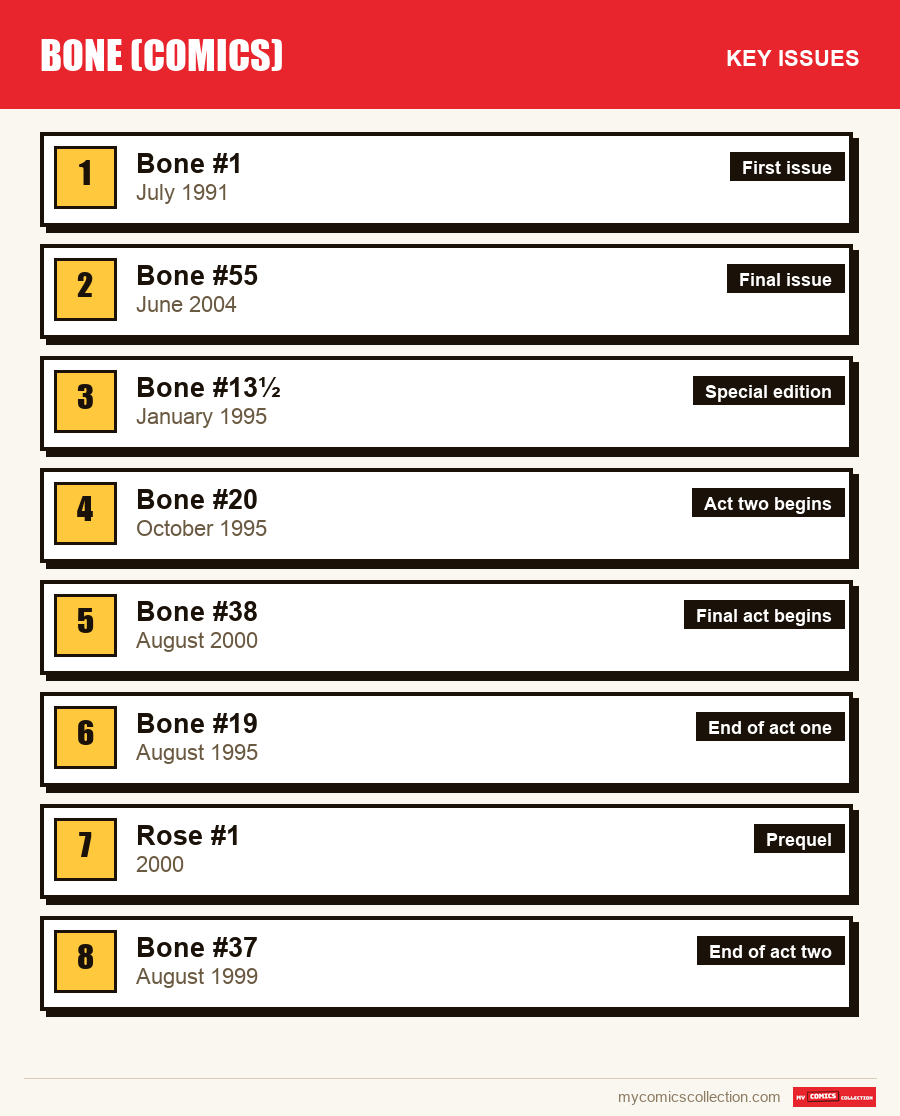
Jeff Smith launches his black-and-white series under his own imprint, Cartoon Books. Run out of Boneville after Phoney's failed run for mayor, cousins Fone, Phoney and Smiley Bone get lost in the desert before reaching a mysterious valley. This is the founding issue and the centerpiece of any Bone collection.
Bone #55
Thirteen years after #1, Jeff Smith wraps up the series with this fifty-fifth issue. The same year sees the final collection, Crown of Horns, and the one-volume edition, which wins an Eisner Award in 2005. The issue that closes the epic.
Bone #13½
This special issue, published with Wizard magazine, contains the story "Up on the Roof". The story was later included as a chapter in The Great Cow Race collection, which officially ties it to the series' first act. A numbered oddity much loved by completists.
Bone #20
This issue opens "Solstice", renamed "Phoney Strikes Back" in the one-volume edition, which runs through #37. It is also the period when the series briefly moves to Image Comics, which publishes issues 21 to 27 before the return to Cartoon Books.
Bone #38
After a one-year gap following #37, this issue opens "Harvest", renamed "Friends and Enemies" in the one-volume edition. This third and final act, which runs through #55, takes the war for the Valley to its conclusion.
Bone #19
This issue closes "Vernal Equinox", renamed "The Valley" in the one-volume edition. Starting with #1, this first act is the series' longest in time, just over four years. It covers the first three collected volumes, beginning with Out from Boneville.
Rose #1
The first of three issues of the prequel written by Jeff Smith and illustrated by Charles Vess, who earned an Eisner nomination for the work. It tells the youth of Rose, the future Gran'ma Ben, and her sister Briar, and looks back at Lucius's past. The natural companion to the main series.
Bone #37
This issue ends "Solstice", the second act, which ties with the third for the most issues. It is followed by a one-year break before the series resumes with #38. A useful milestone for anyone rebuilding the series act by act.