
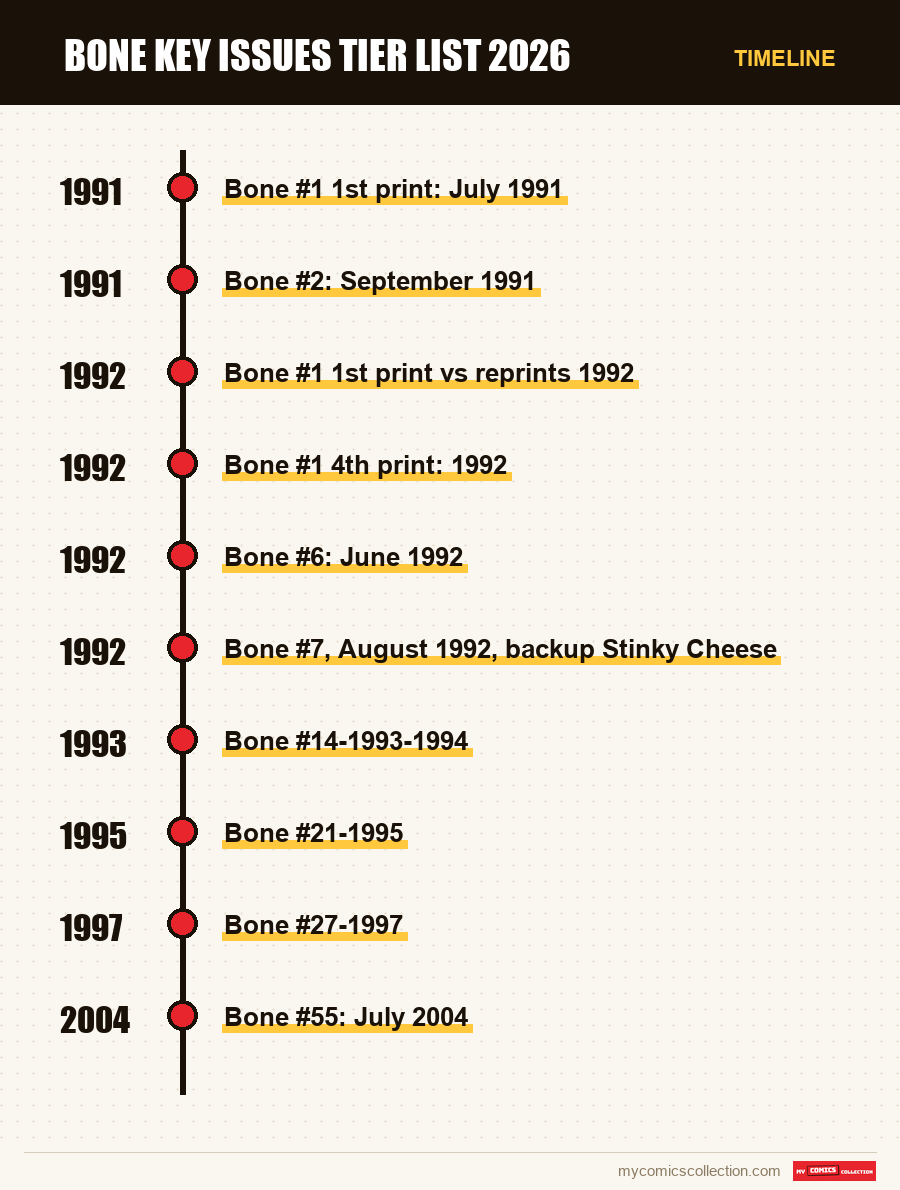
The 2026 tier list of key Bone issues classifies the numbers by valuation potential: Tier S blue-chip (Bone #1 July 1991 Jeff Smith Cartoon Books self-publisher Columbus Ohio, Bone #1 1st print 1991 black-and-white with edition of 1500 copies, Bone #6 June 1992 Rose Princess narrative focus, Bone #55 July 2004 final 13 years of series): central assets at €80-12,000 depending on grade. Tier A (Bone #2 September 1991 self-published, Bone #14 1993-1994 Image Comics period, Bone #21 1995-1996 transition Image, Bone #27 1997 return Cartoon Books). Tier B sleepers (Bone #7 August 1992 backup Stinky Cheese, Bone Holiday Special 1993, Stupid Stupid Rat Tails 1999 spin-off, Bone: Tall Tales 2010 collected color). Tier C speculative bets 2026-2027 (Netflix Bone animation TV series in development, Jeff Smith RASL potential spin-off).
Building a solid Bone collection in 2026 requires a methodological discipline distinct from other comic catalogs: without rigorous prioritization of issues and print runs, the collector disperses his budget on accessible Image period issues while the blue-chip self-published Cartoon Books, whose first print runs remain limited to 1,500 copies, continue their discreet revaluation. The tier list separates the must-have from the nice-to-have, the rare 1st print from the accessible reprint, the urgency of purchase from opportunistic patience: a structuring tool when tackling an indie catalog whose editorial complexity (self-publishing 1991-1995, Image period 1995-1998, Cartoon Books return 1998-2004) goes beyond simple chronological reading.
Ce Bone 2026 tier list guide classifies the major key issues into four tiers (S, A, B, C) according to three weighted criteria: historical narrative and editorial importance, market performance over five rolling years, and probability of Netflix catalyst in the 2026-2030 window. Each issue is documented with exact date, creative team and price range by CGC grade. Objective: to allow the French-speaking collector to build a budgeted purchasing strategy, avoiding the classic traps of the Bone catalog (confusion 1st print 1991 vs 4th print 1992, Image period reprints vs originals Cartoon Books, color editions Scholastic Graphix 2005-2009 without lasting speculative value).
Bone 2026 tier list methodology
A useful tier list does not simply align numbers in order of price: it prioritizes according to a coherent investment and collection thesis. For Bone in 2026, three methodological axes structure the classification, with specificities linked to the singular editorial trajectory of the series: independent comic self-published by Jeff Smith via Cartoon Books in Columbus Ohio in July 1991, partial transition to Image Comics between 1995 and 1998, return to Cartoon Books until the final Bone #55 in July 2004, i.e. 13 years of continuous work which redefined the standards of comics American independent.
Tier S/A/B/C classification criteria
- Narrative and editorial historical significance (40%): first appearances of structuring characters (Fone Bone, Phoney Bone, Smiley Bone, Thorn, Gran'ma Ben, the Rat Creatures), founding events (Out from Boneville chapter opening, Rose Princess focus, Crown of Horns finale), canonical runs cited by academic criticism. For Bone, the weighting includes the absolute rarity of self-published 1st prints 1991-1992 (confidential print runs of 1,500 to 3,000 copies), a decisive differentiating factor compared to accessible Image reprints.
- Market performance 5 years (35%): CGC price trend documented on GoCollect, Heritage Auctions, ComicConnect between 2021 and 2026. A Bone #1 1st print CGC 9.8 which has appreciated by 380% over five years is not equivalent to an Image reprint which is stagnating. The market weighting takes into account premium indie comparables (Teenage Mutant Ninja Turtles #1 Mirage 1984, Cerebus #1 Aardvark-Vanaheim 1977) to situate Bone in its editorial ecosystem.
- Likelihood of Netflix Catalyst 2026-2030 (25%): proximity of Bone with Netflix Animation announcements, status of the Bone TV series project announced in October 2019 then re-announced in 2022 and 2023, traction of verifiable rumors on Deadline, Variety and The Hollywood Reporter. The 2026-2028 window remains the most likely for an effective release, with direct impact expected on the first print runs.
Definition of third parties
- Tier S: blue-chip: central issues, value recognized worldwide in the indie comics community, no risk of historical downgrading. These are the defensive assets of the collection. If you could only own four Bones, these would be them.
- Tier A: fundamentals: historically structuring issues with solid performance but without the absolute status of Tier S. Make up the backbone of a serious collection, major beyond the three or four initial acquisitions.
- Tier B: sleepers with conviction: issues undervalued with regard to their narrative or editorial significance, with catalyst identified at 12-36 months. Moderate risk, re-rating potential documented by internal comparables in the 1990s indie catalog.
- Tier C: speculative bets: numbers with a strong thesis but dependent on uncertain future events (Netflix release, RASL spin-off project). Limited budget allocation recommended, never more than 15% of annual Bone budget.
Voluntary out-of-scope
This tier list does not classify the modern colorized Scholastic Graphix variants (2005-2009), the TPB color editions accessible at €25-40 without speculative premium, nor the international editions (Delcourt France, Tokyopop short periods) whose liquidity remains structurally limited outside local markets. Crossovers with other indie works are covered in the dedicated resources: to understand the Image Comics context, consult the 30 year history of Image Comics and the Image Comics and Independents calendar. For comparable indie 1990s, tier lists TMNT et Sandman offer relevant comparables regarding the dynamics of re-rating of the first confidential drawings.
Tier S: the central Bone blue-chips
Four issues absolutely dominate the Bone catalog and constitute the defensive core of any serious collection. They combine absolute rarity in high grade (self-published print runs of 1,500 to 3,000 copies for the 1991-1992 originals), indisputable historical importance and maximum liquidity on the major auction markets Heritage Auctions and ComicConnect. The particularity of Tier S Bone lies in its long chronological spread: from July 1991 (Bone #1 1st print) to July 2004 (Bone #55 final), i.e. 13 years which cover the entire lifespan of the series, a perfect illustration of the coherence of a self-published work carried by a single author from start to finish.
Bone #1 1st print: July 1991 (Jeff Smith / Cartoon Books)
The absolute founding number. Published by Cartoon Books, the publishing house founded by Jeff Smith in Columbus Ohio, in July 1991, Bone #1 1st print launches “Out from Boneville”, the first saga of the run which will number nine. The initial pitch: three Bone cousins (Fone Bone, Phoney Bone, Smiley Bone) exiled from Boneville following Phoney's shenanigans, end up in a mysterious valley where they meet Thorn and his Gran'ma Ben: invents a narrative formula that fuses cartoon humor, epic fantasy and the European tradition of adventure comics (Disney, Tintin, Walt Kelly's Pogo). The initial confidential edition of 1,500 copies, printed in black and white on modest quality newsprint, makes this issue one of the rarest of the 1990s decade in indie collections. Jeff Smith, coming out of an uncertain commercial career in animation, took the full gamble of self-publishing without a major national distributor, distribution initially ensured by word of mouth convention by convention.
- CGC 9.8: public sales 2024-2026 between €8,500 and €12,000. Heritage Auctions documents a CGC 9.8 sale at $10,200 in September 2024. Census CGC 9.8 less than 35 examples known worldwide.
- CGC 9.6: €4,200 to €6,000. The grade of serious collectors who accept a controlled discount to preserve the accessibility of premium entry.
- CGC 9.4: €2,200 to €3,200. Institutional entry point for an ultra-rare indie 1st print from this decade.
- CGC 9.0: €1,200 to €1,700. The acceptable liquidity threshold for a collector with a capped budget, to be favored on 7-10 year optics.
- CGC 8.0: €600 to €900. The minimum acceptable to preserve blue-chip status and future resale liquidity.
5-year trend: +380% between 2021 and 2026 in CGC 9.4, with a marked acceleration in 2023-2024 driven by the Netflix Animation confirmation of the TV series project and by the growing academic recognition of Bone as a canonical work of modern comics (Time Magazine top 10 graphic novels, multiple Eisner Awards). Crucial detail: Bone #1 1st print 1991 is distinguished from later reprints (2nd print 1992, 3rd print 1992, 4th print 1992) by the indicia mentioning "First Printing" on the back of the inside cover page, by the total absence of mention "Image Comics" anywhere in the issue (the series will join Image only in 1995 from Bone #21), and by the exact square ratio of the dimension of the Cartoon Books logo at the bottom of the cover. Sellers frequently play on the confusion between the four 1991-1992 prints, which is why the slabbed CGC purchase is non-negotiable above €300.
Bone #6: June 1992 (Jeff Smith / Cartoon Books)
Rose Princess' entry into the narrative. Published June 1992 by Cartoon Books, written and drawn by Jeff Smith, Bone #6 introduces the narrative focus on the epic fantasy dimension of the run, shifting the series away from the simple cartoon humorous register of the first five issues. It is in this issue that the mythological complexity of the valley (Lord of the Locusts, Crown of Horns, red dragon Mim) begins to unfold, transforming what could pass for a cartoon parody into a long-term fantasy saga capable of narratively competing with the references of the genre. The issue also marks the economic consolidation of Cartoon Books: from Bone #6 onwards, print runs permanently exceeded 3,000 copies, reflecting the word-of-mouth convention which had begun to bear fruit.
- CGC 9.8: €1,800 to €2,800. Census CGC 9.8 less than 80 copies worldwide for the 1st print.
- CGC 9.6: €850 to €1,250.
- CGC 9.4: €420 to €620.
- CGC 9.0: €220 to €320.
- CGC 8.0: €120 to €180.
5-year trend: +245% in CGC 9.6 between 2021 and 2026, with a recent plateau which could represent a tactical entry window for collectors with an intermediate budget. The Netflix catalyst indirectly pulls the rating upwards, the character of Rose Princess (who will become the emotional pivot of the entire Crown of Horns finale) being cited in production leaks as central to the narrative design of the animated series. The probability of accelerated re-rating over 18-24 months remains high, conditional on the actual release date of the first season.
Bone #1 4th print: 1992 (Jeff Smith / Cartoon Books)
The 1st print accessible. Published in 1992 by Cartoon Books, the 4th print of Bone #1 offers access to the emblematic cover of the founding issue at a price divided by ten to twenty compared to the 1st print 1991. This issue represents the major strategic compromise for French-speaking collectors on a constrained budget: visual presence of the historic cover in the collection, perfect editorial identification (“Fourth Printing” mention on the indicia page), and correct liquidity on secondary auction markets. The circulation of the 4th print, estimated between 8,000 and 12,000 copies according to Cartoon Books censuses, remains modest but opens access to CGC 9.8 grades that are much more accessible than for the original 1st print.
- CGC 9.8: €380 to €550. Census CGC 9.8 greater than 150 copies.
- CGC 9.6: €180 to €260.
- CGC 9.4: €95 to €140.
- CGC 9.0: €55 to €80.
- CGC 8.0: €30 to €45.
5-year trend: +160% in CGC 9.8 between 2021 and 2026, with a strong correlation to 1st print price movements. The 4th print functions as a “close hedge” to the founder: if the investor cannot access the 1st print, the 4th print captures a substantial part of the same historical and visual theme at a significantly lower price. Liquidity is excellent, with the issue being followed by both Bone completionists and general 1990s indie collectors. Absolute verification to be required before purchase: the mention “Fourth Printing” in the internal index, otherwise there will be confusion during raw transactions.
Bone #55: July 2004 (Jeff Smith / Cartoon Books)
The final number. Published July 2004 by Cartoon Books, Bone #55 closes the series after 13 years of continuous publication, marking the narrative resolution of "Crown of Horns", the final saga which sees Thorn, Fone Bone and the Lord of the Locusts converge in an epic climax unanimously praised by critics. The issue represents several structuring first/last appearances (last appearance of several major secondary characters, definitive resolution of the fate of Rose Princess under her identity Gran'ma Ben), with an emotional impact comparable to canonical conclusions like Sandman #75 or Cerebus #300. The print run of Bone #55, estimated at around 7,500 copies, remains below the average for mid-series issues (#20-#45), a rarity linked to the immediate collector's character recognized by readers at the time of release.
- CGC 9.8: €480 to €720. Census CGC 9.8 less than 90 copies.
- CGC 9.6: €220 to €320.
- CGC 9.4: €110 to €160.
- CGC 9.0: €65 to €95.
- CGC 8.0: €35 to €55.
5-year trend: +210% in CGC 9.8 between 2021 and 2026, a performance which places Bone #55 in the top quartet of the best performing final numbers on the indie market 1990s-2000s. The growth thesis rests on three pillars: documented census rarity, canonical conclusion narrative status, and Netflix perspective which could include an adaptation until the finale in the 2028-2030 window. For a collector seeking to combine narrative symbolism and market performance, Bone #55 offers the most relevant Tier S/budget ratio in the catalog.
Tier A: the Bone fundamentals to integrate
Four issues constitute the backbone of a serious Bone collection beyond the Tier S blue-chips. Without possessing the absolute aura of #1 1st print, #6, #1 4th print and #55, these issues cover the structuring editorial moments of the series (self-publishing/Image/return Cartoon Books transitions) and guarantee complete narrative coherence. Their gradual integration between 2026 and 2028 makes it possible to stabilize a collection before switching to Tier B and C bets.
Bone #2: September 1991 (Jeff Smith / Cartoon Books)
The confirmer. Published September 1991 by Cartoon Books, Bone #2 demonstrates that Bone #1 was not a one-off but the launch of an enduring series. The print run of the 1st print of Bone #2, estimated at 1,800 copies, also remains confidential and places this issue in the same rarity category as Bone #1 1st print, with a discount conditioned only by the “second issue” status which remains structurally secondary to the first issue status. The narrative content consolidates the dynamic trio Fone/Phoney/Smiley and introduces several mythological elements which will unfold over the rest of the run.
- CGC 9.8: €1,200 to €1,800. Census CGC 9.8 less than 40 copies for the 1st print.
- CGC 9.6: €550 to €800.
- CGC 9.4: €280 to €420.
- CGC 9.0: €140 to €210.
- CGC 8.0: €75 to €110.
5-year trend: +280% in CGC 9.6 between 2021 and 2026, performance similar to that of runners-up from comparable confidential indie series. The issue remains under-represented in high CGC grade, which creates an opportunity for re-rating if Netflix actually pulls the entire catalog. Absolute verification: “First Printing” indicia and exclusive Cartoon Books logo without Image Comics mention.
Bone #14-1993-1994 (Jeff Smith / Cartoon Books)
The antechamber Image. Published during the 1993-1994 transition by Cartoon Books, Bone #14 marks the conclusion of the first major self-published editorial phase before the partial switch to Image Comics which will occur with Bone #21. The issue includes narrative sequences recognized as among Jeff Smith's most graphically accomplished to that point, with layout work that anticipates the visual maturity of the second half of the run. For collectors interested in the editorial dynamic, Bone #14 represents the last chance to acquire an exclusively Cartoon Books issue before the Image period.
- CGC 9.8: €320 to €480.
- CGC 9.6: €150 to €220.
- CGC 9.4: €75 to €110.
- CGC 9.0: €40 to €60.
- CGC 8.0: €22 to €35.
5-year trend: +185% in CGC 9.8 between 2021 and 2026. The issue benefits from a double catalyst: narrative consolidation for Bone completists, and editorial transition status for fans of the history of the indie industry. Sub-Tier S performance but solid, to be integrated between 18 and 24 months after priority Tier S acquisitions.
Bone #21-1995 (Jeff Smith / Image Comics)
The Image entry. Published in 1995 under the aegis of Image Comics following the distribution-publication agreement between Jeff Smith and the label co-founded by Todd McFarlane, Jim Lee, Rob Liefeld, Erik Larsen, Marc Silvestri, Jim Valentino and Whilce Portacio in 1992, Bone #21 marks the transition from the Cartoon Books logo to the Image logo on the cover, a structuring editorial step. The circulation of the 1st print Image, estimated at 25,000 copies, increases accessibility while creating a new collection category (Image period Bone) which has its own market dynamic distinct from the Cartoon Books 1991-1994 issues.
- CGC 9.8: €180 to €260.
- CGC 9.6: €85 to €125.
- CGC 9.4: €45 to €65.
- CGC 9.0: €25 to €38.
- CGC 8.0: €14 to €22.
5-year trend: +145% in CGC 9.8 between 2021 and 2026. To understand the Image Comics editorial context, consult the 30 year history of Image Comics which details the trajectory of the label and its role in the consolidation of American indie comics. Bone #21 functions as an editorial as well as a narrative key issue, making it a relevant diversifying asset.
Bone #27-1997 (Jeff Smith / Cartoon Books)
The return of Cartoon Books. Published in 1997 under Cartoon Books after the end of the Image Comics agreement, Bone #27 marks the return of the series to its original label, following Jeff Smith's decision to regain full control of distribution. The issue represents a structuring editorial turning point: it is from Bone #27 that the Bone series definitively operates in completely independent mode until the final #55 in 2004, i.e. seven additional years of self-publishing. The circulation of the 1st print Cartoon Books second-run, estimated at around 12,000 copies, remains lower than that of the Image period and creates an interesting relative rarity.
- CGC 9.8: €140 to €210.
- CGC 9.6: €65 to €95.
- CGC 9.4: €35 to €52.
- CGC 9.0: €20 to €30.
- CGC 8.0: €12 to €18.
5-year trend: +125% in CGC 9.8 between 2021 and 2026. The issue offers access to “return Cartoon Books” status at a controlled entry price, complementary to Bone #21 (Image entry) for collectors seeking to document the double editorial transition via their pivotal issues.
Tier B: Bone sleepers to conviction
Four issues and derived publications offer re-rating potential undervalued by the market in 2026. The Tier B bet is based on the identification of narrative or editorial niches which have not yet been the subject of media revaluation but whose documented significance justifies an increase thesis at 12-36 months. The recommended budget allocation for Tier B Bone is between 20 and 30% of the total annual budget, with the remainder being prioritized for Tier S and A.
Bone #7, August 1992 (Jeff Smith / Cartoon Books), backup Stinky Cheese
Published August 1992 by Cartoon Books, Bone #7 contains a parody backup feature dedicated to the supporting character Stinky Cheese who appears virtually nowhere else in the main run. For catalog completists, this backup constitutes a structuring editorial oddity, the issue being regularly sought in high grade by specialist Bone collectors. The combined rarity of the 1st print edition (estimated at 2,200 copies) and exclusive content creates a dynamic of latent demand.
- CGC 9.8: €580 to €850.
- CGC 9.6: €280 to €420.
- CGC 9.4: €140 to €210.
- CGC 9.0: €75 to €110.
Bone Holiday Special: 1993 (Jeff Smith / Cartoon Books)
Published at the end of 1993 by Cartoon Books, Bone Holiday Special is a one-shot issue which offers a festive non-continuity story built around the three Bone cousins and the valley. The rarity of the print run (estimated at 4,500 copies) and the recognized immediate collector's character make it a structuring item for serious collections. The issue includes illustrations and sequences that are not included in any subsequent TPB compilation, which solidifies its unique value.
- CGC 9.8: €320 to €480.
- CGC 9.6: €150 to €220.
- CGC 9.4: €75 to €110.
- CGC 9.0: €42 to €62.
Stupid Stupid Rat Tails: 1999 (Jeff Smith / Tom Sniegoski / Cartoon Books)
Published in 1999 by Cartoon Books, Stupid Stupid Rat Tails is a 4-issue spin-off miniseries co-written by Jeff Smith and Tom Sniegoski that explores the mythological origins of the Rat Creatures, the central antagonist species of the main Bone run. The mini-series constitutes the first exercise in narrative extension of the Bone universe beyond the main run, and establishes the pattern which will be continued later with Bone: Tall Tales (2010) and Bone: Quest for the Spark (2011-2013). For collectors interested in the expansion of the Bone universe, the complete set of 4 issues constitutes a structuring asset.
- Stupid Stupid Rat Tails #1 CGC 9.8: €180 to €260.
- Stupid Stupid Rat Tails #1 CGC 9.6: €85 to €125.
- Complete set 4 numbers CGC 9.8: €480 to €720.
- Raw NM complete set: €95 to €140.
Bone: Tall Tales: 2010 (Jeff Smith / Cartoon Books / Scholastic Graphix)
Published in 2010 by Cartoon Books in partnership with Scholastic Graphix, Bone: Tall Tales is a one-shot color edition graphic novel that compiles short stories outside of the main continuity and adds new narrative content. The editorial specificity of the issue (double publication Cartoon Books / Scholastic Graphix) creates two distinct versions with different rarity ratios, the original Cartoon Books version remaining significantly rarer than the general public Scholastic Graphix version. For the speculative market, only the Cartoon Books version offers structuring heritage interest.
- Cartoon Books edition CGC 9.8: €220 to €320.
- Cartoon Books edition CGC 9.6: €110 to €160.
- Cartoon Books edition raw NM: €55 to €80.
- Scholastic Graphix raw NM: €18 to €28.
Collecting this series?
Track what you own, what you are missing and what your collection is worth. 7 day trial.
Start my trial →Tier C: Bone speculative bets 2026-2027
Tier C brings together bets whose revaluation thesis depends on uncertain future events: actual release of the Netflix Animation series, RASL spin-off project or indirect adaptation, and signals of re-rating of the expanded Bone catalog following a possible additional Eisner Hall of Fame nomination for Jeff Smith. The Tier C allocation must never exceed 15% of the total annual Bone budget, the investment horizon being deliberately stretched (24-48 months) and the risk of drawdown real.
Netflix Bone Animation TV Series: central catalyst 2026-2028
First announced in October 2019 by Netflix Animation with Jeff Smith as executive producer and Adam Kline as showrunner, the Bone animated series project has undergone several phases of re-development announced in 2022 and 2023. The 2026-2028 window remains the most likely for an effective release of the first season, with a direct impact expected on the first print runs Bone #1 to #6 (projected revaluation from 50 to 120% in case of confirmed exit). Historical comparables (Sandman Netflix 2022, Locke & Key Netflix 2020) suggest an immediate effect on CGC 9.6+ within six months of official release date announcement.
For the speculative collector, the priority allocation focuses on Bone #1 4th print CGC 9.6+ (accessible entry point with full exposure to the catalyst), Bone #6 CGC 9.6+ (exhibition Rose Princess, central character of the Netflix design according to leaks), and a complete set Stupid Stupid Rat Tails (exhibition Rat Creatures, structuring antagonists expected in season 2). The speculative bet on Bone #1 1st print 1991 remains reserved for institutional budgets (€5,000+) because the minimum entry ticket in CGC 9.0 already caps at €1,200-1,700. To situate this bet in a broader modern comics thesis, consult the guide modern comics invest 2020-2026 and the update 2027 pillar strategy.
RASL spin-off and expanded Jeff Smith universe
RASL, a black-and-white mini-series published by Jeff Smith at Cartoon Books between 2008 and 2012, remains the author's second major project after Bone. Rumors of RASL adaptation into a live-action or animated series (TBD platform, sporadic mentions on Deadline in 2023 and 2024) constitute a latent catalyst which could, through a halo effect, indirectly pull Bone's rating upwards, with Jeff Smith's status in indie pop culture being inseparable from the two works taken together. The recommended allocation focuses on RASL #1 first print 2008 (entry point at €25-40 in raw NM, re-rating potential 300-500% in case of official adaptation confirmation) rather than on complementary Bone Tier C issues.
Strategy by budget: building your Bone 2026 collection
Budgetary discipline conditions the effectiveness of the strategy. The following ranges offer a consistent allocation according to three typical profiles, from a budget starting at €500 to an institutional budget of €15,000+. The fundamental rule: never sacrifice grade quality (CGC 8.0+ exclusively) on the first prints, even if it means extending the acquisition schedule.
Beginner budget €500-1,500 over 12-18 months
Recommended allocation: Bone #1 4th print CGC 9.6 (€180-260), Bone #6 CGC 9.0-9.4 (€220-620 depending on grade), Bone #55 CGC 9.6 (€220-320), and a complete set TPB color editions Scholastic Graphix (€160-220 raw NM) for narrative completeness. This allocation allows access to the three central narrative symbols (founding number via 4th print, focus Rose Princess via #6, final via #55) while maintaining acceptable resale liquidity. The absolute gap between Bone #1 1st print and 4th print being divided by 20 to 30, the 4th print constitutes the major strategic compromise for this profile.
Intermediate budget €1,500-5,000 over 18-30 months
Recommended allocation: Bone #1 1st print CGC 8.0-9.0 (€600-1,700 depending on grade), Bone #6 1st print CGC 9.6 (€850-1,250), Bone #2 1st print CGC 9.4-9.6 (€280-800), Bone #55 CGC 9.8 (€480-720), Bone Holiday Special 1993 CGC 9.6 (€150-220). This allocation positions the collector on two essential Tier S 1st prints (Bone #1, Bone #6) and a Tier A complement (Bone #2) which covers the first three structuring issues, supplemented by the finale and a reasoned Tier B. The projected revaluation over 5 years reaches 80-150% in the Netflix-confirmed median scenario.
Institutional budget €5,000-15,000+ over 24-48 months
Recommended allocation: Bone #1 1st print CGC 9.4-9.6 (€2,200-6,000), Bone #2 1st print CGC 9.6-9.8 (€550-1,800), Bone #6 1st print CGC 9.8 (€1,800-2,800), Bone #14 CGC 9.8 (€320-480), Bone #21 Image CGC 9.8 (€180-260), Bone #27 back Cartoon Books CGC 9.8 (€140-210), Bone #55 CGC 9.8 (€480-720), Stupid Stupid Rat Tails complete set CGC 9.8 (€480-720). This allocation builds a heritage collection which covers the entirety of the structuring editorial transitions and all the key narrative issues, with a particularly robust long-term re-rating expectation on the 1st prints 1991-1992. Concentrated risk remains managed by chronological diversification (1991-2010) and publisher diversification (Cartoon Books / Image / Scholastic).
Common Pitfalls to Avoid in the Bone Catalog
The Bone catalog presents several specific pitfalls that regularly degrade the performance of amateur collections. The precise identification of these pitfalls constitutes a methodological prerequisite before any Tier S or A acquisition.
Bone #1 1st print vs reprints 1992
First structuring trap: the confusion between Bone #1 1st print July 1991 (run 1,500 copies, CGC 9.8 value between €8,500 and 12,000) and the 1992 reprints (2nd print, 3rd print, 4th print, cumulative print runs greater than 25,000 copies, CGC 9.8 value between 380 and 1 200 € according to print). Unscrupulous sellers frequently play on ambiguity by presenting reprints as “Bone #1 first issue” without specifying the print run, which can lead to costly acquisition errors. Strict rules: require the full indicia on photo before purchase (“First Printing” or “Fourth Printing” mandatory), refuse any raw purchase above €300 without CGC or CBCS authentication, check the ratio of the Cartoon Books logo which differs subtly between the four 1991-1992 prints.
Image period reprints vs originals Cartoon Books
Second structuring trap: the confusion between Bone issues #21 to #27 published under Image Comics (1995-1997) and their possible subsequent Cartoon Books reprints (post-1998). Image originals feature the Image logo on the cover, indicia mentioning Image Comics as publisher, and print runs estimated between 18,000 and 30,000 copies. Post-return-publisher Cartoon Books reprints feature the exclusive Cartoon Books logo, indicia mentioning Cartoon Books as publisher, and more confidential prints. For the Image period collector, only Image originals retain full historical value; Cartoon Books reprints, despite their superior rarity, do not offer the same editorial significance.
Color editions Scholastic Graphix without speculative premium
Third structuring trap: the overvaluation of the Scholastic Graphix color editions published between 2005 and 2009 (9 TPB color compiling the entire original black-and-white run). These editions, sold in large-scale bookstores at a unit price of 10 to 14 dollars at the time, never developed a lasting speculative premium despite their massive commercial success (more than 10 million copies sold cumulatively according to Scholastic). For the speculative market, these TPB color editions remain accessible at €25-40 in perfect NM new shrink-wrap condition, with no identified re-rating potential. Their acquisition is justified solely by narrative completeness (full color compilation of the run) and not by the investment thesis.
International variants and foreign editions
Fourth structuring trap: the overvaluation of international editions (Delcourt France, Tokyopop court edition, German Carlsen editions, Spanish Astiberri editions). These editions, although sometimes aesthetically accomplished, remain structurally illiquid outside local markets and do not offer a significant resale premium on the US/UK market which dominates indie comics valuation. For the French-speaking collector, the complete Delcourt edition remains interesting for reading but should not be confused with a heritage asset.
Monitoring 2026-2030: signals and re-rating schedule
The Bone 2026-2030 strategy relies on a calendar of signals to be monitored to adjust allocations between third parties and capture re-rating windows. Three families of signals structure the monitoring: Netflix Animation signals, secondary market signals, and broader indie comics ecosystem signals.
Netflix Animation signals to monitor
The official confirmation of an actual Netflix Bone release date is the central trigger. Signals to watch for: official Deadline or Variety announcement with specific release date, first official visual teaser published on the Netflix Animation account, opening of promotional sessions with Jeff Smith as executive producer. Each positive signal typically triggers a revaluation of 30 to 80% on Bone #1 4th print and #6 CGC 9.6+ within 3 to 6 weeks, the tactical window for arbitrage on the eBay and Heritage Auctions secondary market.
Secondary market signals
The progression of CGC 9.8 censuses on Bone #1 1st print constitutes a structural signal of supply tension. Quarterly monitoring recommended via the online CGC Census database. Any increase of less than 5% per quarter indicates preserved scarcity and supports the long-term investment thesis. Conversely, an acceleration in the number of CGC 9.8 submissions greater than 15% per quarter would indicate an influx of copies discovered in private collections, a signal of downward pressure in 12-18 months on public sale prices.
Signals expanded indie comics ecosystem
The dynamics of the broader indie comics market (TMNT Mirage 1984, Cerebus Aardvark-Vanaheim 1977, The Walking Dead Image 2003) serves as an indicator of general trends for the category. To follow these comparables, consult the complementary tier lists TMNT 2026 et Sandman 2026 which document price movements on premium indie works with a comparable rarity profile. A major revaluation of the premium indie segment (for example TMNT #1 Mirage which would sustainably cross $100,000 in CGC 9.6) would pull the entire Bone catalog through a halo effect, through a general reclassification of the “indie 1980s-1990s blue-chip” category.
Indicative calendar 2026-2030
Year 2026: discreet accumulation phase on Tier S and A at high grades, exploiting the price windows created by Heritage Auctions Q2 and Q4 market fluctuations. Year 2027: close monitoring of Netflix Animation signals, tactical arbitrations on Bone #1 4th print and #6 according to official announcements. Year 2028: if the Netflix series is actually released, window for partial profit-taking on Tiers B and C while retaining the entirety of Tier S assets. Years 2029-2030: asset consolidation, possible integration of RASL and additionally extended Jeff Smith universe. To frame this strategy within a broader indie comics plan, the guide comics Image universe guide pillar offers a transversal reading of the segment.
To estimate the current value of your existing Bone collection before any arbitrage, the service free estimate allows you to obtain an updated odds range. To explore the Bone catalog available for purchase on Comics Manager, visit complete comics and the selection key issues comics.
Bone 2026 tier list FAQ
Bone #1 1st print (July 1991, Jeff Smith / Cartoon Books, print run 1,500 copies) remains the absolute foundational issue. If the budget only allows one Tier S acquisition, this is it, ideally in CGC 8.0 minimum (€600-900) to preserve blue-chip status and resale liquidity. Bone #1 4th print 1992 (€380-550 in CGC 9.8) is the second accessible choice if the budget caps below €500, with full exposure to historical coverage and satisfactory liquidity.
Bone #1 4th print 1992 is a priority for budgets under €500: this is the only access to the cover of the founding issue which remains accessible in CGC 9.8 (€380-550), while maintaining correct liquidity. The 1st print 1991 is to be preferred for budgets above €1,200 (CGC 9.0 minimum): its census rarity of less than 35 CGC 9.8 copies known worldwide justifies the premium entry ticket. The absolute rule: require the photographed indicia before any raw purchase above €300, the confusion between the four 1991-1992 prints being the number one trap of the catalog.
Bone Cartoon Books refers to the issues published directly by the publishing house founded by Jeff Smith in Columbus Ohio (Bone #1 to #20 between 1991 and 1994, then Bone #27 to #55 between 1997 and 2004). Bone Image Comics designates the issues published under a distribution-publication agreement with the Image label (Bone #21 to #26 between 1995 and 1997). The original Cartoon Books 1991-1992 prints remain ultra-rare (1,500 to 3,000 copies), the Image 1995-1997 prints are more accessible (18,000 to 30,000 copies), the Cartoon Books second-run 1997-2004 prints find an intermediate rarity (7,500 to 12,000 copies). Valuation follows this hierarchy of scarcity.
Three strict rules: buy exclusively CGC slabbed copies (or CBCS for constrained budgets), check the concordance of the CGC serial number on the official CGC Cert Verification database, refuse any purchase of raw originals over €300 without third-party authentication. The 2nd print, 3rd print and 4th print 1992 reprints are the most frequent traps for Bone #1, regularly presented as "first issue" without specifying the print run. The internal index mentioning “First Printing” is the absolute marker, to be required on photo before any transfer.
For Bone #1 1st print 1991: CGC 8.0 minimum is the acceptable liquidity threshold, CGC 9.0 the institutional threshold. Below (7.0-7.5), resale remains possible but with a negotiated discount. For Bone #2 and Bone #6 1st prints: CGC 9.4-9.6 offer the most relevant preservation/price ratio. For Bone #21 Image and Bone #27 return Cartoon Books: CGC 9.6-9.8 are the sweet spots, with 9.4 rarely overstating the census rarity. For Bone #55 final 2004: CGC 9.8 is mandatory, the Modern Age slab premium being structuring for the conservation of value.
Related articles
- Bone Key Numbers: Complete Guide
- Complete story of Bone in comics
- Story by Jeff Smith, author of Bone
- Comics investment update 2027 pillar strategy
- Comics Image universe guide pillar
Do you own Bone or other 1990s indie comics? Estimate the value of your collection for free to know their current rating.