
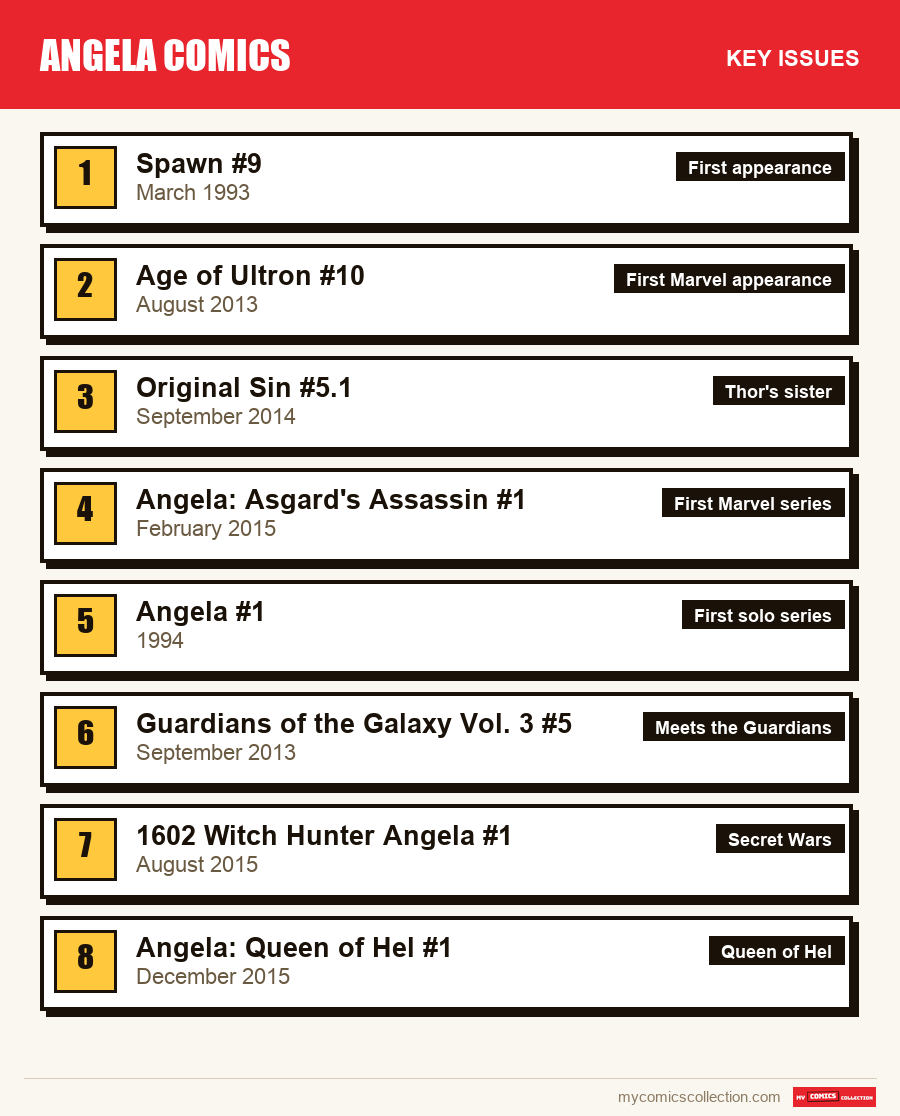
Angela first appeared in March 1993 in Spawn #9 (Image Comics), created by Neil Gaiman and Todd McFarlane. The character was later at the center of a decade-long legal battle between the two men, won by Gaiman in 2012 with a $1.1 million settlement. Gaiman then ceded his rights to Marvel, which integrated Angela into its universe in Age of Ultron #10 (June 2013) before making her, via the Original Sin crossover, Thor's lost sister: Aldrif Odinsdottir. Spawn #9 remains very accessible on the market (CGC 9.8 census greater than 2,300 copies), while the Marvel prints linked to its Asgardian revelation have sparked renewed interest since its arrival in the Marvel Rivals video game in September 2025.
Few comic book characters can boast of having changed editorial universes twice, of having triggered one of the most commented upon trials in the history of American comics, and of having ended up becoming Thor's hidden sister. Angela nevertheless ticks all three boxes. Born in the dark pages of Spawn in the early 1990s, shaped by the pen of Neil Gaiman and the pencil of Todd McFarlane, she first existed as a celestial bounty hunter tracking down monsters escaped from hell on behalf of Paradise. It was only after a decade of legal disputes that her destiny changed: bought by Marvel, she became an Asgardian warrior with a disrupted identity, revealed to be the biological sister of Thor and Loki, before joining the Guardians of the Galaxy then briefly reigning over Hel.
For collectors, this trajectory straddling two publishing houses makes the search for keys a little more complex than usual: you have to follow the character from the Image comics of the 1990s to the Marvel series of the 2010s, passing through a legal settlement which redefined the intellectual property of several secondary characters in the Spawn universe. This article traces this story in detail, identifies the numbers that really count for the rating, and explains why Angela's recent arrival in a successful video game revives buyers' interest in her first paper appearances.
Genesis of an editorial scandal: the birth of Angela in Spawn
In March 1993, Image Comics published Spawn #9, an issue that would have a lasting impact on the series created by Todd McFarlane two years earlier. For the occasion, McFarlane entrusted the screenplay to Neil Gaiman, already enjoying the success of Sandman at DC/Vertigo, as part of an agreement between Image's founding authors aimed at rotating the writing of the label's flagship titles. Gaiman delivers a dense script that introduces in one go three characters who will weigh heavily in the mythology of Spawn: Cogliostro, the mysterious old man who will become the hero's mentor, Medieval Spawn, a medieval incarnation of the infernal costume, and Angela, a bounty hunter sent by Heaven to track down and eliminate the hellspawn wandering on Earth.
The character as drawn by McFarlane contrasts with traditional angelic imagery: articulated white armor, stylized feather wings, spears and multiple weapons, the attitude of a ruthless killer rather than a benevolent messenger. Gaiman, for his part, writes her an acerbic voice and a rigid moral code which places her as a credible adversary of Spawn, more interested in the accomplishment of her mission than in any compassion. This contrast between McFarlane's design and Gaiman's writing would become, a few years later, the crux of the problem: who, the designer-editor or the guest screenwriter, really owns Angela?
Upon its release, Spawn #9 sold in the same proportions as the rest of the series, driven by the general craze for Image titles from the early 1990s and by very high print runs typical of the comic boom era. This large print run largely explains why this issue remains today one of the easiest issues to find among the first notable appearances of modern comics: according to the CGC census consulted in April 2022, more than 2,370 copies had already been graded 9.8 without any higher copy existing, a volume which reflects both the abundance of the original offer and the care with which the sellers of the time preserved their stacks of comics d'Image, then perceived as safe investments.
The Gaiman vs. McFarlane legal battle
Angela's editorial story cannot be told without revisiting the dispute that pitted Neil Gaiman against Todd McFarlane for nearly ten years. In 2002, Gaiman sued McFarlane in federal court in Wisconsin, arguing that his contribution to Spawn #9 entitled him to a share of co-ownership in the characters he had co-created, in particular Medieval Spawn, Cogliostro and Angela, as well as in the derivatives that McFarlane had continued to exploit without paying royalties to the author. McFarlane, for his part, defended the “work for hire” thesis, arguing that any work carried out on behalf of Image and his company McFarlane Productions accrued entirely to the publisher, regardless of the star status of the guest author.
The court ruled in favor of Gaiman in principle in 2002, a decision which is still a reference today in American intellectual property law applied to comics: it establishes that the substantial creative contribution of a screenwriter on original characters cannot be reclassified a posteriori as a simple salaried service without explicit agreement to this effect. But the dispute, far from stopping there, continued for a decade through appeals, counter-appeals and ancillary procedures relating to the exact extent of the rights and the sums owed to Gaiman in respect of the derivative products (figurines, adaptations, reissues) marketed in the meantime by McFarlane.
The case finally closed in January 2012 with a settlement agreement approved by a federal judge in Wisconsin. The terms specify that Gaiman obtains full ownership of the character Angela, as well as financial compensation of $1.1 million intended to cover royalties owed on characters created in Spawn #9 and on derivatives such as Dark Ages Spawn, Domina or Tiffany. This legal closure immediately frees Angela for new editorial adventures: Gaiman, owner of the character, quickly chooses to sell it to Marvel rather than keep it or relaunch it at Image, a choice which will completely reorient the trajectory of the character.
The move to Marvel: Age of Ultron and the Aldrif Odinsdottir revelation
Marvel formalized the acquisition of the rights to Angela from Neil Gaiman in the early 2010s, and chose to introduce her into its main continuity via a high-profile event: Age of Ultron, the maxi-series by Brian Michael Bendis and Bryan Hitch published in 2013. In Age of Ultron #10, published in June 2013, Angela burst into the Marvel universe after having literally been "ripped from Paradise" and transposed into an alternate reality where she crosses paths with the Guardians of the Galaxy. Gaiman himself remained associated with this transition, consulted by Bendis on how to integrate the character without betraying his original essence.
The logical continuation of this appearance arrives a few months later with the “Angela” arc of Guardians of the Galaxy (2013), written by Bendis with Sara Pichelli drawing, which occupies episodes #4 to #10 of the series and will then be compiled under the title Guardians of the Galaxy Vol. 2: Angela. Gamora organizes the assault on a space prison to free Angela, sealing her lasting integration within Peter Quill's cosmic team. This status as a new Guardian recruit could have been enough to make Angela just another secondary character in the vast Marvel roster of the 2010s. It is a second event, a year later, which will truly transform her status.
Original Sin and the Revelation of the Tenth Realm
In 2014, the Original Sin event shook up several parts of Marvel continuity by revealing secrets buried by Odin. In the arc "Thor & Loki: The Tenth Realm", written by Jason Aaron and Al Ewing with Lee Garbett drawing, the reader learns that Odin and Freyja had a daughter, Aldrif, kidnapped when she was an infant by the Queen of Angels during the conflict between Asgard and the kingdom of Heven, the tenth kingdom, immediately erased from the collective memory of Asgard and cut off from the World Tree. Taken in and raised in the hatred of Asgard by the servant Loriel, Aldrif grew up under the name Angela, becoming the best warrior in Heven, without ever suspecting her origins. The plot twist strikes a double blow: it gives a coherent retroactive explanation to the presence of a celestial character foreign to Thor's Nordic cosmology, while offering Thor and Loki an unexpected sister who will lastingly enrich their family mythology.
This revelation immediately transforms the collector's status of Age of Ultron #10, which retrospectively becomes the first Marvel appearance of a character now presented as a member of the royal family of Asgard, alongside Thor, Loki and Odin. The comics market reacted accordingly in the years following the revelation, the rare variants of this issue, notably the retail variant signed Joe Quesada printed at 1 copy for 50, having seen their price rise significantly above that of the standard cover.
Angela: Asgard's Assassin, Queen of Hel and the duet with Sera
Building on the success of his revelation, the character obtained his own regular series at the end of 2014: Angela: Asgard's Assassin, written by Kieron Gillen and Marguerite Bennett, with Phil Jimenez then Stephanie Hans drawing. Published over six issues between 2014 and 2015, the series opens with the “Priceless” arc and installs Angela in the role of an uprooted warrior, rejected by Heven after discovering the truth about her origins, and not exactly welcomed with open arms by an Asgard who discovers her existence at the same time as her. The first issue met with a solid commercial reception for a new secondary character series, ranking among the best sellers in the American market in the month of its release in December 2014, an honorable score which confirms the readership's interest in this revamped version of the character.
On the narrative level, Angela: Asgard's Assassin introduces a character who will become inseparable from her in the following years: Sera, former Anchorite (one of the silent and praying angels of Heven) who became Angela's companion after joining her fight against a monster and realizing that she did not recognize herself in the role that had been assigned to her at birth. The relationship between Angela and Sera, one of the few openly queer representations in the Marvel universe from this period, was praised by specialist critics for its sincerity, at a time when this type of representation remained rare in mainstream superhero comics.
The series continues directly with Angela: Queen of Hel (2015-2016), in which the character finds herself propelled to the head of the Nordic kingdom of the dead before abdicating this cumbersome throne. This period marks the peak of Angela's editorial exposure at Marvel: multiple series, cross-curricular appearances in the Thor and Guardians of the Galaxy titles, and status as an identifiable figure within the broader Asgardian mythology, alongside older characters like Sif or Valkyrie.
Collecting this series?
Track what you own, what you are missing and what your collection is worth. 7 day trial.
Start my trial →The impact of adaptations on the rating
Unlike other characters resulting from similar rights acquisitions, Angela has, to date, not been the subject of any live action adaptation within the Marvel Cinematic Universe. No Disney+ film or series included her in its cast, and recurring speculation around a possible appearance in the Thor or Guardians of the Galaxy productions never materialized. His career outside the pages of comics therefore remains, for the moment, limited to more peripheral adaptations: the animated series Todd McFarlane's Spawn broadcast on HBO at the end of the 1990s, in which a version of the character was dubbed by Denise Poirier, and a brief cameo in the 1997 film Spawn, played by actress Laura Stepp: two adaptations which concern the original Image version of the character, prior to its acquisition by Marvel.
The most significant development for the character's current rating is much more recent and takes place outside of paper form: in September 2025, Angela joined the playable roster of the successful video game Marvel Rivals for its Season 4, "Heart of the Dragon", alongside Daredevil. Presented as a Vanguard-type character capable of alternating between an aerial mode with a spear and a ground mode with a double chopper, Angela becomes the 42nd playable hero in the roster and benefits from a team synergy with Thor called “Divine Armory”. This exposure to a public of players often foreign to paper comics historically constitutes, for many secondary Marvel characters, a factor of rediscovery which results in a one-off increase in demand for the first printed appearances, in particular Age of Ultron #10 and Angela: Asgard's Assassin #1, the two titles most directly associated with the Asgardian identity of the character popularized in the game.
For a collector, this recent dynamic changes the reading of the market: while Spawn #9 remained until now the most sought-after key mechanically due to its status as the very first appearance, the interest of players coming from Marvel Rivals is more naturally drawn towards the Marvel issues which tell the story of Aldrif Odinsdottir, sister of Thor, rather than towards the original bounty hunter of the Spawn universe.
Buying guide
Building a coherent collection around Angela requires clearly distinguishing the two parts of her editorial history, the Image period of the 1990s and the Marvel period of the 2010s, and knowing the classic pitfalls linked to the massive print runs of the comic boom era. Here are the points to be aware of before purchasing:
- Spawn #9 (Image, March 1993): the real key to the character, first appearance of Angela, Medieval Spawn and Cogliostro under the pen of Neil Gaiman. The original print run having been very large, favor high grade copies (9.6 and above) to hope for real added value; below, the issue remains affordable and is treated above all as a reading piece or a complement to the Spawn collection.
- Newsstand edition vs comics shop edition (direct edition): as with many Image titles from the early 1990s, newsstand copies were printed in significantly lower quantities than copies distributed in specialized stores. Check the UPC barcode at the bottom of the cover: a barcode with a displayed price generally indicates a newsstand edition, rarer in the case of Spawn.
- Age of Ultron #10 (Marvel, June 2013): Angela's first appearance in the Marvel Universe proper. Clearly distinguish the standard cover, relatively common, from the retail variant signed Joe Quesada printed in a 1:50 ratio, much more sought-after and whose price has historically exceeded that of the classic version by several multiples.
- Angela: Asgard's Assassin #1 (Marvel, December 2014): the preferred number to represent the “Aldrif Odinsdottir, sister of Thor” version of the character, the one that most directly corresponds to his current appearance in Marvel Rivals. Pay attention to the numerous variant covers published on this launch, the rarity of which varies greatly from one artist to another.
- General condition and pages: Image comics from the early 1990s used paper of varying quality; systematically check the yellowing of the pages (white pages vs off-white) on ungraded copies, this criterion weighs heavily in the difference in value between two copies of similar appearance.
- CGC/CBCS gradation: given the volume already graded for Spawn #9 (several thousand copies in 9.8), a gradation only brings net added value on truly impeccable copies; for later, rarer Marvel issues in very high grade, the gradation is more easily justified.
- Do not confuse the two “Angela”: keep in mind that the Image version (Spawn) and the Marvel version (Aldrif Odinsdottir) are legally and editorially related but visually different; When purchasing a derivative piece (statue, variant cover, artwork), make sure you know which iteration of the character it refers to.
As with any comic book key whose popularity fluctuates according to cultural news, the good reflex remains to compare several sales made recently rather than relying on a single displayed price. If you already have Angela-related issues in your collection and want to track their value over time, the collection management application allows you to centralize your copies, their condition and their origin, and to keep an eye on the evolution of their rating without having to re-enter your data each time you check.
The key issues to know
Spawn #9
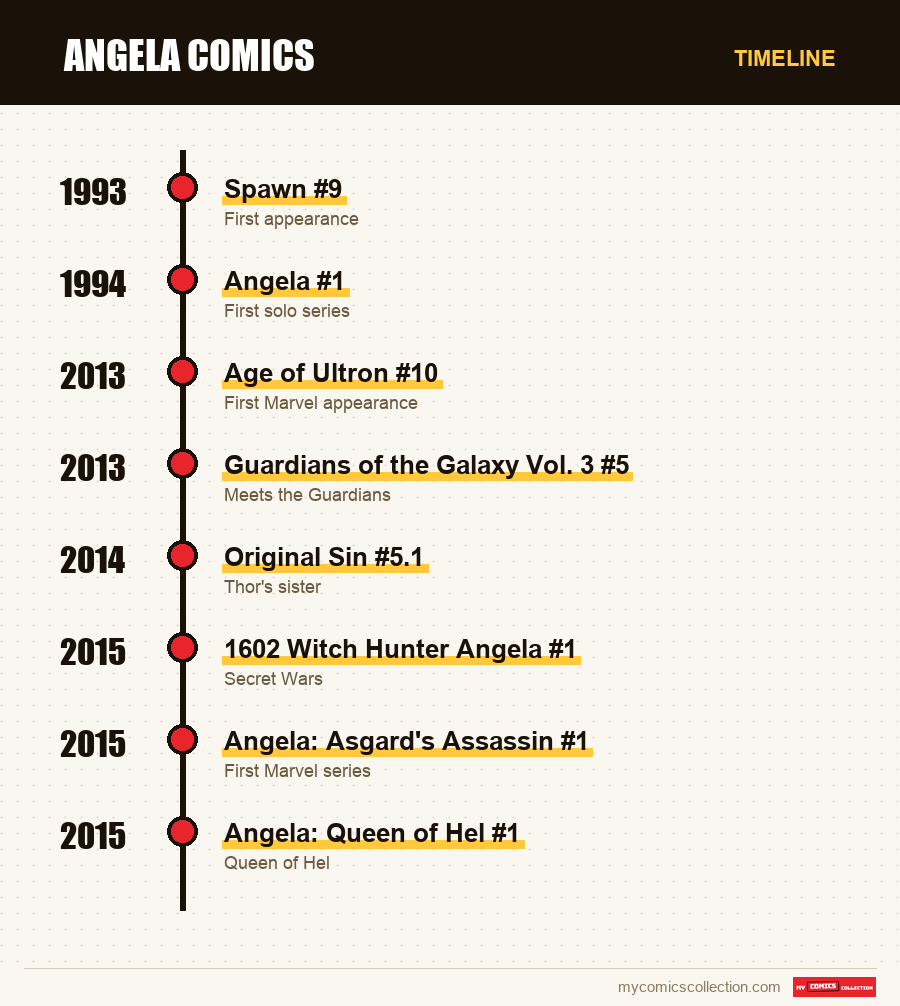
Written by Neil Gaiman and drawn by Todd McFarlane, this issue introduces Angela, a bounty hunter working for Heaven who tries to kill Spawn. It also introduces Cogliostro and Medieval Spawn. The creation of these three characters later fueled the dispute between the two creators.
Age of Ultron #10
On sale from June 2013, the final issue of Brian Michael Bendis's event brings Angela into the Marvel Universe, torn from Heaven by the damage done to the fabric of reality. The character arrives with a design reworked by Joe Quesada. It is the key issue of her Marvel era.
Original Sin #5.1
The first chapter of "Thor & Loki: The Tenth Realm", by Jason Aaron, Al Ewing, Lee Garbett and Simone Bianchi. Thor learns he has a sister and heads with Loki to Heven, the tenth realm cut off from Asgard. Angela receives her true name, Aldrif, daughter of Odin and Freyja.
Angela: Asgard's Assassin #1
Released in December 2014 with a February 2015 cover date, this launch by Kieron Gillen and Marguerite Bennett, with Phil Jimenez and Stephanie Hans, shows an Angela cast out of Heven who wants nothing to do with Asgard. Sera, her companion, is already part of the story. This is the issue that embodies the Aldrif version of the character.
Angela #1
The character's first miniseries at Image, three issues long, written by Neil Gaiman and drawn by Greg Capullo. It deepens Angela's celestial world, beyond her role as Spawn's opponent. The series was later collected along with a one-shot starring the character.
Guardians of the Galaxy Vol. 3 #5
By Brian Michael Bendis and Sara Pichelli, the direct follow-up to Age of Ultron: Angela appears near Earth and sets off the alarm on the Guardians of the Galaxy's ship. Rocket, Gamora and Iron Man head out to intercept her. It is the start of her place on the cosmic team.
1602 Witch Hunter Angela #1
During Secret Wars, Marguerite Bennett and Stephanie Hans transplant Angela and Sera into the England of 1602, as witch hunters serving King James. The series offers the first appearance of these alternate versions of both heroines. An interlude praised for its painted art.
Angela: Queen of Hel #1
Marguerite Bennett and Kim Jacinto launch the character's second Marvel solo series. Exiled from Heven and robbed of Sera, Angela descends into the realm of the dead to save her, to the point of conquering its throne. The series follows directly from Asgard's Assassin.