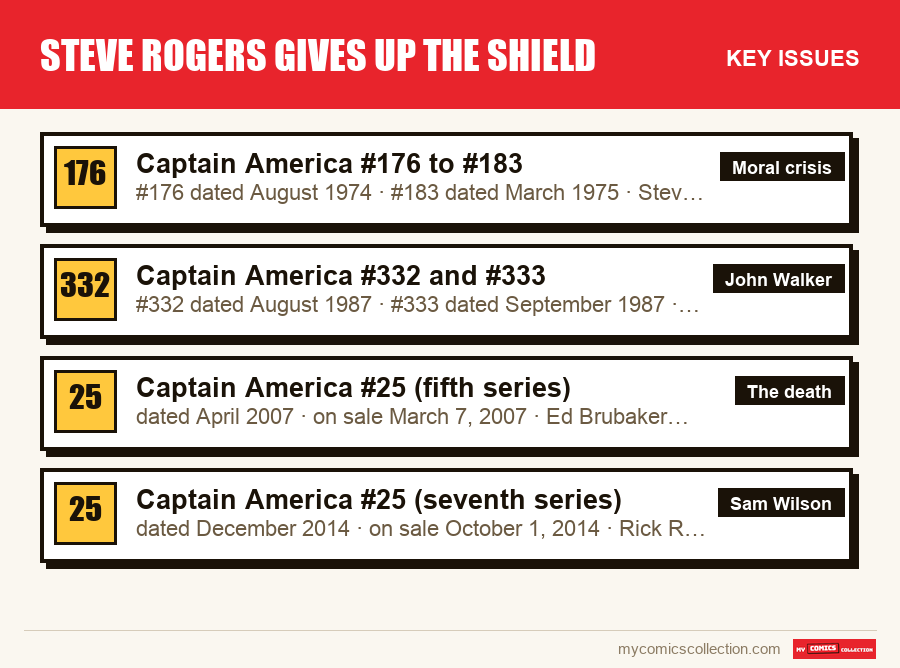
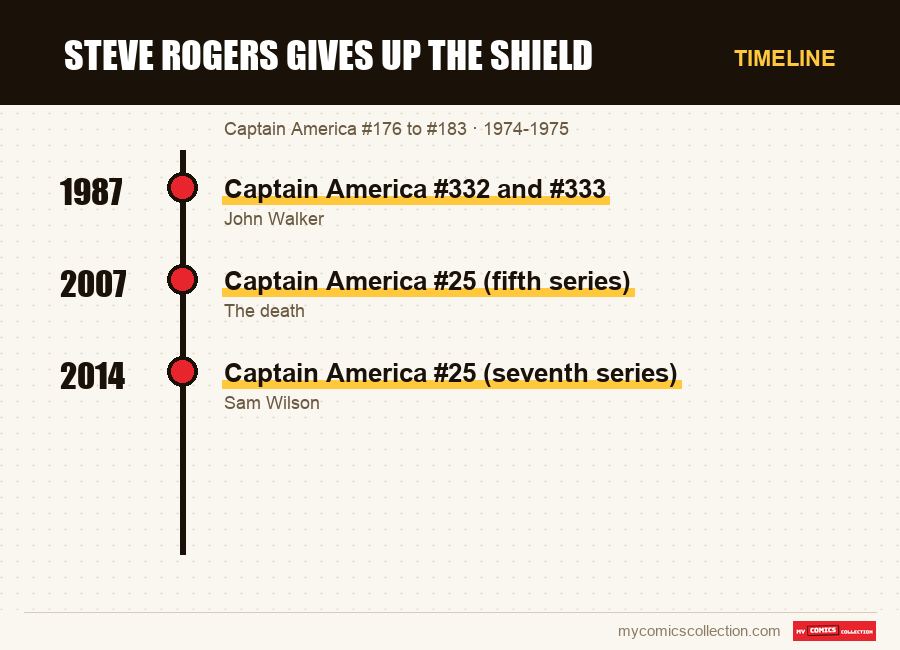
In the comics, Steve Rogers has given up the role of Captain America at least four times. In 1974, disgusted by the Secret Empire scandal, he abandons the costume in Captain America #176, becomes Nomad in #180 and returns in #183 (dated March 1975). In 1987, he refuses to serve the government in #332 ("The Choice"); John Walker replaces him in #333, until Steve's return in #350 (February 1989). In 2007, Steve is killed in Captain America #25, and Bucky Barnes takes the shield in #34 (March 2008). In 2014, aged, he hands it to Sam Wilson in Captain America #25 of Rick Remender's series, before All-New Captain America #1. Chris Evans returns as Steve Rogers in Avengers: Doomsday (December 18, 2026); this guide does not speculate on the plot.
There is an idea that keeps returning in Captain America's history: the costume does not belong to the man who wears it. Steve Rogers is the quintessential Captain America, but writers have regularly forced him to part with it, sometimes by moral choice, sometimes by death, sometimes by age. Each time, the question asked is the same: what makes Captain America, the serum, the shield or the values?
Cinema made this motif famous, with the scene where Steve hands the shield to Sam Wilson. The first teaser of Avengers: Doomsday, in December 2025, confirmed Chris Evans's return, showing Steve taking up his old costume again. This guide does not try to guess what the film will do with that image. It tells the comics where the handoff has already taken place, and points out the issues to read for each.
First of all: what does not count as a handoff
Other men have worn the costume when Steve was absent, notably during the years when he was supposed to be frozen in ice, between the end of the Second World War and his return in Avengers #4, dated March 1964. These replacements were invented after the fact to explain the adventures published in the 1940s and 1950s. Steve passed nothing on to them: he did not know they existed. This guide therefore keeps only the moments when Steve, alive or dead, himself leaves the role to another.
1974: Nomad, the man without a country
Captain America #176 to #183
At the end of the Secret Empire arc, Steve discovers that the conspiracy he was fighting went all the way up to the top of the state. In #176, "Captain America Must Die!", drawn by Sal Buscema, he gives up the costume: he can no longer embody a country that betrayed him. In #180, dated December 1974, "The Coming of the Nomad!", he becomes Nomad, a hero without a flag. In #183, "Nomad: No More", he takes up the role of Captain America again, convinced that he must defend the American ideal rather than his government.
This arc is the model for all later handoffs. Steve Englehart, who writes the series during the Watergate period, makes the costume a political object: to wear it is to accept to represent something. It is also the moment when the character becomes more than a soldier: a man capable of disobeying.
1987: the government's Captain America
Captain America #332 and #333
A government commission demands that Captain America, a creation of a military program, put himself under its orders. In #332, "The Choice", Steve refuses and gives up the costume. In #333, "The Replacement", the commission chooses John Walker, until then known as Super-Patriot, to replace him. Walker is more brutal, more obedient, and the story shows step by step what the role becomes when entrusted to someone who understands only its appearance.
Meanwhile, Steve does not stay idle. In #337, dated January 1988, "The Long Road Back", he adopts a new costume and a new name, The Captain. You have to wait for #350, dated February 1989, "Seeing Red", for him to resume his identity, after a confrontation with the Red Skull. Walker then becomes U.S. Agent, another career that begins there. Mark Gruenwald, who writes this whole arc, is one of the character's most enduring writers; our selection of the best Captain America runs gives him a place.
2007: Steve's death, Bucky's shield
Captain America #25 (fifth series)
In the wake of Civil War, Steve is shot on the steps of a courthouse. "The Death of the Dream" makes this death a media event well beyond the usual readers. It is the only handoff where Steve decided nothing: he is no longer there to choose his successor.
The relief comes from his oldest comrade in arms. Bucky Barnes, his World War II partner turned the Winter Soldier, puts on the costume in #34, dated March 2008, still under Brubaker's pen and Epting's pencil. It is a darker Captain America, marked by decades of commissioned assassinations, who seeks to deserve the role. Our Winter Soldier reading guide follows this path in detail.
Steve returns in Captain America: Reborn, whose #1 is dated September 2009, written by Brubaker and drawn by Bryan Hitch. A remarkable fact: once back, he first lets Bucky keep the shield, and operates under his own name, notably in Steve Rogers: Super-Soldier (2010). It is only in 2011, with a new series whose #1 is dated September 2011, drawn by Steve McNiven, that he becomes Captain America full time again.
2014: the serum fades, Sam Wilson takes over
Captain America #25 (seventh series)
Deprived of the serum's effects, Steve has regained his real age: an old man. In "The Tomorrow Soldier: Conclusion", he hands the shield to Sam Wilson, the Falcon, his longtime partner. It is the handoff closest to the one cinema staged, and the only one where Steve chooses, alive and lucid, to pass the role on to someone who deserves it.
Sam Wilson is not a passing replacement. He carries the title for several years, with his own series and his own political positions, which divide his readers within the story. The character's origin, in the 1960s, is told in our article on the first appearance of the Falcon.
In 2016, Steve regains his youth, and the series Captain America: Steve Rogers, whose #1 is dated July 2016, written by Nick Spencer and drawn by Jesús Saiz, sets up an unprecedented situation: two Captain Americas at the same time, Sam and Steve. The series then takes a turn that strongly divided readers, and leads to the Secret Empire event in 2017.
Since then: two shields, and more
Coexistence has become the norm. In 2021, The United States of Captain America, whose #1 is dated August 2021, by Christopher Cantwell and Dale Eaglesham, shows Steve and Sam setting off in search of the stolen shield, and meeting ordinary citizens who have proclaimed themselves Captain America in their own community. The idea pushes the 1987 logic to its end: the title belongs to no one.
In 2022, Marvel publishes two parallel series: Captain America: Symbol of Truth, with Sam, written by Tochi Onyebuchi and drawn by R.B. Silva, and Captain America: Sentinel of Liberty, with Steve, written by Collin Kelly and Jackson Lanzing and drawn by Carmen Carnero. Since 2025, Chip Zdarsky writes the main series, with Steve at the center; it is in this series that David Colton is introduced, whose path is traced in our article on Zdarsky's Avengers.
Recommended reading order
Captain America #176 to #183 (1974-1975)
The model: a man who sets down the costume because he no longer believes in what it represents. Eight issues, to read in one go.
Captain America #332 to #350 (1987-1989)
The longest and richest: the role entrusted to another, and what that reveals. If time is short, read #332, #333, #337 and #350.
Captain America #25 to #42 by Brubaker, then Reborn (2007-2009)
The death and Bucky's relief. Brubaker's run is ideally read in full, from its start in 2005.
Captain America #25 by Remender and All-New Captain America (2014-2015)
The handoff to Sam Wilson, the closest to the films. To be completed with Captain America: Sam Wilson.
For the character as a whole, all eras combined, our Captain America reading guide gives a complete path, and the best Captain America arcs page ranks stories by quality rather than by theme.
What these issues represent for a collector
Handoff issues are not all key issues in the market's sense. The 1987 #333 is, because it is also John Walker's first appearance as Captain America; #180 too, as Nomad's first appearance; the 2007 #25 was massively bought on release and remains very abundant; the 2008 #34 marks a first for Bucky in the costume. This guide gives no price: no source consulted publishes a dated, verifiable price for these issues over the recent period.
A final shelving precaution. Captain America has gone through many relaunches, and the same issue number, #25 for example, exists in several different series. In an inventory, always note the year or the series number next to the issue number. Without that, the 2007 #25 and the 2014 one get confused, even though they tell two opposite handoffs. Our modern Captain America key issues detail these landmarks.