In short
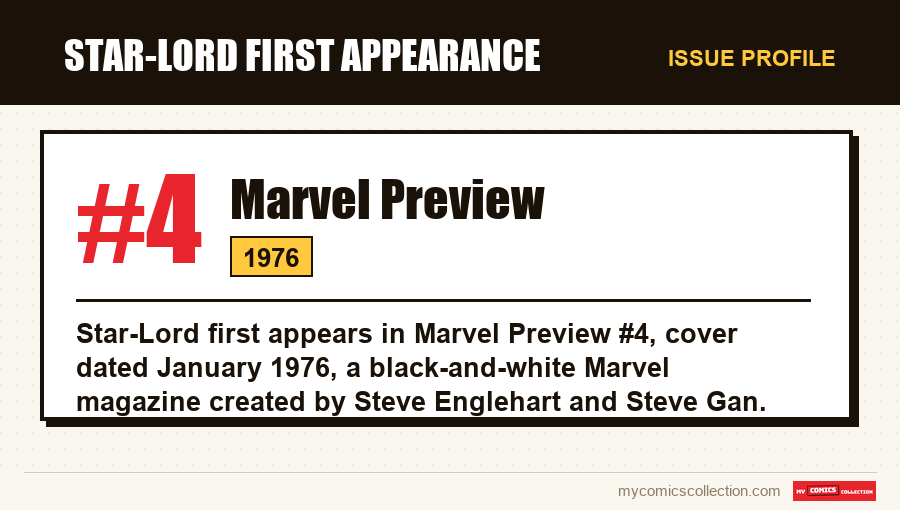
The debut is Marvel Preview #4, dated January 1976: a Marvel magazine printed in black and white, with "Star-Lord" as its lead story. Writer Steve Englehart and artist Steve Gan are the creators. The back-up, "The Sword in the Star," centers on Prince Wayfinder. Peter Quill joined the Guardians of the Galaxy only decades afterward, so the debut sits outside the color comics line that readers associate with him.
Few debuts are as easy to name and as easy to mislabel as this one. Star-Lord is a household name because of the 2014 Guardians of the Galaxy film, yet his first story appeared nearly four decades earlier in a magazine that sat on a different rack from the monthly superhero comics. A search for the character's first appearance leads to one precise issue, and the details around it determine whether a purchase is the right book.
Cover date, creator credits and the dates of later appearances were checked issue by issue before writing; the sections on buying are method and analysis, and no value is stated anywhere.
What Marvel Preview #4 is: the identity of the issue
On the newsstand this was one of Marvel's magazines, a title published over its run by Magazine Management and the affiliated Marvel Comics Group, and its cover date reads January 1976. It is a black-and-white comics magazine, not a color comic book. The lead feature is "Star-Lord," and the issue marks the character's debut. The back-up feature, "The Sword in the Star," follows Prince Wayfinder.
The creator credit that matters is the pairing of Steve Englehart and Steve Gan, who are named as the creators of Star-Lord. The full credit box, with cover artist, inker and letterer, is best read from the indicia of a copy in hand.
The format is the first thing to understand. Marvel Preview was part of Marvel's magazine line, printed in black and white and sold outside the standard comics format. That is why Star-Lord's earliest story reads differently from the color Marvel books of the same month, and why the issue sits on the shelf beside magazine-format titles rather than monthly superhero books.
How Star-Lord enters the story
The issue presents Star-Lord as its lead feature, and the title of the story is the character's name. That detail already tells you how Marvel framed the debut: not as a guest in another hero's book, but as the headline attraction of a magazine issue. The character who would later be known as Peter Quill begins here as a protagonist in his own right, in a science fiction setting that suited the magazine format.
This guide does not retell the story. For a collector, the point is that every later Star-Lord story starts here, and that later writers rebuilt Peter Quill several times, so the 1976 version is a first draft, not the character moviegoers know. The issue is where the name, the title and the creative pairing first appear together.
The back-up feature is a useful detail for identification. The Sword in the Star, with Prince Wayfinder, shares the issue with the lead. If a listing describes a copy of Marvel Preview #4 and mentions neither feature, it is worth asking whether the seller has looked at the contents page.
Who created Star-Lord and in what context
Steve Englehart wrote a considerable amount of Marvel material in the first half of the 1970s. His bibliography includes Captain America issues #153 to #167 and #169 to #186 (1972 to 1975), The Avengers issues #105 to #144 and #147 to #152 (1972 to 1976), and Doctor Strange volume 2 issues #1 to #18 (1974 to 1976), alongside Marvel Preview #4 in 1976. Anyone who follows the Avengers knows the name, and the Star-Lord issue is a short but notable entry in that body of work, written while he was also producing monthly superhero titles.
Steve Gan, the artist, was born on May 22, 1945, and is described as a Chinese-born Filipino comics artist. He studied architecture at the Mapua Institute of Technology and worked in the Philippine komiks industry before beginning to draw for Marvel in 1974. His Marvel work of the period includes Savage Tales issues from 1974 and 1975, Dracula Lives in 1975, Skull the Slayer from 1975 to 1976, co-created with Marv Wolfman, and several Conan the Barbarian issues in 1976. Marvel Preview #4 belongs to that run of magazine and adventure work, which gives the Star-Lord debut a clear place in his career.
For a collector, the practical point is that both names are tied to the debut. A listing that names only one of the two is incomplete.
Why Marvel Preview #4 is the key issue
An issue becomes a key issue when later events make it the reference point. For Star-Lord, those events are many and spread across decades. The character's appearances after 1976 include Marvel Preview #11 in Summer 1977, #14 in Spring 1978, #15 in Summer 1978 and #18 in Spring 1979. In Marvel Preview #11, Chris Claremont reworked the character, with John Byrne as penciller and Terry Austin as inker. Heinlein's lawyers objected to the cover blurb on that issue, so it was pulled and reprinted.
Further appearances followed in other formats. Marvel Super Special #10 (Winter 1979) was written by Doug Moench and penciled by Gene Colan. Marvel Spotlight volume 2 issues #6 and #7 (May and July 1980) were written by Moench and drawn by Tom Sutton, and they were the character's first traditional comic-format appearances. Marvel Premiere #61 (August 1981) was written by Moench and drawn by Sutton.
Then came the revival. Keith Giffen brought the character back in Thanos #8 to #12 (May to September 2004), and again in Annihilation #1 to #6 (2006), drawn by Andrea Di Vito. The four-issue Annihilation: Conquest: Star-Lord followed in 2007, by Giffen and Timothy Green II, and Dan Abnett and Andy Lanning launched a 25-issue Guardians of the Galaxy run in 2008 with Paul Pelletier as penciller. The collector reading of all this is straightforward: every one of these later stories traces back to the January 1976 magazine.
The cinema connection reinforces the demand. The 2014 Guardians of the Galaxy film featured the character, and the film-versus-comics comparison is covered in Guardians of the Galaxy (2014): the film versus the comics. Interest in the debut issue followed attention to the character, which is why the issue is discussed so often even though it is a magazine.
Do you collect this series?
Track what you own, what you are missing and what your collection is worth. 7-day trial.
Start my trial →
Reprints and the issues most often confused
The most useful rule for this character is to separate the original from its reprints. In February 1982, a color reprint of Marvel Preview #11 appeared with a new framing sequence by Claremont and Michael Golden. In July 2014, the collected edition Star-Lord: Guardian of the Galaxy gathered Marvel Preview #4 and #11 along with other early appearances. Neither is the 1976 magazine, and a listing that blurs them is describing a different object.
Three confusions come up repeatedly. The first is between the magazine and the later comic-format titles: Marvel Spotlight and Marvel Premiere are color comics that feature Star-Lord, but the debut is in Marvel Preview. The second is between issues of the same magazine: #4 is the debut, #11 is the Claremont, Byrne and Austin story, and the later numbers continue the series. The third is between Star-Lord books of different decades. The Legendary Star-Lord series launched in July 2014, the January 2016 Star-Lord volume 2 by Sam Humphries and the December 2017 Star-Lord volume 3 by Chip Zdarsky are modern books with their own numbering.
The same caution applies to the team. The Guardians of the Galaxy first appeared in Marvel Super-Heroes #18 in 1969, with a different lineup, and that story is covered in the team first-appearance guide. Star-Lord was not part of that team, so the two debuts are separate searches with separate answers.
Why the magazine format shapes how this issue is collected
Marvel's black-and-white magazines of the 1970s were produced for a different audience than the monthly color titles, and Marvel Preview was one of them. For a Star-Lord collector that has three consequences. The first is shelving: a magazine does not fit the standard comic board and bag, so storage supplies must be sized to the magazine, and a copy forced into a smaller bag will show pressure along the edges. The second is cataloging: the title is Marvel Preview, not Star-Lord, so a search for the character's name inside a collection database will not find the issue unless the record lists it under the magazine and issue number 4.
The third consequence is comparison. A magazine of this kind and a color comic of the same year are not graded or described by the same visual cues. A black-and-white interior shows paper tone and handling marks plainly, and the cover carries the full visual impact of the issue. When you compare two copies of Marvel Preview #4, compare the covers first, then the spine, then the interior paper, and record each in your notes. That routine keeps the comparison fair and makes any later resale description accurate.
What to check before buying a copy
Because this is a magazine, the inspection list differs from the one for a standard comic. Start with the cover: confirm that the masthead reads Marvel Preview, that the issue number is 4, and that the date is January 1976. Then check the contents for the two features, "Star-Lord" and "The Sword in the Star." A copy that is missing pages, or that has an interior that does not match, is not the issue it claims to be.
Examine the spine and edges, where magazines show wear differently from comics. A larger format means the corners and bottom edge take more handling damage, and the paper stock carries creases that a straight-on photograph can hide. Ask for photographs of the spine, the back cover and the first interior page. Look for any restoration, such as color touch, added tape or a replaced piece, and ask the seller to state it plainly.
For a slabbed copy, read the label's notes as well as the numerical grade. The label identifies the issue and the notes, and it is where restoration or a page-quality remark would appear. A raw copy should be described with its defects named, not left to a general phrase like "good shape." For a quick benchmark on a specific copy, the free comic valuation tool accepts the series, number and condition, and the result depends on what you enter.
The appearances that follow, in order of importance
If you want a short reading and collecting list after the debut, five issues stand out. Marvel Preview #11 (Summer 1977) is the Claremont, Byrne and Austin story, pulled and reprinted after the cover blurb dispute. Marvel Spotlight #6 and #7 (May and July 1980) are the Moench and Sutton issues in a comic format. Annihilation: Conquest: Star-Lord (2007) is the Giffen and Green miniseries that restarted the character in the cosmic line. Guardians of the Galaxy volume 2 (2008) by Abnett, Lanning and Pelletier made him the team's leader in the stories that fed the film.
For the full chronology, the history of Star-Lord in comics is the companion page, the Annihilation: Conquest reading order places the 2007 miniseries within its event, and the ranking of Guardians runs compares the later stories.
Frequently asked questions
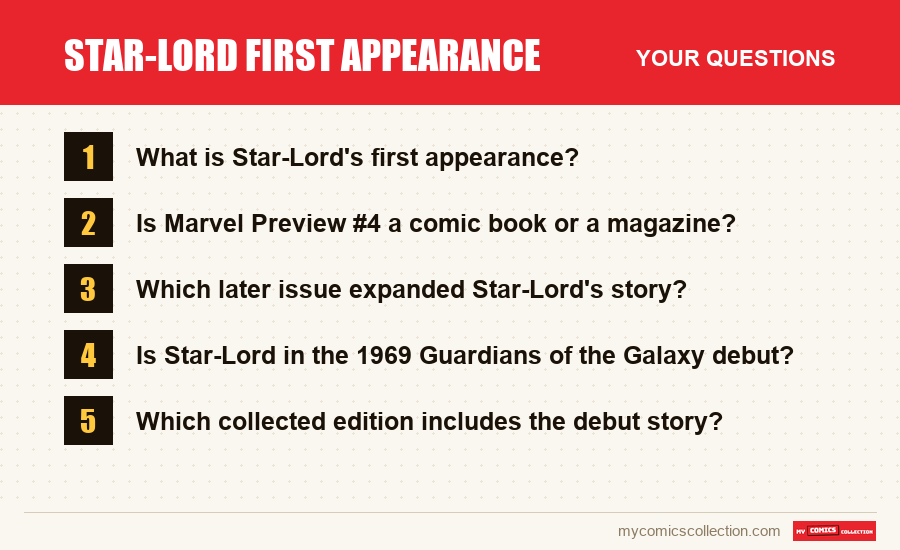
Star-Lord first appears in Marvel Preview #4, cover dated January 1976, a black-and-white magazine from Marvel. The lead feature, titled "Star-Lord," introduces the character, and the creators are writer Steve Englehart and artist Steve Gan. The back-up story is "The Sword in the Star," featuring Prince Wayfinder.
It is a black-and-white comics magazine from Marvel's magazine line, issued over its run by Magazine Management and the affiliated Marvel Comics Group. The format differs from a standard color comic book in size, printing and how it was sold, which affects how you store it and how you inspect its corners and spine.
The Summer 1977 issue, Marvel Preview #11, pairs writer Chris Claremont with penciller John Byrne and inker Terry Austin. Heinlein's lawyers objected to the cover blurb, so the issue was pulled and reprinted. A color reprint with a new framing sequence appeared in February 1982.
No. The team's debut is Marvel Super-Heroes #18 (1969), with a different lineup from the one in the 2014 film. Star-Lord debuts separately in Marvel Preview #4, so the character and the team have two distinct first-appearance issues.
Star-Lord: Guardian of the Galaxy, published in July 2014, collects Marvel Preview #4 and #11 along with other early appearances. It is a convenient way to read the stories, but it is a reprint and not a substitute for the 1976 magazine in a collection.
Own a copy of Marvel Preview #4 or another early Star-Lord appearance? Enter the issue and its condition for a free estimate.
Estimate my comic