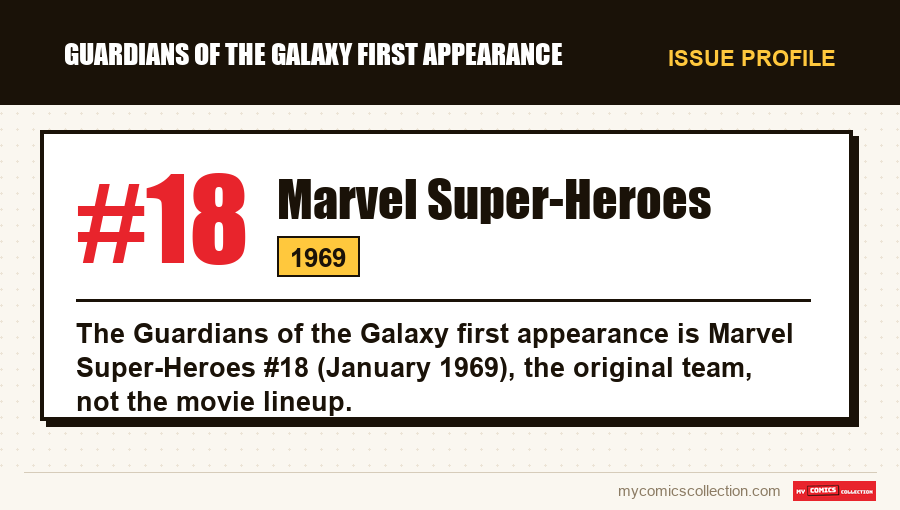
The Guardians of the Galaxy first appearance is in Marvel Super-Heroes #18, cover dated January 1969, written by Arnold Drake and drawn by Gene Colan. In the 31st century, four survivors of worlds conquered by the Badoon join forces against the occupier: Earth astronaut Vance Astro, Martinex of Pluto, Charlie-27 of Jupiter and Yondu of Centauri-IV. This is the key issue for the first team, not the one from the movies.
This issue is one of the few in the catalog where buyer and seller can agree on the title, the price and the condition, and still be wrong about what is being sold. A collector searching for "the Guardians of the Galaxy first appearance" wants, nine times out of ten, the team they saw on screen: a human outlaw, a green-skinned assassin, an armed raccoon and a tree. None of those characters is in Marvel Super-Heroes #18. The issue is a genuine team first appearance, authentic and dated, but for a different team, and that confusion costs you at resale more often than at purchase.
As always in this guide, only verified information (creators, issue numbers, dates) is stated as fact; the analysis is our own, with no reproduction of protected art or dialogue.
What Marvel Super-Heroes #18 Actually Contains
The issue is carried by a single complete story, set in the 31st century. Arnold Drake sets up an Earth and a solar system that are already lost: the Badoon Brotherhood has subjugated the human colonies, and the resistance rests on individuals nothing had destined to meet. Vance Astro is an astronaut who left Earth in the 20th century and arrived after a thousand-year voyage at Centauri-IV, where he discovers that humanity beat him there by a faster means than his own. Yondu is a native of that planet, an archer whose arrows obey sound. Charlie-27 comes from the Jupiter colonies, where the gravity produced a massive build. Martinex is the last survivor of Pluto, with a crystalline body.
The four find each other, ally and name themselves in this very issue: the team name does not arrive later, it is established right there. For a collector, that matters, because it makes Marvel Super-Heroes #18 a multiple first appearance, four characters and a lineup, and not a mere foreshadowing. Gene Colan is on art, in a register darker and sturdier than the clean space graphics often associated with Marvel science fiction of this period.
An Anthology Near the End of Its Run: The Editorial Context
Marvel Super-Heroes was not a character series but a tryout title. It had taken over the numbering of Fantasy Masterpieces, which explains why the number on this #18 does not match eighteen issues published under this title, and why a catalog search can return both names for the same series. This is the title where Captain Marvel had been launched a few issues earlier, at #12: the house logic was to test an idea on a long story, then decide.
For the Guardians, the decision was to decide nothing. The title shifted toward reprints soon after, and the team from Drake and Colan had no immediate follow-up. It sat unused for several years before returning as a guest in 1970s series, notably in Doctor Strange's Defenders, then in a series finally devoted to it, before crossing paths with the Avengers in the late part of the decade. That gap of several years is precisely what made this issue a back-of-the-box curiosity for a long time, and not a closely followed piece.
Why This Issue Became a Key, and When
The price trajectory of Marvel Super-Heroes #18 is not that of a classic recognized from the start. For decades, it was a 1969 anthology issue with an obscure team, pricey for cosmic specialists, invisible to everyone else. Its status changed when the name "Guardians of the Galaxy" became a mainstream brand, from the moment the franchise took hold in movie theaters. The market then went looking for "the first appearance," and found it here, because this is where the name is born.
This dynamic has a practical consequence: demand for this issue is more sensitive to screen news than to the internal history of the series. It rises when the name is on screen, it falls back afterward, and it reopens every time a 1969 character resurfaces in a production. Yondu is the clearest example: his name was reused in the movies for a character treated very differently from the archer of Centauri-IV, and that reuse lifted the issue more surely than any rereading of Drake's story.
The 1969 Guardians and the 2000s Guardians: What Does Not Overlap
This is the point to understand before buying. The team founded in 2008 by Dan Abnett and Andy Lanning, the one whose lineup the public knows, brings together characters created separately and elsewhere: Star-Lord and Rocket Raccoon appeared in the magazine Marvel Preview in the mid-1970s, Groot much earlier still, in a 1960 monster anthology, Drax in the pages of Iron Man in 1973, Gamora with Jim Starlin in the mid-1970s. None of these debuts is Marvel Super-Heroes #18.
The link between the two lineups exists, but it is thin and runs through one man: Vance Astro, who became Major Victory, appeared on the 2000s team. In other words, the January 1969 issue is the first appearance of the team that carried this name first, and the first appearance of only one member of the team the public identifies today. A seller who writes "1st appearance Guardians of the Galaxy" is telling the truth; a buyer who reads "first Star-Lord" is mistaken. The description is not deceptive, merely incomplete, and it is up to you to ask the question.
What Moves the Value of This Issue
On a January 1969 issue, three variables weigh before any other. The first is the condition of the spine: the staples of this period and an already acidic newsstand paper mean the centerfold and the upper corners carry the first defects. The second is the relative whiteness of the pages: a copy with frankly browned paper caps out whatever the cover looks like. The third is the flatness of the cover, because the dark ink used on this group illustration shows rubbing and reading creases more starkly than a light background would.
On top of that comes a factor specific to anthologies: these titles were kept less often than the star character series. A buyer in 1969 kept his Amazing Spider-Man and read his anthology. The consequence shows today in the relative scarcity of high grades rather than in the scarcity of copies themselves. Plainly put, finding a complete copy is doable; finding one that grading will place at the top of the spectrum is another matter, and that is where the price gap widens, often by a significant factor for a single notch.
Do you collect this series?
Track what you own, what you are missing and what your collection is worth. 7-day trial.
Start my trial →
Telling One Edition from Another
The original printing is an American newsstand issue from January 1969, with a twelve-cent cover price and no barcode: barcodes only reach comics in the late 1970s, and their presence on a copy of this title immediately rules out a period printing. Next, check the indicia, at the bottom of the first interior page: it carries the date, the issue number and the publisher, and it is the only mention that cannot be faked without touching the paper.
Three other objects circulate under the same cover image. Copies distributed in the United Kingdom in this period sometimes carry a price in pence printed or stamped on the cover: these are period copies, but the market treats them differently from the American printing, and a seller should flag it. Collected-edition reprints of the story exist and are not worth what the issue is. Finally, if a facsimile edition of this issue has been published, it is recognizable by its modern paper, its spine and a contemporary indicia that mentions the reissue: a facsimile is not a counterfeit, but confusing it with a 1969 printing changes everything.
Buying Pitfalls
The first pitfall is the listing wording. A listing that highlights movie-derived names for a 1969 issue signals either a seller who does not know what they are selling, or a seller counting on the confusion. Ask for a photo of the indicia and a photo of the spine, not only the cover.
The second pitfall is undisclosed restoration. On an issue this old, discreet reinforcement of the centerfold, re-gluing of a staple or touching up a cover corner are common and do not show on a front photo taken from a distance. A restored copy is negotiated in a separate category, not with a small discount.
The third pitfall is the lot. Late-1960s anthologies often circulate in bundles where #18 serves as the selling point to move the neighboring issues. The calculation is simple: what you would pay for #18 alone, at the estimated grade, compared with the lot price. If the difference does not cover the rest of the bundle, the rest of the bundle is what you are buying.
The Neighboring Issues That Matter Too
In the same title, #12 remains the most closely followed piece, for the launch of Captain Marvel. The issues around #18 follow the same tryout logic and produced no lasting character, which leaves them affordable: they complete a run without straining a budget.
Outside the title, the real constellation to watch if your goal is the modern team lies elsewhere: the black-and-white magazines of the mid-1970s for Star-Lord and Rocket Raccoon, a 1960 monster anthology for Groot, and Jim Starlin's cosmic corner for Gamora and Thanos. That is where, and not in Marvel Super-Heroes #18, the first appearances of the movie characters are decided. And for the Badoon, the villains of the 1969 story, the thread leads back to the Silver Surfer series, where they had been introduced a few months earlier.
What Grading Changes on This Specific Issue
Having a copy of Marvel Super-Heroes #18 graded means something different depending on the starting condition. At the top of the spectrum, grading is practically indispensable: the price gap between two neighboring notches is such that no serious buyer will pay top-of-market money on a description alone. At the bottom and middle of the spectrum, the cost of the service and the shipping weighs heavily against the gain, and a copy described honestly with good photos sells without difficulty.
The interesting case is the average copy you think is better than it is. On this issue, the dark cover and the 1969 paper produce many disappointments when the slab is opened. Before sending it in, examine the centerfold in raking light and look at the page edges in profile: those two steps explain most of the gaps between the hoped-for grade and the grade received. And if the copy is meant to stay in your collection rather than leave again, grading gives you nothing that the bag and board do not already do.
How to Track It in a Collection, and What to Remember
This issue deserves a wordier record than average, because its interest rests on a distinction that cannot be read from the cover. Note the title as it appears on the object, the number, the January 1969 date, and above all a clear mention of what the copy is: first appearance of the team of Vance Astro, Martinex, Charlie-27 and Yondu. You will spare yourself an unpleasant surprise the day an heir, a buyer or you yourself rereads the line ten years later.
In My Comics Collection, the item is found by searching the title in the catalog, including under the series' earlier name. Fill in the estimated or certified grade, the type of printing, the possible price in pence, and whether or not there is restoration: these four fields, not the cover, will determine the value you read later. And if you landed on this page because you were looking for the first Star-Lord, the good news is that you just avoided the most widespread mistake in the cosmic market: the 1969 issue is a real key, but not the one you thought you were buying. Both can sit in the same collection, as long as you know which one you are paying for.
A January 1969 copy with browned paper and a copy with an intact centerfold do not belong to the same market: get yours appraised before listing it for sale or sending it for grading.
Appraise my comic
Frequently Asked Questions
No. Star-Lord first appeared in a Marvel magazine of the mid-1970s, several years after this issue. Marvel Super-Heroes #18 introduces the 1969 team: Vance Astro, Martinex, Charlie-27 and Yondu. A listing that links the two mixes up two distinct lineups sharing the same team name.
The story is written by Arnold Drake and drawn by Gene Colan. It is the only origin story of this team, published with a January 1969 cover date, in an anthology title that served as a testing ground for ideas not yet assigned to a regular series.
Because Marvel Super-Heroes continues the numbering of Fantasy Masterpieces, the title that preceded it. This #18 is therefore not the eighteenth issue published under this name. In a catalog, the same series can appear under both names, which explains the failed searches.
It is a period copy meant for the British market, not a reprint. Its treatment differs from that of the American January 1969 printing, however, and buyers do not react to it the same way. A seller should always mention it, and a photo of the cover lets you verify it.
It depends on the grade. At the top of the spectrum, grading is almost required by the market, because the gap between two notches is considerable. In the middle and bottom, the cost of the service often absorbs the gain, and sharp photos of the centerfold and page edges are enough to sell properly.