
In short
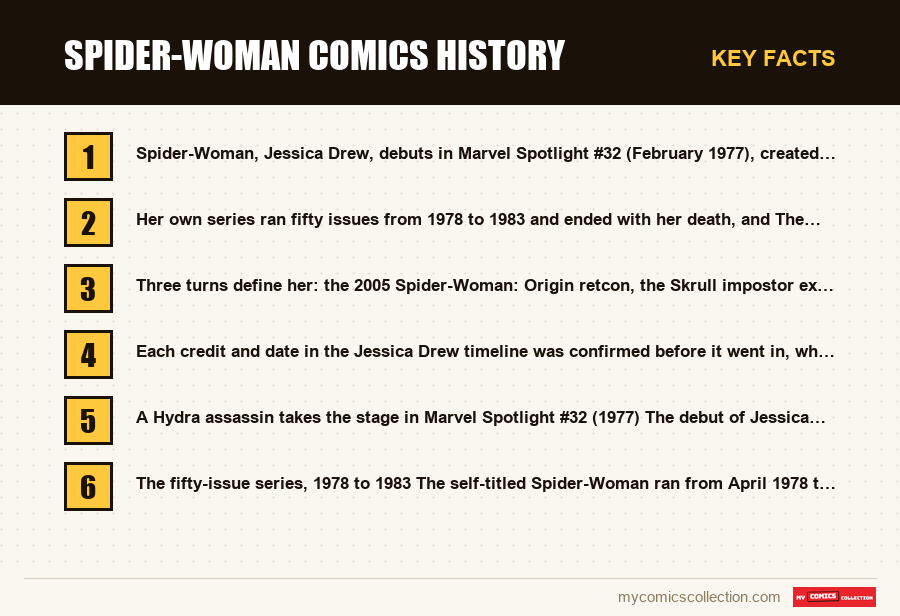
Spider-Woman, Jessica Drew, debuts in Marvel Spotlight #32 (February 1977), created by Archie Goodwin and Marie Severin as a Hydra agent sent against Nick Fury. Her own series ran fifty issues from 1978 to 1983 and ended with her death, and The Avengers #240-241 (1984) brought her back. Three turns define her: the 2005 Spider-Woman: Origin retcon, the Skrull impostor exposed in Secret Invasion (2008), and the 2014 to 2015 solo books by Dennis Hopeless.
Few Marvel heroes have a bibliography that looks as uneven as Jessica Drew's. She starts in an anthology slot, earns a fifty-issue series, dies, returns in someone else's book, spends two decades as a supporting player, and then becomes a team anchor and a headliner again. Read in order, those swings form a clear shape: a character repeatedly rebuilt by the writer who happens to hold her.
Each credit and date in the Jessica Drew timeline was confirmed before it went in, while the stretches of her 1978 run that could not be pinned to exact issues are described without numbers. The interpretation of Jessica's changes is our own, and no panel or line of dialogue is copied.
A Hydra assassin takes the stage in Marvel Spotlight #32 (1977)
The debut of Jessica Drew sits in Marvel Spotlight #32, dated February 1977. Archie Goodwin conceived the character and wrote the story, and the freelancer Marie Severin designed her costume and look.
What the debut actually does is more interesting than the name. Jessica is introduced as a brainwashed Hydra spy who is goaded into an attempt on Nick Fury, and Hydra recaptures and hypnotizes her again. She is a pawn rather than a hero, which is a stranger starting point than most superhero debuts allow.
That framing shaped everything that followed. A hero who starts as a manipulated agent has to earn her independence, and each later writer either leans into that history or tries to wash it out. Fury is the other half of this story, since the spymaster she is sent to kill stays near her orbit, and the Nick Fury comics history is a natural companion read.
A second origin arrives in Marvel Two-in-One
Shortly after the debut, Marv Wolfman wrote a four-issue story in Marvel Two-in-One that gave Jessica a different origin. Wolfman wrote it because the original account felt too implausible, and the new version identified her as Jessica Drew with memories of being a spider implanted by Hydra. The change lives in a team-up book rather than in her own title, yet it is the move that made a standalone series workable.
The established backstory that settled from this period places her birth in London, to an American scientist father, Jonathan Drew, and a French mother. The family moves to a laboratory near Mount Wundagore, a site built with the High Evolutionary, and her father gives her an experimental spider-blood serum before she is placed in a genetic accelerator. Hydra later captures her, erases her memories and shapes her into the agent called Arachne.
The fifty-issue series, 1978 to 1983
The self-titled Spider-Woman ran from April 1978 to June 1983 and lasted fifty issues. Marv Wolfman wrote the opening run and left after issue #8. Mark Gruenwald then took over as writer, with Carmine Infantino continuing as penciler. At issue #20, Gruenwald, Infantino and the editor Roger Stern all departed, and Michael Fleisher became the writer. After Fleisher, Chris Claremont wrote a stretch of the series with Steve Leialoha as artist, and Ann Nocenti wrote and Brian Postman penciled the final four issues, with Gruenwald back as editor.
The series follows Jessica as a private investigator, with stories set in San Francisco, Los Angeles and Madripoor. That is a notable choice: while Spider-Man was swinging through New York, his female counterpart worked on the West Coast in a detective mode, closer to a noir series than to the street-level costume brawls around her. The staff turnover is steady, so a straight read will feel the shifts.
Issue #50 closes the run with Jessica's death in a climactic battle against Morgan le Fay. Readers reacted angrily to the character being killed.
Death and resurrection: Avengers #240-241 (1984)
That way back came in The Avengers #240-241, cover-dated February and March 1984. Roger Stern wrote the story in which Jessica was resurrected with the help of Doctor Strange. It is a revealing detail that the revival happens in an Avengers storyline rather than in a Spider-Woman title: she no longer had one, and the Avengers were the place where the cast and the editors who valued her were working.
For a run, the pair of issues is a bridge rather than a destination: two comics inside a larger Avengers sequence that restore the character to the shared universe. They also mark a pattern that holds for the rest of her history: Jessica's biggest shifts tend to happen in other people's books.
The wilderness years: Wolverine, a back-up story and a cameo (1988 to 2003)
For roughly two decades after the revival, Jessica is a supporting presence. In Wolverine (1988) she and Lindsay McCabe form part of the supporting cast for the first sixteen issues, and she returns later in the run, with appearances in #27 and in #125 to #128. She appears there without her costume, a telling choice that treats her as a person with a life outside the mask.
In 1996 Sensational Spider-Man Annual carried a Gruenwald back-up story called "The Return of Spider-Woman," a piece that later stories treated as non-canon. In 1999 she appears in the third Spider-Woman volume, the series starring Mattie Franklin, and in 2003 Brian Michael Bendis used her in an arc of Alias.
In this stretch her appearances are spread across other series, so reading her means following the host titles rather than a single spine.
Do you collect this series?
Track what you own, what you are missing and what your collection is worth. 7-day trial.
Start my trial →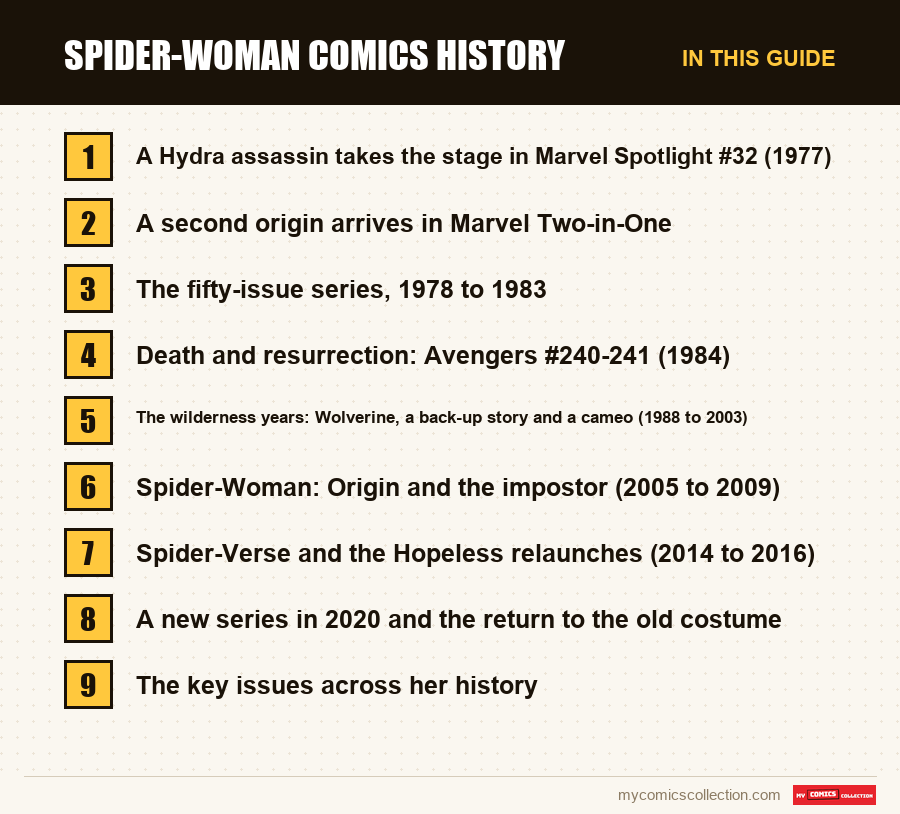
Spider-Woman: Origin and the impostor (2005 to 2009)
Spider-Woman: Origin, a five-issue miniseries whose first issue appeared in December 2005, rewrote her story. Brian Michael Bendis and Brian Reed wrote it, with art by the Luna Brothers, Jonathan and Joshua Luna. The retcon ties her powers to a laser beam that struck her mother's womb and carried spider DNA, and in it her parents disappear before Hydra recruits her under false pretenses, with Taskmaster handling her training. The older account of a serum and a genetic accelerator is replaced by a more compact, more modern tale, and it plants the thread that her father had links to Miles Warren, the man who later became the Jackal.
The same period contains the most surprising decision in her history. New Avengers launched in January 2005 with Jessica on the team, and the 2008 Secret Invasion storyline revealed that the Spider-Woman who had appeared in that series for roughly four years was a Skrull impostor, the Skrull Empress Veranke. Bendis wrote Secret Invasion with Leinil Francis Yu on pencils, Mark Morales on inks and Laura Martin on colors, and the series carries a June 2008 cover date on its first issue. Bendis has said he planned the twist from the start of New Avengers, which means a reread can find hints.
The real Jessica, abducted rather than replaced by choice, rejoined the New Avengers once the Skrull invasion was exposed. Marvel followed up with a seven-issue Spider-Woman limited series in 2009 by Bendis and the artist Alex Maleev, which was also released as a motion comic. From July 2010 to January 2013 she was a regular in the 2010 Avengers series, from #1 through #34, and in 2014 she was a regular character in Secret Avengers, after she had joined S.W.O.R.D. at Abigail Brand's invitation.
Spider-Verse and the Hopeless relaunches (2014 to 2016)
In 2014 Jessica is a key player in Spider-Verse, and the fifth volume of Spider-Woman begins by tying into it, written by Dennis Hopeless. A costume redesign arrives in issue #5. That series ended at issue #10 when Secret Wars interrupted it, and in that event Jessica co-pilots a ship that is shot down, and she dies with its passengers, a death later undone.
The 2015 relaunch put a new #1 on the stands, still written by Hopeless, with Javier Rodriguez drawing and coloring. The story picks up with Jessica in the second trimester of a pregnancy, and she later gives birth to a son, Gerry, and begins dating Roger Gocking, the character known as Porcupine. The book moves away from the spy and detective angles toward a superhero balancing a newborn, a team and a life.
In 2016 she became a protagonist in the Spider-Women event alongside Spider-Gwen and Silk, and Spider-Woman #6 and #7 served as tie-ins. The crossover is a reminder that Jessica now lives inside a family of spider heroes: the Spider-Gwen comics history and the Silk key issues guide cover the other two, and a collector reading the crossover will want all three threads open.
A new series in 2020 and the return to the old costume
A new Spider-Woman series started in March 2020, with Karla Pacheco as writer and Pere Perez as artist. The series launched with a redesigned costume created by Dave Johnson, and Jessica returned to her 1970s look from issue #11. The back-and-forth suggests that the original Severin design still reads as the character's identity. The series also tied into Devil's Reign with issues #18 and #19.
This is where the trajectory lands, for now. Jessica started as a manipulated agent, became a detective, died, came back, was rewritten, was impersonated by a Skrull, and has since headlined several new volumes. The constant is the name and the costume.
The key issues across her history
- Marvel Spotlight #32 (February 1977): the debut, by Archie Goodwin and Marie Severin, with Jessica as a Hydra agent set against Nick Fury.
- Spider-Woman #1 (April 1978): the start of the fifty-issue series, with Marv Wolfman writing the opening run.
- Spider-Woman #20: the issue where Gruenwald, Infantino and Roger Stern depart and Michael Fleisher takes over as writer.
- Spider-Woman #50 (1983): the final issue, ending with her death against Morgan le Fay.
- The Avengers #240-241 (February and March 1984): the resurrection storyline, written by Roger Stern.
- Spider-Woman: Origin #1 (December 2005): the origin rewrite, scripted by Brian Michael Bendis and Brian Reed and drawn by Jonathan and Joshua Luna.
- Secret Invasion #1 (June 2008): the event that exposed the Skrull impostor, by Bendis and Leinil Francis Yu.
- Spider-Woman #1 (2015, volume 6): the Hopeless and Rodriguez relaunch that built the current supporting cast.
How to follow Jessica Drew in a collection
Start by separating the people who share the name. At least one other woman has carried the Spider-Woman name in Marvel history, and listings routinely mix the identities, so a clean checklist needs a line for Jessica Drew specifically, with the series volume attached to every entry. The 2015 relaunch is a sixth volume and the 2014 book a fifth, with the 2020 series after them, so any tracker that records only the title will merge three different runs.
Next, treat her bibliography as three blocks. The first is the 1977 debut plus the 1978 series, which is a long, fifty-issue stretch best handled as a run with its gaps tracked by number. The second is the host-book years, where her key moments live inside The Avengers, Wolverine, Alias, New Avengers and Secret Invasion, so the shopping list is a set of single issues and short arcs. The third is the modern solo books, which read best as collected volumes in order. Note which entries are crossover tie-ins (Spider-Verse, Secret Wars, Spider-Women, Devil's Reign), because that is where numbering confusion appears.
Finally, remember that the debut sits in an anthology. Marvel Spotlight #32 is cataloged under the series that carries it, so a search for the character name alone brings up her own later series first. The Marvel blog index collects the other guides in this series, and the free comic valuation page is the place to compare a specific copy once the identification is clear.

Frequently asked questions
Look to Marvel Spotlight #32, February 1977. Goodwin wrote it and Severin shaped the costume. Jessica appears as a Hydra operative steered into targeting Nick Fury, which makes the debut a spy tale more than a hero origin.
The first self-titled series ran fifty issues, from April 1978 to June 1983. Marv Wolfman wrote the opening issues, followed by Mark Gruenwald, Michael Fleisher, Chris Claremont and, for the final four issues, Ann Nocenti with artist Brian Postman. Issue #50 ends with Jessica's death in a battle with Morgan le Fay.
She returns in The Avengers #240-241, cover-dated February and March 1984, in a story by Roger Stern in which Doctor Strange helps resurrect her. The revival takes place in an Avengers storyline rather than in a Spider-Woman book, because her own title had ended with her death.
In Secret Invasion (2008, Brian Michael Bendis and Leinil Francis Yu), readers learned that the Spider-Woman who had been in New Avengers for years was Veranke, the Skrull Empress, in disguise. The real Jessica had been abducted, and she returned to the team after the unmasking.
The 2015 relaunch, with Dennis Hopeless writing and Javier Rodriguez drawing, is the most approachable modern entry point, since it starts at a new #1 and follows Jessica through pregnancy and a new supporting cast. The 2020 series by Karla Pacheco and Pere Perez is a second option, and the 1978 series suits readers who want the original run.
Holding a Marvel Spotlight #32 or a run of the 1978 Spider-Woman series and unsure what condition it is in? Get a free estimate.
Estimate my comic