Here is the Spider-Island reading order, every Amazing Spider-Man issue included: read Spider-Island (2011) in publication order, starting with the six Infested stories in The Amazing Spider-Man #659, #660 and #662 to #665, then the main arc, Amazing Spider-Man #666 to #673, written by Dan Slott with Humberto Ramos and Stefano Caselli. Add Venom vol. 2 #6 to #8 and Spider-Island: Deadly Foes #1; the other tie-ins are optional.
The people of Manhattan gain spider powers: the premise of Spider-Island fits in one sentence, but reading it takes a little method, because the main arc is surrounded by miniseries, issues of neighboring series and prologues tucked into the back of Amazing Spider-Man. Here is the path, issue by issue.
As always on this guide, we only state verified facts (creators, issues, dates); the analysis is our own, with no reproduction of protected art or dialogue.
What to read first
Good news: Spider-Island doesn't call for a long preparation. The event is written by Dan Slott in The Amazing Spider-Man, the series where the main arc carries issues #666 to #673, published from July to November 2011. Issues #666 to #673 belong to the series' continuous numbering; the guide to Amazing Spider-Man volumes explains how it fits with the relaunches.
The prelude proper comes in a single set, Infested: six short stories published as back-ups in The Amazing Spider-Man #659, #660 and #662 to #665, then collected under the title Amazing Spider-Man: Infested. Each takes a few minutes to read, and they plant the clues the main arc sets off.
A reader who already knows the clones, the hero's family of enemies and the New York supporting cast will feel at home. If that's not you, the guide to Ben Reilly and Kaine gives the background on a character who appears in the arc: Kaine, here under the name Tarantula.
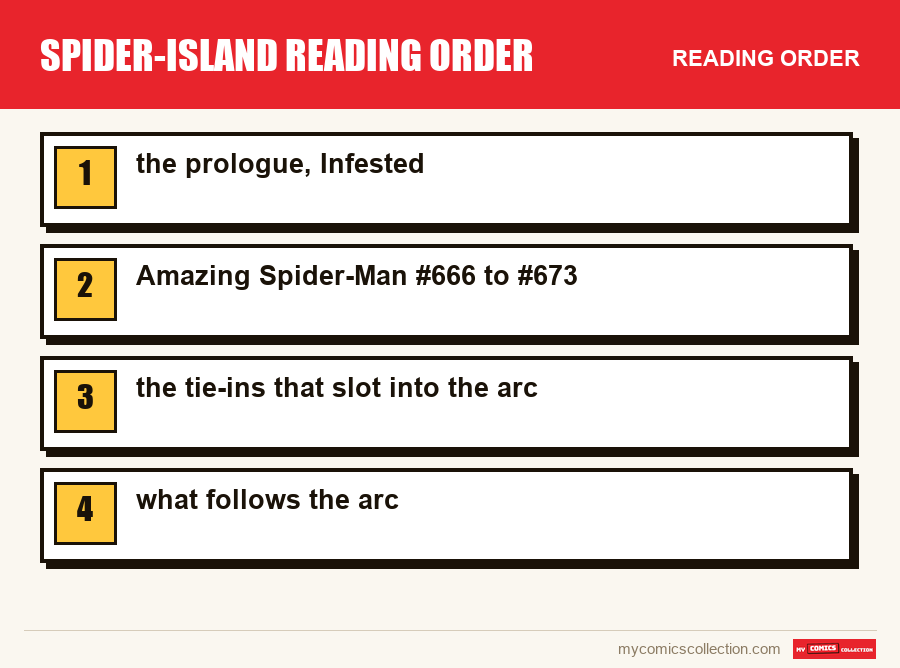
Phase 1: the prologue, Infested
Start with the Infested back-ups, in order, and note that #661 doesn't contain one: Amazing Spider-Man #659 and #660, then #662, #663, #664 and #665.
There are two ways to go about it. In single issues, you read each issue's main story, then the short story that goes with it, which reproduces the reading experience at the time. In a trade paperback, Amazing Spider-Man: Infested collects the six stories in one go; it's the simplest solution for such a fragmented prologue.
This prologue is short, but it matters: once the main arc opens, you'll recognize the elements it had seeded.
Phase 2: Amazing Spider-Man #666 to #673
The main arc has eight issues, all published in 2011: #666 on July 27, #667 on August 10, #668 on August 31, #669 on September 14, #670 on September 28, #671 on October 12, #672 on October 26 and #673 on November 2. The pace is therefore one issue every two weeks on average, with a three-week gap between #667 and #668.
The script is by Dan Slott. On art, two names recur: Humberto Ramos, and Stefano Caselli as penciler and inker, with Marte Gracia on colors.
For reading: split the arc into three blocks of issues, #666 to #668, #669 to #671, then #672 and #673, and pause at each block to slip in the tie-ins from the next phase. Read these eight issues back to back before any other tie-in if you want a first read with no detours; come back to the tie-ins afterward.
A collector's tip: #666 is the opening issue. If you are building the run, make sure you gather the complete sequence #666 to #673, not just the first.
Phase 3: the tie-ins that slot into the arc
The list below follows the 2011 release dates. It gives you a "moving" reading: each tie-in sits between two issues of the main series.
- August 2011, with #666 to #668: Spider-Island: Cloak and Dagger #1 and Spider-Island: Deadly Foes #1 (August 10), Venom vol. 2 #6 and Spider-Island: The Amazing Spider-Girl #1 (August 17), Spider-Island: Deadly Hands of Kung Fu #1 (August 31).
- September 2011, between #668 and #670: Spider-Island: Avengers #1 (September 7), Herc #7 and Spider-Island: The Amazing Spider-Girl #2 (September 14), Spider-Island: Cloak and Dagger #2 and Spider-Island: Spider-Woman #1 (September 21).
- Late September and October 2011, around #670 and #671: Herc #8, Venom vol. 2 #7 and Spider-Island: Deadly Hands of Kung Fu #2 (September 28), Spider-Island: Heroes for Hire #1 (October 5).
- Late October 2011, with #672: Venom vol. 2 #8, Spider-Island: The Amazing Spider-Girl #3, Spider-Island: Cloak and Dagger #3 and Spider-Island: Deadly Hands of Kung Fu #3 (October 26).
The titles Black Panther: The Most Dangerous Man Alive #524, Spider-Island: Daily Bugle #1 (a free preview) and Spider-Island: I Love New York City #1 round out the picture.
Among these titles, four issues deserve a place of their own, because the event's main collection gathers them: Venom vol. 2 #6 to #8 and Spider-Island: Deadly Foes #1. These two series are read alongside the arc, not after it. If you want to know more about the character of Venom, the titles in the Venom reading guide will give you the rest of his run.
Method: organizing a single-issue read
To avoid getting lost in the thirty or so issues involved, go by series rather than by date. First set down the stack of Amazing Spider-Man #659 to #673 without #661, then a Venom vol. 2 #6 to #8 stack, then one stack per miniseries (Spider-Girl, Cloak and Dagger, Deadly Hands of Kung Fu), and finally the standalone issues: Herc #7 and #8, Avengers #1, Spider-Woman #1, Heroes for Hire #1, Deadly Foes #1.
Then read the main stack in blocks, and open the other stacks when the phase 3 schedule tells you to. This method takes a bit longer at first, but it saves you from hunting for a specific issue in a half-sorted box, and it shows you right away what is missing from your collection before you begin.
Do you collect this series?
Track what you own, what you are missing and what your collection is worth. 7-day trial.
Start my trial →
Phase 4: what follows the arc
After #673, the Amazing Spider-Man series continues. For the rest of the run, the guide Dan Slott: where to start offers a reasoned way into the following arcs; we don't detail here what comes next, because this page is about reading Spider-Island in order.
A point of method: at the end of #673, don't rush into the remaining tie-ins. Take a break, then come back to the miniseries that interest you most, keeping in mind that each one tells the same event from the point of view of its central character.
The tie-ins you can skip
Optional doesn't mean weak: these issues follow a character close to the hero during the infestation, without changing the course of #666 to #673. If you only want the central story, skip without remorse Spider-Island: Avengers #1, Spider-Island: Heroes for Hire #1, Spider-Island: Spider-Woman #1, Herc #7 and #8, and Black Panther: The Most Dangerous Man Alive #524.
The reason is the same for all of them: these issues belong to series with their own continuity. They read well if you already follow those series, but they aren't needed to understand the main arc. The miniseries The Amazing Spider-Girl (3 issues), Cloak and Dagger (3 issues) and Deadly Hands of Kung Fu (3 issues) form an in-between category: they are short, they read in one sitting, and they will appeal to readers of those characters. For a look at one of them, see the page on Cloak and Dagger on screen and in comics.
Single issues or trade paperbacks: how to read it
In single issues. Publication order gives you a natural path: one issue of Amazing Spider-Man about every two weeks, with tie-ins interleaved. Prepare a checklist, tick off what you've read, and keep the Infested issues apart, since they sit at the back of the series' issues.
In trade paperbacks. Three verified volumes cover the essentials. Spider-Island exists as a hardcover (January 2012, 376 pages) and as a trade paperback (October 2012); it contains Amazing Spider-Man #666 to #673, Venom #6 to #8, Deadly Foes and the Infested stories (#659, #660 and #662 to #665). Spider-Man: Spider-Island Companion exists as a hardcover (February 2012, 424 pages) and as a paperback (October 2012); it notably collects the three miniseries Spider-Girl, Cloak and Dagger and Deadly Hands of Kung Fu, Herc #7 and #8, Avengers #1, Spider-Woman #1, Black Panther #524, Heroes for Hire #1 and Spider-Island Spotlight #1.
Read Spider-Island first, then its Companion if you enjoyed the event: it's the most economical method. Always check the table of contents before buying, and look at the condition of the copy rather than just the volume's title.
The key issues to know
The 2011 issues are easy to find; spotting them mostly helps you complete a run with no gaps. Here are the issues to build your search around.
- Amazing Spider-Man #666: the arc's opening, published on July 27, 2011.
- Amazing Spider-Man #673: the conclusion, published on November 2, 2011. It files with the seven before it.
- The #1s of the tie-ins: Spider-Island: Cloak and Dagger #1, Spider-Island: Deadly Foes #1, Spider-Island: The Amazing Spider-Girl #1 and Spider-Island: Deadly Hands of Kung Fu #1 each open a short miniseries: finding them quickly fills out a section of your box.
- Amazing Spider-Man #659, #660 and #662 to #665: the issues that contain the Infested stories; a reader who only buys the main series already owns them.
To value a copy, look at the condition and the cover (main or variant) and compare against completed sales. For an overview of crossovers and what collectors look for in them, the guide to key issues of crossovers and events lays out the method.
Recap: the complete order
- Amazing Spider-Man #659 and #660 (Infested back-ups)
- Amazing Spider-Man #662 to #665 (Infested back-ups)
- Amazing Spider-Man #666 (July 27, 2011)
- Amazing Spider-Man #667, Spider-Island: Cloak and Dagger #1, Spider-Island: Deadly Foes #1
- Venom vol. 2 #6, Spider-Island: The Amazing Spider-Girl #1
- Amazing Spider-Man #668, Spider-Island: Deadly Hands of Kung Fu #1
- Spider-Island: Avengers #1
- Amazing Spider-Man #669, Herc #7, Spider-Island: The Amazing Spider-Girl #2
- Spider-Island: Cloak and Dagger #2, Spider-Island: Spider-Woman #1
- Amazing Spider-Man #670, Herc #8, Venom vol. 2 #7, Spider-Island: Deadly Hands of Kung Fu #2
- Spider-Island: Heroes for Hire #1
- Amazing Spider-Man #671
- Amazing Spider-Man #672, Venom vol. 2 #8, Spider-Island: The Amazing Spider-Girl #3, Spider-Island: Cloak and Dagger #3, Spider-Island: Deadly Hands of Kung Fu #3
- Amazing Spider-Man #673 (November 2, 2011)
Frequently asked questions
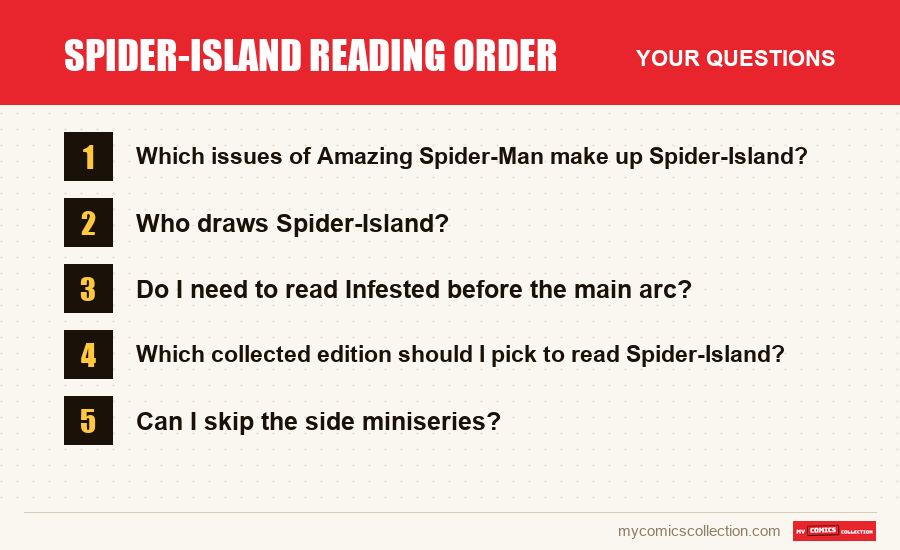
The main arc takes up The Amazing Spider-Man #666 to #673, published from July to November 2011, written by Dan Slott. The Infested prologue appears as short stories in #659, #660 and #662 to #665. These are the issues the Spider-Island collection reprints.
The writer is Dan Slott. The art goes to Humberto Ramos and Stefano Caselli, the latter also inking his own pages. Marte Gracia handles the colors and Joe Caramagna the lettering, under the editorial direction of Stephen Wacker.
It isn't mandatory, but it's recommended: these six short stories, published in the back of several issues of Amazing Spider-Man, set up elements the arc picks up. The Amazing Spider-Man: Infested collection gathers them in a single volume.
The Spider-Island collection gathers Amazing Spider-Man #666 to #673, Venom vol. 2 #6 to #8, Deadly Foes and the Infested stories. It exists as a hardcover (2012) and as a trade paperback (2012). The Companion collects most of the other tie-ins.
Yes: the main story makes sense with the eight issues of Amazing Spider-Man #666 to #673, plus Venom vol. 2 #6 to #8 and Deadly Foes #1 if you want the full main collection. The miniseries on Spider-Girl, Cloak and Dagger or Deadly Hands of Kung Fu are for readers of those characters.
Your Amazing Spider-Man #666 to #673 form a set: have them valued before you break it up.
Estimate my comic