Cloak & Dagger (series, 2018-2019) adapts the duo that appeared in Spectacular Spider-Man #64 (1982) Bill Mantlo and Ed Hannigan : Tyrone Johnson (Cloak), linked to darkness, and Tandy Bowen (Dagger), bringer of light. The series modernizes their origins, making them teenagers from New Orleans and develops their symbolic shadow/light link. Here is the detailed comparison, series versus comics.
An initiatory story about two teenagers who are opposed by everything and bound by destiny, Cloak & Dagger brings to the screen an iconic duo born in the pages of Spider-Man. It draws on a pair of characters with powerful symbolism. Source-by-source decryption.
As in each article in this series, only verified information (creators, distribution, dates, comic numbers) is stated; the comparative analysis is ours, without reproducing dialogue or protected images.
Title : Cloak & Dagger (2018-2019)
Creator: Joe Pokaski
Actors: Aubrey Joseph (Tyrone/Cloak), Olivia Holt (Tandy/Dagger)
Broadcast: 2018-2019, Freeform (2 seasons)
Studio: Marvel Television
Spectacular Spider-Man #64 (1982): 1st appearance (Mantlo & Hannigan)
Tyrone Johnson (Cloak): the cloak of darkness
Tandy Bowen (Dagger): daggers of light
The shadow/light link: the duality at the heart of the duo
- Le duet Cloak and Dagger and their unbreakable bond.
- THE powers: Tyrone commands the darkness, Tandy the light.
- La shadow/light duality as a symbolic heart.
- Their origin linked to a experimental drug.
- Their status as protectors of those left behind.
- The action is located at New Orleans, not in New York.
- The origins are modernized and linked to the same childhood accident.
- The story focuses on the social and intimate drama of the two teenagers.
- The link to Spider-Man, present in the comics, disappears.
- Elements of local mythology (voodoo, Loa) are added.
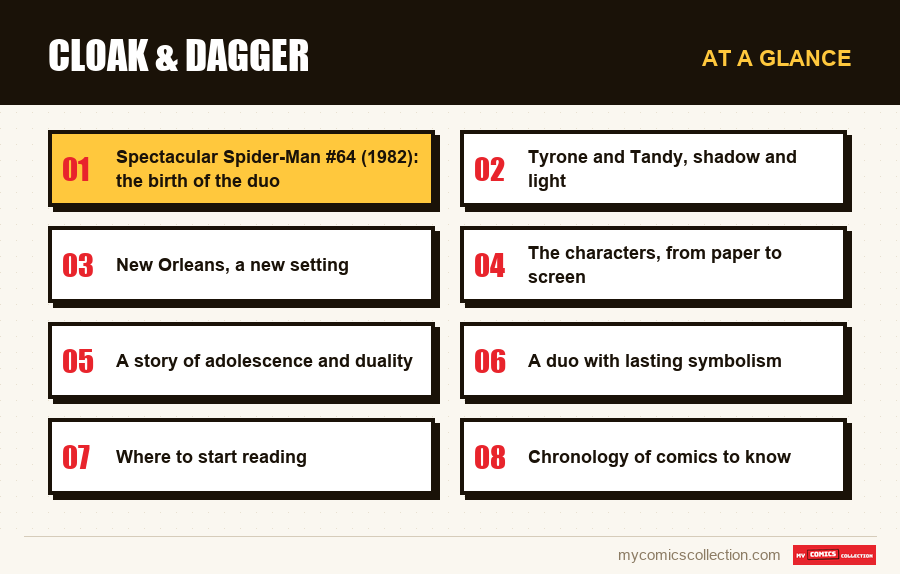
Spectacular Spider-Man #64 (1982): the birth of the duo
Cloak and Dagger first appear in Spectacular Spider-Man #64 (1982), created by Bill Mantlo and Ed Hannigan. The inspiration, according to Mantlo, came to him during a visit to Ellis Island, a historic gateway for immigrants to the United States. The duo was born in the wake of Spider-Man, who crosses paths with them as they bring forth their expeditious justice in the streets. Tyrone Johnson and Tandy Bowen are two young runaways, victims of an experimental drug which, instead of killing them, awakens in them opposing and complementary powers: one becomes a well of darkness, the other a source of light.
From the beginning, Cloak and Dagger are characters apart in the Marvel universe: neither quite heroes, nor quite avengers, they embody an ambiguous justice, born from suffering and marginality. Their fight against drug traffickers, a strong social theme of 1980s comics, gives them a realistic and committed dimension. The series takes up this base (drugs, duality, marginality) but profoundly reinvents it to make a contemporary adolescence story.
Tyrone and Tandy, shadow and light
The genius of the concept lies in the complementarity of the two heroes. Tyrone Johnson, becoming Cloak, is enveloped in a cloak of living darkness; he can engulf his enemies in a dimension of shadow and cold, and teleport. But he is also hungry, devoured by a hunger for light that only Tandy can quench. Tandy Bowen, now Dagger, projects daggers of pure light, capable of wounding but also of healing, particularly addictions. One cannot go without the other: Cloak needs Dagger's light to avoid sinking, Dagger needs Cloak to channel his excess energy.
This interdependence makes Cloak and Dagger one of Marvel's most symbolic duos. Their relationship, made of mutual need and tenderness, goes beyond the simple partnership of vigilantes: it tells of two broken souls who complete and save each other. The series brings this connection to the forefront, making it the emotional driving force of its narrative. Aubrey Joseph and Olivia Holt embody this fragile alchemy, faithful to the spirit of the duo while anchoring it in a contemporary and tormented adolescence.
New Orleans, a new setting
The most visible change is in the setting. The comics anchored Cloak and Dagger on the streets of New York, alongside Spider-Man and the city's heroes. The series transplants them to New Orleans, a city with a strong character, full of history and mystique. This move is not trivial: it allows the series to weave a unique atmosphere, between jazz, working-class neighborhoods and local traditions. Elements of mythology specific to the region (references to voodoo, Loa, spirits) enrich the story with a color absent from the comics.
This setting also serves the social purpose of the series. New Orleans, marked by inequalities and tensions, offers a realistic setting to address the themes dear to the duo: marginality, injustice, police violence, the divide between communities. Tyrone, a young black man confronted with racism and brutality, and Tandy, a young white girl from a deprived background, embody two faces of precariousness. By transposing the duo into this setting, the series updates their social significance and gives them a strong contemporary resonance.
The characters, from paper to screen
- Tyrone Johnson (Cloak): Shrouded in darkness, he swallows up his enemies and teleports, haunted by a hunger for light.
- Tandy Bowen (Dagger): She projects daggers of light that wound and heal.
- The duo itself: Their interdependence between light and shadow is the heart of the story.
- The figures of New Orleans: Series-specific additions, rooted in local mythology.
- Spider-Man: Present at the origin of the duo in the comics, absent from the series (question of rights).
Collecting this series?
Track what you own, what you are missing and what your collection is worth. 7 day trial.
Start my trial →A story of adolescence and duality
Where the comics made Cloak and Dagger already trained vigilantes, the series adopts the original story, showing two teenagers discovering their powers and learning to live with them. This bias brings the series closer to other Marvel productions intended for a young audience, by focusing on introspection, the emotions and the wounds of adolescence. The pace, slower and more intimate than in the comics, leaves time to explore the traumas of the two heroes: the loss of a loved one, the guilt, the difficulty of building oneself in a hostile world.
The duality of shadow/light, at the heart of the concept, becomes a metaphor for their inner trajectories. Cloak bears the darkness of mourning and anger; Dagger, the light of hope, but also the burn of pain. Their meeting is as much a superhero partnership as it is mutual therapy, where each helps the other confront their demons. This psychological reading, more advanced than in the comics, makes the series a sensitive story about resilience and repair, faithful to the spirit of a duo always defined by their vulnerability.
A duo with lasting symbolism
While Cloak and Dagger have never been at the forefront of Marvel superheroes, their symbolism has earned them a lasting place in readers' hearts. The idea of two opposing and complementary beings, linked by a vital need, has a poetic force that spans the decades. Their fight against drugs, anchored in the social concerns of the 1980s, already gave them a committed dimension rare for the time. The series extends this heritage by updating their issues, proof that the concept remains relevant well after its creation.
For the reader, Cloak and Dagger are an invitation to explore a more intimate and social part of the Marvel universe, far from major cosmic threats. Their story speaks of marginality, mutual aid and redemption, with a sincerity that touches. By bringing this duo to the screen, the series has rediscovered precious characters, whose founding duality continues to inspire. She reminds us that Marvel's wealth is not only due to its most famous icons, but also to these singular figures born in the margins of more well-known stories.
Where to start reading
To discover Cloak and Dagger, their first appearance in Spectacular Spider-Man #64 (1982) lays the foundation for the duo. Their dedicated series from the 1980s, which extend their fight against crime and drugs, develop their mythology and their relationship. Their subsequent appearances alongside other New York heroes, especially during major crossovers, enrich their journey. This journey covers the sources of a series that profoundly reinvents an emblematic duo of Marvel symbolism.
Chronology of comics to know
- 1982: Spectacular Spider-Man #64: First appearance of Cloak and Dagger.
- 1980s: Their dedicated series develop their fight against drugs.
- Subsequent decades: Their appearances alongside the heroes of New York enrich their mythology.
Collection side: what numbers to aim for after the series
Cloak & Dagger points to a Bronze Age key. Spectacular Spider-Man #64 (1982, first appearance of the duo) is a sought-after number, whose popularity benefited from the popularity of the characters. Their dedicated series from the 1980s are more accessible targets to deepen their mythology. The appearances linked to the major crossovers in New York offer other avenues. These targets cover various budgets. As always, condition and gradation determine value; relying on real recent sales is strongly recommended.
Its place in the saga and for the collector
Cloak & Dagger brought to the screen a duo with powerful symbolism, modernizing its origins and anchoring it in a new setting. For the collector, it revived interest in Spectacular Spider-Man #64 and the series from the 1980s. It illustrates the effect of adaptations on the market, including for secondary characters. Beyond speculation, the series invites us to discover a more intimate and social side of Marvel, where two broken souls save each other. By updating the social scope of the duo, it proves that their founding duality, born in 1982, retains all its strength.
The verdict: a duo reinvented with sensitivity
- Loyalty: the duo, their opposing powers, the duality of shadow / light and the origin linked to a drug come from the comics.
- Freedoms: the New Orleans setting, the modernized origins, the absence of Spider-Man, the added local mythology.
- Collectible numbers: Spectacular Spider-Man #64 (1982), the dedicated series from the 1980s.
Cloak & Dagger reinvents an iconic comic book duo in a contemporary tale of adolescence, anchored in New Orleans. Faithful to the shadow/light link and the vulnerability of the characters, the series modernizes their origins and their social significance. For the reader as well as the collector, it is an invitation to discover, from Spectacular Spider-Man #64, one of Marvel's most poetic duos. Few of the publisher's creations are based on such a simple and strong idea: two beings completely opposed to each other, condemned to not being able to exist without one another. This image of inseparable light and shadow crosses the decades without losing any of its emotional charge, and explains why Cloak and Dagger, born in the margins of a Spider-Man story, ended up establishing themselves as figures in their own right in the Marvel universe.
Frequently asked questions
They appear in Spectacular Spider-Man #64 (1982), created by Bill Mantlo and Ed Hannigan. Tyrone Johnson (Cloak) and Tandy Bowen (Dagger) are two runaways gifted with powers opposed by an experimental drug.
Cloak commands the darkness: he swallows his enemies in a shadow dimension and teleports away. Dagger projects daggers of light that hurt but also heal. Their interdependence is the heart of the duo.
It retains the duo, their powers and the duality of shadow / light, but modernizes their origins, moves the action to New Orleans, removes the link to Spider-Man and adds local mythology.
This setting gives the series a unique atmosphere and serves its social purpose (inequalities, tensions, marginality) while allowing the addition of elements of local mythology absent from New York comics.
Spectacular Spider-Man #64 (1982, first appearance of the duo) is the most sought-after key. Their dedicated series from the 1980s are more accessible targets to deepen their mythology.
Does the series make you want to collect? Estimate the value for free of your issues (Spectacular Spider-Man #64…) with our tool based on current eBay listings.