
Runaways (series, 2017-2019) adapts the cult comic Runaways #1 (2003) Brian K. Vaughan and Adrian Alphona: six teenagers discover that their parents form a secret criminal organization, the Pride, and flee. The series maintains the premise and the characters but stretches the plot, softens some shocks and develops the parents. Here is the detailed comparison, series versus comics.
A story of adolescence and family betrayal, Runaways brings to the screen one of the most beloved Marvel comics of the 2000s. It draws on a comic strip hailed for its freshness and modernity. Source-by-source decryption.
As in each article in this series, only verified information (creators, distribution, dates, comic numbers) is stated; the comparative analysis is ours, without reproducing dialogue or protected images.
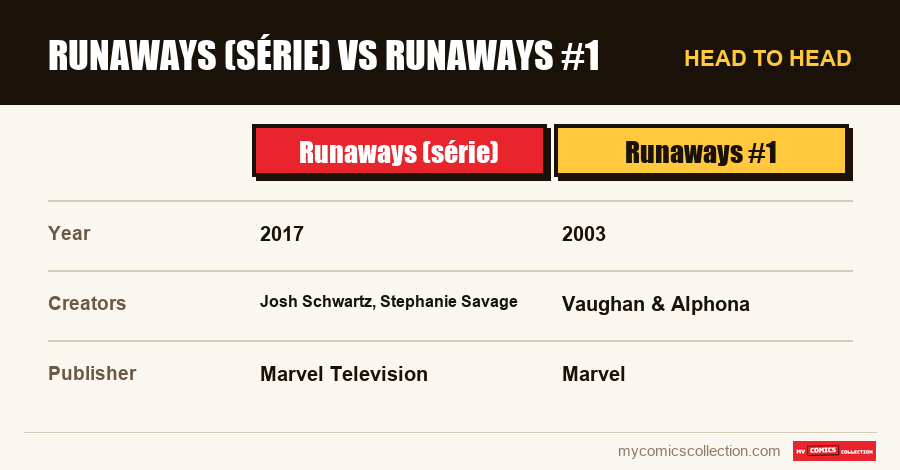
Title : Runaways (2017-2019)
Creators: Josh Schwartz and Stephanie Savage
Actors: Rhenzy Feliz, Lyrica Okano, Virginia Gardner, Ariela Barer, Gregg Sulkin, Allegra Acosta
Broadcast: 2017-2019, Hulu (3 seasons)
Studio: Marvel Television
Runaways #1 (2003): Vaughan & Alphona
The Pride: criminal parents organization
Old Lace: the dinosaur telepathically linked to Gert
Nico, Karolina, Chase, Gert, Molly, Alex: the six teenagers
- Le postulate: teenagers discover that their parents are criminals.
- Le Pride, the parents' secret organization.
- THE six teenagers and their respective powers.
- Old Lace, the dinosaur related to Gert.
- Le Staff of the One of Nico, emblematic witch weapon.
- Le pace: the escape, immediate in the comic, is long delayed.
- THE parents are much more developed, with their own arcs.
- Some shocks and deaths from the comic are softened or moved.
- The series adds original plots to flesh out three seasons.
- The tone is close to teen drama, designer brand.
Runaways #1 (2003): a cult comic by Vaughan and Alphona
Runaways was born in 2003 under the pen of Brian K. Vaughan and the pencil of Adrian Alphona, as part of Marvel's Tsunami imprint, intended to appeal to a young readership. The premise is frighteningly simple: six teenagers who are brought together by nothing, brought together during an annual evening organized by their parents, discover by chance that the latter form a secret society of supervillains, the Pride. In shock, they decide to flee and turn their backs on their families. It's the start of a journey where they learn to master their own gifts and build themselves, far from the shadow of monstrous parents.
This comic marked the 2000s with its freshness, its humor and its way of renewing the tale of adolescent superheroes. Far from the classic vigilante teams, the Runaways are betrayed children, forced to grow up too quickly. Vaughan explores with finesse the themes of loyalty, identity and family heritage. The series takes up this base with fidelity, while adapting it to the requirements of a television format spread over several seasons.
Pride, parents like no other
The heart of the story is the Pride: an alliance of six pairs of parents, each with a particular power or resource: wizards, time travelers, aliens, mutants, scientists, gangsters. Together, they serve dark masters and build their power in the shadows of the city. The revelation of their double life is the founding shock of the story: the figures supposed to protect the heroes are in reality the greatest threats. This inversion, the enemy is not in the street but at the family dinner table, gives Runaways its singularity and emotional charge.
The series considerably develops the parents, where the comic kept them more in the background to favor the point of view of the teenagers. Each couple receives its own torments, its justifications, its flaws. This choice, typical of the teen drama worn by Josh Schwartz and Stephanie Savage, makes the antagonists more human and complex, but also dilutes the urgency of the escape which, in the comic, was immediate. The series prefers psychological exploration to the run; the comic preferred movement and shock. Two approaches, two rhythms.
Six teenagers and their powers
The strength of Runaways lies in its gallery of endearing teenagers, all faithfully transposed to the screen. Nico Minoru, apprentice witch, wields the Staff of the One, a mystical weapon born from her own blood. Karolina Dean, of extraterrestrial ancestry, radiates colorful light and can fly. Chase Stein inherits the technological genius of his parents. Gert Yorkes shares a telepathic link with Old Lace, a genetically modified dinosaur. Molly Hayes, the youngest, has superhuman strength. And Alex Wilder, the group's strategist, whose role in the comic reserves one of the biggest surprises of the story.
Each of these characters embodies a facet of adolescence: marginality, the quest for identity, first love, anger against authority. The series gives them time to breathe and exist, developing their relationships and their doubts throughout the episodes. This attention to the characters is one of its successes, faithful to the spirit of the comic which, despite its adventure appearance, was above all a learning story. The Runaways are not heroes in tights: they are teenagers looking for their place in a world that has betrayed them.
Collecting this series?
Track what you own, what you are missing and what your collection is worth. 7 day trial.
Start my trial →The characters, from paper to screen
- Nico Minoru: Apprentice witch with the Staff of the One, emotional leader of the group.
- Karolina Dean: Of extraterrestrial origin, it radiates light and can fly.
- Chase Stein: Heir to the technological genius of his parents.
- Gert Yorkes: Telepathically linked to the dinosaur Old Lace.
- Molly Hayes and Alex Wilder: The youngest girl with superhuman strength and the strategist with deep secrets.
A teen drama with Marvel flavor
The series bears the imprint of its creators, Josh Schwartz and Stephanie Savage, recognized artisans of teen drama. This signature is felt in the care given to relationships, romantic tensions and family dynamics, which sometimes take precedence over action. Where the comic relied on a nervous rhythm and shocking twists and turns, the series favors a slower, serialized progression, where each character, teenager as well as parent, benefits from in-depth development. This choice appealed to a part of the public, sensitive to the psychological depth, while frustrating readers attached to the tempo of the comic.
This approach illustrates a classic tension in adaptation: should we serve the rhythm of the source or the codes of the host media? By opting for teen drama, the series has assumed its television identity, even if it means moving away from the brilliance of the comic. The result is a work in its own right, faithful to the spirit of the characters but with its own breath. She extends the universe of Vaughan and Alphona without trying to copy it, which is also a form of respect.
A modern look at family and identity
Beyond the adventure, Runaways is striking for the modernity of its themes. The story directly addresses diversity of origins, sexual orientation, plural identities, through a group of adolescents who reflect contemporary society. Karolina, in particular, embodies a trajectory of affirmation which has marked readers and viewers alike. This inclusive dimension, present from the 2003 comic, was ahead of its time; the series amplifies it and brings it to the forefront, in line with the expectations of its audience.
The central theme, however, remains that of family: what to do when those who raised you turn out to be monstrous? Runaways questions filial loyalty, the possibility of getting rid of a poisonous heritage, the construction of oneself against one's origins. It's a coming-of-age story, where growing up means learning to judge your parents and choose your own path. This depth, beneath the trappings of adventure, explains the lasting attachment that the Runaways arouse, from paper to screen.
Where to start reading
To extend the series, the first volume of Runaways by Brian K. Vaughan and Adrian Alphona, starting with Runaways #1 (2003), is the ideal entry point and one of the most beloved runs of the 2000s. The sequel, again by Vaughan, continues the group's adventure. Subsequent revivals, notably by Rainbow Rowell, revived the series with great critical success. This journey covers the sources of an adaptation faithful to the spirit of a comic that has become cult.
Chronology of comics to know
- 2003: Runaways #1: the revelation of Pride and the escape of the adolescents.
- 2000s: The runs by Vaughan and then other authors extend the adventure.
- 2017: Relaunch by Rainbow Rowell, acclaimed by critics.
Collection side: what numbers to aim for after the series
Runaways points to highly sought-after modern keys. Runaways #1 (2003, first appearance of the team and Pride) is an emblematic number of the 2000s, whose popularity rose with the popularity of the group. The first volumes of Vaughan and Alphona's run are essential for any fan. The later relaunches, more accessible, allow you to discover the characters without breaking the bank. These targets cover various budgets. As always, condition and gradation determine value; relying on real recent sales is strongly recommended.
Its place in the saga and for the collector
Runaways brought a cult comic from the 2000s to the screen, in keeping with its spirit of learning and family betrayal. For the collector, it reignited interest in Runaways #1 and Vaughan and Alphona's run. It illustrates the effect of adaptations on the modern comics market. Beyond speculation, the series invites you to discover one of Marvel's great teenage stories, where the adventure is coupled with a reflection on heritage and identity. By extending Vaughan's universe without betraying it, it pays homage to a comic strip that had a lasting impact on its era.
The verdict: a faithful and sensitive adaptation
- Loyalty: the premise, the Pride, the six teenagers, Old Lace and the Staff of the One come from the comic.
- Freedoms: the pace slowed down, the parents developed, the shocks softened, intrigues added, a teen drama tone.
- Collectible numbers: Runaways #1 (2003), Vaughan and Alphona's run, Rowell's relaunch.
Runaways faithfully transposes the spirit of a cult comic, while embracing the codes of teen drama which stretch its story and humanize its antagonists. Faithful to its characters and its themes (family betrayal, the quest for identity) the series develops its own breathing. For both the reader and the collector, it is an invitation to discover Vaughan and Alphona's run, one of Marvel's gems of the 2000s. Few comics have been able to speak with such accuracy and tenderness about adolescence, its anger, its doubts and its hopes, while boldly reinventing the codes of the superhero story. By giving flesh to these characters over three seasons, the series extended this success and reminded us why the Runaways have occupied, for twenty years, such a special place in the hearts of readers, that of a youth who refuses the heritage imposed on them to invent their own path, against all odds.
Frequently asked questions
From Runaways #1 (2003), created by Brian K. Vaughan and Adrian Alphona for Marvel's Tsunami imprint. The comic features six teenagers who flee after discovering that their parents form a criminal society, Pride.
It retains the premise, the six teenagers and Pride, but slows down the pace, develops the parents much more and softens certain shocks, adopting the tone of the teen drama dear to its creators.
The secret organization formed by the heroes' parents: six couples with varied powers and resources, in the service of dark masters. Its revelation is the founding shock of the story, which pushes the adolescents to flee.
A genetically modified dinosaur, telepathically linked to Gert Yorkes. This is one of the most striking elements of the comic, faithfully reproduced in the series.
Runaways #1 (2003, first appearance of the team and the Pride) is the most sought after key. The first volumes of Vaughan and Alphona's run are essential for fans.
Does the series make you want to collect? Estimate the value for free of your numbers (Runaways #1…) with our tool based on current eBay listings.