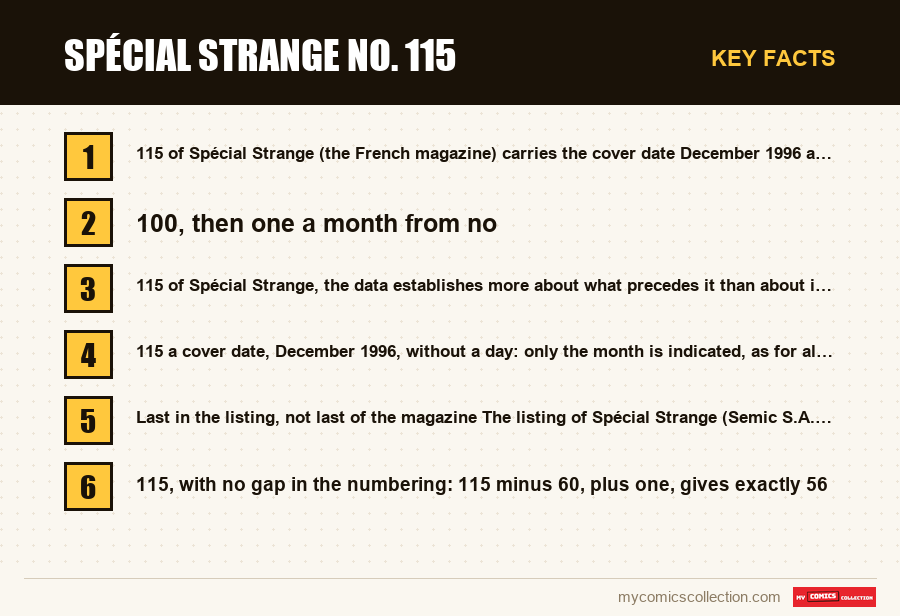
Issue no. 115 of Spécial Strange (the French magazine) carries the cover date December 1996 and the story "Match retour". It is the last issue in the catalogue listing, which is not the same thing as the last issue of the magazine: the listing says nothing about what came after, or why it stopped. It does, however, establish a rhythm: one issue every two months up to no. 100, then one a month from no. 101 to no. 115.
In a list of gaps, the last issue of a series has a reputation: we assume it is rare, we suppose the run is closed, we imagine it marked by its position. Before we attribute anything to it, we need to look at what the data establishes about it, and what it leaves open. For issue no. 115 of Spécial Strange, the data establishes more about what precedes it than about itself.
As always on this guide, only verified information (creators, numbers, dates) is stated as fact; the analysis is our own, with no reproduction of panels or protected dialogue.
What the listing tells us about no. 115
The listing gives no. 115 a cover date, December 1996, without a day: only the month is indicated, as for all the issues from no. 101 to no. 115. It also gives a story title, "Match retour", and credits at the level of the issue: three names on writing (Scott Lobdell, D. G. Chichester, Evan Skolnick) and three on art (Joe Madureira, Bryan Hitch, Roger Cruz).
What the listing does not give weighs just as much. There is only one story title per issue, and the listing does not say whether the issue contains other episodes. There is therefore neither a full contents list nor an episode-by-episode attribution of the three writers and three artists. Knowing who wrote "Match retour" rather than any other content the same issue may hold is not possible from this page: it is read in the copy itself.
Last in the listing, not last of the magazine
The listing of Spécial Strange (Semic S.A., 1989) covers 56 issues, from no. 60 to no. 115, with no gap in the numbering: 115 minus 60, plus one, gives exactly 56. It stops at no. 115. The tempting inference is that the magazine stopped there. That is not established: a listing stops when its sources stop, and the end of its sources is not the end of publication.
The start of the listing calls for the same caution. It begins at no. 60, because the previous series, the one from 1975, ends in the listing at no. 59 with a date of November 1988: the numbering continues from one series to the next. A "no. 115" is therefore not the 115th issue of a series launched in 1989; it is the 56th entry of a listing that picks up a counter already running.
The catalogue says nothing about the cause of a possible stop, and this page does not put forward any. What can be written is this: at no. 115, the listing ends. Anything that comes after has to be checked elsewhere, for example by looking through a stack or with a seller for an issue bearing a higher number.
A rhythm that speeds up before the end of the listing
This is the part that can be measured. From no. 60 to no. 100, each interval between two consecutive issues is two months: 40 intervals, all identical. The listing opens in January 1989, and no. 100 carries the date September 1995. Then no. 101 is dated October 1995, one month after no. 100. And so on up to no. 115: 14 intervals of one month.
The switch is therefore readable to the issue, and it is no. 101 that embodies it. The figures show its effect: the calendar year 1994 has six issues in the listing (no. 90 to no. 95), the year 1996 has twelve (no. 104 to no. 115). The final stretch of the listing runs at twice the pace of 1994.
For a collector, this changes two things. A lot of fifteen consecutive issues, from no. 101 to no. 115, covers fifteen months, from October 1995 to December 1996: a little over a year of publication, where fifteen bimonthly issues would have covered more than two years. And the switch provides a dating rule: within this run, the gap between two issue numbers in months equals the gap in positions, which makes it possible to recover the month of an issue whose cover is damaged.
The immediate neighbours: 112, 113 and 114
The three preceding issues carry story titles with no sequel marker: "Arithmétique de base" (no. 112, September 1996), "La force fait le mal" (no. 113, October 1996), "Pertes inacceptables" (no. 114, November 1996). No. 115 continues this run of standalone titles. Since no. 109, none of the titles in the listing carries a "part" or "chapter" mention.
The contrast is clear with the stretch from no. 101 to no. 108, where the title announces the position within a sequence: "chapitre 1" at no. 101, "5ème partie" at no. 105, "7ème partie" at no. 107, "8ème partie" at no. 108. Between no. 105 and no. 107, no. 106 carries another sequel label, "La quête de Légion, 4ème partie". A single title per issue does not tell us what that no. 106 contains beyond it, if anything; it simply reminds us that the title does not describe the whole issue.
One fact about the credits, checked against the listing: the list of writers for no. 115 is identical, name for name and in the same order, to that of no. 114. The artists, on the other hand, differ in two names out of three: Joe Madureira appears in both, Tom Grummett and Chris Bachalo in no. 114, Bryan Hitch and Roger Cruz in no. 115.
Do you collect this series?
Track what you own, what you are missing and what your collection is worth. 7-day trial.
Start my trial →
The credits of the last issue in the listing
Scott Lobdell's name appears on the writing of the end of the listing without interruption, from no. 91 to no. 115. Across the whole listing, he is credited on 29 issues, between his first credit at no. 86 and no. 115, with one absence at no. 90. The last issue therefore falls within a very long presence, which does not mean that he wrote every episode.
D. G. Chichester appears on eight issues in the listing, from no. 100 to no. 115, including nos. 114 and 115. Evan Skolnick appears on four, the last three being: no. 95, then no. 113, no. 114 and no. 115. Fabian Nicieza, credited on 30 issues since no. 75, has his last credit at no. 112: he does not appear in the last three numbers.
Bryan Hitch appears on no. 115 and nowhere else in the listing. This is a dating detail for a stack as much as a credit: if an unexpected name appears on the art, it is a hint that you are looking at the last issue and not at a neighbour. Just keep in mind that the listing credits the issue, not the page.
Recognising the copy, avoiding confusion
Three identification markers are reliable because they come from the data: the number 115, the cover date December 1996, and the story title "Match retour". The title alone is not enough to settle everything in this magazine: the listing contains a repeated title, "Mots croisés", carried by two issues, nos. 91 and 92. So never look for a copy on the story title alone: the number is what identifies the object.
The date is the second source of error: it carries only the month. A seller who announces "December 1996" is describing the cover, not the date of release. Check the number on the copy rather than trusting an ad that gives only a title or a month.
Entering it in a list of gaps
In a tracking table, record no. 115 as "last issue in the listing" and not as "last issue", with the field you fill in yourself: "possible continuation not verified". This wording protects you from a completion error: believing the series is closed when the data does not guarantee it.
If you fill a series in blocks, the logical split is to divide before no. 101: no. 60 to no. 100 form the bimonthly part (41 issues), no. 101 to no. 115 the monthly part (15 issues). The two together do add up to 56. To go further in reading the issues, the blog offers other sheets in the same vein.
Frequently asked questions
It is the last issue in the catalogue listing, dated December 1996. The listing does not say whether the magazine continued or stopped there, or why. To settle it, you need to find a trace of a no. 116 somewhere other than this list.
At no. 101, dated October 1995, one month after no. 100 dated September 1995. Before that, each interval in the listing is two months, from no. 60 of January 1989 to no. 100: forty identical intervals. After that, all the intervals from no. 101 to no. 115 are one month.
The listing gives only the title of the story, not the contents of the issue: there is one title per number, and the listing does not say what the issue contains beyond it. The full content, such as the order of the episodes, is read in the copy itself and not in the catalogue.
The issue is credited to three writers, Scott Lobdell, D. G. Chichester and Evan Skolnick, and to three artists, Joe Madureira, Bryan Hitch and Roger Cruz. The listing credits the issue, not the episode: attributing "Match retour" to one of them would require reading the copy.
Start from a known reference point. From no. 101 (October 1995) to no. 115 (December 1996), each issue is one month after the previous one: no. 108 is dated May 1996, no. 112 September 1996. Before no. 100, it is two months per issue.
No. 115 is the last issue the listing knows of, dated December 1996: to follow it, treat it for what it is, a stopping point in the list and not proof of an ending.