Silver Surfer: when the numbers to look for are not in the character's series
Typing a character's name into a search engine first brings up the series with that name. This reflex seems obvious, and yet it is the wrong starting point: a character who appeared in another series accumulates his determining issues there before obtaining his own title. The statement of August 30, 2026 on the query “Silver Surfer 1 1968” shows this in detail: of the five least expensive advertisements, two are not numbers of the Silver Surfer series but Fantastic Four #74, offered at $15.20 and $19.95 because the character appears there. The amounts quoted here are those claimed by sellers that day, never completed transactions.
The report concerns current advertisements, on a general auction site in the American market, on a single date. It must be said from the outset to avoid any misunderstanding: these amounts are asking prices, displayed by sellers who hope to obtain them. Nothing in front of us says that a buyer paid them. And because a single date only constitutes a point, no comparison over time is possible: an isolated point shows neither rise nor fall, it does not show anything at all. Anyone who claims to read a trend in a photograph taken at a given moment is telling themselves a story that the data does not tell.
On this query, the count separates two populations. Unverified advertisements, that is to say copies sold as is without going through a verification body, number 104: the lowest asks $9.99, the median is $169.62 and the highest asks $3,400.00. The verified copies, counted separately because they do not describe the same commercial object, are 86: $64.99 at the lowest, $547.50 at the median, $16,500.00 at the peak. This top is a single seller's hope, not a market level; it compares to nothing and proves nothing.
Why the name of the character is not the name of the series you should look for
A character is born somewhere. This place is almost always a series already established, which has readers, a rhythm of publication and a place in the publisher's program. The character first serves as an adversary, a guest or a plot device. If he meets his audience, the publisher ends up giving him a title in his name. In between, several issues of the home series chronicled its early moments, and those are the ones collectors seek out.
The result is an asymmetry that the search engine does not correct. The series in the name of the character exists, it is well referenced, it goes to the top. The determining numbers bear the name of another title, and only appear if you remember to ask for them. A collector who only questions the name of the character sees dozens of copies of the homonymous series pass by without ever coming across what he was really looking for. We do not have any date of creation of the character here and we will not invent it; the mechanism can be read directly in the statement.
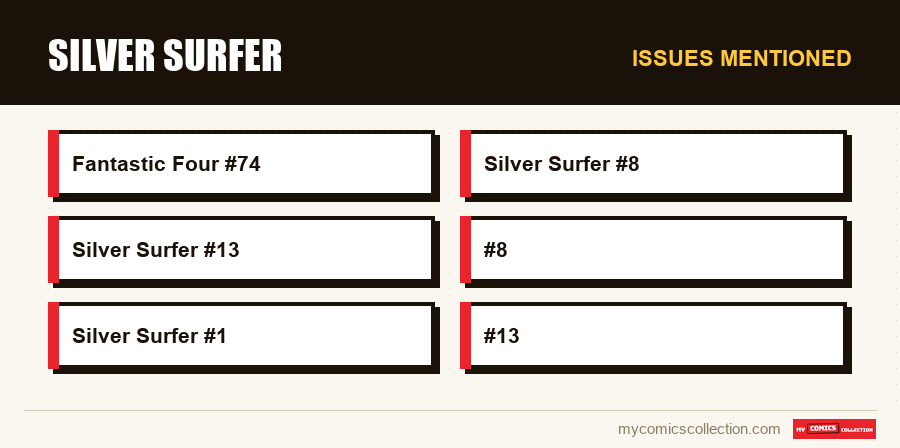
This statement indeed contains a clear index. The request related to “Silver Surfer 1 1968”, therefore the first issue of a homonymous series. Among the five cheapest ads that she put up, two concern Fantastic Four #74: $15.20 for a loose cover copy, $19.95 for another. These ads came out because their wording quotes the character. In other words, the engine mixes two different series in the same list, simply because the character's name appears in both.
This mixture is not a trap set by sellers. This is a mechanical consequence of the way the ads are written: a seller who has an issue of another series in which the character appears has every interest in mentioning it, and he does so. The wording then becomes a readable document, provided you know what you are reading there.
Read ad wording as a signal, not a headline
Two names in the same wording
When an advert cites both a series name and a character name that don't match, it is almost always describing an issue of another series where the character appears. This is the case for both Fantastic Four #74 raised by a request yet centered on the character.
A mention of status slipped into the title
“Detached Cover” on the $15.20 ad, “No Back Cover” on the $20.00 ad: these details are in the wording, not in a dedicated box. They weigh heavily on the amount requested and are read before everything else.
A number that is not the one you are looking for
The cheapest ad in the survey, at $9.99, is a Silver Surfer #8. The request was for #1. A list of results always contains neighboring numbers from the same series, and their price says nothing about the number sought.
A year that contradicts the request
Un Silver Surfer #13 dated 1970 appears at $20.00 in a search that asked for 1968. The year in the label is a useful filter: it separates objects that the name alone confuses.
These four readings have one thing in common: they are done on the text of the ad, before even looking at the image or the seller. A label is a declaration. It does not guarantee anything, but it provides guidance: it says what series, what number, what year, and sometimes what defect. The collector who only reads the price deprives himself of everything else, and compares objects which only have in common that they appear in the same list.
A low number is never good news in itself. Of the five least expensive advertisements in the survey, two bear a mention of a structural defect (cover detached for one, back cover missing for the other) and two others concern a series different from that which was requested. The lowest amount therefore does not describe the object sought at its best price: it describes another object, or the same one in poor condition.
Comparing a price without its condition amounts to comparing things that do not have the same identity. This is true for a damaged copy compared to a healthy copy, and it is true for a verified copy compared to a copy sold as is: hence the separate counting of the 104 unverified advertisements and the 86 verified advertisements.
What the lower limit of a reading really says
The minimum of a statement catches the eye because it appears accessible. It is actually the least informative value in the entire series. Of the 104 unverified listings, the lower bound at $9.99 corresponds to a number that the query was not looking for, while the median at $169.62 much better describes the level at which sellers are actually positioning themselves. Between the two, the gap is not noise: it is the difference between two distinct objects classified under the same name.
This phenomenon has a structural cause. An abundant personal series produces many available copies: the more issues published, the more advertisements in circulation, and the lower the lower limit goes. The number sought can remain rare while the rest of the series clutters the results. Rarity of the number and abundance of the series coexist under the same name, and this is precisely why the lower limit says nothing about the number sought.
The same logic applies to the upper limit. Maximum at $3,400.00 on the unverified side, at $16,500.00 on the verified side, these are unique listings. They reflect the hope of their seller, not a transaction. Using an extremum as a benchmark means taking an individual's most optimistic position for the average position of a market.
There remains the median, the only value here which summarizes a population rather than a case. We still need to know which population: $547.50 for the verified versus $169.62 for the non-verified, this is not the same price difference for the same object, it is the measure of two different commercial offers. And here again, a single date does not allow any reading of evolution.
Collecting this series?
Track what you own, what you are missing and what your collection is worth. 7 day trial.
Start my trial →Six blind spots in character name research
The query returns what it names
Questioning a character name first goes back to the series of the same name, because that's where that name is densest. Issues from another series only appear if their wording cites the character, which is entirely up to the seller.
The year is not filtered
A query for 1968 dates a copy dated 1970 to $20.00. Without careful reading of the date displayed, two objects separated by several years find themselves compared as if they were equivalent.
The fault has no box
“Cover detached” or “back cover missing” live in the title of the ad, alongside the rest. Automatic sorting by price does not see these mentions and places these copies at the top, at their reduced amount.
Verified and unverified in one package
The 86 verified listings and the 104 unverified listings answer the same query, but mixing their prices produces an average that describes neither. The statement counts them separately, a results list does not.
Neighboring numbers invite themselves
A #8 and a #13 come up on a request for #1. They do belong to the requested series, but their amount does not provide information on the number sought: they are different issues, with their own availability.
Appearance in another series is invisible when sorting
An issue of another title sold for the presence of the character behaves, in a list sorted by price, like any other line. Nothing indicates that it is a different series other than the name written in the wording.
The practical consequence: index by series, never by character
All of the above converges on a simple organizational rule, and that is the only conclusion that really needs to be remembered. An inventory line describes an item. A copy belongs to a series, to an issue, to a year. It does not belong to a character: a character goes through ten titles, and taking it as a storage key amounts to placing in the same box objects which have neither the same publisher, nor the same numbering, nor the same availability.
A collection classified by character produces exactly the error that the statement illustrates: it places side by side a Silver Surfer #1 and one Fantastic Four #74, because the same character appears there, even though these two issues have nothing in common in terms of research, monitoring or comparison. Conversely, a collection classified by series then by number allows you to instantly know what is missing in each title, and to conduct two distinct searches rather than a single confusing one.
This does not mean that the character disappears from the organization. It becomes an attribute, a label placed on lines which remain anchored in their series. This is the meaning of the reasoning: we do not oppose the two, we prioritize them. The series identifies, the character connects. Reversing this order is what is expensive, because it prevents you from seeing the numbers of another title when you are looking for them.
Un reading guide dedicated to the character is also a good indicator: it lists different titles by nature, and puts before the reader's eyes the list of series to watch. The same verification applies to the host series, whose editorial history explains why some of its issues interest collectors who otherwise would never have stopped at it.
What to note in your collection
The exact title of the series, as printed. This is the only data that distinguishes a Fantastic Four #74 of a Silver Surfer #1 in a listing where the character's name appears on both sides. Without this field, two lines become indistinguishable as soon as memory fades, and any subsequent search starts off on the wrong foot.
The number, separated from the title. The report brings up #1, #2, #8, #13 and #74 in the same list. Storing “Silver Surfer 8” in a single box prohibits any sorting and any hole detection in a sequence. A number stored in its own field allows you to see at a glance what is missing between two owned copies.
The year worn by the copy. A #13 from 1970 was brought back by a request for 1968: the year is what prevents confusing issues of the same series published at different times. It also serves to rule out reissues when comparing an owned copy to a current announcement.
Defects declared, word for word. Cover detached, back cover absent: these mentions explain part of the lowest amounts in the statement. Copying the exact wording instead of a vague note allows, months later, to understand why a particular copy is not comparable to another of the same number.
The date of the statement and its nature. Recording “amounts requested on August 30, 2026, announcements in progress, verified counted separately” next to a number gives it its only possible meaning. Without this mention, a noted price becomes over time a supposedly acquired value, whereas it has never been anything other than a request made by a seller on a specific day.
Because the seller cites the character in the wording of his ad. Fantastic Four #74 rose twice in the August 30, 2026 statement, at $15.20 and $19.95, on a request which nevertheless targeted “Silver Surfer 1 1968”. The engine responds to the ad text, not the series title.
No. This announcement is a Silver Surfer #8, while the request related to #1. This is a different issue in the same series, with its own availability. The lower limit of a reading rarely describes the targeted object: here it describes a neighboring number.
It separates two populations counted separately: 104 unverified advertisements on one side, 86 verified advertisements on the other. These are not two prices for the same commercial item, but two different offers. Adding them together would produce an average that would describe neither.
Neither. The reading was taken on a single date, August 30, 2026, and a single point does not draw any trajectory. It would take several measurements spaced over time, done in the same way, for a comparison to have the slightest meaning.
Not necessarily: it's a personal choice between having the booklet and having an intact copy. What matters is to never compare your price to that of a healthy copy without mentioning the defect. An amount without its condition means nothing.
Store your copies by series, not by character
My Comics Collection saves each copy with its series, issue, year and condition, so that the same character can appear in several titles without your lines getting confused. You immediately see what's missing in each series you follow, including those where your favorite character is only a guest.