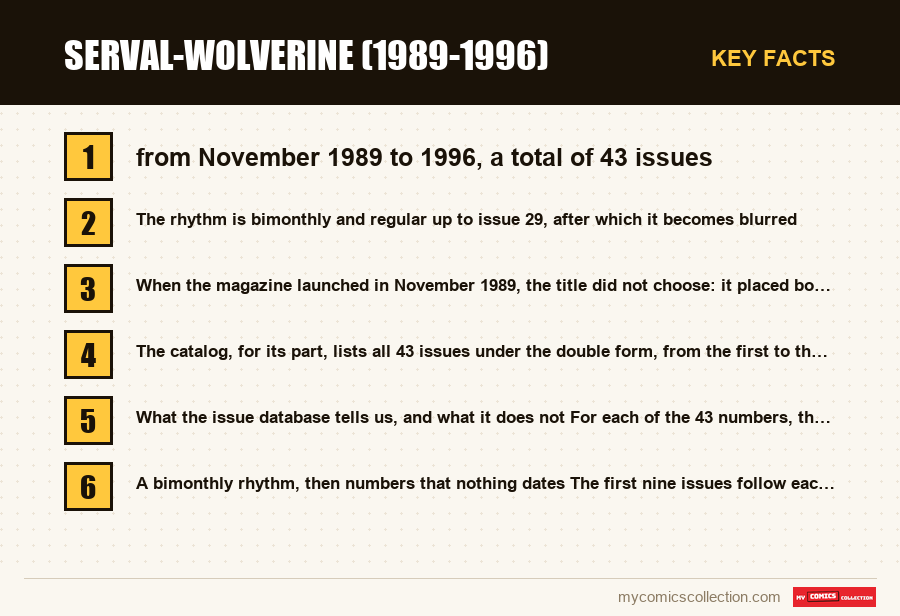
Serval-Wolverine is a magazine published by Semic S.A. from November 1989 to 1996, a total of 43 issues. The character was called Serval in French, and the title keeps both names: that is why one copy is sold under one name, another under the other. The rhythm is bimonthly and regular up to issue 29, after which it becomes blurred. Chris Claremont opens the series as writer, and Larry Hama signs the last twenty-eight issues.
You are looking for the few issues missing from your run, and you run into a problem that other newsstand titles do not pose: the name under which to search for them. One seller typed "Wolverine", another "Serval", a third copied the full logo. All three refer to the same object, and none of them turns up in a search for the others. This guide starts from there, because it is the real obstacle to completing this series.
As always in this guide, only verified information (creators, issue numbers, dates) is stated as fact. The analysis is ours, with no reproduction of panels or protected dialogue.
Serval or Wolverine: where the double name of the title comes from
French readers first knew the character as Serval. When the magazine launched in November 1989, the title did not choose: it placed both names side by side. This hesitation is not a graphic detail. It is the trace of a precise moment when a French-speaking readership already knew one name, while the other was asserting itself elsewhere. The catalog, for its part, lists all 43 issues under the double form, from the first to the last.
The consequence is concrete. The full title is long, and a hurried seller copies only half of it, the half that their age or their idea of the market suggests. You have no way of guessing under which label the issue you are missing is filed, and there is only one reliable method: search both names, systematically, keeping two saved searches in parallel.
A point of honesty: knowing which of the two names dominated the cover, and whether that balance shifted over seven years, requires looking at the copies themselves. The catalog gives a series title, not the evolution of a logo.
Why listings get it wrong, and how to turn that to your advantage
Labeling errors are not all of the same kind. There is the listing that gives only one of the two names: correct, but incomplete. There is the one that confuses this magazine with another publication devoted to the same character, since the name alone does not identify a title. And there is the one that sells an American issue, because the seller read the character's name without looking at the format.
The second category is the one that costs money; the first is the one that can earn you some. A lot described under the name least sought after by the market at the moment receives fewer visits, and therefore fewer bids. Make a habit of launching your search on the term you judge least used, and of sorting by listing date rather than by relevance: you will see copies pass that other buyers do not see.
What the issue database tells us, and what it does not
For each of the 43 numbers, the catalog records a French story title, a writer and one or more artists. That is a rare resource: these French-translated contents hardly exist anywhere else in a usable form. But it must be said right away what it is not, or you would draw false certainties from it.
An issue of this format contained more than one episode. The record, however, keeps only one title per number, the one standing in for the main story. Complementary stories, which are sometimes the real interest of a copy, do not appear. The strict consequence: it is impossible to assert from this data that a given number contains the first French appearance of a character, or that it corresponds to a given American issue. Any listing that claims so without showing a photographed contents page is putting forward something it has not verified either.
A bimonthly rhythm, then numbers that nothing dates
The first nine issues follow each other with clockwork regularity: November 1989, January 1990, March, May, July, September, November, January 1991, March 1991. One issue every two months, without accident. This rhythm resumes from number 16, dated May 1992, through number 29, dated July 1994, at the same cadence and without a gap. For you, this means that a gap in your run across these two stretches is a gap in your collection, not an issue that never existed.
Between the two, and from number 30 onward, the catalog records only the year. Twenty of the 43 numbers are in this case, nearly half the series. Be careful about what this information means: it says that the month is not recorded, not that it was not printed. The absence is in the record, not necessarily on the paper.
This detail explains the fanciful sorting seen in many sales listings: numbers 30 to 43 are often arranged in an approximate order, since nothing in their record separates them month by month. If you buy a lot from this stretch, count the numbers one by one rather than trusting the description, and photograph the colophon of your own copies to pick out the month where it is printed.
Five writers at the helm, and what that changes for the reader
The writing changes hands five times, and not at regular intervals. Chris Claremont signs the launch, with "Possession vaut titre" as issue 1. Peter David takes over around issue 5, where both names appear side by side, then alone until issue 8. Archie Goodwin handles issues 9 to 12, Jo Duffy the three that follow, including the two-part story titled "Le projet Lazarus". Then Larry Hama comes in at issue 16 and never leaves.
That last figure is the most telling in the series: Larry Hama is credited on 28 issues, two-thirds of the total, from number 16 to the last. If you read this magazine for one writer's voice, it is his that you are buying. And if you want the varied signatures of the beginning, the window is short: it spans fifteen issues, which concentrates demand on a small pool of older copies.
Three issues carry a co-credit on the writing, and two of these co-credits are French names, on numbers 33 and 35. These copies deserve a close look rather than assumptions: a local editorial contribution has no equivalent in an American edition, and it is precisely this kind of particularity that makes a collection of magazines more interesting than collected volumes.
The artists, read as a map of the series
On art, the list is long because each issue combined several episodes, and so several hands. But blocks stand out clearly: John Buscema at the start, almost without interruption from number 1 to number 8, John Byrne from 9 to 12, Marc Silvestri over the long stretch from 16 to 26, Mark Texeira from 27 to 30, then Adam Kubert, who closes the series from 34 to 43.
One name breaks this logic of blocks: Barry Windsor-Smith is credited on thirteen issues spread from number 10 to number 38, in discontinuous appearances. Such dispersion over nearly thirty issues does not look like a handover, it looks like a complementary story published in installments. What those installments exactly contain must be read in the copies, but the pattern is enough to identify a set of issues to examine together if you are hunting that artist.
Two other names deserve attention. Jim Lee appears in issues 12 to 14, a three-issue window that carries weight with buyers who follow him. And Ciro Tota, a French artist, is credited on five of the early issues, including the first: his presence is a marker of local production and an argument for anyone who collects Franco-Belgian comics as much as American ones.
Do you collect this series?
Track what you own, what you are missing and what your collection is worth. 7-day trial.
Start my trial →
The issues that matter, and why
Issue 1, dated November 1989, is the most in demand, for the banal reason that applies to every first issue on the newsstand: it was bought by curious readers who did not follow the series, it circulated, it was read. Its own interest lies elsewhere: it brings together a script by Chris Claremont and, on art, a co-credit to Ciro Tota and John Buscema. That combination is not that of an American comic book; it is specific to this edition.
Issue 16 is the second point of attention, and almost nobody mentions it. That is where Larry Hama comes in and where Marc Silvestri appears, with "Au bout des ténèbres". The two-thirds of the series that remain begin at this issue. A collector who does not want to buy everything has a defensible starting point there, and it is a copy that can still be found at a reasonable price, because the market focuses only on number 1.
Finally, issue 43, "Chemins épineux", closes the series in 1996. The last issues of a newsstand title were often less widely distributed than the first, as sales dropped before the cessation: the 38 to 43 stretch is the one you see least often in lots.
Recognizing the edition and judging a copy
Start with the colophon, that small-print legal notice, and check the publisher's name, Semic S.A., then the number. If the seller does not supply this photograph, consider the identification as not made.
On condition, this flexible format has its own points of weakness. The stapled spine shows wear from the first reading, and a reading fold parallel to the spine is visible flat under raking light: look at the cover at an angle rather than straight on. Corners blunt in piles, the top edge yellows when the magazine has been stored upright, and the inside paper browns unevenly depending on the period of publication.
Completing the 43 numbers without getting caught out
On a series this size, buy in slices rather than one by one. The two bimonthly blocks, the start up to number 9 and the stretch from 16 to 29, are often found in coherent lots, sold together by a single reader who followed the magazine on the newsstand. The stretches where the catalog gives only the year turn up in bulk, and that is where you have to count.
Three traps recur. The lot advertised as "complete" that is not, because the seller counted the magazines without checking the sequence of numbers: demand the list of numbers, not the total. The number given for another issue because of the double name of the title. And the final issue of the series sold at the price of number 1, by a seller who saw that the series was worth something without knowing where its value lay.
A word about story titles, which create their own confusions in French. Number 12 carries "Tempête de Neige", yet Tempête is also the French name of a mutant heroine: a search engine mixes the two, and a well-meaning listing can promise a presence that is not in the episode. Check the contents, and look at the Storm hub if she is the character you follow. Another detail: not all titles were Frenchified, and number 29 remains "Prophecy", which changes the words you have to type.
Tracking the collection and gauging its value
A series of 43 issues spread over seven years is hard to hold in your head. Keep the inventory by number rather than by date, since nearly half of the records have no month, and note for each copy the condition of the spine and of the corners. This is the level of detail a serious buyer will ask you for.
On price, reason in ratios rather than sums. Number 1 sits at a multiple of the common numbers, and the gap widens with condition much more than with the issue number: a worn first issue can be worth less than an immaculate number 16. Stretches held by a sought-after artist, Silvestri in the middle, Kubert at the end, sell above the rest when they are sold grouped and in good condition, and at the price of bulk when they are broken up. The large neighboring universes follow the same pattern, whether it is the X-Men or Cable.
What to take away from this series
Serval-Wolverine is a short series by newsstand standards, coherent in its second half thanks to Larry Hama's constancy, and more talkative in its first half where five writers follow one another in fifteen issues. Its real peculiarity for a collector, however, lies in its name, which carries two identities for the same character and durably disrupts the secondhand market.
Make that flaw your method: two saved searches, a sort by newest, a requirement for photographs of the colophon and the contents, and an inventory kept by number. With these four habits, you will buy the copies that others never saw pass by.
Frequently asked questions
Both, always, and separately. The magazine title combines the two names, and each seller copies only part of it. A search on a single term mechanically lets some listings slip past. Set up two distinct alerts, sorted by publication date, then check the publisher in the colophon before buying.
Forty-three, from the first dated November 1989 to number 43 published in 1996. The run is continuous, with no parallel numbering in the catalog. A lot advertised as complete should therefore contain 43 numbered copies with no gap: ask for the list of numbers rather than the total count of magazines, since that is where the missing issues hide.
Because the catalog records only the year for about twenty issues, notably the stretches 10 to 15 and 30 to 43. That does not prove the cover or the colophon carried no date: the absence is in the record, not necessarily on the paper. Look at the copy to settle it.
That cannot be asserted from the available data, which keeps only one story title per issue, whereas each copy published several. The complementary stories are therefore missing from the record. When a listing promises a first appearance, ask for a photo of the internal contents page, not of the cover.
Number 16, dated May 1992, is the most defensible entry point: Larry Hama takes over the writing and Marc Silvestri the art, for a stretch that covers the two-thirds still to come. It stays accessible because the market focuses its attention on number 1, which many curious readers bought in the autumn of 1989.