
In short
The Sentry debuts in The Sentry #1, a Marvel Knights miniseries cover-dated September 2000. Paul Jenkins wrote it and Jae Lee drew it, from a concept Jenkins developed with Rick Veitch, who received no credit on the page. The five-issue run, ending in January 2001, introduces Bob Reynolds as a man who remembers he is a superhero that nobody else recalls, while the Void, his enemy, begins to return.
Few debuts in modern Marvel history ask a collector to hold two timelines in mind at once. Inside the story, the Sentry is a half-forgotten hero of an earlier era. On the publishing calendar, he arrived in the summer of 2000, and that gap between fiction and fact is exactly what this guide keeps separate from the first line to the last.
Every credit, cover date and issue number below was read against published reference pages for the 2000 series and its follow-ups; the buying advice on grading and copy checks is our own analysis, and it deliberately contains no figures.

What The Sentry #1 is: the issue at a glance
The Sentry #1 is the opening chapter of a five-issue miniseries published by Marvel Comics under its Marvel Knights line. The five issues carry cover dates from September 2000 to January 2001, which means the debut is a September 2000 book, even though comics carrying a September date reached shops earlier in the year. Diamond Comic Distributors reported the issue as the 31st best-selling comic of July 2000, a useful reminder that on-sale month and cover month are different things when you are matching a copy to a listing.
The credits that matter are short. Paul Jenkins wrote the series and Jae Lee drew it. The two had already worked together on a Marvel Knights Inhumans miniseries, so the Sentry project was a reunion rather than a first collaboration. Rick Veitch is the third name in the creation story: Jenkins and Veitch developed the idea in the late 1990s, and Veitch's conceptual contribution was never printed in the credits box. When you describe the issue to another collector, the safest wording is that Jenkins and Lee are the credited creators and that Veitch contributed to the concept without a printed credit.
One detail about the covers is worth knowing before you shop. The cover of issue #2 combines Lee's line art with painted colors by Jose Villarrubia. That credit belongs to the second issue, so do not carry it over to the first issue when you write a description or a listing. If a seller attributes the painted look of issue #2 to the debut, the claim is mixed up.
It also helps to know where the series sits in Marvel's own catalog of the period. Marvel Knights was an editorial line overseen by Joe Quesada, who commissioned the miniseries after Jenkins pitched it. The line was built around creator-driven, adult-leaning takes on Marvel characters, and The Sentry was a different kind of experiment inside it: a brand-new hero dropped into the middle of established continuity as if he had always been there.
How the Sentry is introduced on the page
The miniseries opens with Bob Reynolds, an ordinary civilian who comes to remember that he is the superhero known as the Sentry. Alongside that memory comes a second one: his archenemy, the Void, is about to return. Reynolds then tries to warn other Marvel heroes, and he tries to understand why nobody remembers that the Sentry ever existed. That is the engine of the five issues, and it is the reason the debut reads differently from a standard origin story.
The character is therefore introduced twice over. For the reader, he is brand new in 2000. For the characters in the story, he is an old acquaintance whose memory has been erased from the world. The series plays on this by letting Reynolds react to heroes who look at him as a stranger while he insists he fought beside them. This is the editorial hook that gave the book its identity, and it is also what makes the Sentry unusual to collect: the character arrives with a fictional past that no earlier comic can supply.
The follow-up material fills in the same premise from other angles. The miniseries led into flashback one-shots built around the Fantastic Four, Spider-Man, Angel and the Hulk, and the story concluded in The Sentry vs. the Void. Those one-shots are the place where the fiction of a forgotten hero is dramatized beside characters collectors already know, and they are worth keeping in mind as companions to the five-issue run rather than substitutes for it.
Fiction versus publication history: the forgotten hero who was never old
The most common mistake about the Sentry is to treat the in-story claim as a fact about comics history. Within the narrative, the Sentry is presented as a hero from an earlier period whom the world has forgotten. In the real publishing record, no earlier Sentry comic exists. The first time the character appeared on a printed page was September 2000, in a book written by Jenkins and drawn by Lee.
That distinction matters in three practical ways. First, it tells you what to search for. A listing that promises a Sentry cameo from decades earlier is describing something the publishing record does not support, and the fiction of a forgotten past should not be allowed to inflate the pedigree of an older issue. Second, it clarifies what a collector is actually buying: a modern-era first appearance, in a miniseries that sold well enough to chart in its release month, rather than a rediscovered vintage debut. Third, it frames the character's design. The Sentry was built to feel like a Silver Age hero in tone while being a creation of the year 2000, and that tension is the point of the series.
The same caution applies to retellings in later books. When another writer revisits Reynolds, the in-story history is rewritten again, sometimes giving the character fresh connections to older heroes. Those are editorial choices inside later stories. They do not move the date of the first appearance, and they do not turn a back issue into a debut. If you ever need to settle a dispute about a first appearance, the question is which printed comic first showed the character, not which story claims he existed first.
Who made the Sentry, and the editorial context in 2000
Paul Jenkins and Jae Lee are the credited creators. Jenkins developed the concept with Rick Veitch in the late 1990s, and when the idea reached Joe Quesada, who edited the Marvel Knights line, it was commissioned as a miniseries with Jenkins writing and Lee illustrating. Jenkins and Lee had collaborated before on Inhumans, which is a helpful clue about why the pairing worked: Lee's moody, heavily atmospheric style suited a story about a hero whose memory is unreliable.
Another small piece of origin history concerns the name. Jenkins pictured a guardian figure with a watchtower, and the name Sentry was chosen after Centurion had been considered. It is a modest detail, but it is the kind of verified background that separates a collector who knows the book from one who only knows the headline.
Marvel Knights itself is the key to the context. The line gave Quesada room to place new material in the Marvel Universe without waiting for the main continuity to catch up, and a new hero presented as having always existed was an ideal fit for that approach. The result was a book that could be read cold by someone who had never opened an Avengers comic, yet that quietly rewired how a later generation of readers thought about the Marvel Universe.
Do you collect this series?
Track what you own, what you are missing and what your collection is worth. 7-day trial.
Start my trial →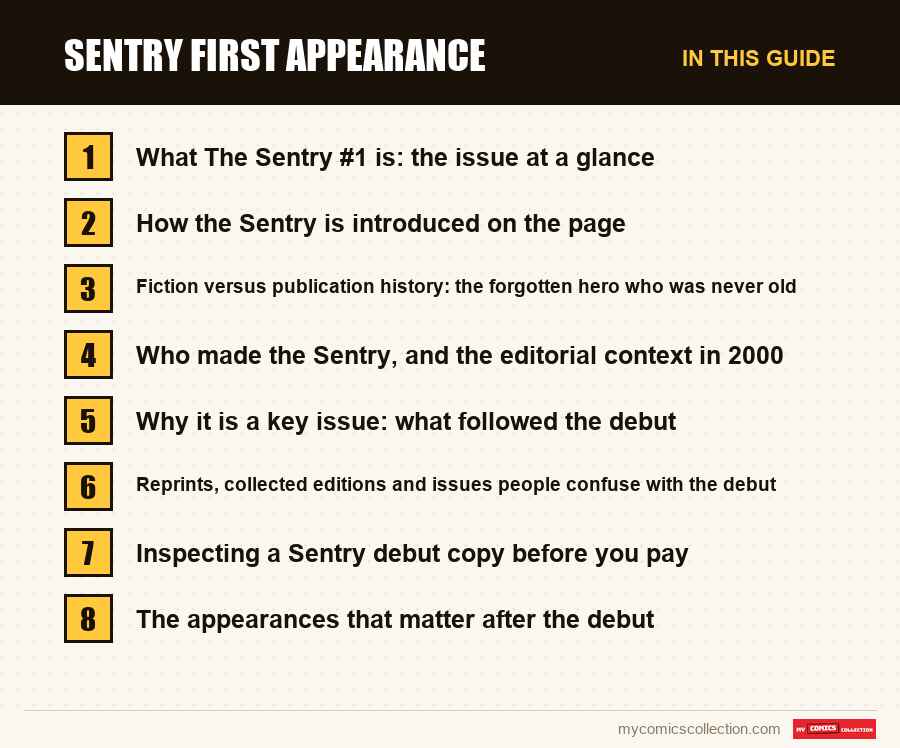
Why it is a key issue: what followed the debut
The Sentry matters to collectors because the character did not disappear after January 2001. The one-shots and the concluding Sentry vs. the Void extended the story immediately. Then the character came back in a much larger way when he joined the Avengers books of the mid-2000s, an arc this guide lists in its final section.
That is the structure behind most debut-issue demand: a character introduced in a self-contained book, later moved into the biggest team titles in the publisher's line. Each time a writer revisits the Sentry, readers who want the origin look back to the five-issue series, and the first issue is the entry point. The chain of later appearances gives the debut staying power that a one-off cameo would not have.
Reprints, collected editions and issues people confuse with the debut
The 2001 collection of the five issues and the related one-shots is the standard way to read the debut without owning the original comics. It reprints the story, which means it is a different object from the first printing of issue #1, and a collector who wants the original should confirm they are looking at the monthly comic, not the trade paperback. The reference listing for that edition gives its release date as December 1, 2001.
Several different books carry the Sentry name, and they are easy to blur together. The 2000 miniseries is the debut. A separate eight-issue miniseries called Sentry, published in 2005, was written by Jenkins and drawn by John Romita Jr., and it is a later story, not an origin. A third volume of Sentry ran five issues in 2018 under Jeff Lemire, with art by Joshua Cassara and Kim Jacinto, and a fourth volume ran four issues from February to May 2024 and introduced a character named Mallory Gibbs, also called Solarus. Each of those has "Sentry" on the cover, and none of them is the first appearance.
Numbering is another trap. Because several volumes begin at #1, a listing that says only "Sentry #1" is ambiguous. The reliable markers are the cover date, which should read September 2000 for the debut, and the creative credits, Jenkins and Lee. When a database entry or a seller's description does not give a year, check those two things before you pay.
Finally, the flashback one-shots with the Fantastic Four, Spider-Man, Angel and the Hulk are tie-ins that expand the story and should not be mistaken for the debut. They are a good way to read the series if you want the full arc, and they give context to the idea of a forgotten hero, but they carry a later place in the chronology than issue #1.
Inspecting a Sentry debut copy before you pay
Because the debut is a modern-era comic, the first thing to confirm is the printing. Compare the cover date and the credits in the indicia with the description, and make sure the listing refers to the monthly issue rather than a later reprint or a collected edition. If a copy is sold as a graded book, look at the label and the year written on it, and confirm the issue number and the volume match the 2000 miniseries.
Condition is the main variable once identity is settled. For a comic printed in the 2000s, the usual weak points are corner wear, spine stress along the staples, edge chipping on the cover, and fingerprinting or gloss loss on the surface. Atmospheric, dark covers tend to show defects clearly, so a strong scan of the front, back and spine is worth requesting. Ask for the cover and interior pages from the seller rather than relying on a single image.
For raw copies, a clear grade expectation matters more than an optimistic description. Our CGC grading guide explains how graders evaluate corners, spine, surface and page quality, and it is a good reference for comparing a raw copy against the standard a holder would require. If you are considering a copy that carries a restoration label, our note on restored purple label books explains how that label changes the way collectors treat a copy.
The appearances that matter after the debut
If you want to follow the Sentry beyond the miniseries, these are the verified landmarks, in order.
New Avengers #7 to #10 (July to October 2005). After a minor role in the first six issues, the Sentry is the focus of this four-issue stretch. It is the point where the character moves from a stand-alone Marvel Knights creation into the main Avengers line, in the Bendis era covered by our Bendis career guide.
Sentry vol. 2 (2005). An eight-issue miniseries by Paul Jenkins and John Romita Jr., which began in 2005 and concluded in 2006. It returns the character to his original writer, but with a different artist than the 2000 series.
Mighty Avengers #1 (May 2007) and Dark Avengers #1 (March 2009). The Sentry joins the team in the first and becomes a regular in the second, a run that continues until his role in the Siege storyline, which our Siege reading order lays out.
Sentry vol. 3 #1 to #5 (2018). A five-issue run by Jeff Lemire with art by Joshua Cassara and Kim Jacinto, which gives modern collectors a clean place to continue after the Bendis years.
For a full chronological walk through these books and the story around them, our Sentry history is the companion piece to this one.
Frequently asked questions
The Sentry first appears in The Sentry #1, a Marvel Knights miniseries cover-dated September 2000. Paul Jenkins wrote it and Jae Lee drew it, with a concept developed alongside Rick Veitch. The five-issue series ran through January 2001 and introduced Bob Reynolds, the Sentry, and his enemy the Void.
No. Inside the story, the Sentry is presented as a hero the world has forgotten, but no earlier printed Sentry comic exists. The character was created for the 2000 miniseries, so that issue is the true debut, and the idea of a lost past is a narrative device rather than a publishing fact.
Paul Jenkins and Jae Lee are the credited creators. Jenkins developed the original idea with Rick Veitch in the late 1990s, and Veitch's contribution was not credited in print. Editor Joe Quesada commissioned the miniseries for the Marvel Knights line after Jenkins pitched it.
No. The 2001 collected edition reprints the five-issue story and related one-shots, but it is a different object from a first printing of the monthly issue. Collectors who want the original should look for the September 2000 cover date and the Jenkins and Lee credits.
The natural next step is New Avengers #7 to #10 from 2005, where the character takes center stage in the main Avengers line. For more of the original writer, the 2005 Sentry miniseries by Paul Jenkins and John Romita Jr. continues the story.
Holding a copy of The Sentry #1 or another Marvel Knights comic? Estimate its value from the cover date, credits and condition.
Estimate my comic